Treason!
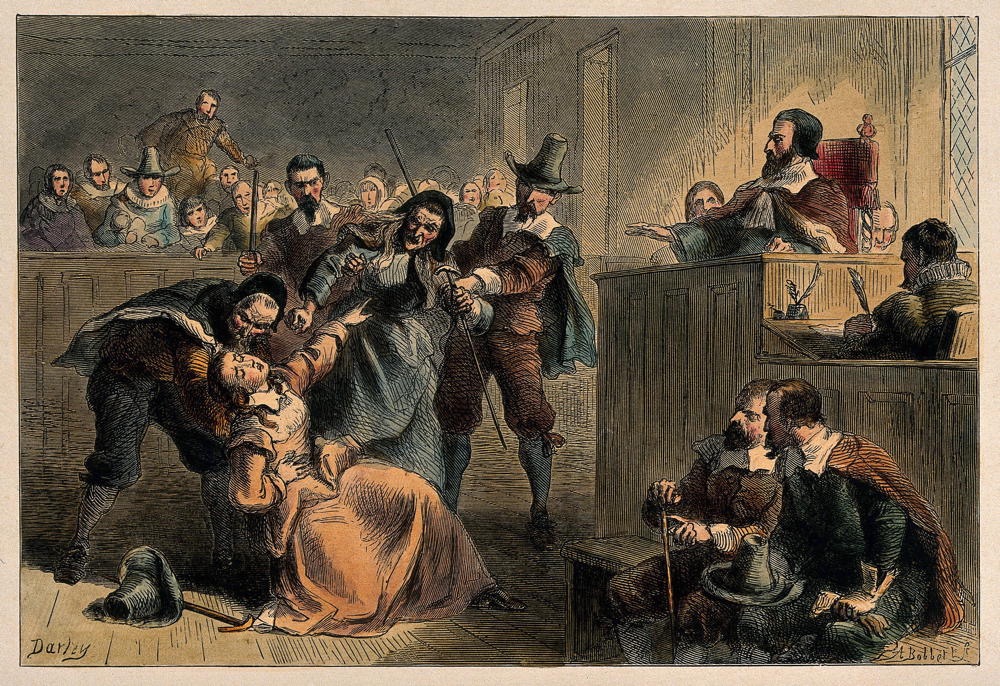
F. O. C. Darley:
Bacon's rebellion, Virginia, 1676-1677:
Lydia, the wife of the rebel Edmund Cheeseman, faints as he is condemned for treason by the governor of Virginia, William Berkeley; a toothless old lady is restrained from attacking her. Coloured etching by A. Bobbet after F. Darley.
(1935–43)
"We'd all be better off removing him from office
for some medical reason than for Treason!."
Probably the very least likely Comeuppance our incumbent might eventually face would be charges of Treason!. Not due to lack of evidence, since the papers seem filled with ample evidence that such evidence exists, but because of something else, something infinitely more insidious than even Treason!. Treason!, according to the Legal Information Institute at Cornell Law School, “consists only in levying war against the United States or adhering to its enemies by giving them aid and comfort.” It requires an overt act, not merely speech, and must be attested to by at least two witnesses to be successfully prosecuted. Our Constitution defines and prescribes its prosecution, which may occur either in a Federal District Court or in the Senate, presided over by the Chief Justice of the Supreme Court. Conviction might result in a death penalty or a prison sentence of at least five years and a fine of at least $10,000, and the loss of the right to hold future public office. It’s serious business.
But the necessary conditions seem essentially unattainable, though probably not because our incumbent has been indemnified against criminal prosecution for any actual duty of office he might commit by the Chief Justice and his kangaroo Supreme Court.
Comedownance
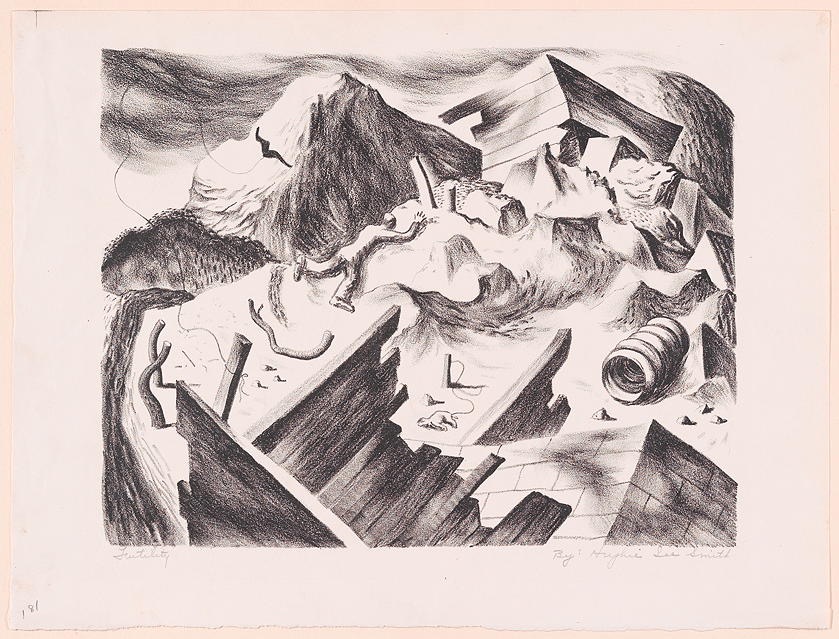
Hughie Lee-Smith:
Futility
(1935–43)
"…an at least as effective
and perhaps even more appropriate Comedownance instead."
In 1968, during the famous Earthrise NASA mission, astronaut and apostle Jim Lovell declared how perfect Earth seemed compared to the void of space surrounding it. He later expanded on his experience by famously declaring, “You go to heaven when you’re born.” He explained that people look for a distant heaven, yet Earth already has the perfect gravity, water, atmosphere, and distance from the sun to sustain life, making Earth the literal paradise we are searching for. We humans seem to maintain a rather proud tradition of underestimating our surroundings and experiences. We seek Comeuppances while, perhaps, already in the middle of experiencing an unrecognized Titanic one. Who’s to say that this isn’t that? Never having experienced any corruption as extensive as that practiced by our incumbent, what form might his Comeuppance naturally take? Would we necessarily know it just because we witnessed it, or might it appear too stealthily for anybody to readily recognize its presence? Maybe the blesséd event has taken the form of a Comedownance this time, a different direction than anybody expected, yet at least every bit as effective as any alternative Comeuppance.
The evidence seems ample if subtle.
TheAche
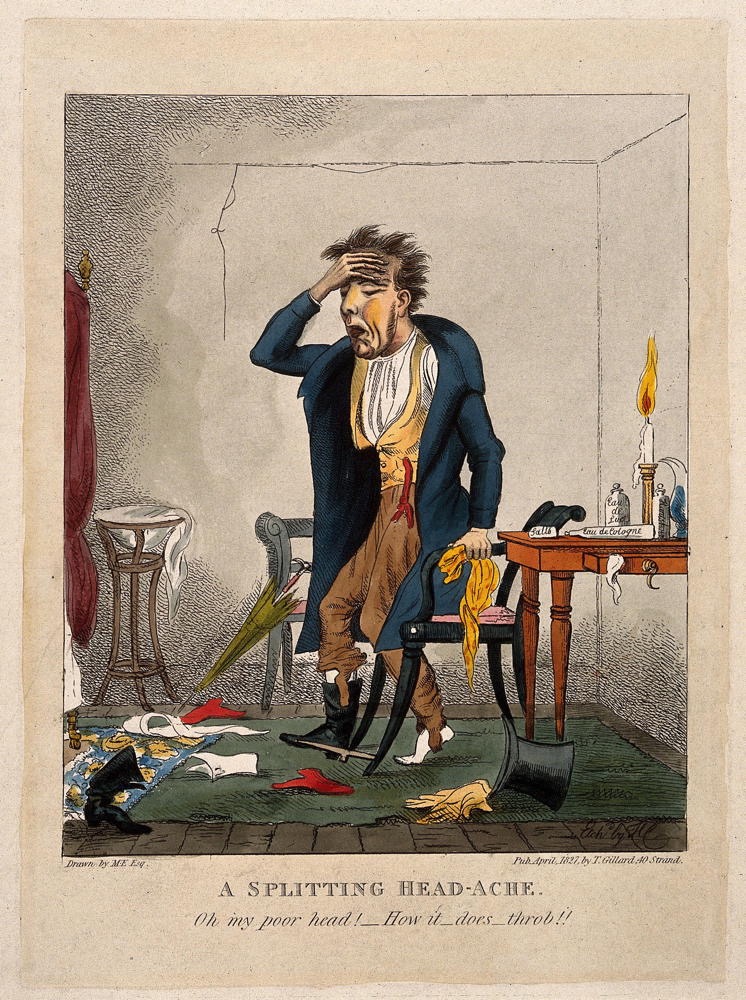
Henry Richard Cook:
A man with an excruciating headache.
(1827)
"This might be what TheAche has been so insistently whispering to me."
I find myself becoming more familiar with TheAche than I ever imagined I might become. I am not, and I never have been, a particularly vengeful man. I do not easily think ill of anyone, though in our incumbent’s case, I have almost gleefully made exceptions. The long months, now degrading into even longer years of irresolution, have left me genuinely bereft. Those I once thought well of, I can no longer hold off on my judgments. I cannot ascribe to inattention what only wholehearted support can explain. The erosion of our sacred norms undermines more than mere policy; it utterly degrades polity itself, leaving not even a recognizable shell behind. No logic known to man or demon defined this path to ruin. Only studied inattention could possibly explain the degradation. Will it be complete before we finally depose this weasel and his retinue, or might a few shreds of decency still remain flapping in a severely wounded breeze? I ache for the Comeuppance part of this story to wade in with real vengeance.
I acknowledge and almost accept that nobody gets to dictate any moment of Comeuppance.
Advocacy
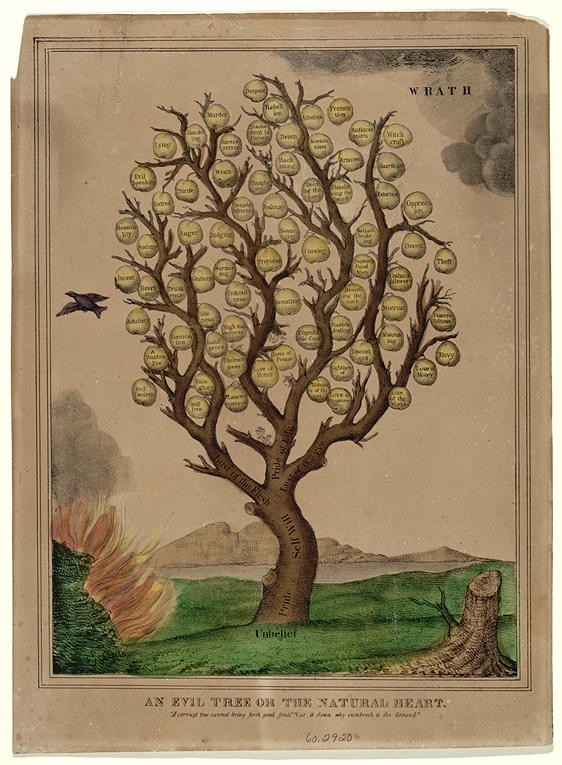
Harry T. Peters "America on Stone" Lithography Collection:
An Evil Tree or the Natural Heart
(c. 1830-40)
"Heaven or Edward Bernays, help us."
We seem to have become a society of partisans, endlessly arguing across an unfathomable abyss. The us-es and the thems, the for-s and against-s, discontents in frantic search of any cohering story, less E Pluribus Unum than Ex Uno Plura or, more likely, E Unum, Duobus, out of one, two, an eternal-seeming dichotomy. We have become the great either/or, the Janus-minded democracy, utterly dependent upon Advocacy, a popularly practiced form of blasphemy where everything’s considered fair, like in love and war. Any story promoting a favored policy seems automatically approved, regardless of its relative truthfulness. It’s judged by its ability to inspire and move hearts, minds, and butts—without any ifs, ands, or buts—not by adherence to any competing standard. Lies are always permitted, solely depending upon how effectively they sway. The ends always justify any means intended to advance the partisan position. Each advocate firmly believes that they, alone, enjoy God’s unconditional approval, and that they, alone or in close concert with cohorts, represent the higher righteousness regardless.
Advocacy does not debate.
Squall
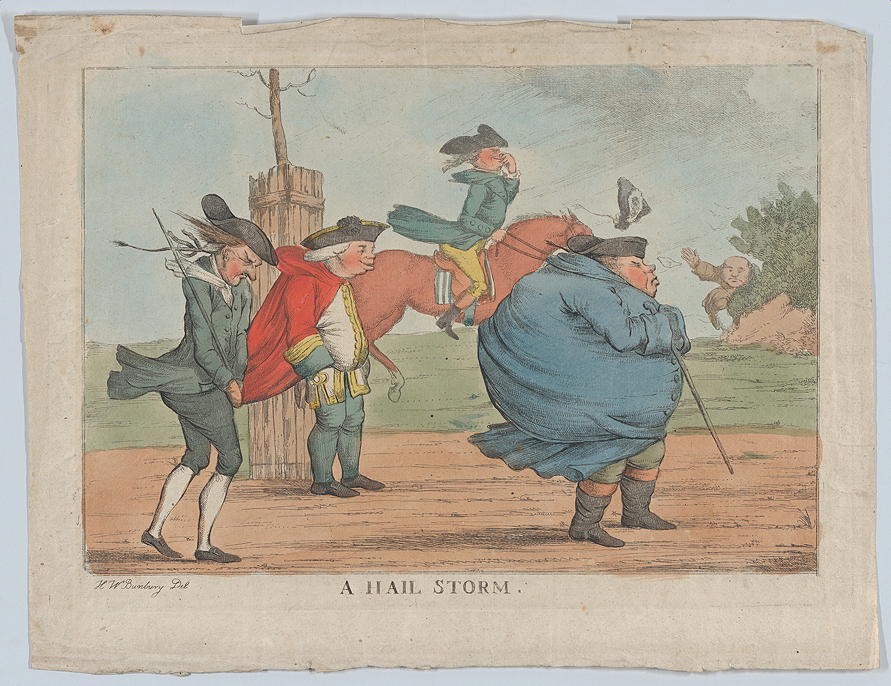
Henry William Bunbury:
A Hail Storm
(1800-1820)
"The Squall has started, and the world shudders in heartfelt anticipation."
Historians will later argue over precisely which idiosyncratic action ultimately did in his administration that, by its own admission, never seriously considered administering anything. There were no shortages of idiotic actions; the very premise of his tenure seemed anchored in stupidity, and that’s not just me speaking. By a very wide margin, the majority opinion became that his election had been a grave mistake, for his actions had finally awakened us from the most tenacious trance to overtake the nation since secession, and it had been every bit as poisonous. But when inflation rose at a nearly unprecedented rate, and the reality of what had been touted as big and beautiful finally came into ugly operating focus, people felt compelled to reject whatever had once been his mandate. He quickly became the most unpopular incumbent ever, after he blundered his way into a forever war that would never end any war. Then his delusions rendered him intolerable.
A Squall of past-due Comeuppances suddenly emerged.
Weekly Writing Summary For The Week Ending 10/15/2026
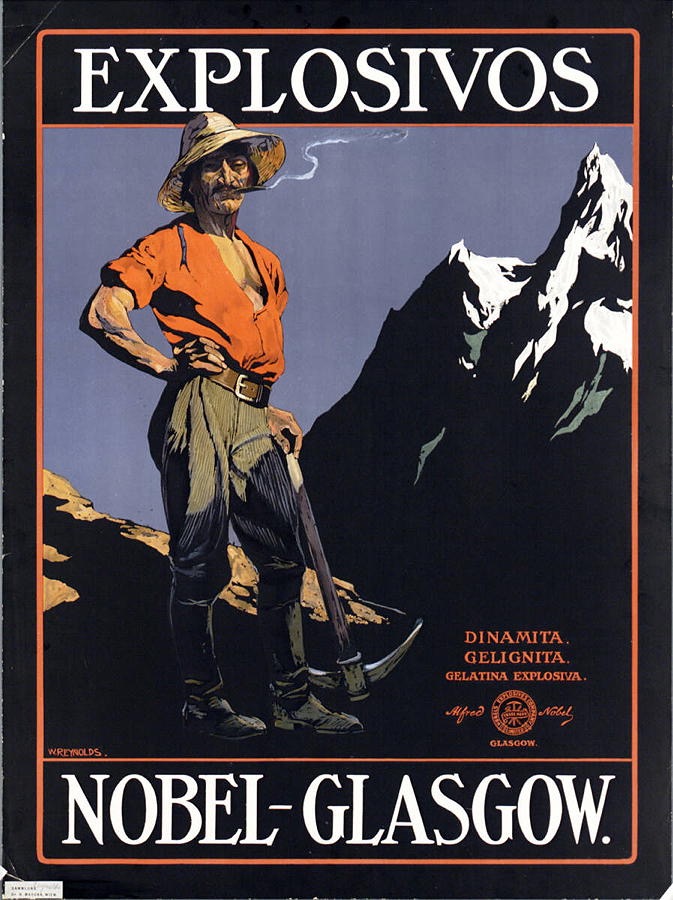
Warwick Reynolds:
EXPLOSIVOS NOBEL - GLASGOW
(UM 1900)
This week's Comeuppance installments turn the lens inward, discovering that the most persistent Comeuppances may not arrive from outside at all, but live embedded in the work, the dread, and the daily weather of an examined life. From self-generating reckonings to Sisyphean devotion, these six essays map territory the series has been circling since its first installment. The week ends with a quiet bookshop revelation and a confession that may be the most honest thing the series has yet produced.
Thank you for following along!
SisypheanComeuppances
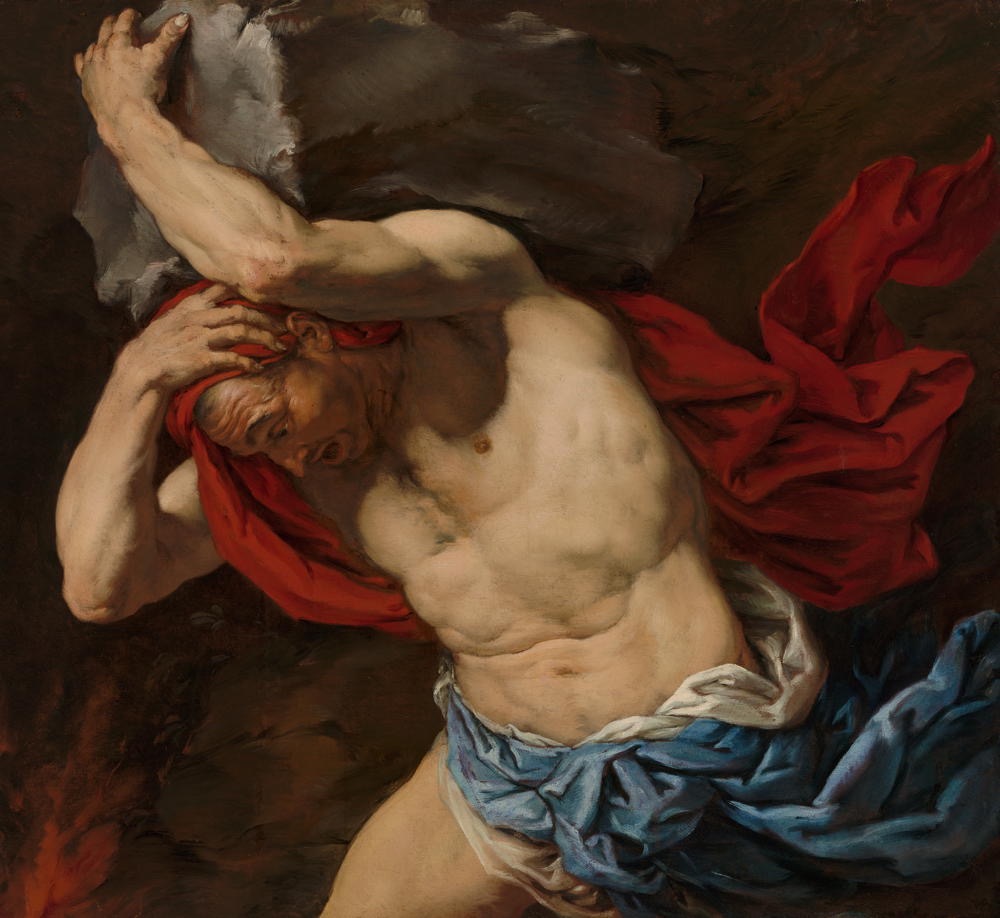
Antonio Zanchi:
Sisyphus
(1660/1665)
"I doubt that my modest contributions to literature really deserve much more than a decidedly Sisyphean existence."
Comeuppance doesn’t only occur at conclusions. It often, perhaps most often, occurs as what I might consider to be a lifestyle. Any task unlikely ever to be completed might exemplify this Comeuppance type, for its very uncompleteability might reasonably be considered a Comeuppance. Consider Sisyphus, that mythical king who, having offended some God or other, was sentenced to push a rock to the top of a very steep hill, only to have it roll back to the bottom once he’d successfully reached the top. His work might have been its own Comeuppance. In Sisyphus’s instance, he had no choice but to labor away unfruitfully each and every, literally, god-damned day. Most of the rest of us don’t have nearly as good an excuse for the obviously useless efforts we pretty much insist on engaging in each day. Often, a hobby stands in for formal employment, providing the means by which we might meaningfully pursue what anyone else might reasonably mistake for uselessness.
We should judge the relative usefulness of any effort more carefully, for the usual completion criteria fail to capture some of the more subtle, if even more significant, contributions the dung beetles among us routinely pursue.
EverydayComeuppance
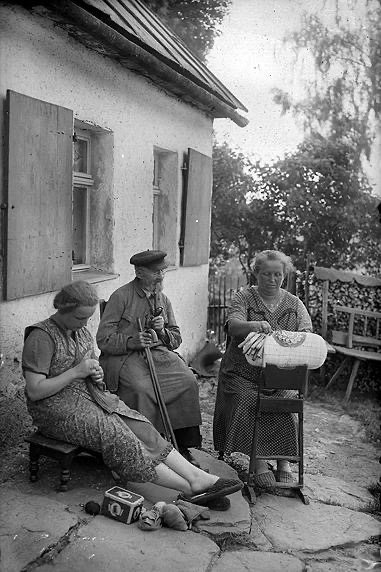
Hermann Krauße:
Alltag im Dorf [Everyday life in the village]
(c. 1930)
"…bringing absolutely no significant alternative meaning to the pre-existing plotline. "
A Comeuppance doesn’t require a great calamity to appear. Many, probably most, arrive with little fanfare, more stealthily than those proverbial little cat’s feet, unanticipated and apparently undeserved. These are the EverydayComeuppances, the micro-penances that visit everyone occasionally, eventually. They connote no necessary guilty anything: pleasure, indulgence, or otherwise. They arrive unbidden and probably undeserved, though they rightfully spark a spate of questioning inside their victims, who must, at least for decency’s sake, ask themselves a few troubling questions to at least attempt to confirm that this wasn’t karma visiting to balance some invisible scales, to make certain this Comeuppance wasn’t the direct result of some sin of either omission or commission. Shit does, indeed, sometimes just happen, and the presence of a victim does not now and never has necessarily pointed to any actual crime having been committed. The punishment’s no different in either case, but the guilt sure is.
My latest EverydayComeuppance visited me at approximately 1:34 this morning.
DreadReconning
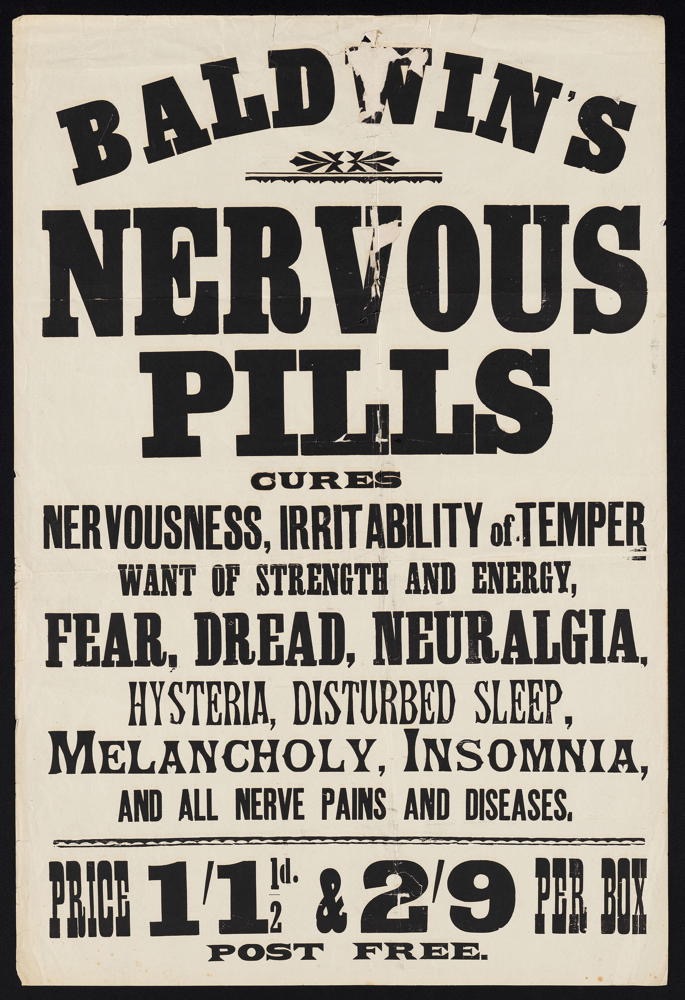
G. Baldwin (Firm):
Baldwin's Nervous Pills
(1900?)
"…the inept and corrupted performer taking way more
than his fair share of our stage."
Over approximately three years in the early 1970s, while I was wrestling to resolve a troublesome military draft problem, I lived every day in dread that I might be spirited away somewhere against my will. I gained Non-military Conscientious Objector status after a lengthy, terrifying process of petitioning my local draft board and appearing before a hearing. I’d thought I’d be assigned to change bedpans for half the prevailing minimum wage in some military hospital somewhere, but I learned no formal process existed for assigning Non-military COs. I was responsible for identifying an available position and convincing the local commanding officer that I was qualified. I was charged with reporting to the draft board’s “evil” secretary (a label I’d given her because I thought her job responsibilities were essentially evil) and showing proof of my attempts to secure an assignment. I wrote letters in my poor, if honest, hand, and dutifully photocopied them as evidence of my diligence. After a few months, the evil secretary confided that I could stop reporting to her each month because I’d demonstrated my due diligence. I still had to fulfill my CO stint, but I never got a response to any of my many letters. Still, I lived in constant dread that I would wake up some morning to find a couple of hostile MPs waiting on my porch to drag me off to my Comeuppance.
Because of my tenuous status, I couldn’t agree to take a permanent job, nor was I qualified to attend school.
DuelingComeuppances
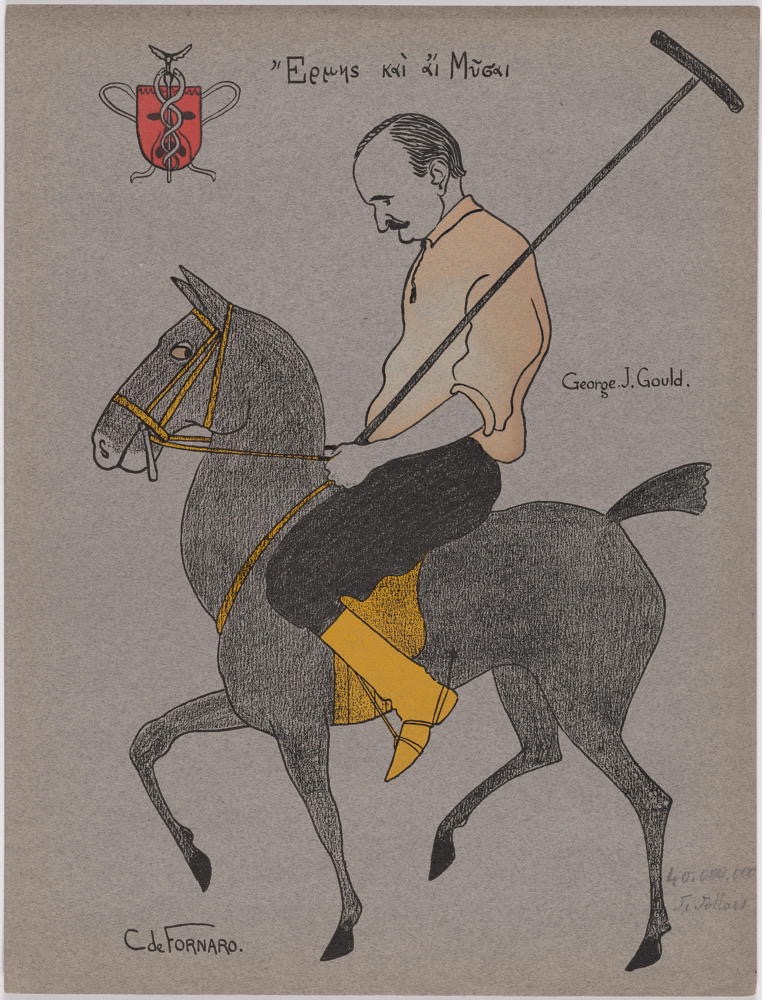
Carlo de Fornaro:
George Jay Gould
Portfolio: Millionaires of America
(1902)
"…any story that somehow manages to slip out around its edges…"
Most days, I feel as though I’m engaged in a contest of DuelingComeuppances. I feel almost certain that one or more of my activities, probably a combination, will ultimately contribute heavily to doing me in. Yet, I persist, if only because I honestly know no better. I don’t do my best, but I also rarely, if ever, really try to do my worst. I inhabit the horse latitudes of human behavior, experiencing far more calm than storm, with inspiration blessedly rare. I understand that living involves accepting certain complicities, that there never was, nor could ever be, immunity from any inevitability. I lack the vegan’s sincere dedication to any ideology. I soothe myself by insisting that at least I don’t kill my meat myself. Yes, I still feel urpy whenever I pass a feedlot, and likely always will. I am not engaged in any activity intended to reform or improve me. I have been known to drink to excess at times of celebration or sincere heartbreak, neither of which really offers a decent excuse for engaging in such obviously self-destructive behavior. I excuse these and many other personal shortcomings by touting how I no longer maintain any shred of tobacco dependence, but I’ve known the attraction to addiction in my time, and the depression that comes from denying even a perverse desire.
I am learning that Comeuppances are not just passion plays between good guys and worst ones.
Nobeled
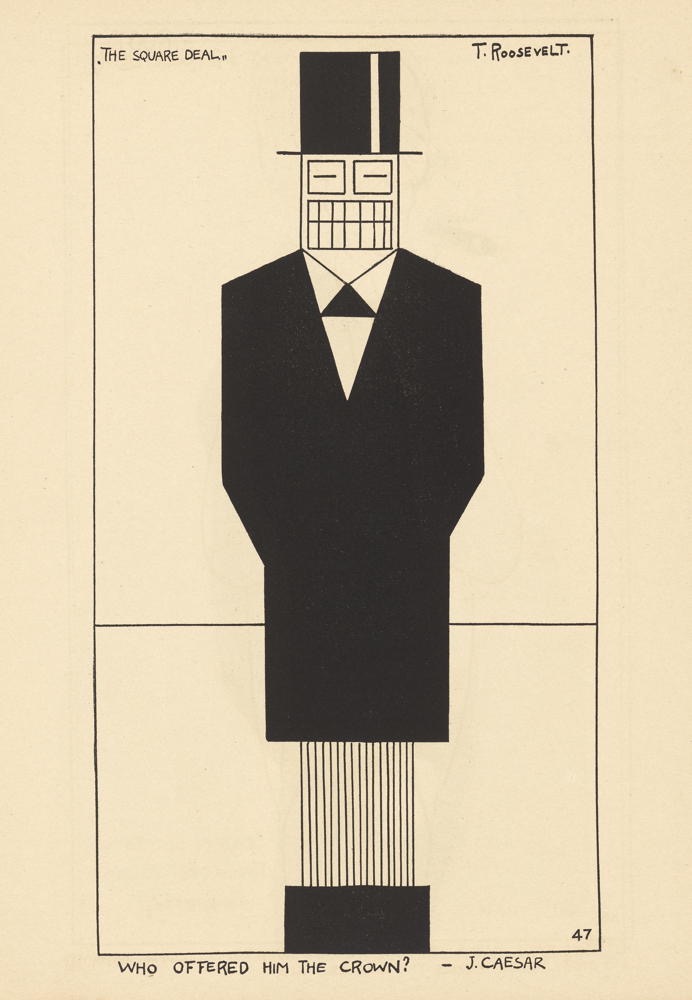
Carlo de Fornaro:
Theodore Roosevelt
(1911)
"Those never nominated also receive a prize."
Be especially careful about what you lust after, for these tend to turn into Comeuppances. Our incumbent has lusted after being awarded a Nobel Peace Prize, but has always been thwarted. Though he insists he ended eight wars in the first few months of his second term, maybe ten, depending on who’s counting, the Nobel Prize Committee still hasn’t considered him a serious candidate. One woman who earned her prize the old-fashioned way reportedly gave our incumbent her prize to gain favor with him, a favor that was won but which just as quickly evaporated as he failed to reward her with what she’d probably wanted. The latest winner was announced this week, which prompted a raft of fresh grousing from the general direction of the bathroom just off the Oval Office. He went so far as to declare sanctions against this year’s winner’s former employer, officially treating the International Court of Justice in The Hague as if it were a terrorist organization because it spoke of bringing an actual terrorist to justice. Between all his pouting and touting, Our Incumbent remains unnominated for the one prize he seems to lust after most. This failure to gain his heart’s desire seems like the perfect Comeuppance for him.
And so it might go.
Self-Generating
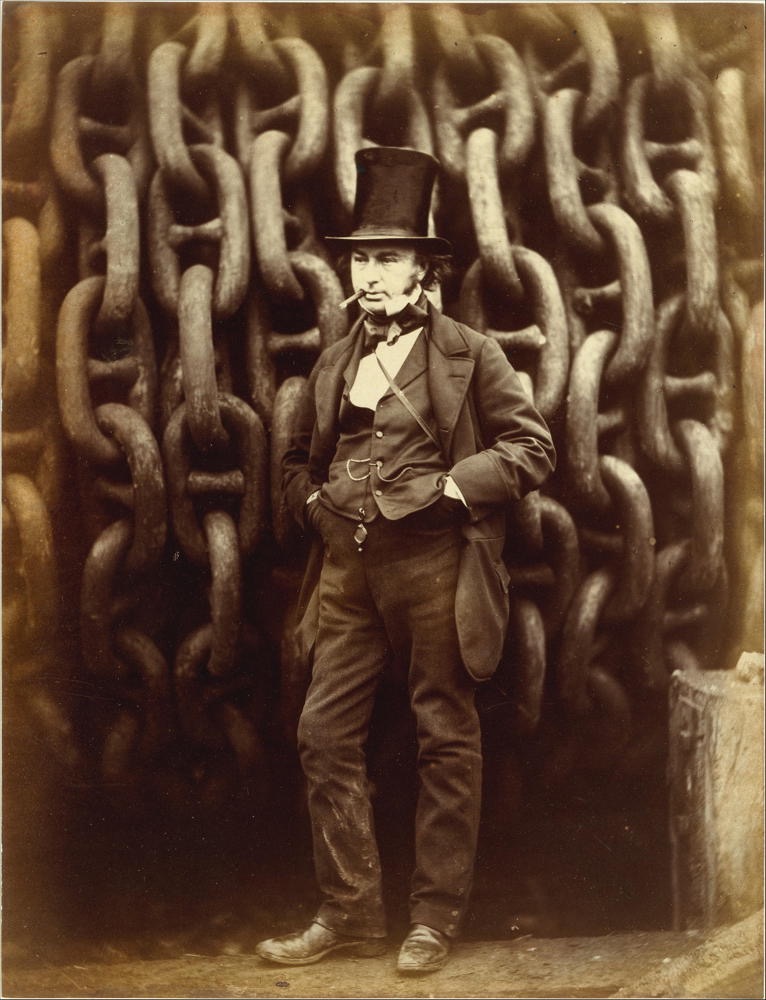
Robert Howlett:
Isambard Kingdom Brunel Standing Before the Launching Chains of the Great Eastern
(1857)
"Maybe there's always a Comeuppance."
The term Comeuppance suggests two players, one receiving and one delivering, but since I started this series three weeks ago, I’ve noticed that some Comeuppances seem more like the solo variety. At first, this felt like pounding one’s head against that proverbial brick wall, but this kind of Comeuppance doesn’t quite work like that. Some activities just seem to have some Comeuppance built right into them, as if the Comeuppance was an integral part of the experience, cause and effect so tightly coupled as to seem inseparable. I was reminded of this this morning when an old friend texted me that my email inbox reported itself full when he tried to drop me a note. Emails have always been my foil. I have not yet learned how to elegantly manage them, so they tend to manage me, and rather hostilely. I forever lose incoming mail, miss important messages, and get chastised by the sender. The same happens with voicemails and text messages, too; each silently builds a queue until it overwhelms the technology’s capacity to cope. Then an old friend or an upset creditor sends a note via another medium, and a self-inflicted Comeuppance begins.
I have received innumerable lectures on the proper ways to manage my message queues.
Weekly Writing Summary For The Week Ending 10/08/2026
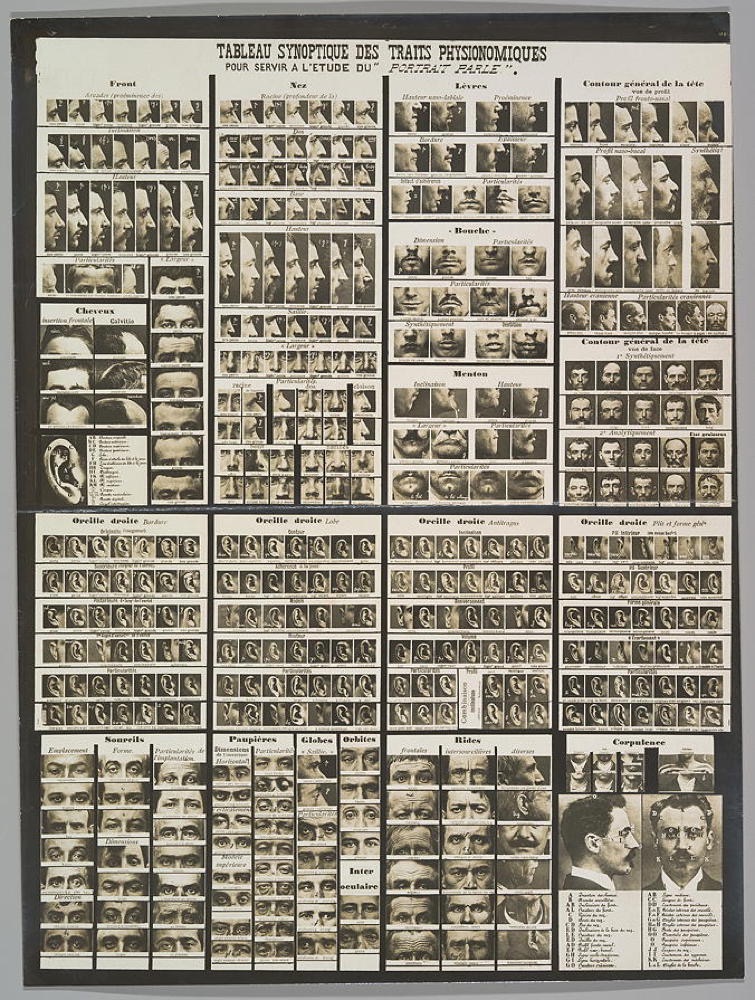
Alphonse Bertillon:
Tableau synoptic des traits physionomiques: pour servir a l'étude du "portrait parlé"
[Synoptic table of physiognomic traits: to be used in the study of the "spoken portrait"]
(c. 1909)
This week’s Comeuppance essays move through the series’s darker chambers, tracing the distance between how I imagine justice, mercy, and civic virtue and how I actually practice them. I offer no comfortable resolutions, only clearer maps of the territory where Comeuppance accumulates.
Thank you for following along!
ThePeople
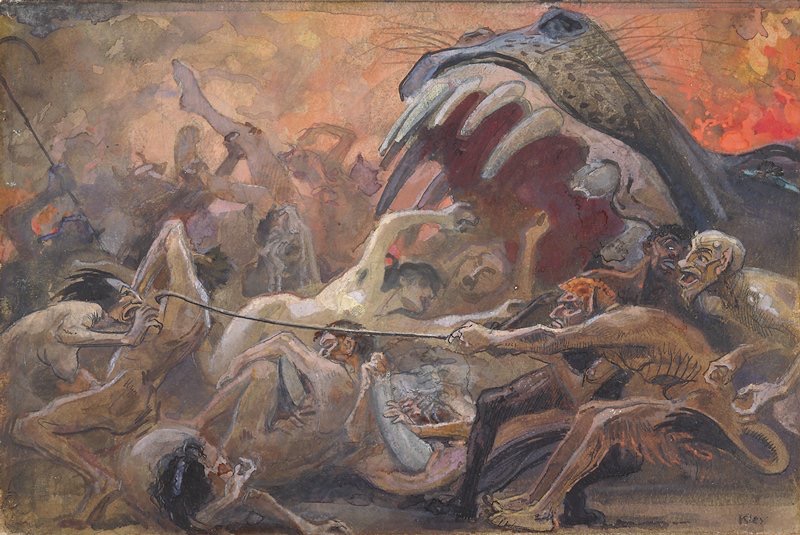
Heinrich Kley:
Demons Pulling People into the Jaws of Hell
(c. 1910–15)
"We nonetheless insist that this behavior represents a more perfect union."
The Founders wisely designated the supreme law of the land they founded as being of and by “We, ThePeople.” Individuals had previously signed the Declaration of Independence, but our Constitution addressed its contents in the name of a more amorphous presence. ThePeople suggests a majority opinion without hinting at any underlying dissent, though we know from personal experience that every law, every statute, was the product of disagreement and debate before ever being approved. Agreement was never the native state of even these United States. We rely on this studied misrepresentation to project a necessary sense of union. Dissent might better describe the advocacy we practice, though every minority, no matter how marginal their actual position, insists that their parochial perspective most accurately represents the opinion and will of We, ThePeople, echoing our founding and preserving ambiguity.
We, ThePeople probably serves as our most enduring virtue signal, for it designates the side where righteousness exclusively resides.
Stalker
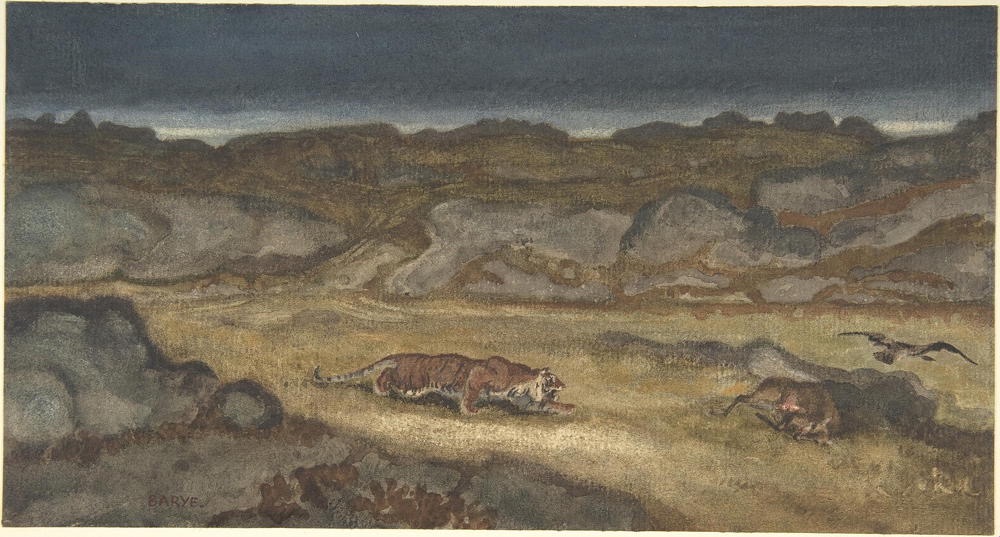
Antoine-Louis Barye:
Tiger Stalking Prey
(c. 1850)
"I, of course, know much better at least half the time…"
I hadn’t a clue I was a Stalker, even though The Muse had been steadfastly attempting to clue me in by complaining about my apparent obsession. No, I did not feel especially compelled to write about our incumbent. I honestly felt that I was performing a necessary public service by being a vocal critic. Hadn’t God given me the gift of criticism? What was I supposed to do with that gift, if not exercise it? Yes, vehemently at times, perhaps in tones that might have come across as overly strident. Had he not richly deserved every critique I dealt? Did I not still have the right to say whatever I damned well pleased, even if I also carried an equal and opposite obligation to not always say whatever I pleased in public?
I see now that I had been Stalking, though I still strongly feel that my effort was necessary and well within my rights, since our incumbent had been a public menace.
Paranoid
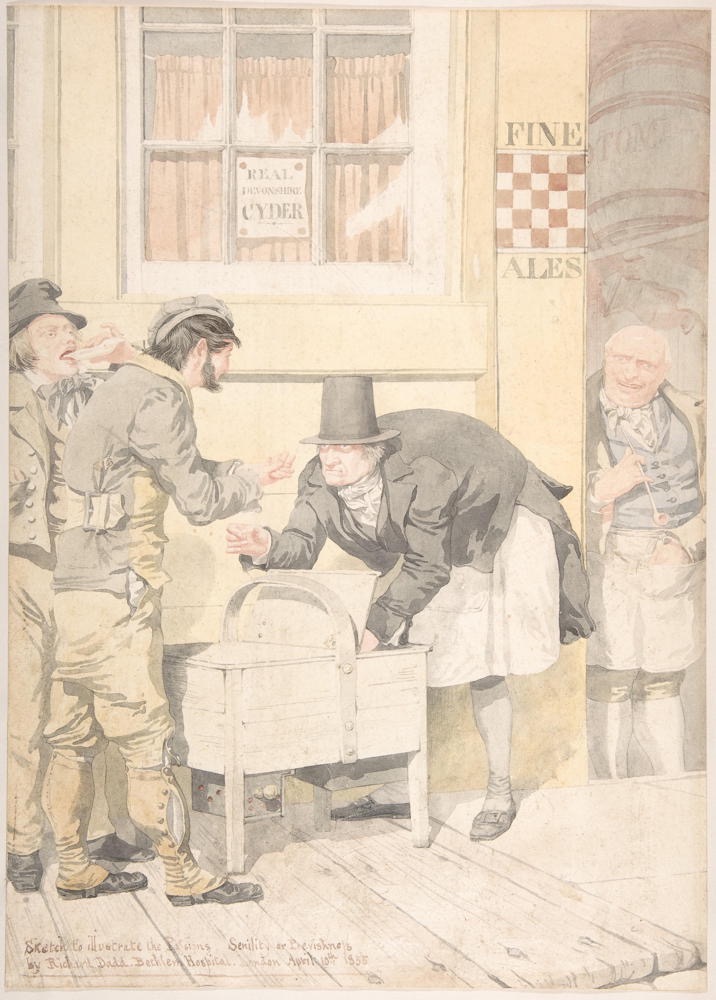
Richard Dadd:
Sketch to Illustrate the Passions—Senility or Peevishness
(1855)
"I fear we're just investing in an impending Comeuppance instead."
If I asked you to name the most likely outcome from a country being named the most prosperous in the history of the world, I doubt that you would reply, “Paranoia,” yet that’s what we find. We are that country. We could have been recognized as the most generous or the most peaceful in the history of this world, but we aren’t. We aren’t, and we’re slipping further into Paranoia. Congress allocates around 50% of our annual discretionary budget to Defense, though it comprises only about 15% of our overall budget. We spend more on mandatory spending like Social Security, Medicare, and Medicaid, but we also complain much louder about those choices. In some ways, our Federal budget mirrors our society’s Paranoia: we focus the bulk of our spending on ensuring our future security, yet we remain perhaps the most Paranoid country in the history of this world.
What justifies such a self-image?
Mercy
William Blake:
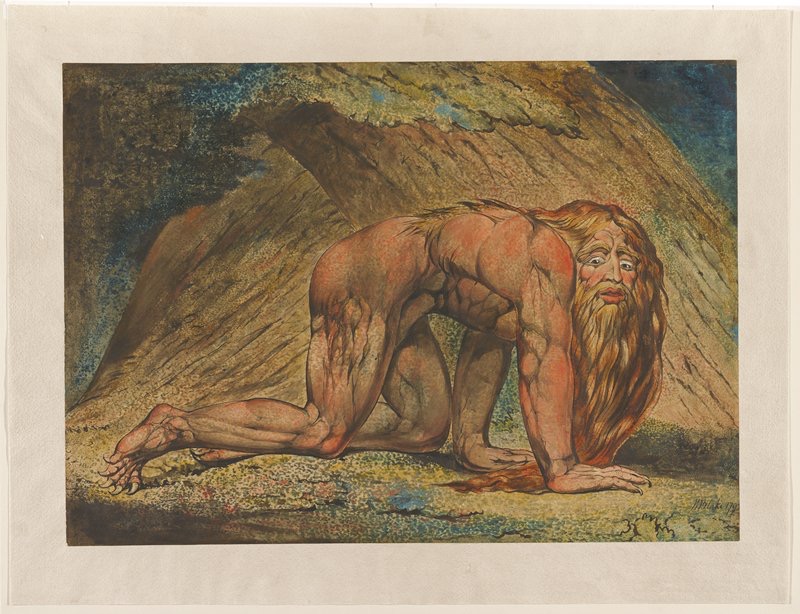
Nebuchadnezzar
(1795)
God stripped the king of his realm and drove him to “eat grass as oxen, . . . his body . . . wet with the dew of heaven, till his hairs were grown like eagles’ feathers, and his nails like birds’ claws” (Daniel 4:33)
Yea, we all could use a little mercy now
I know we don’t deserve it, but we need it anyhow
-Mary Gauthier
Mercy might represent the most powerful Comeuppance available anywhere, any time, to anyone. It seems to be the absolute antithesis of Comeuppance, though, almost the exact opposite of what first comes to mind when the word Comeuppance comes to mind. I think of vengeance first: swift, terrible swords and harsh words. Mercy seems beside any cogent point at the point of final punishment. Yet the choice remains, whatever the infraction, whatever the sentence, to mete out Mercy instead. But doesn’t that behavior just encourage what Comeuppance intended to discourage? Perhaps. Therein lies a rub. Mercy cannot possibly be a transactional response to any infraction. It might be the very soul of relationality, intent on enhancing a sense of community, just when that was supposed to be beside any remaining point. When I considered whether or not I really wanted to become the monster I intended to punish, when wreaking Comeuppance, I might have been deeply considering taking Mercy on myself first, less an act of generosity than self-preservation. It might be that no punishment ever adequately fits any crime, especially any peacekeeper.
In theory, Comeuppance seems quite obvious.
Justice
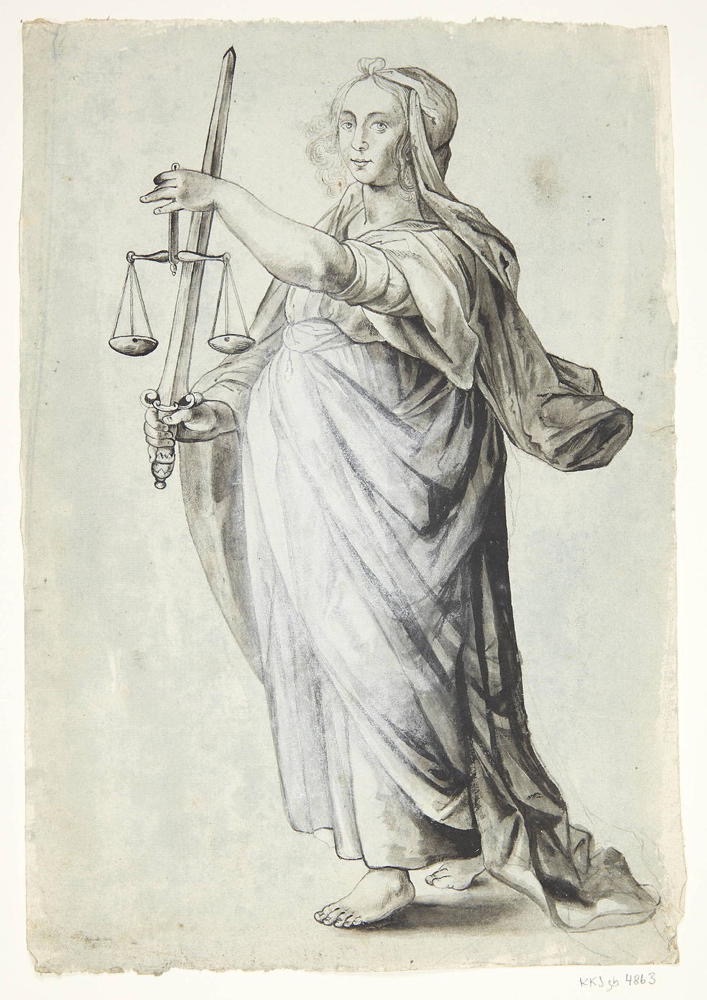
Unknown Artist, after Jacob Matham:
Justice
(17th Century)
"…just a self-proclaimed son of a bitch."
Justice serves as a secular society’s primary religion, for it promotes fairness, ethics, and even morals. It properly seeks to treat everyone fairly and as impartially as humanly possible. It performs retribution when necessary, but also seeks to restore and repair when harm occurs. In any society proclaiming freedom of or from religion, such as ours, Justice might well serve as the bastion defending any individual religion from persecution. In this second- or third-degree paradox, the secular protects the sacred. In an instance where a religious belief attempts to overtake a civil society, which one might reasonably argue describes the MAGA desecration our incumbent has attempted, Justice might reasonably be the first focus of insurrectionists because they might believe it properly threatens any other sacred movement’s dominance. Those who firmly believe, for instance, that these United States should properly be ruled as a White Christian Nation stand opposed to the secular religion that each formal religion’s practice utterly depends upon, be it Christian, Muslim, Taoist, or otherwise. White Christian Nationalists undermine their own insistences without recognizing they do.
Of all the insults visited upon our society by our incumbent and his minions, the assault on our sacred secular religion has proven the most terrifying.
Trespass
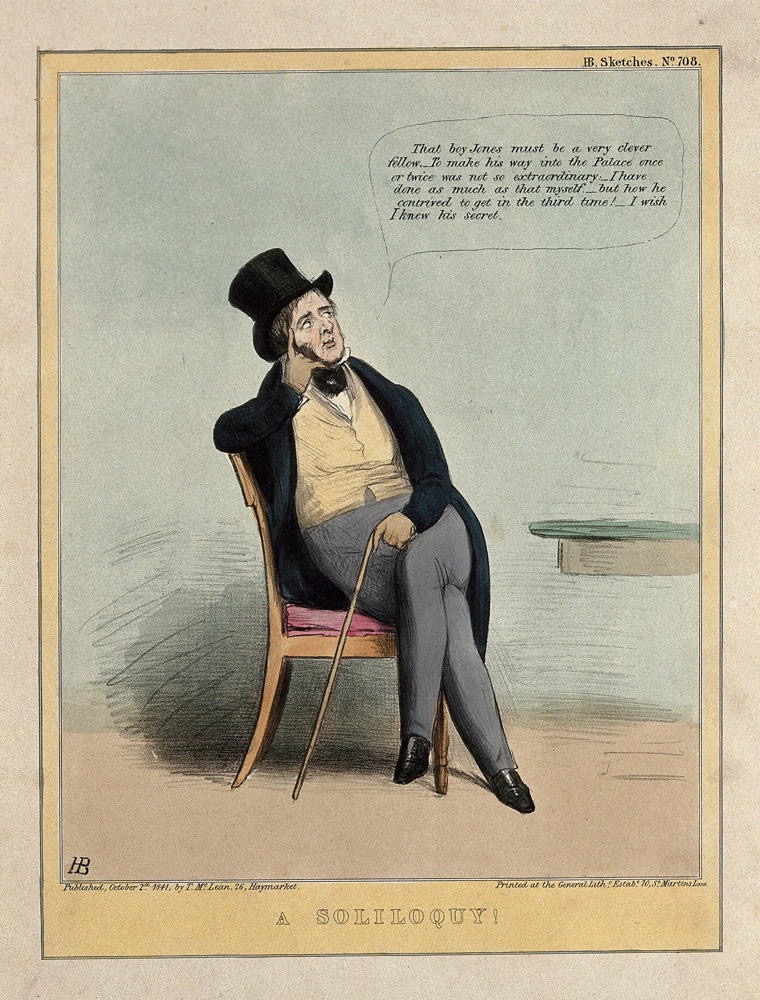
John Doyle (H.B.):
Lord Melbourne speaks his thoughts aloud. Coloured lithograph
(1841)
"…I will never know what is or isn't."
Of all the civil and criminal infractions, Trespass seems the most passive. One need not prove motive to bring charges against a trespasser. Nor does anyone need to prove physical damage, for the very act of presence serves as adequate evidence of the commission. If I “get in your space,” I might violate your subtlest rights, the rights to control your space. The Lord’s Prayer asks for forgiveness for any trespasses committed against us as well as those we might have committed against others, challenging more vengeful notions of jurisprudence, for any decent Comeuppance might well stem from any odd trespass both committed and unforgiven. Comeuppance seems unjustified in those cases where the Trespass was contritely forgiven. “No harm, no foul,” in the popular jargon. This convention suggests that jurisprudence might first demand an absence of forgiveness and, perhaps, at least a little taste for vengeance. Of course, many have characterized this universe as natively dog-eat-dog, with the wronged perhaps perfectly or even imperfectly, but nonetheless justified in pursuing redress to the extent any court might grant it.
I am eventually forced to ask myself if I really intend to encourage this dog-eat-dog nature by actively engaging in it.
Weekly Writing Summary For The Week Ending 10/01/2026
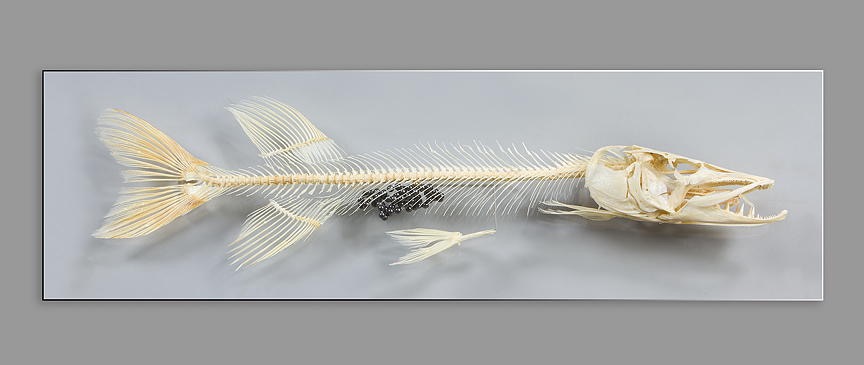
Ted Noten:
The Revenge of the Pearl Necklace (2009 )
Zuiderzee Museum, Netherlands - CC BY-SA.
This first full week of Comeuppance dispatches established the series’ central argument and its range. The writing moved from the hollow irrelevance of unchecked power, through the mechanisms of self-destruction, escalation, and class entitlement, to the quiet devastation of the deep influence of what was never experienced at all. The series opened looking outward at a political spectacle and ended looking inward at a universal, inescapable condition. That arc, from the overt to the tacit, from the incumbent’s Comeuppance to everyone’s, may be the series’s most important early discovery.
Thank you for following along!
TacitComeuppance
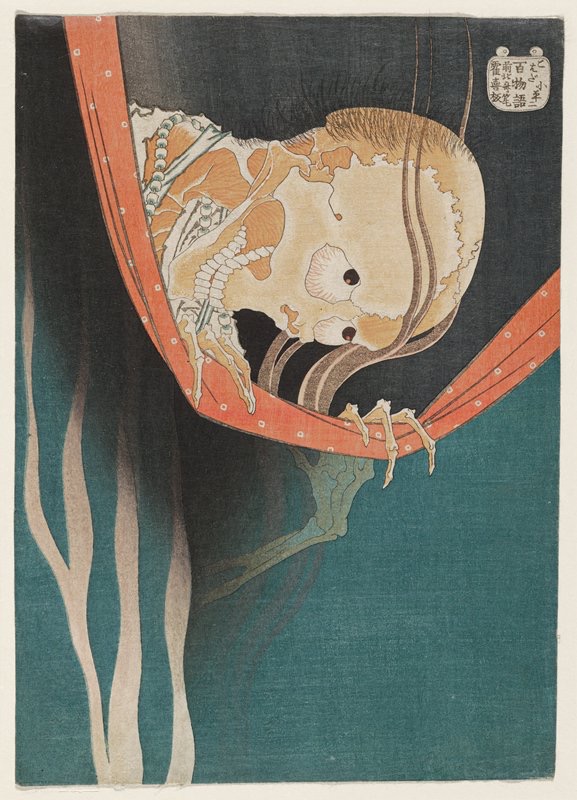
Katsushika Hokusai 葛飾 北斎, Publisher: Tsuruya Kiemon
The Ghost of Kohada Koheiji
(c. 1831–32)
"…those burdens must remain as tacit as any primary experience never chosen."
I usually think of a Comeuppance as an overt event, an active, observable verb, one of those actions often classified as equal and opposite, a tangible result. But in this story, I want to consider a separate and more common kind of Comeuppance, the kind that, once I mention it, might seem shockingly familiar: The TacitComeuppance. These occur as a result of choices or, perhaps, of events. Because I chose to go West, I tacitly forfeited every opportunity to experience East. That eastern extent of my former possibility, therefore, became forever inaccessible to me. Whether I forewent great good fortune or avoided catastrophe must, then, remain forever unknowable to me, except, of course, through imagination. That road not taken might well take on a mythical magnitude, a sense that it must have been beneficence foregone or a curse, but nonetheless lost.
I experience these as tacit events, if tacit doesn’t render them too indistinct to count as events.
JackSmith
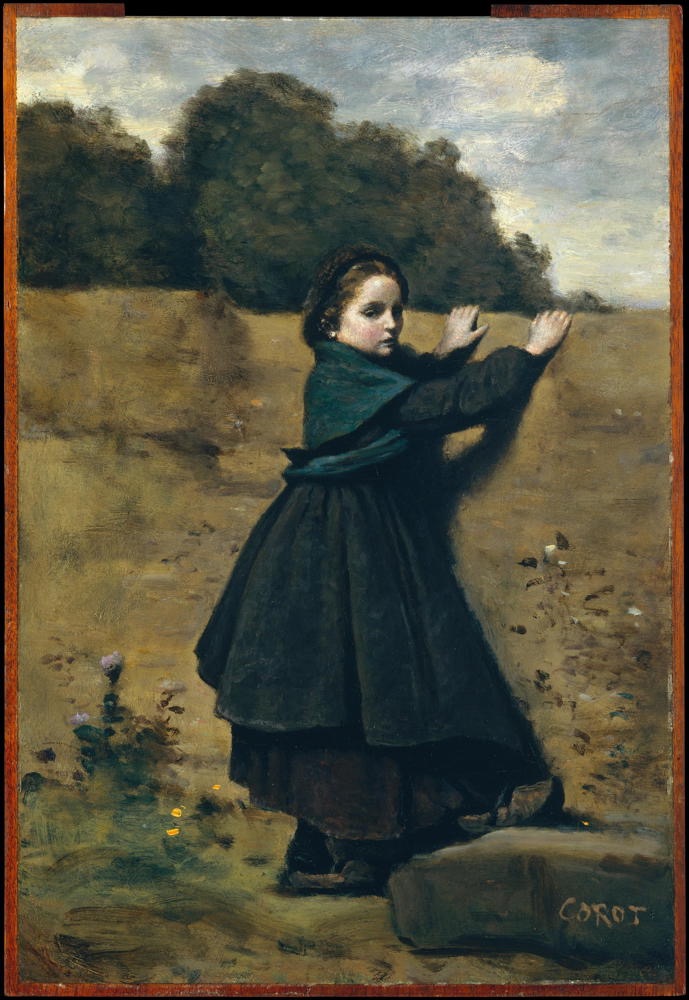
Camille Corot
The Curious Little Girl
(1860–64)
"Wait until he experiences what another focused, just prosecution feels like, with a conviction attached"
It would not surprise me even a little bit if our over-the-top flamboyant incumbent was done in by a humble civil servant named JackSmith. Anonymity incarnate, a career prosecutorial investigator, veteran of a long posting to The Hague. A man without a political axe to carry or grind, a relative innocent who never lost his faith in truth, justice, or even the recently beleaguered American Way. It will be a very cold day in Hell before anyone successfully tarnishes his reputation. He respectfully declines to be led to slaughter by a hapless Senator out to make a name for himself. He appears with gratitude to report that his investigation, the one that crooked judge in Florida sidelined on party lines, found clear evidence that our incumbent broke the law when trying to overturn a free and fair election, and that he was undoubtedly guilty of multiple felonies, including but not limited to the January 6th attacks on our Capitol. The rest is history.
His testimony came across as absolutely unimpeachable, unlike our incumbent, who appears to have committed more than a few additional impeachable offenses before he was even elected a second time.
CountryClubCulture
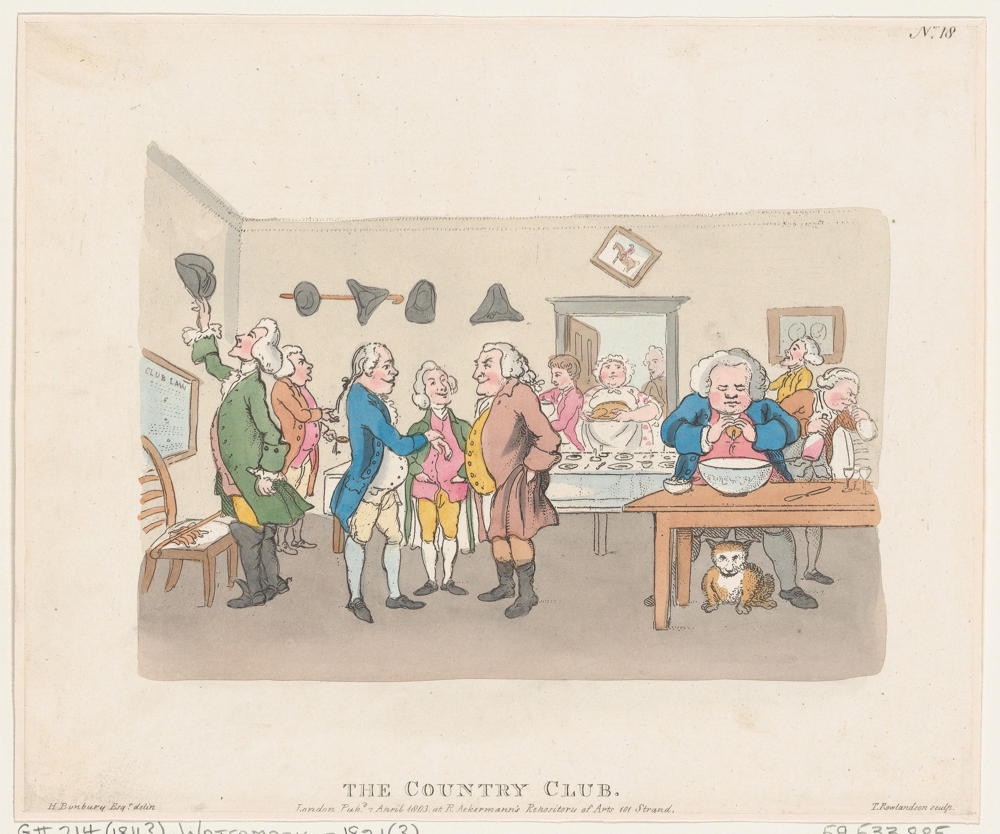
Thomas Rowlandson, Etcher
The Country Club
(April 7, 1803)
"Their Comeuppance has been stalking them for centuries."
The United States has always been divided by class, if by nothing else. As F. Scott Fitzgerald’s narrator stated in his 1926 short story The Rich Boy, “Let me tell you about the very rich. They are different from you and me.” Even if they aren’t really all that different, they certainly seem to want to be recognized as different, as exhibited by what appear to be their obviously exclusionary lifestyles. In every truly prosperous person’s portfolio lurks a country club membership, often treasured as validation of the difference they seem to need to assert so vehemently. Country clubs have storied histories as persistent bastions in overt opposition to any notion of E Pluribus Unum, for they were first and foremost exclusionary. Out of many, a select few were chosen, with a member typically inviting a desirable candidate, and the membership voting on whether to actually allow them in as a member. Historically, Jews, blacks, and other “undesirables” were excluded from consideration. These were originally white, male Christian institutions. Women could join as spouses of actual members. Fees were assessed based on each club’s status. Our local little version is not nearly as exclusionary as it once was, and relies upon self-selection to survive.
Today, anyone willing to cough up the $9,500 initiation fee and $440/month dues for a regular golf membership, with a $60/month food minimum, is welcomed.
Escalating
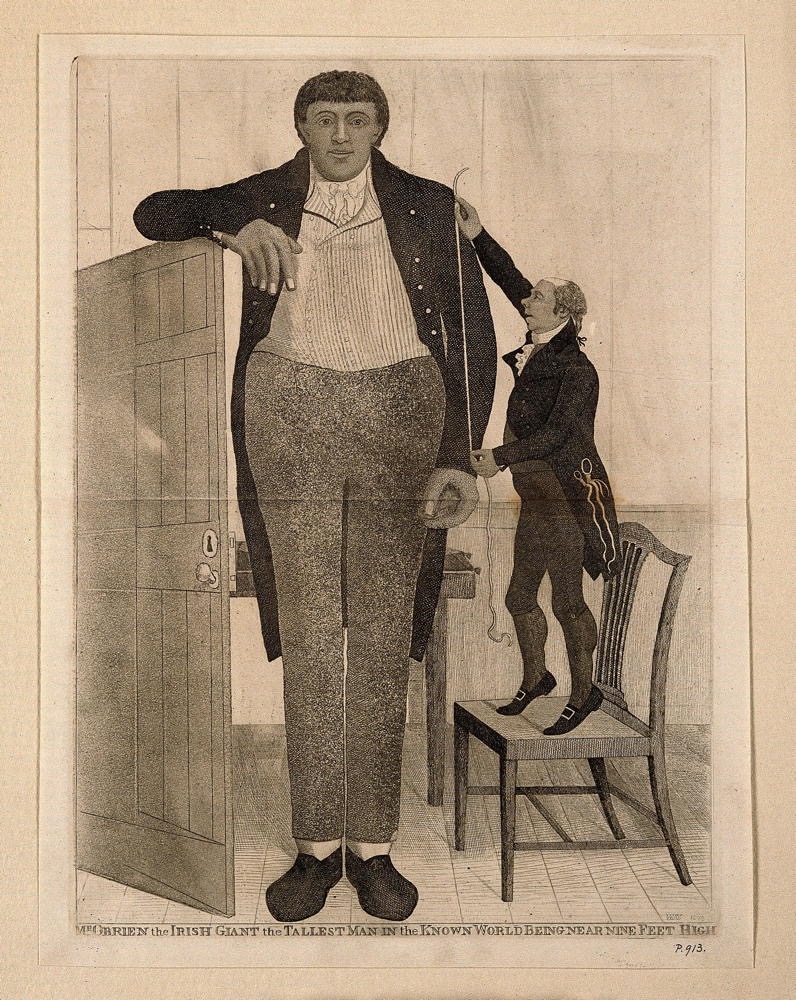
John Kay (caricaturist)
Mr. OBrien the Irish giant the tallest man in the known world being near nine feet high.
(1803)
"Maybe that means that he secretly wants to be sent there, too?"
Our incumbent’s Comeuppance seems inevitable because he possesses a single defense, or perhaps that defense possesses him. When faced with even a minor conflict, he always escalates. I do not mean to suggest, by mentioning this fact, that he has not amply lived up to his newly minted reputation as also always ultimately chickening out, but on his way to the henhouse, he tends to escalate whatever tempest he’s stumbled into this time. He seems especially blessed in his ability to attract tempests, so he’s forever producing headlines and sparking provocative commentary. “What’s he up to now?” Nobody seems the least bit surprised when (never if) another controversy emerges, for he spawns them as reliably as a low-pressure ridge produces tornadoes. He might go into business as Calamity, Incorporated if he weren’t already so damnably busy perverting the sacred office of our presidency.
I speak today of his Escalating nature, for his cure for whatever even distantly threatens him always involves escalation.
SelfSabotaging
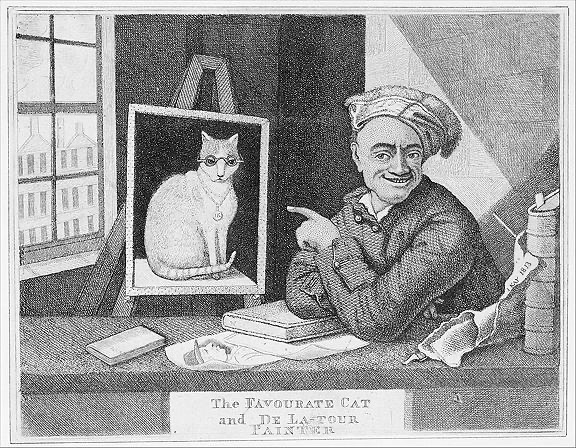
John Kay (caricaturist)
The Favourite Cat and De La-Tour Painter
(1813)
"Maybe his omniscience amounts to his Comeuppance."
At some indefinite point, our incumbent became a caricature of himself, an open running joke that he himself never suspected. Oh, his spider senses might have registered his growing unpopularity, but he had never developed the senses to accept such judgments. To him, he was a misunderstood genius, a wrongly maligned savior. He never stopped believing his own propaganda. Comeuppances work like any other experience. They ultimately demand acceptance, but like any difficult-to-swallow medicine, they often spark a process. Disbelief commonly accompanies initial twinges that something might be amiss. Anger might reasonably follow and precede some bargaining, which often feels like negotiating with an insistent demon. Acceptance might follow, but as a practicing malignant narcissist, our incumbent has been cycling through his disbelief, anger, and bargaining stages without seeming to come any closer to exiting into acceptance. His Comeuppance might manifest in just this cycling and end with him never even suspecting that he was never anything but the very soul of accepting.
Advisors and supportive followers eventually come to see the swirling, and they begin their own cycling toward their own unwished-for acceptance.
Irrelevancies
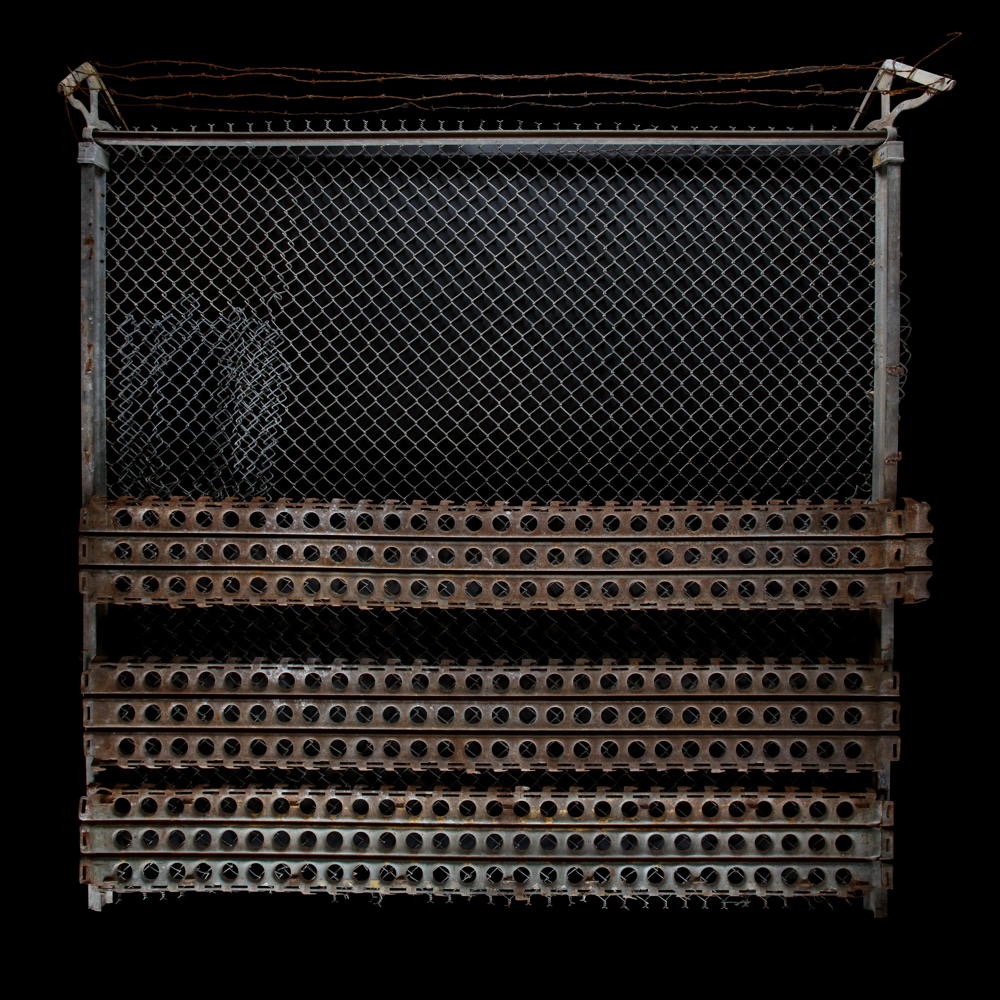
U. S. Government
30-foot-long section of border fence that separated
the Mexican city of Mexicali from the U.S. city of Calexico, California
(c. 1950s)
"Few will mourn what had already become just more Irrelevancies pretending they're dancing on that stage."
Most presidential acts are destined to become Irrelevancies. Heartfelt proposals meant to transform mostly fall far short of their promise. A few of the least obviously brilliant ideas might eventually morph enough to contribute to making a real difference, but these will largely go unnoticed. The first nuclear reactor accident was not the result of clever technology failing, but of a maintenance man accidentally dropping a wrench: an inadvertence. That innocent incident rendered all the clever safety mechanisms deliberately embedded in the technology irrelevant. Much of what we insist must exist for any society to thrive will likewise probably ultimately amount to simply more Irrelevancies. I might rail about people who wear their pajamas to shopping centers, but I suspect this practice will not ultimately cause the fall of anybody’s civilization. My youthful self would not have believed that I would one day voluntarily submit to vaccinations in the meat department of my local Safeway store, for that would have been unthinkable. When the unthinkable becomes commonplace, old insistences have already become Irrelevancies.
We’re entrained to believe that our President is the most powerful person in the world.
Weekly Writing Summary For The Week Ending 09/24/2026
Unknown Lithuanian Artist
Taupyklė – Kliunkis Pliumpis („Humpty-Dumpty“)
""Piggy Bank — Klunk Plump""
(not dated)
This week's Prosperity dispatches completed the series. The writing moved from the paradox of NonBinaryProsperity through the machinery no sane person volunteers to work with, from the misconceptions I've been thriving on all along to the vengeance with which Prosperity always returns. Then Comeuppance began, arriving with a wanted poster and a fictional president ripening for his reckoning. The Prosperity series ended where it always had to: not with resolution, but with the recognition that Prosperity naturally expands beyond its originating boundaries, carrying its losses as credentials.
Thank you for following along!
MakeBelieve
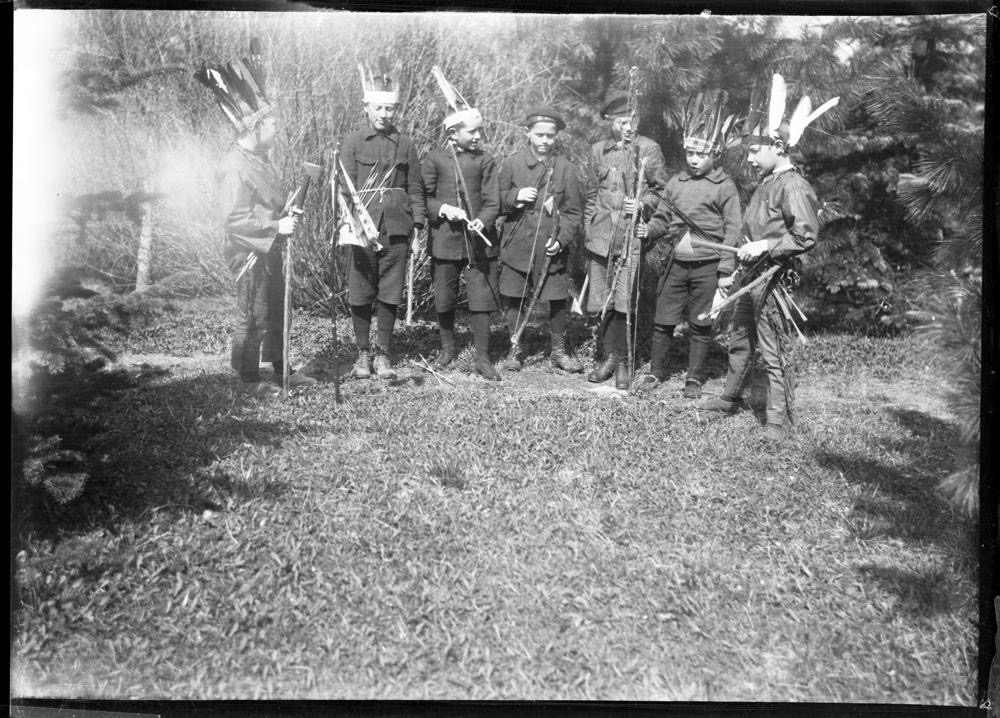
Bernhard Åström
Indianer i Masaby
(c. 1925)
"Our current president only exists in fictional form on some livestream that never was alive, ripening for his Comeuppance."
Donald J. Trump’s second term was almost entirely a fictional affair. This alone explains why it had no central theme beyond incoherence. It was not just that the incumbent was increasingly displaying the effects of his widely speculated prefrontal dementia, something he referred to as “fake news,” but that he lacked coherent purpose. He had no reason even to become president. No agenda. No motive, other than self-service, which had always stood in for his missing character. He recruited an equally unfocused cohort to populate his administration that, unsurprisingly, never once proved itself capable of administering anything. It would have been a complete joke had it not injured real people by inflicting actual damage, much of it inadvertent. It was as if we’d elected a chimp president. He could wear the uniform, albeit cut funny for his figure, but he couldn’t steer anything, much less our ship of state. Anybody could explain his track record by randomly sticking pins into something, drawing the resulting perimeter, and calling it a work of original art. It was all a fiction.
Much of whatever anything becomes results from our own more or less willing suspension of disbelief.
TheArc
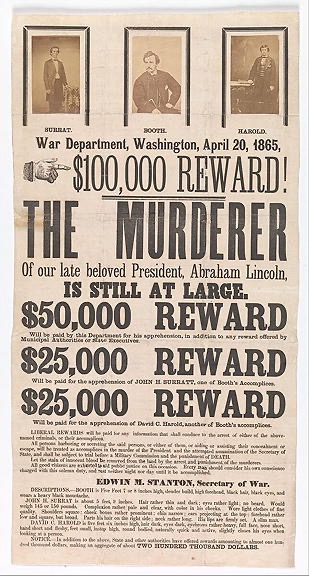
Multiple Artists/Makers
[Broadside for the Capture of John Wilkes Booth, John Surratt, and David Herold]
(April 20, 1865)
“The arc of the moral universe is long, but it bends toward justice”
Rev. Martin Luther King, Jr.
"That overlong Arc of Decency will perhaps this time finally inflict his Comeuppance."
Twenty-one months ago, on the Winter Solstice, anticipating the inauguration of who, I felt certain, would prove to be the worst President in the history of our country and probably in the history of this world, I began writing a series I entitled NextWorld. In it, I reviewed a few of my memories from his forgettable first term and speculated on how those patterns might manifest during his second. He seemed no less malignant than he had been through his first attempt, and I had no good reason to expect he wouldn’t be worse through his second. I needed reminding because I had reset into a contented complacency through Biden’s Presidency. I know that many seemed deeply dissatisfied with Biden’s performance, but their complaints seemed petty to me after observing his predecessor’s turn. I was preparing myself for an eclipse, where a reliable sun would be overshadowed by forces far more malignant than any moon.
I took no pleasure in this exercise.
ProsperityLost
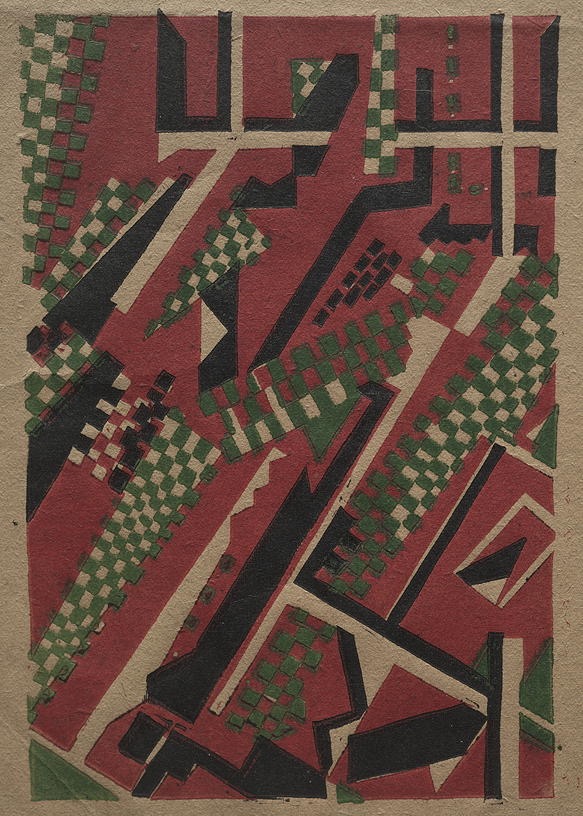
Edward Alexander Wadsworth
The Open Window
(c. 1914)
"Prosperity always returns with renewed vengeance."
I lost my Prosperity the same way Milton described Adam and Eve losing their paradise, for neither event ultimately amounted to much of a loss. I could consider them each a trade, and perhaps, even a fair one. Eve ate of the apple of the Tree of Knowledge, a decidedly good decision if only because it assured that she’d never be a dumb broad (excuse the pejorative). Adam, when confronted with the choice between abandoning his true love to lonely exile or accompanying her, chose to take a bite of Eve’s apple and trade his physical paradise for a more mobile emotional one. True, both traded infinite goodness for the vagaries of finite existence, but they gained considerable plot momentum in the process. Imagine where literature might have matured from a world consumed by unending sameness. In retrospect, if not in prospect, their ParadiseLost was an infinite emotional gain: true love.
When The Muse and I entered exile, seventeen years ago this year, we similarly forfeited our own hard-won paradise.
ProsperityMachinery
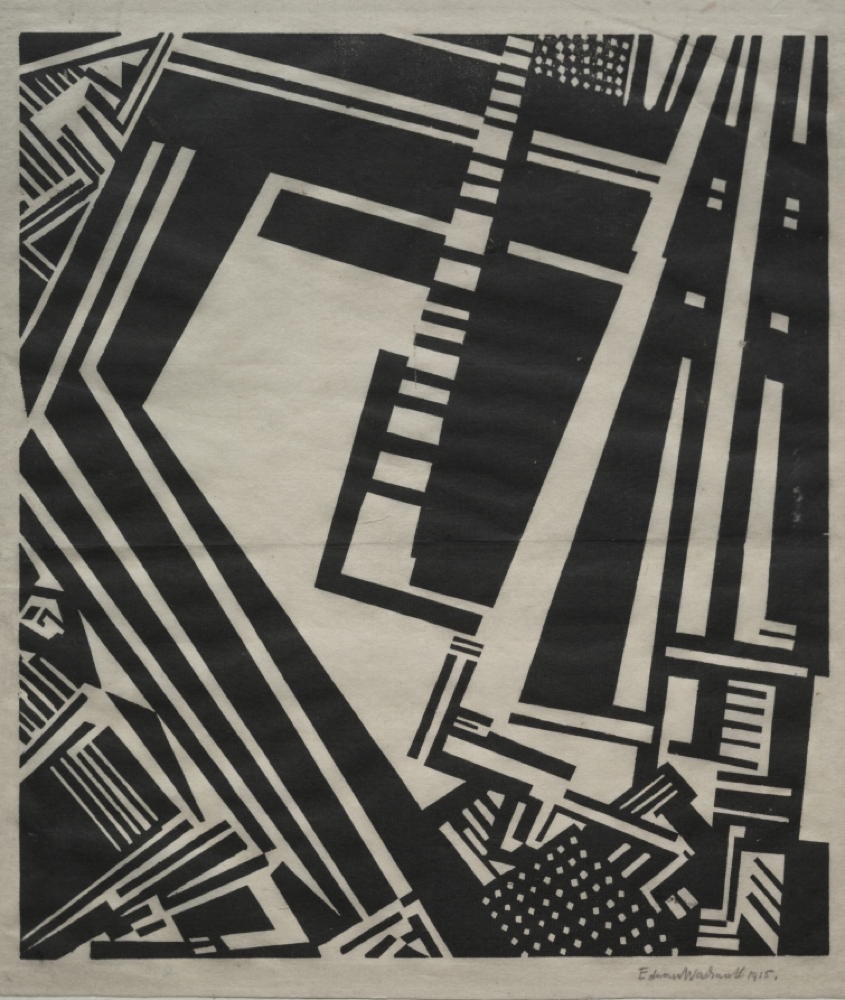
Edward Alexander Wadsworth
Illustration (Typhoon)
(1914–1915)
"…the least of what every Prosperity demanded in return."
Prosperity requires a vast company of supporting characters. It’s neither an island nor an isthmus, but an integrated element within recursive layers of ecosystem, some of which we’d really rather not acknowledge. If living requires some level of complicity, Prosperity seems to demand an even greater involvement in operations no sane person would ever volunteer for. Such seems to be Prosperity’s price. It’s not just laziness that insists we compromise ourselves in these ways, or convenience, for much of what our grandfathers never needed to consider has become essential to maintaining the Prosperity we’ve grown more than merely accustomed to. Many of these compromises—if, indeed, they can still be properly considered compromises—arise from genuine improvements which always bring along some number of unwanted externalities. The Villa Vatta Schmaltz had no indoor plumbing or electricity when it was built in 1907. This must be why the bathrooms are anything but spacious and inconveniently located. The upstairs bathrooms began their lives as a sleeping porch.
Much of the ProsperityMachinery we so utterly depend upon stays comfortably invisible to our daily lives.
Pwospwairatee
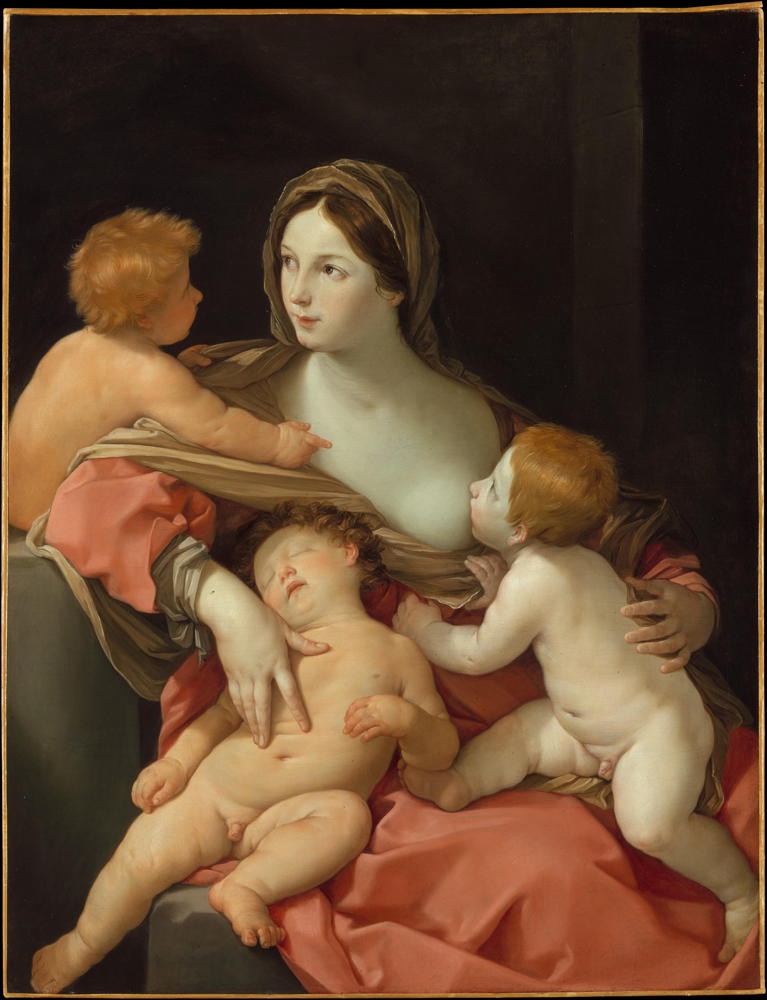
Guido Reni
Charity
(ca. 1630)
"… I might reasonably thrive on a few of my more reassuring misconceptions."
Now, after thirteen weeks spent considering Prosperity, I am realizing just how immature and generally juvenile my conception of the subject had been. I remain largely ignorant of it, since simple consideration rarely yields wisdom; more likely, dissatisfaction. Confessing my ignorance probably produced no more than negative knowledge, certain aversions as opposed to mature understandings. I might be little better for the effort, though I suspect I might possess a better appreciation of the depth of my former misunderstanding. It will likely be a life’s work to recover and construct much better than I’ve already grown too accustomed to. I don’t have all that much life left now.
At least I know that my Prosperity was never my possession.
NonBinaryProsperity
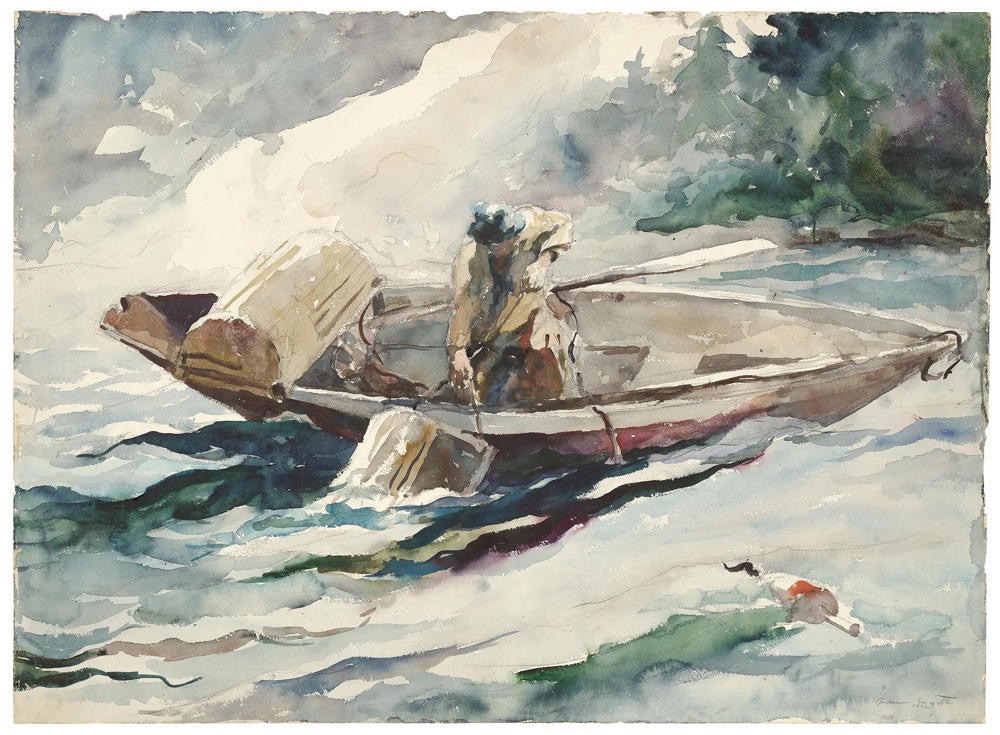
Andrew Wyeth
Maine Fisherman
(1936)
"…grateful we can actually employ our old, reliable Walla Walla Way."
True Prosperity might be NonBinary, defying specific classification. It seems to be anything but all-or-nothing, eschewing either/ors in favor of some flavor of both/ands. It tends to smother under clever definitions, and might sometimes even be mistaken for degradation. Environmentalists often get sideways with Prosperity because they treat externalities as if they define an entire context. They seem to entrap themselves too easily in impossible imperatives, casting themselves as the only noble ones and defending traditions nobody else seems to fully appreciate. They perceive change as degradation and stasis as somehow possible in a world that’s necessarily either economically expanding or contracting. Those pursuing Prosperity must remain mindful, too, of the environmental stewardship every development demands, though they risk being cast as an adversary to apple pie when they suggest that perhaps a diet of both butter and guns might be necessary and not impossible or necessarily degrading.
Our controversies devolve into strict dichotomies these days.
Weekly Writing Summary For The Week Ending 09/17/2026
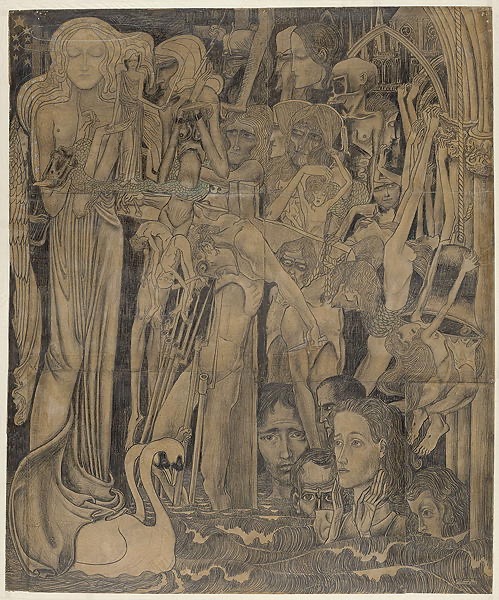
Jan Toorop
Loss of Faith
(1894)
This week’s Prosperity dispatches arrived as the series entered its final approach. The writing ranged from the historical accounting in Legacy to the nonlinear economics in Cascades, from the paradox in Unsecurity to the epistemological honesty in PresumptiveProsperity, from the anthem in ScaryProsperity to the quiet triumph in Restoring. The Muse walked back into her garden. The pickup toodled out to the farm market. The mechanic wouldn’t take a nickel. In these final installments, the series found that Prosperity naturally expands beyond its originating boundaries—and that might be all it ever does.
Thank you for following along!
Restoring
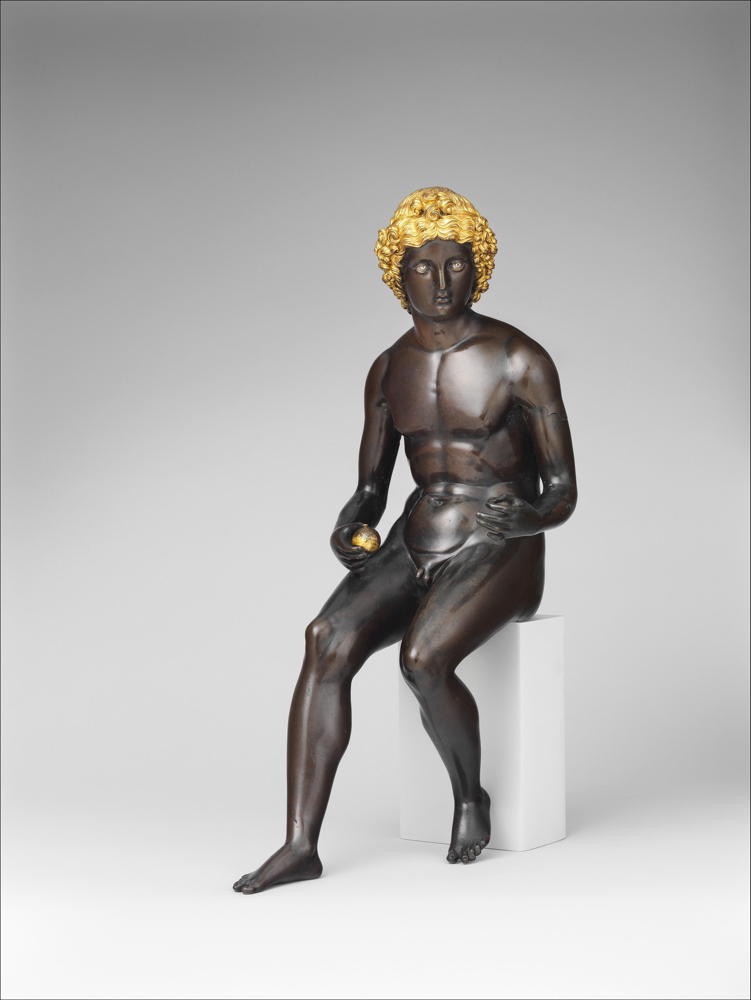
Antico (Pier Jacopo Alari Bonacolsi)
Paris
(ca. 1518–1524)
"Restoring Prosperity properly refocuses its inherent potential."
“Please return your tray tables to their full upright position.” This common command stands here as the simplest example of Restoring. What was undone might be redone. What seemed irrevocably lost might be capable of Restoring, if not itself, then, perhaps, a successor or substitute. ProsperityLost might serve as the first move in a cyclical pattern of Restoring Prosperity again. I will pine after an exact replica of whatever I lost, even though Restoring that might well shortchange me. I rarely imagine replacing it with something better than whatever I lost. This amounts to an aspirational affliction, perhaps due to a faulty imagination, or maybe I simply imprinted on that ProsperityLost so the loss became my Prosperity, at least temporarily; plenty of nothing beats nothing left at all.
Six weeks and change after The Muse broke both ankles, her osteopath released her from wearing the boots that stabilized the broken bones.
ScaryProsperity
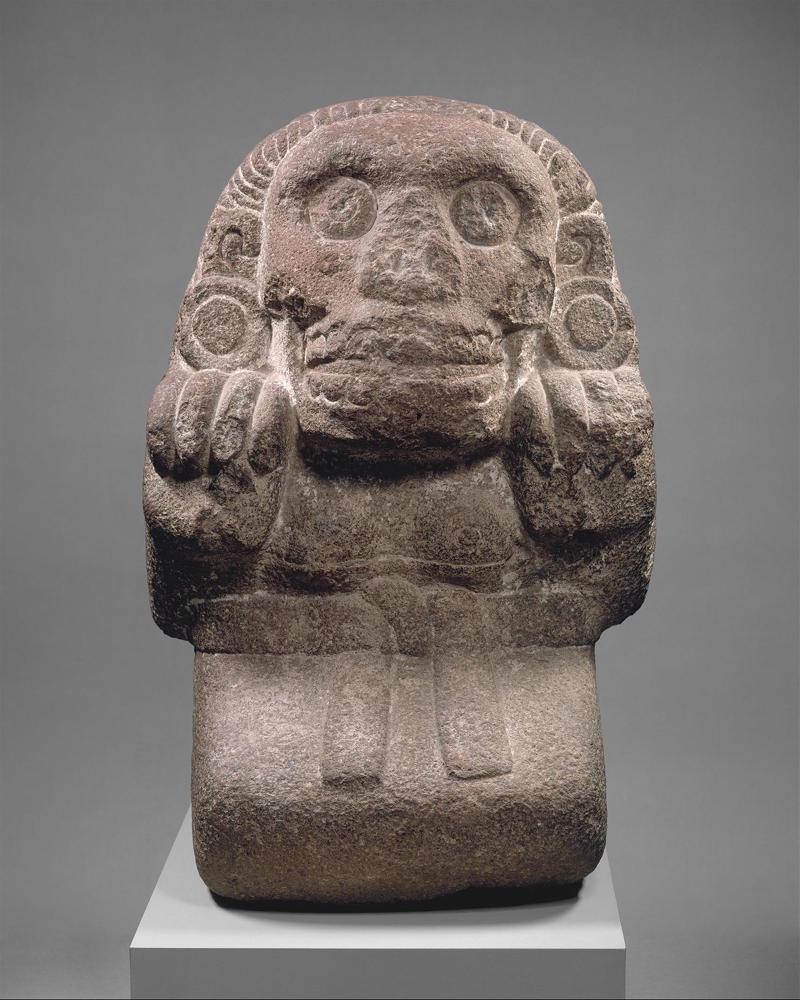
Unknown Mexica (Aztec) Artist Cihuateotl (15th–early 16th century)
We stand on the precipice of the greatest discoveries in the history of this world so far. How could it possibly be otherwise, as we stand here with all of human history receding behind us? This might be why every day seems so imperiled right now. With the promise of even modest Prosperity, externalities seem to become more prominent. We see mostly downsides and forget how fraught every prior radical improvement initially seemed. There were always naysayers; they often even dominated whatever discussions surrounded the emerging opportunity. Remember, most Americans were Tories during the Revolution. If people had been able to access their druthers, they would have probably passed up every opportunity to rewrite history, preferring to stay home, however uncomfortable, over dangerous exploring and potentially discovering great good fortune. Prosperity in the past has often come into its futures kicking and screaming bloody murder.
How embarrassing when the future dawns brighter than anyone ever imagined it could be again.
PresumptiveProsperity
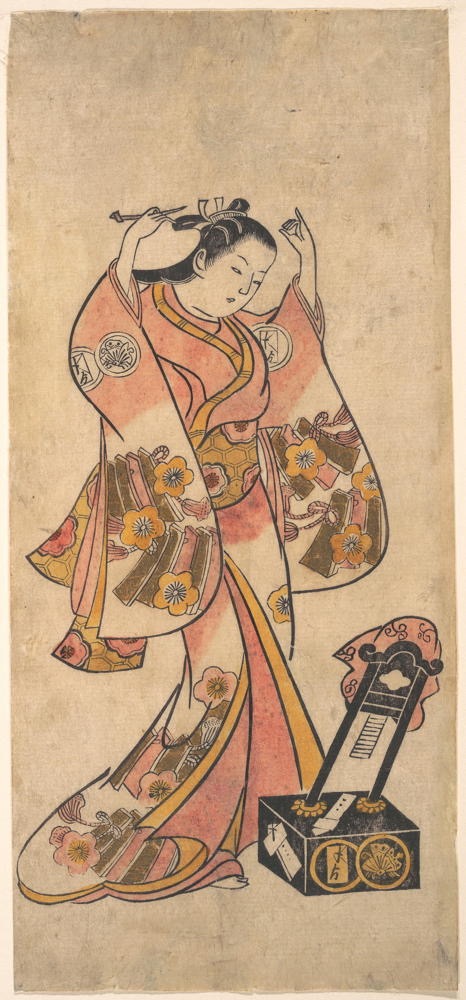
Torii Kiyomasu II
Sanjō Kantarō as a Woman Arranging Her Hair Before a Lacquer Mirror
(before 1763)
"…Prosperity stands in good company because of this."
I have a physicist friend who seems to hold vast amounts of arcane knowledge. He can pull full-blown proofs out of seemingly non-existent air. He often corrects my misconceptions, and I never fail to find fault with myself then for not having accumulated what he considers casual knowledge, but then we held different foci both in our choice of professions and in our personal lives. It was a wonder we ever encountered each other, given how different our worlds seem. We have each retained our grounding orientation, though we agree on more than either of us probably had any right to anticipate. We are vastly different and also quite disarmingly similar. As a result, we are quite compatible.
I remember the first time I encountered the kind of knowledge the world might expect me to retain.
UnSecurity
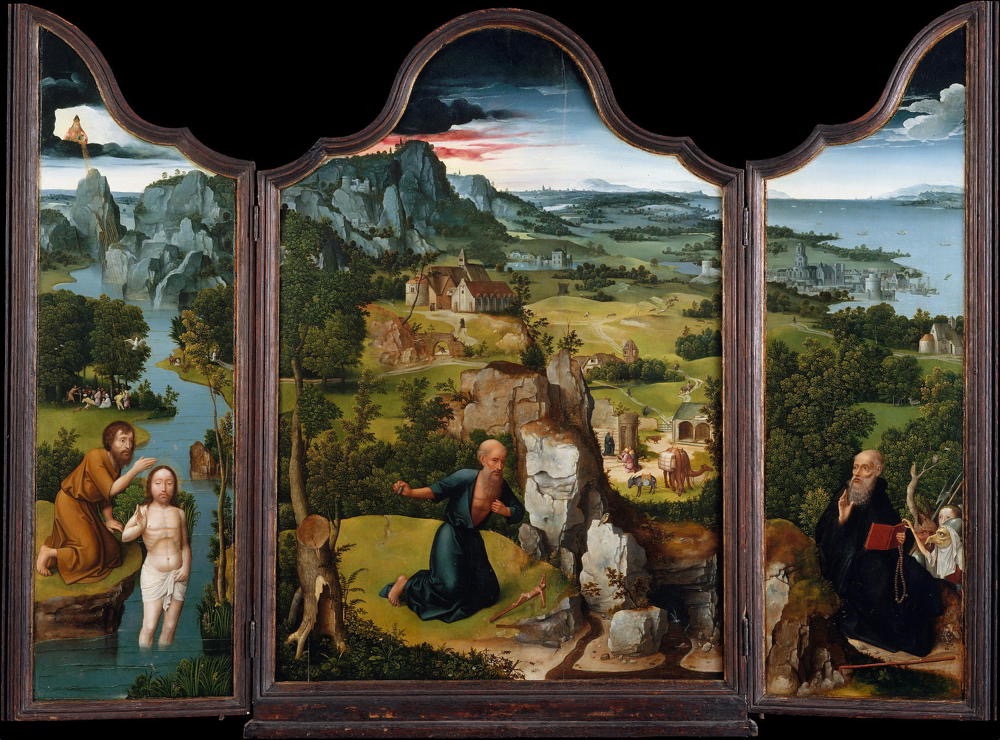
Joachim Patinir
The Penitence of Saint Jerome
(ca. 1515)
"… and they usually cost much more than Prosperity ever bargains for."
Our Prosperity was never really secure. Its security was usually merely presumed, for there could never have been an adequate defense against its many enemies, and it always had its enemies, many of them. It survived, while it survived, as a matter of apparent grace, without coherent explanation. It came, but was always capable of leaving or, more likely perhaps, of being snatched away for no apparent reason. There were always those who insisted upon assaulting any decency, as if their special gift was the superpower to sour others’ experience. They were always trouble, and everyone knew they were or would be real trouble before their story ended. They were often just jealous, envious of others’ apparently better circumstances, angry at themselves for where they landed, but also at least equally angry at others for prospering. It never made sense to assault themselves, though they were capable of severely wounding themselves and would wound themselves on occasion, but continuous self-destruction makes little sense, even to almost complete idiots. Regardless of the defense erected against such forces, Prosperity would often lose, especially on the first round or two, though it would always retain an ability to recover and renew. It mostly made no sense to maintain a robust defense, since it could eventually renew and recover infinitely as it wished. Prosperity was always persistent.
A piece of Prosperity’s perversion insisted that we needed to maintain a more active defense.
Cascades
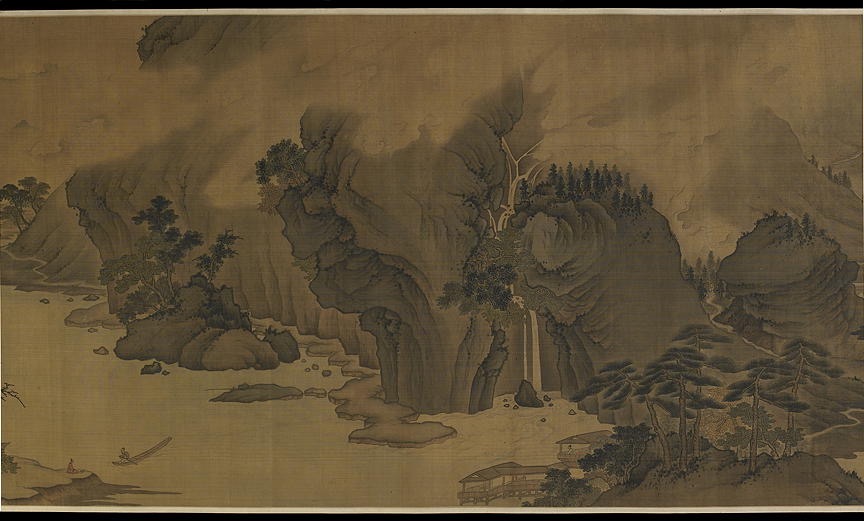
Formerly attributed to Xu Daoning (ca. 1000-after 1066)
Autumn river in the rain and clouds
(16th century- China)
"We seem at least obligated to deal with this world as it is,…"
Economics works in mysterious ways, and doesn’t always seem to work at all. Prosperities can rise and fall with startling speed, partly because they do not move linearly. Both Prosperity and penury can fool the eye that expects straight-line predictability. Both require systems thinking even to begin to comprehend, and even then they might still seem mysterious. Ruinous change can seem to occur faster than instantly, especially for those who can’t register nonlinear variation. Beneficial shifts can occur just as seemingly erratically, probably because both Prosperity and Penury tend to operate as Cascades. Their values do not travel via thin, straight wires, but through wilder splashes, as if they were water racing through a rocky ravine. So much apparently random variation litters their courses that accurate prediction seems unlikely, if not impossible. This might be why they both just seem to happen.
Accounting for both Prosperity and penury might be best attempted after the fact, once a period of insulating time has passed.
Legacy
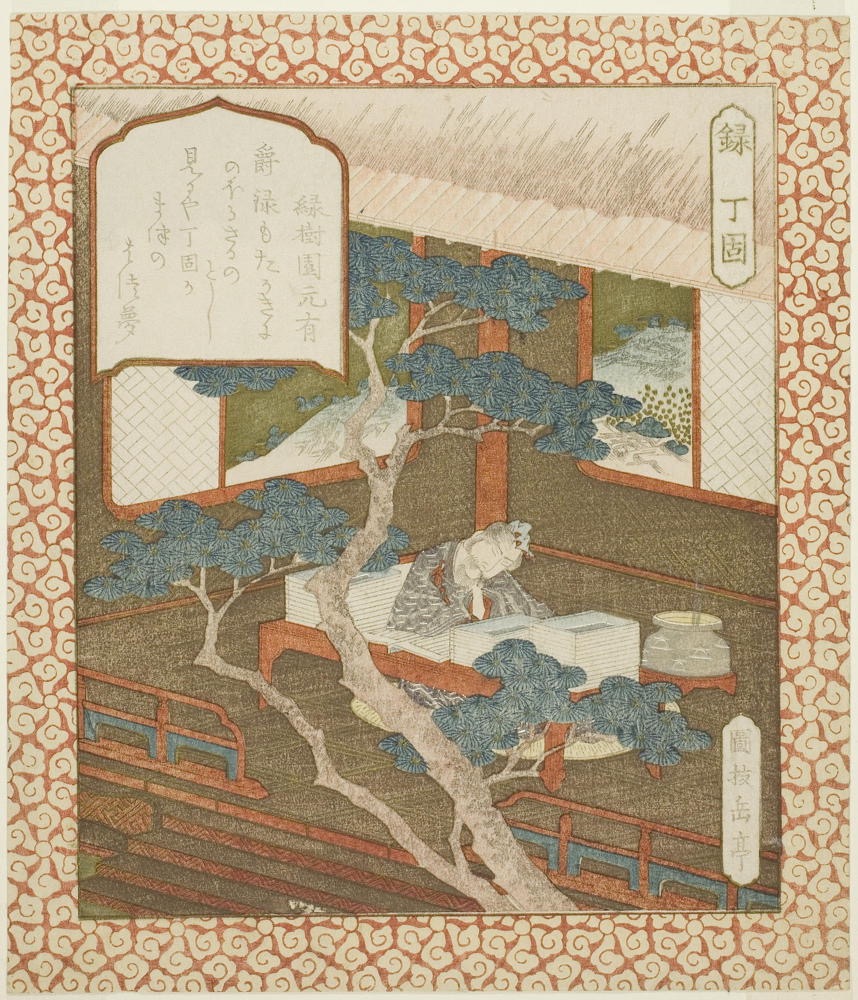
Yashima Gakutei
Prosperity: Ding Gu (Roku, Teiko),
from an untitled series of happiness, prosperity, and longevity
(c. 1824)
"This will be the work by which future generations will judge patriots."
With fewer than ten installments of this Prosperity series remaining, I start foreshadowing the ending here. I must have explained the process by which I intended to consider Prosperity in this series, a method I might label Dialogic. Rather than start with the ending in mind, I began with questions, honestly intending to inquire, then inquire again, following the story however it seemed to unfold. This tactic might explain the winding pathway this series must have seemed to have been taking. I began each writing session a little bit baffled about where the unfolding story might lead me next, for in this type of analysis, the subject guides the writer rather than the writer crafting the plot. The plot emerges, and the writer trusts that it must. This writer chose, day to day, so only in that way did I influence the resulting flow. The storyline has emerged from the process rather than the process or the author guiding it, so I have not employed foreboding until now, and not only because I couldn’t have known enough about where the Dialogic method would lead me, but also because foreboding couldn’t have served any possible purpose if my purpose was genuine discovery. But we both know an end seems near now, and we both wonder where this expose might be going.
It has been demonstrating its Legacy with every installment.
Weekly Writing Summary For The Week Ending 09/10/2026

Utagawa Hiroshige II (Shigenobu)
Dramatic Picture of Sakura
(Not Dated)
This week’s Prosperity dispatches arrived as our housemade Mirabelle wine began fermenting in the kitchen and a sleep clinic visit produced the series’ most unexpected installment. The writing ranged from the guitar-shaped Blooming of every Prosperity to the ancient ritual of CreatingWorlds, from the public policy failure of NotInsurance to the taxonomy of StickyProsperity, from the comic philosophy of TheApneas to the sleepless night that followed the loss of Innogrance. The kitchen smells like sweet yeasty bread. The Prosperity persists, wounded but present.
Thank you for following along!
Innogrance

Utagawa Hiroshige II (Shigenobu)
Calligrapher: Yokogawa Horitake
Memorial Portrait of Ichiryusai Hiroshige (1797–1858)
(1860)
"Who knows where this game of Prosperity goes next?"
My sense of Prosperity seems to depend upon two critical, if rarely deliberately acknowledged, resources: innocence and ignorance, in some proportionate mix: Innogrance. Some of my sense of Prosperity certainly stems from what I do not presently know or even suspect, an innocence. It just never occurred to me to consider that stuff. The rest of my sense of Prosperity might reasonably stem from my ignorance. Had I known how to create the Prosperity I presently enjoy, I doubt that I would have managed to produce anything close to what I have experienced. Prosperity seems to be one of those states that require some blind backing into rather than clever forward strategy. Sure, strategy, however clever, might well contribute its share, but Innogrance seems responsible for producing the balance.
This balance seems just as delicate as you might suspect.
TheApneas

Utagawa Hiroshige II (Shigenobu)
“America”: A Native American Woman on Horseback in the Snow
(1860)
"…the promise to be rid of something that's only present by the evidence of its absence."
As I recounted in my ADecentNight story, posted as a part of my Decency Series, both The Muse and my internist have been after me to volunteer for a sleep study at our local sleep center. They suspect, on scant evidence, that I might “suffer” from a condition they call Sleep Apnea, a condition in which I cannot quite muster a belief. I find TheApneas, as a class, to represent the most interesting category of human difficulty, because they are defined as the presence of the absence of something. This formulation makes my head ache, so I avoid thinking about it very much. Even when I think about it, I make no headway toward understanding or acceptance because its very definition seems entirely paradoxical. I’m left failing to interpret a calculus with nothing more powerfully interpretive than my usual meager long division. Further, if found to be “suffering” from this apparently imaginary disorder, the treatment involves being sentenced to wearing essentially a vacuum cleaner over my face, in lieu of sleeping. How such a nightmarish treatment might cure something that, by definition, exists only by not existing, deeply baffles me, and should.
I suspect that TheApneas qualify as first-world disorders.
SlipperyProsperity

Utagawa Hiroshige 歌川 広重
Shirasuka: Shiomi Slope,
no. 33 from the series Fifty-Three Stations of the Tokaido
(Tōkaidō gojūsan tsugi)
(1847-52)
"I tolerate working harder for it than it ever seems to work for me."
Prosperity seems to exist in two distinct forms: Slippery and sticky. Sticky seems to be the more noun-like of the Prosperities. These might serve as outward manifestations of Prosperity possessed, though they can be misleading, as appearances are not always what they seem. Many of the Prosperities seem slipperier, either because they have no physical presence or because their presence simply seems far less apparent than their sticky counterparts. The art we display on our walls, and the books we so proudly exhibit on our shelves, serve as prominent examples of our sticky Prosperity. Indeed, our very home, The VillaVattaSchmaltz, represents probably the stickiest Prosperity we possess, though, yes, it sometimes seems as if The Villa possesses us more than we possess it. Either way, its presence seems inescapably sticky.
Much of The Muse and my Prosperity was never reducible to mere possessions, however grand those might appear, for our underlying Prosperity seems decidedly less sticky than art, books, or address.
NotInsurance

Torii Kiyomasu II
Susano-o no Mikoto Killing the Eight-headed Dragon
(1748)
"…Prosperity is NotInsurance, and never will be."
Prosperity spawns predators and pretenders. As medical insurance became more available, so-called “medical cards” emerged to serve those still frozen out of insurance markets, especially for prescriptions and dental services, which are often the most difficult kinds of insurance to afford. To this day, Medicare offers nothing to cover dental expenses, which often peak after one retires. Prescription drug plans have also become notorious for becoming worthless just at the time someone might actually need to rely on them. So, a ready market always awaits some latest scam. Our conservative friends and enemies have been most active in this shadow market, pushing plans that appear to supplement missing elements of seniors’ coverage, but which tend to promise more lavishly than they ever deliver. In recent years, states, which regulate insurance markets, have begun demanding that these alternatives to insurance coverage be clearly labeled, “This Is NotInsurance,” though these warnings make little difference to those without viable alternatives.
Make no mistake, this is not an insurance company problem, but a public policy one.
CreatingWorlds

Utagawa Hiroshige II (Shigenobu)
French Woman, Her Child and Pet Dog
(10th month, 1860)
"…inevitable complications always present when CreatingWorlds."
The kitchen smells yeasty, like bread dough with a distinctive fruity backdrop. The scent hovers below overwhelming, still subtle but inescapable, reminiscent of the underlying fruit, but distinctly different. I mentioned to The Muse, as we stirred the pots containing fermenting Mirabelle plums, that I felt as though I was getting to know this fruit far better than I ever had before. Before, we’d rendered it into jam or tarts, or simply consumed it fresh; we saw only its very narrowest representation. After picking it this year, I pitted the fruit and set it out to slowly and quite deliberately rot, rendering its sweetness into alcohol and thereby Creating Worlds that didn’t exist before. This ritual might be as old as civilization, for Mirabelle plums have probably always produced exponentially more fruit than anybody could consume fresh. Ruled by the inexorable laws of Late Summer, the fruit’s natural yeasts and sweetness would set it to festering without any human intervention. Over millennia, a process of sorts has emerged that we can use to do what nature, left to her own devices, could have accomplished unassisted.
I suppose that just these sorts of activities once regulated the civilized world.
Blooming

Utagawa Hiroshige II (Shigenobu)
Entrance to the Gankirō Tea House in the Miyozaki District,
Yokohama, Bushu
(3rd month, 1859)
"…to identify an opportunity to prosper when it inevitably presents itself as a different-shaped guitar."
Prosperity seems to come and go on something akin to Sandberg’s little cat feet, though everyone who ever owned a cat, little or otherwise, knows just how loud their arrivals and departures can sound. Our cats, Max and Molly, hit the floor with a distinct plop so far from stealthy that nobody can smell stealthy from there. They proceed to march down the upstairs hall, for they most often come and go via a second-story window they access by climbing up the back trellis and storming up the kitchen roof. I hear each footfall as they “creep” down the stairs, and can audibly follow their progress through the front hall and the dining room, even though both rooms’ floors are covered with shock-absorbing vinyl planking, before taking their final launch up and onto the kitchen table, where they hope I’ve left them some kitty treats. I usually have. These cats have learned that their Prosperity reliably exists on the kitchen table, and they are not the least bit shy about directly pursuing it there.
My Prosperities do not seem to come so reliably or noisily.
Weekly Writing Summary For The Week Ending 09/03/2026

Utagawa Hiroshige II (Shigenobu)
View of Iris Gardens at Horikiri
(1861)
This week’s Prosperity dispatches arrived in the shadow of ExistentialDread and emerged into AutumnRains. The writing ranged from the clinical precision of CTSD to the paralyzing honesty of ExistentialDread, from the epic sermon of ReClaiming to the procrastinating wisdom of WithoutHeadlights, from the philosophical revelation of Thawing to the portrait of Prosperity as AutumnRains. The AutumnRains arrived. The Mirabelle wine processing began. The Muse showered and then slept in her own bed for the first time in six weeks. The series found, at last, that Prosperity might be a more or less continuous Thawing — neither liquid nor solid, but mist.
Thank you for following along!
AutumnRains
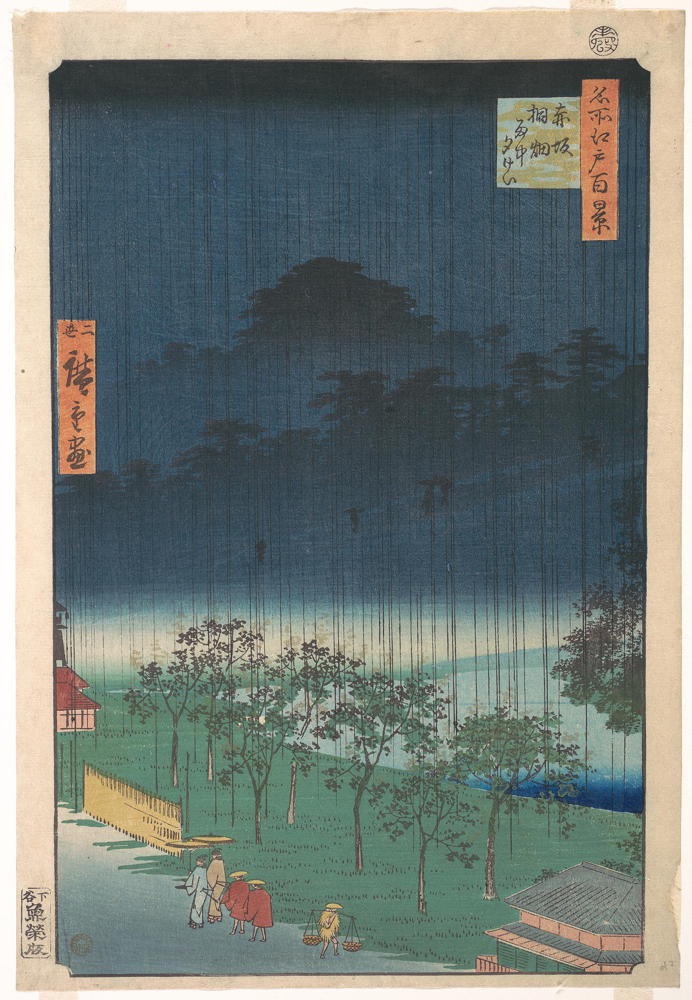
Utagawa Hiroshige II (Shigenobu)
Paulownia Trees at Akasaka in the Evening Rain
(1859)
"I revel in my AutumnRains' reappearance."
Moisture well represents our Prosperity here in this desert steppeland, now trying to pass for Middle American town and pasture. It is beautiful here in springtime when this valley could pass for Ireland, after the Winter and Spring wheat conspire with the Canola to turn the late summer beige stubblefields into a checkerboard of Prosperity after the Winter rains, fogs, and snows have left our soils saturated. This country fasts through its Summers, often seeing no more than passing hints of its Prosperity through June, July, and August. It always feels dicey, as if we might not make it through to the AutumnRains each year. My friend Randal reports that he measured the driest August in at least the prior ten years, with only +.07 inches of SummerRain registered against -4.94 inches of evaporation. Through summers, we typically lose more moisture than we gain, straining our conviction that we didn’t really choose to live on the edge of a freaking desert. I keep my yard Middle American New England emerald, just the way God never once intended.
The AutumnRains return— if not precisely reliably, then inevitably—and they arrive like Prosperity returning from another harrowing Hero’s Journey.
Thawing
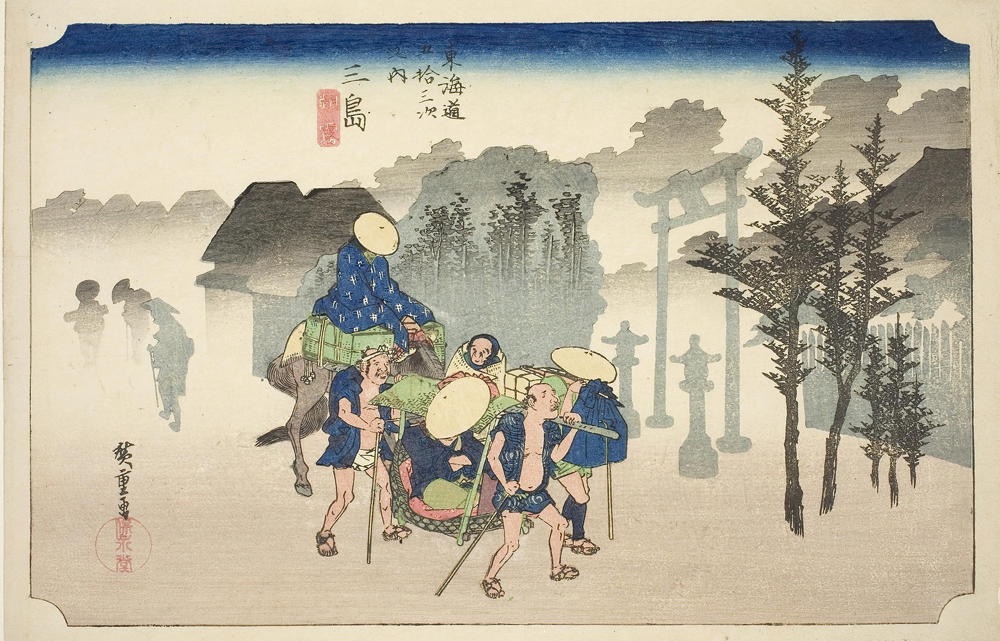
Utagawa Hiroshige 歌川 広重
Mishima: Morning Mist (Mishima, asagiri),
from the series “Fifty-three Stations of the Tokaido Road
(Tokaido gojusan tsugi no uchi),” also known as the Hoeido Tokaido
(c. 1833/34)
"…neither liquid nor solid, but mist."
A surprising period of Thawing typically follows one of my frozen-in-the-headlights-without-the-benefit-of-headlights experiences. Whatever had so effectively inhibited me from engaging dissipates. Not all at once, and never quite completely, but a few openings appear out of what had previously seemed like blinding, inhibiting, frozen mist. I climbed the ladder. I harvested the fruit I’d feared I’d left to rot. My world seemed to right itself, or at least start moving in that general direction. Moving! I accomplished something! I once again sense that I possess actual latitude for action. I feel capable of choosing, at least on a limited basis. I can choose, then I can choose again, and I recognize the fundamental cycling that underpins my Prosperity; for what was Prosperity if not the sense that I might choose more or less freely, that I was less imprisoned in my world than I was an intermittent master of it?
I first sense a loss of Prosperity as a limiting of choices.
WithoutHeadlights
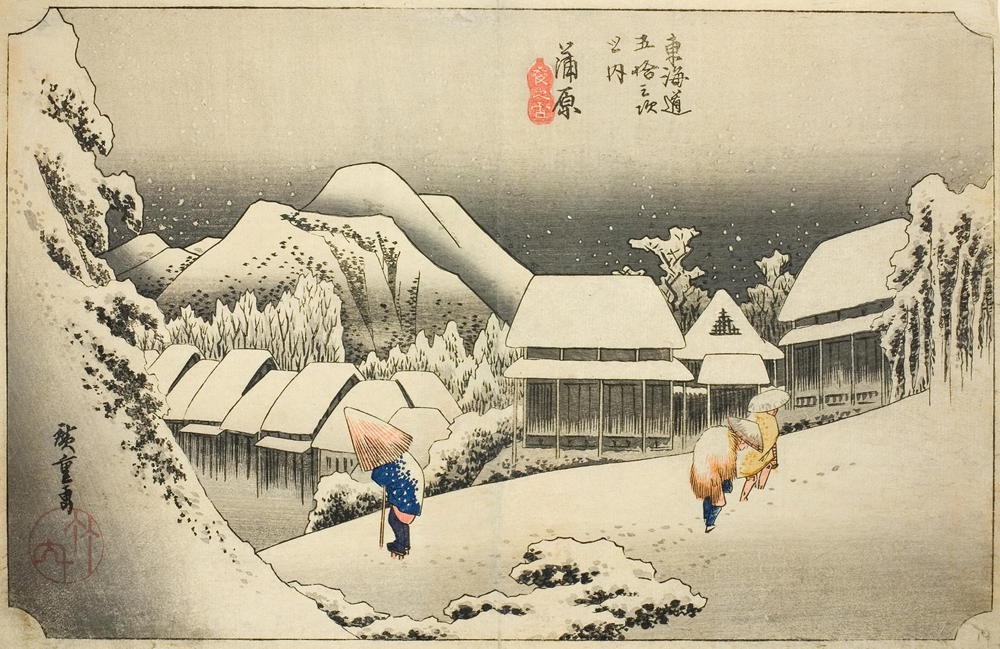
Utagawa Hiroshige[a] (歌川 広重) or Andō Hiroshige[b] (安藤 広重)
Kanbara: Evening Snow (Kanbara, yoru no yuki),
from the series “Fifty-three Stations of the Tokaido
(Tokaido gojusan tsugi no uchi),” also known as the Hoeido Tokaido
(c. 1833/34)
"…teetering on the edge of some tragic change in fortune if I cannot get this tendency under better control."
I heard myself proclaiming that I have been doing that fabled deer-in-the-headlights reaction one better, for I’ve been frozen as if caught in headlights on a dark forest road WithoutHeadlights present. I suspect that this reaction might not be classified as a talent, though I also imagine that it might, like deer’s reaction to bright lights, offer some evolutionary benefit, or used to offer one, before cars made such interactions dangerously commonplace. I can’t tell which of my native responses to such perturbations are positive ones and which might be more dangerous, though I carry opinions. I usually feel guilty when I notice that I’m frozen WithoutHeadlights again, as this must be a snowflake’s response signifying something shameful. I imagine myself more powerful, and capable of shrugging off most threats, though in real life, my vulnerabilities continually surprise me. I occasionally qualify as a superhero, but fleetingly, and only ever in my own mind.
This passing summer has been a struggle for me.
ReClaiming
Hiroshige II (二代目 歌川広重, Ni-daime Utagawa Hiroshige
Chōmeiji Temple (Chōmeiji), from the series Miracles of Kannon
(1859)
"What begins as slander always eventually ends as ashes,
once the epic heroes show up to ReClaim their birthright."
We live in a time that might have been specifically designed to spawn one of those immemorial epic poems. Ours would be known as ProsperityLost and written by someone hopefully far more secular than Milton and less reckless than the probably apocryphal Homer. Ours would be no less epic, however, for we lost something far more precious than even a biblical Paradise or an ancient Greek empire, for our Prosperity had the decency to aspire without explicit expectation that it would result in any physical manifestation. We were free to believe without regard to the likelihood that any of us or our progeny would ever really realize the promise, yet that promise held. Hell, it was born self-evident! With it, we could succeed as a mere matter of birthright or adoption, for we were largely, by design, a nation of immigrants, citizens by some designation superior to race, creed, or even religion. We shared a dream of Prosperity rather than any individual lording over any other. We aspired to equality rather than any dominion over.
The enemies of this curious state were with us from before the fabled American Revolution, in which a minority asserted rights no nation had ever once guaranteed before or had any idea how to uphold.
ExistentialDread
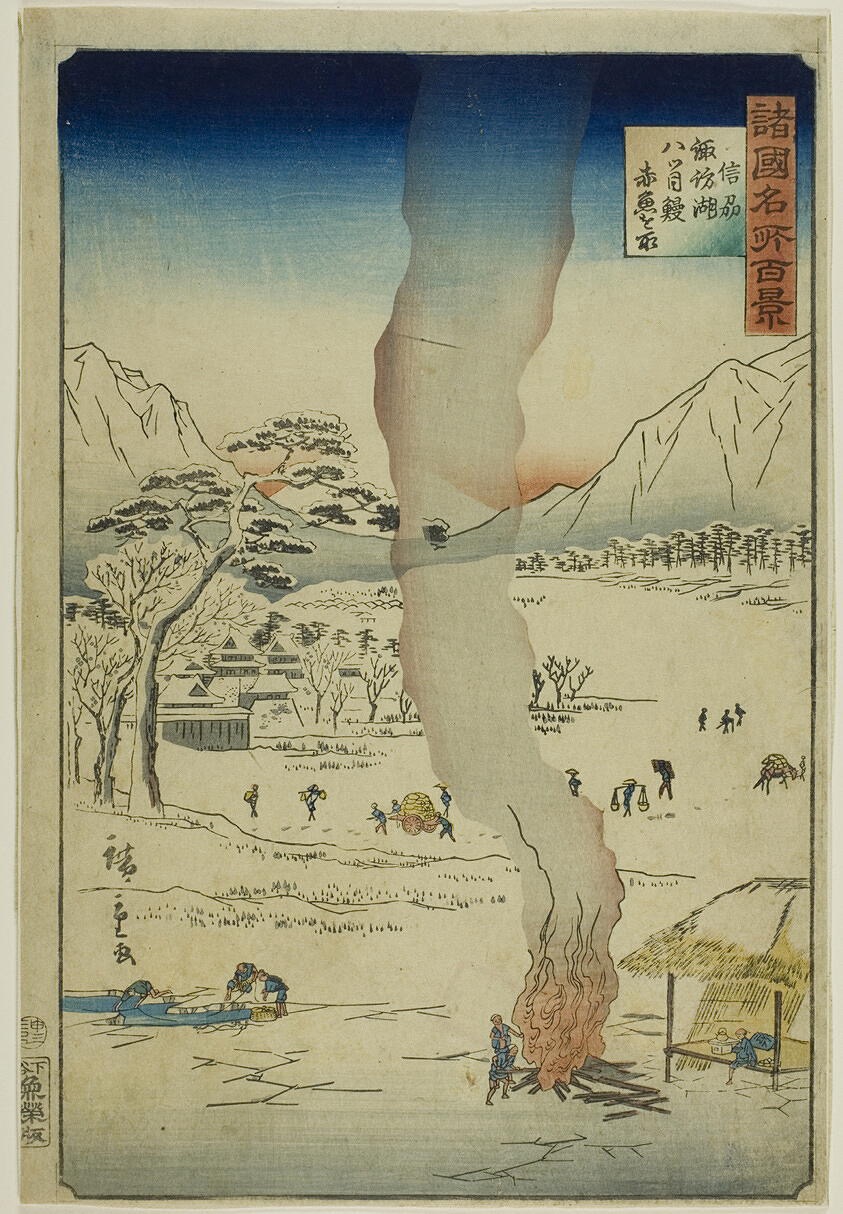
Hiroshige II (二代目 歌川広重, Ni-daime Utagawa Hiroshige
Catching Lampreys, Eels, and Red Rockfish on Lake Suwa,
Shinshu Province ,
from the series “One Hundred Famous Views in the Various Provinces
(Shokoku meisho hyakkei)”
(1860)
"…will this just become another excuse in the already overlong list of reasons why I can't have the Prosperity I once believed I deserved?"
One sure sign that Prosperity feels threatened comes when a persistent ExistentialDread descends. Periodic ExistentialDread offers no real information about the present or future, for these come and go as an inescapable part of any aware existence. To exist has always been to sense threats to continuing that existence, and, as long as these remain intermittent, they offer no real threat to anything, let alone existence. These come as more or less wake-up calls, increasing awareness of the inescapably temporary nature of all existence, of which human existence has never served as any exception. In some ways, intermittent dread serves as a gift. It can sharpen focus and reawaken a lost sense of urgency or significance. Love seems to flourish with a touch of dread in the mix since it can reassert the importance of assertion itself, reminding one that they’re more isthmus than island and should find reasons to appreciate sustaining relationships. But when the Dread turns Existential, and moves in claiming it holds a long-term lease, hinting at permanent residence, Dread’s few benefits quickly evaporate into much worse than nothingness.
The certainty that ExistentialDread brings remains just as illusory as any other certainty in this existence, but it carries a uniquely threatening gravity.
CTSD
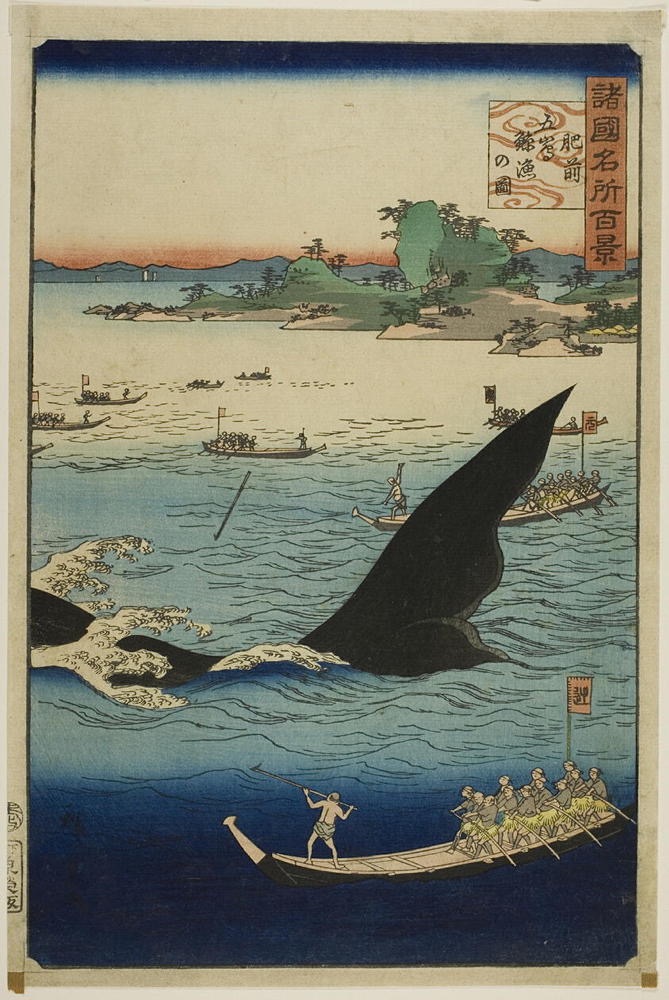
Utagawa Hiroshige II (Shigenobu)
Image of a Whale Hunt at Goto, Hizen Province
(Hizen Goto geiryo no zu),
from the series “One Hundred Famous Views in the Various Provinces
(Shokoku meisho hyakkei)”
(1859)
"I dare not wait until this insult ends to start taking better care of myself."
Traumatic Stress Disorders do not necessarily wait until a trauma passes. The overly popular Post-Traumatic Stress Disorder (PTSD) was very likely first experienced in its Concomitant form, while the trauma was still present. Trauma sows enough confusion that it’s often extremely difficult, if not absolutely impossible, to reflect upon the unfolding experience in the moments it occurs; hence, the much more common recognition of PTSD than its CTSD, Concomitant Traumatic Stress Disorder, predecessor. Trauma seems to be so busy winding up my spring that it might be relatively easy to overlook its presence. Sure, it’s upsetting, but what isn’t? In the moment, it often seems as though the stressors must just be passing through me, transitory upsets apparently leaving little lasting damage. Later, though, Post the Tramatic Stress, Disorders might emerge without having a clear or present cause. Then they can be confusing, as someone clearly not presently threatened by anything starts behaving as if under active siege. Then, if at all, the stories might begin to reemerge and some sense-making might start occurring.
If the trauma lasts longer than an episode or two, it seems probable, if not certain, that some more permanent wounding might be occurring.
Weekly Writing Summary For The Week Ending 08/27/2026
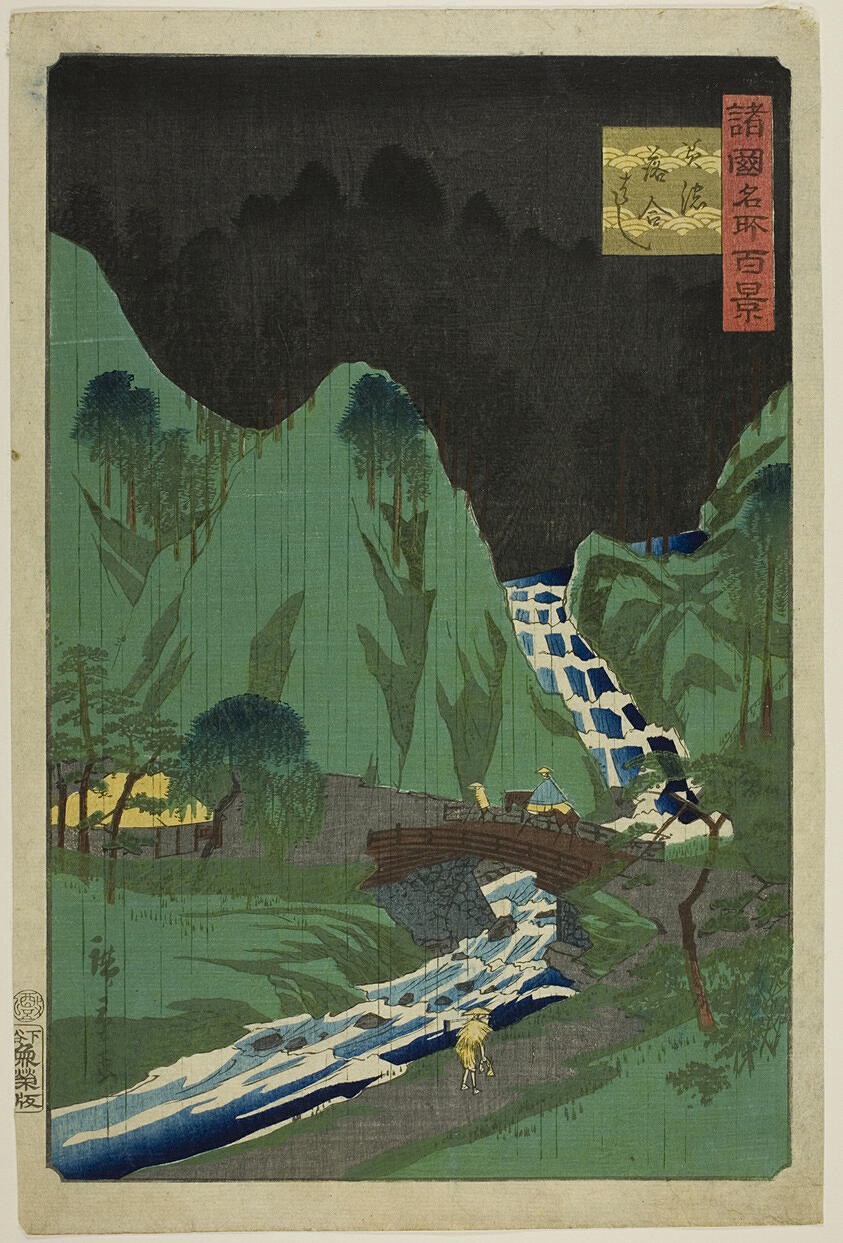
Utagawa Hiroshige II (Shigenobu)
Ochiai Bridge, Mino Province (Mino Ochiai bashi)
from the series “One Hundred Famous Views in the Various Provinces
(Shokoku meisho hyakkei)”
(1861)
This week’s Prosperity dispatches arrived as the series found its most sustained political argument and its most liberating philosophical resolution. The writing ranged from the economic indictment of PhonyProsperity to the legal and moral framework of Impunity; from the historical sweep of Anti-ProsperityPolity to the market pathology of Spookulation; from the kitchen-table fury of StickerShocked to the philosophical liberation of Accschleptances. This week, the series spoke of Spookulation, Spookulators, the self-helpless, and Accschleptance. The hamburger cost thirty dollars. The series, freely given, felt liberated by the end.
Thank you for following along!
Accschleptances
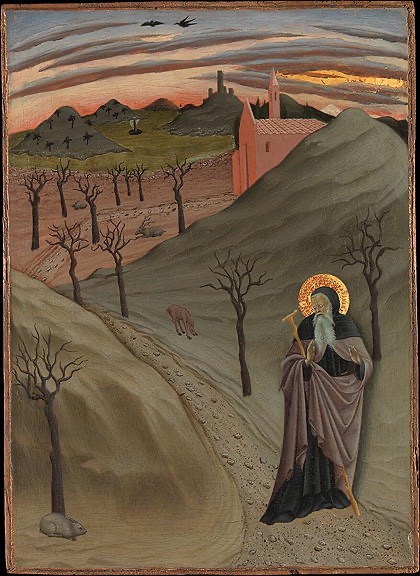
Sano di Pietro or Ansano di Pietro di Mencio
Saint Anthony the Abbot in the Wilderness
(ca. 1440)
"I'm better off without your perfection or mine."
I once believed that Prosperity could only emerge after something close to perfection occurred. Some previously unlikely convergence would produce some utterly surprising manifestation, some outcome seemingly approaching perfection, and Prosperity would thereafter reign. These weren’t completely chance encounters, but they often arrived unexpectedly, initially surprising the benefactors before becoming a seeming birthright. None are precisely born prosperous, and each must learn a few hard-earned lessons before they can properly incorporate the lived practice of Prosperity into a daily routine. Perhaps the key realization on the way to experiencing Prosperity comes when the naive notion that you must first achieve perfection crumbles. A precious form of acceptance replaces that naive notion, what I’ll call Accschleptance: the acceptance that good enough might, in fact, be good enough, that perfection is not only not required but also unlikely ever to appear. The forms within which Prosperity inevitably appears do not include perfection. Therefore, perfection couldn’t possibly be required as a necessary precondition for Prosperity to emerge.
This realization typically comes as a relief, often after a protracted effort to achieve some essentially unachievable perfection or other.
StickerShocked
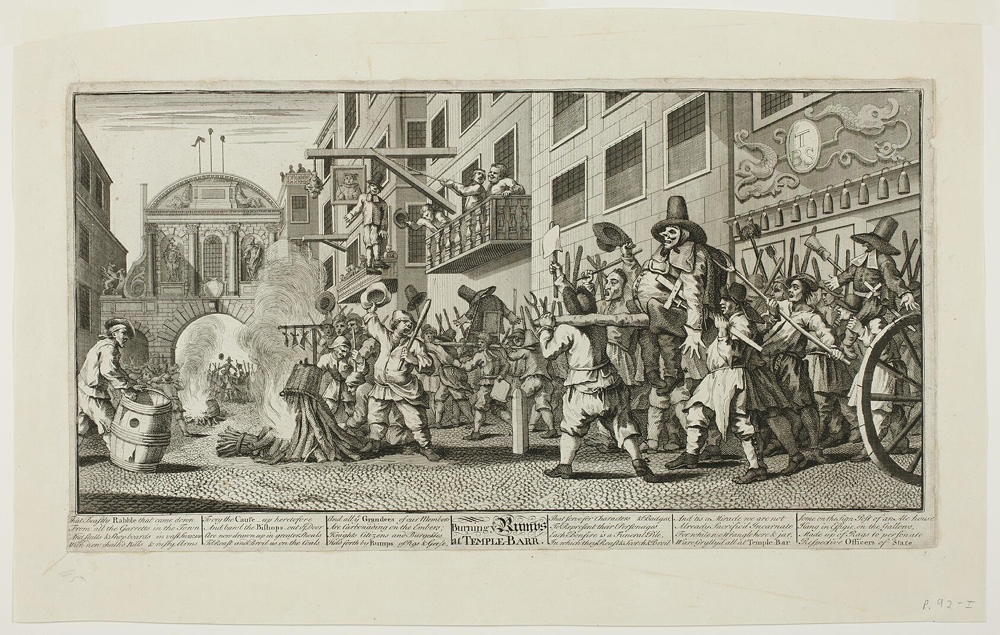
William Hogarth
Burning the Rumps at Temple Bar,
plate eleven from Hudibras
(February 1725/26)
"How much longer before nobody has a Benjamin?"
When I was seventeen, my older brother bought his first house. I remember that he paid about fourteen thousand dollars for it, qualifying for the mortgage under some government program designed to help working stiffs acquire a home. He was managing a Safeway produce department at the time and all of eighteen years old. I looked at that sticker price and quickly calculated how long the indenture would last before he could pay off that place, and I felt aghast. I couldn’t imagine ever willingly agreeing to such an indenture, no more than I could imagine myself ever being able to afford to buy anything priced at anything close to an astronomical fourteen thousand dollars.
I’ve spent my life since convinced that I couldn’t afford.
Spookulation
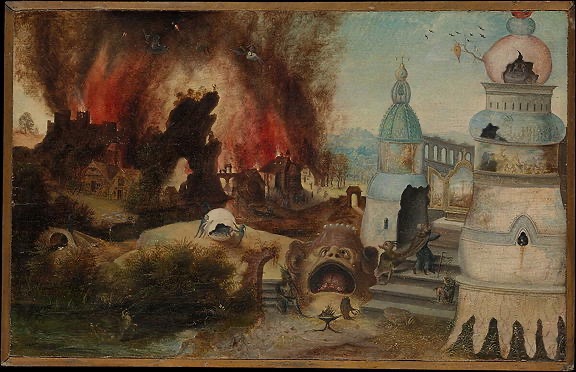
Herri met de Bles
The Temptation of Saint Anthony
(ca. 1550–60)
"The outcome seems certain from the outset."
Prosperity tends to keep speculation in check. The need for assuming great risk, hoping for even greater reward, might be capable of working as a precursor to periods of Prosperity, but it serves as no sure or certain cure for any ill, and should therefore be preserved for rare times of great peril or even greater possibility. When a society comes to perceive its future as necessarily speculative, it might be PreProsperous or merely lost. Only an eight-year-old would plan to succeed by continually upsetting otherwise reasonably stable apple carts. Invoked much more than once in a generation, speculation teeters on the indistinct edge of excessive, for betting the farm on anything too easily puts Prosperity off its feed. It seeks stability, and as such might be the most reliable indicator that the leader isn’t a wild-eyes speculator.
Our present leader turns out to be a wild-eyed speculator.
Anti-ProsperityPolity
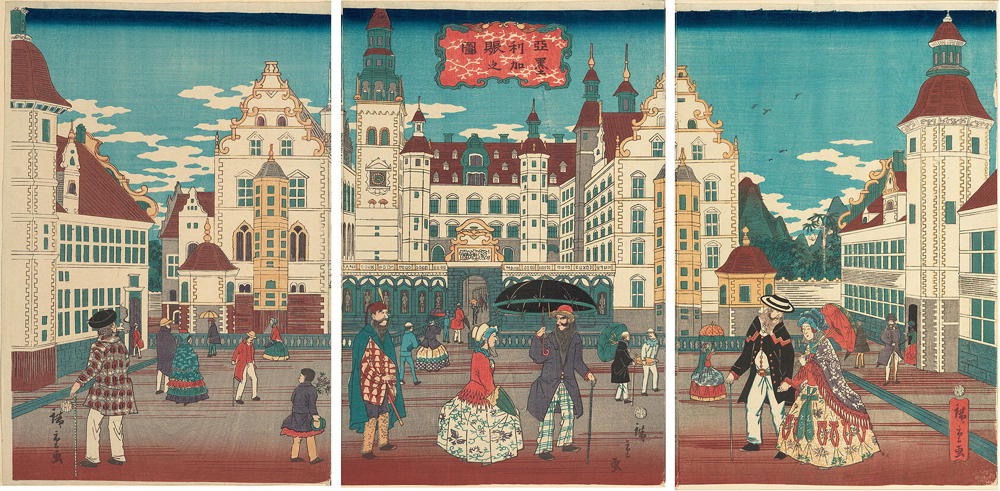
Hiroshige II (二代目 歌川広重, Ni-daime Utagawa Hiroshige
A Picture of Prosperity: America (Amerika shin no zu)
(1861)
"We had better believe we're capable of succeeding, or we've already lost."
Prosperity presented a problem for the captains of industry, for they relied on a tad more desperation in their workforce than Prosperity could provide. Give a worker union wages, and they might start to get ideas that they were more than merely created equal, but equal in more than a metaphorical sense. They’d insist upon something called Collective Bargaining, as if the rabble could comprehend the ins and outs of managing a competitive corporation. They’d surely vote for endless pay increases for themselves, while the shareholders, the real keepers of capitalism’s flame, would become second-class corporate citizens, forfeiting some of their fair share of what were rightfully all their rewards. They were, after all, the investors! Prosperity encouraged a mindset intolerable to the dedicated capitalist, for it equated labor with its natural superior. If capital weren’t king, would everything become a matter of voting? Shouldn’t owners have the final and deciding say?
The strategy was to somehow convince the newly and potentially Prosperous to vote against their own interests.
Impunity
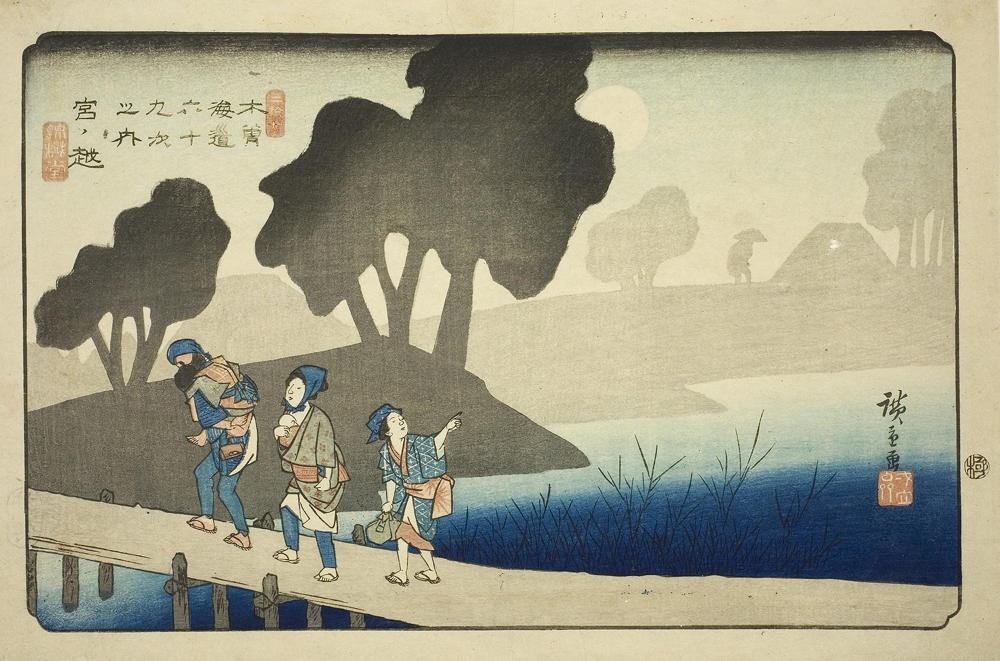
Utagawa Hiroshige 歌川 広重
No. 37: Miyanokoshi,
from the series “Sixty-nine Stations of the Kisokaido
(Kisokaido rokujukyu tsugi no uchi)”
(c. 1835/38)
"History might always ultimately get even withsomething resembling Impunity."
Impunity must be an enemy of Prosperity, for it implies getting away with something, and getting away with something suggests something requiring distancing from one’s actions. The nefarious depend upon Impunity to protect them from well-deserved retribution. They rely upon insider knowledge and special connections to protect them from discovery and punishment. They leave a devastation behind them from which they wish to escape association. They desire nothing better or worse than the freedom that can only come from irresponsible action, where costs get borne by others while they, Impunity, enjoy the ill-gained returns. Impunity can stand to live with itself when it wins by depriving others. It seems to enjoy breaking others’ toys. It believes itself above the law.
I overstate my case for a purpose: to project a brighter and sharper boundary between the Prosperities and their avowed enemy, Impunity.
PhonyProsperity
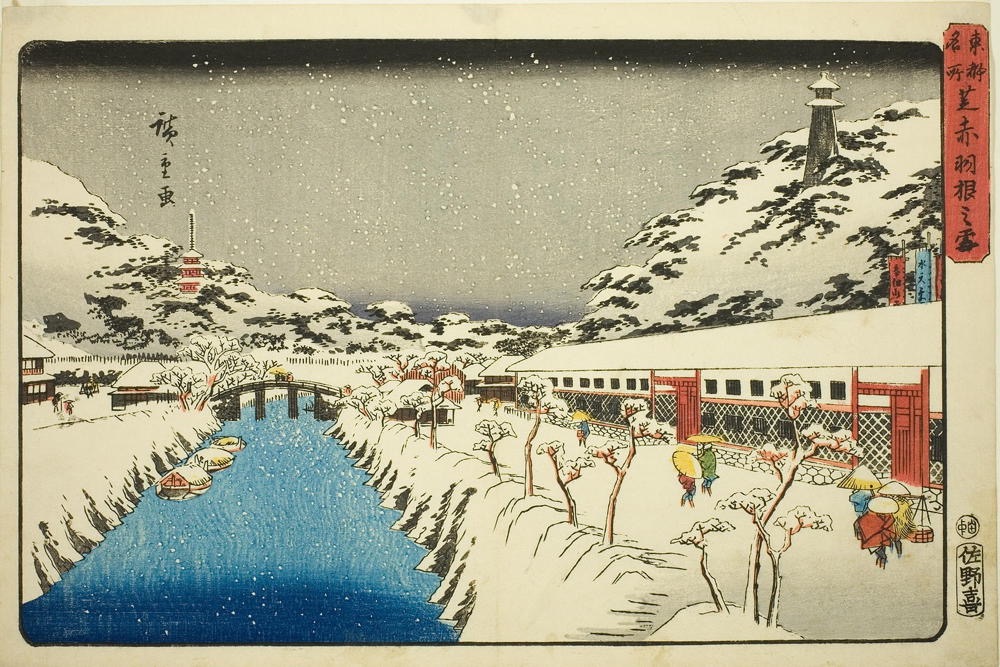
Utagawa Hiroshige 歌川 広重
Snow at Akabane Bridge in Shiba (Shiba Akabane no yuki),
from the series “Famous Places in the Eastern Capital (Toto meisho)”
(c. 1843/47)
"… this will most likely get really ugly before we recover our Prosperity again."
When a political party or ideology takes the US Presidency, it carries a few scant obligations to the American people and, indeed, to the people of the world. As the long-standing designated elephant in the room, the US economy exerts a uniquely influential gravity. This alone implies great responsibility, since so many other struggling economies rely on its stability. These factors and others have historically encouraged a certain moderation. It’s one thing to be powerful enough to do whatever you want, but quite another to be wise enough to restrain that discretionary power to better ensure overall welfare. Economies cannot afford to have many enemies. Few headlines scream what radical initiative a President chose not to choose. Properly managed, an economy should not be featured in many front-page, above-the-fold stories. The discussion of economics should remain dismal enough to nudge it well off the front page of everything, save an occasional Wall Street Journal.
Our incumbent was never anybody’s slave to wisdom or tradition.
Weekly Writing Summary For The Week Ending 08/20/2026
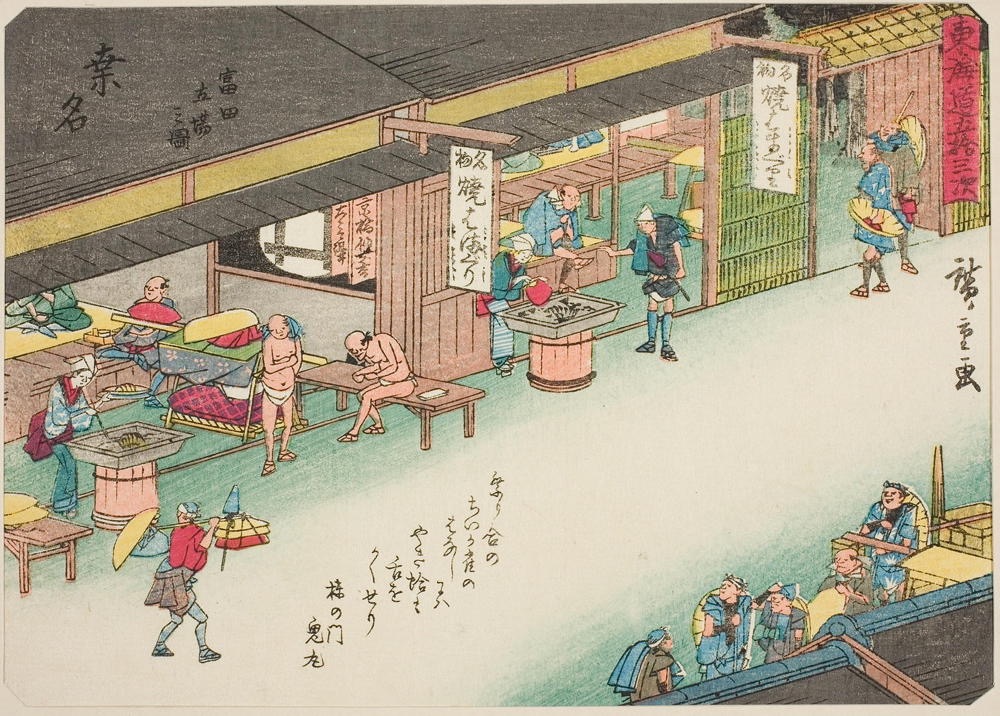
Utagawa Hiroshige 歌川 広重
Kuwana: The Post Station at Tomita (Kuwana, Tomita tachiba no zu),
from the series “Fifty-three Stations of the Tokaido (Tokaido gojusan tsugi),”
also known as the Tokaido with Poem (Kyoka iri Tokaido)
(c. 1837/42)
This week’s Prosperity dispatches arrived on the occasion of my seventy-fifth birthday. They kept arriving through a week that ranged from the tardy but welcome return of shearling slippers to the hardest installment yet written, from the philosophical breakthrough of Easements to the birthday meditation of ProsperityPasting, from the liturgical frame of OrdinaryTime to the coinage of another new term: Amsperity. The series turned sixty-one installments old this week. The slippers arrived three days early and felt like a shipment of gold bullion. The birthday arrived on schedule and felt like OrdinaryTime at its finest.
Thank you for following along!
Amsperity
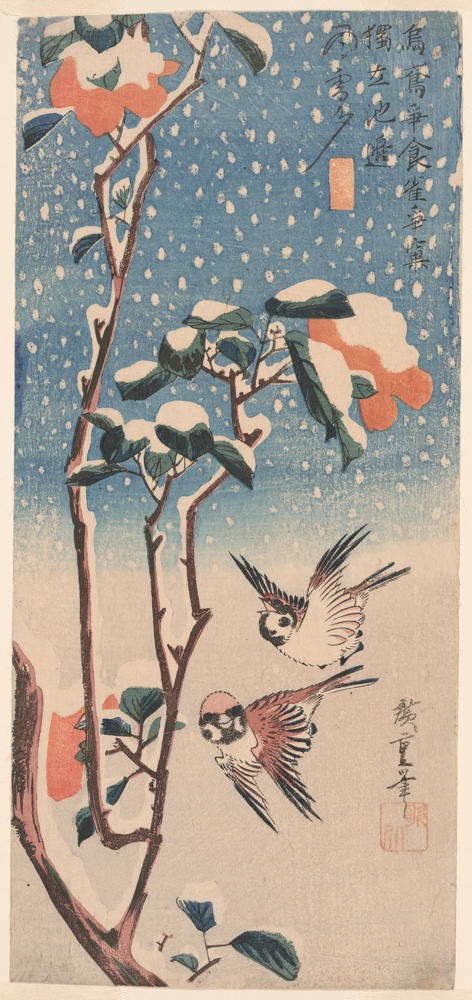
Utagawa Hiroshige 歌川 広重
Sparrows and Camellia in Snow
(c. 1831-33)
"Who, besides such conglomerates, benefits?"
We believe ourselves to be much more skilled at producing and retaining Prosperity than we have generally proven to be in practice. In practice, we have a long history of back-and-forth vacillations. We label these “business cycles” and consider them evidence of nothing more worrisome than The Normals, but these downturns do real damage. Were we more skilled or even professionals at producing and maintaining Prosperity, we might well have eliminated by now the disparities between haves and have-nots. It seems that some subgroup of haves always tries to nudge above their station to take a monopolist’s position in something that might thrive only through egalitarianism. Oh, the nudgers tend to equate egalitarianism with something dreadfully dangerous like communism or socialism, while committing what might be recognized as acts of antisocialism. These purposefully cruel and awfully unusual acts reliably undermine the general welfare and thereby Prosperity, for the myopic purpose of lining their own pockets. Our Prosperity frequently fails us, but usually only because we fail ourselves first.
We seem to be rank amateurs when it comes to producing and preserving our Prosperity.
OrdinaryTime
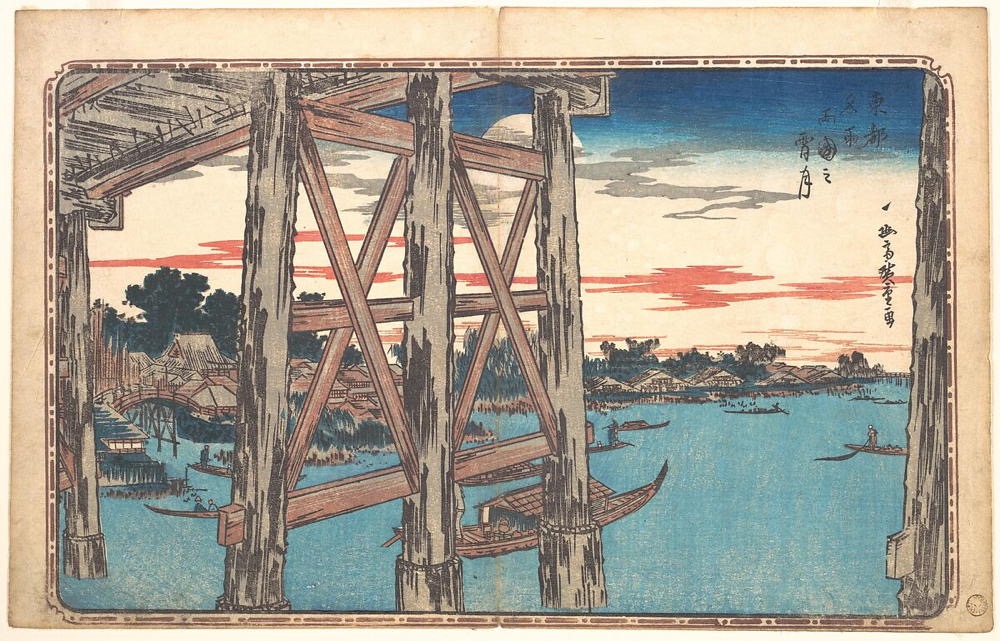
Utagawa Hiroshige 歌川 広重
Twilight Moon at Ryōgoku Bridge
(Not Dated)
"May we soon live in OrdinaryTimes again, Amen!"
Prosperity thrives during OrdinaryTimes. The Ecumenical Calendar divides each year into ferial and festal times, Ordinary days and designated extraordinary ones. It seems sometimes, especially to naive Americans traveling in Italy, that every blessed day has in some way been designated extraordinary on their calender, especially when you were expecting to find a bank or post office open for business only to find it’s the Feast Day of Saint Someoneorother, so whatever service you thought you needed would be unavailable until the following Monday, assuming, often wrongly, that that following Monday isn’t also designated a Day of Holy Obligation to Saint Somebodyelse. Regular life thrives on ordinary days, and, outside of Italy proper, celebrates infrequently. Imagine the difficulty of holding down a regular job while decked out every day in the appropriate garb for properly acknowledging the influence and holiness of good old Saint Martyrdom. Christmas occurs just once each year for good reasons.
When I began this Prosperity Series, I asked myself where Prosperity had suddenly gone, because it seemed to me to have gone missing.
ProsperityPasting
Utagawa Hiroshige 歌川 広重
Small View of Yedo
(1817–58)
"…the very definition of success, and therefore curiously eternal."
I am fondly recalling a Prosperity I never really knew on the occasion of the eve of my seventy-fifth birthday. I have no clue how I managed to survive to such an overripe age, other than to echo that ancient advice that insisted the only way to actually achieve anything must inevitably be one day at a time. My life, then, might only be properly characterized as a series of days, no two all that different, until, over time, great differences emerged. I experienced very few catastrophies, which might be the primary reason I can still sit here fondly recollecting. Even my most wanting periods seem downright prosperous in some senses. When I was foraging for sustenance, I still had my youth, an often underappreciated form of Prosperity that everybody’s certain to lose. As I’ve aged, I have retained many memories, another form that Prosperity assumes, as tangible as air, if not more so some days.
I was born into a world that no longer exists.
Easements
Utagawa Hiroshige 歌川 広重
Asakusa Rice Fields and Torinomachi Festival
(Asakusa tanbo Torinomachi mode),
from the series “One Hundred Famous Views of Edo (Meisho Edo hyakkei)”
(1857)
"…battling each other's spare realities with the jawbones of asses."
Prosperity resolves none of the primary existential human dilemmas, though it does seem to deliver a few Easements. No, not permissions to trespass across another’s property, but the largely psychological sense that one can afford to take one's ease. Freed from the constant pressure otherwise necessary for mere survival, a hierarchy of needs emerges. Higher order urges can take over once Prosperity seemingly resolves the barer necessities, even if only temporarily. I do not believe these higher-order interests are unavailable to the Pre-Prosperous or even the pauper; they just seem more conveniently accessible once simple survival no longer dominates existence. Many artists have flourished while living in icy garrets. Prosperity can reassure without necessarily resolving any of the inescapable human frailties associated with disease or even death. Prosperity cannot prevent that pirate from visiting, or even the odd thief in the night, but it can cast a convincing enough shadow to allow other interests to temporarily dominate one’s consciousness. It opens space without really resolving much.
We humans seem remarkable for how distractible we’ve always been.
Seeking
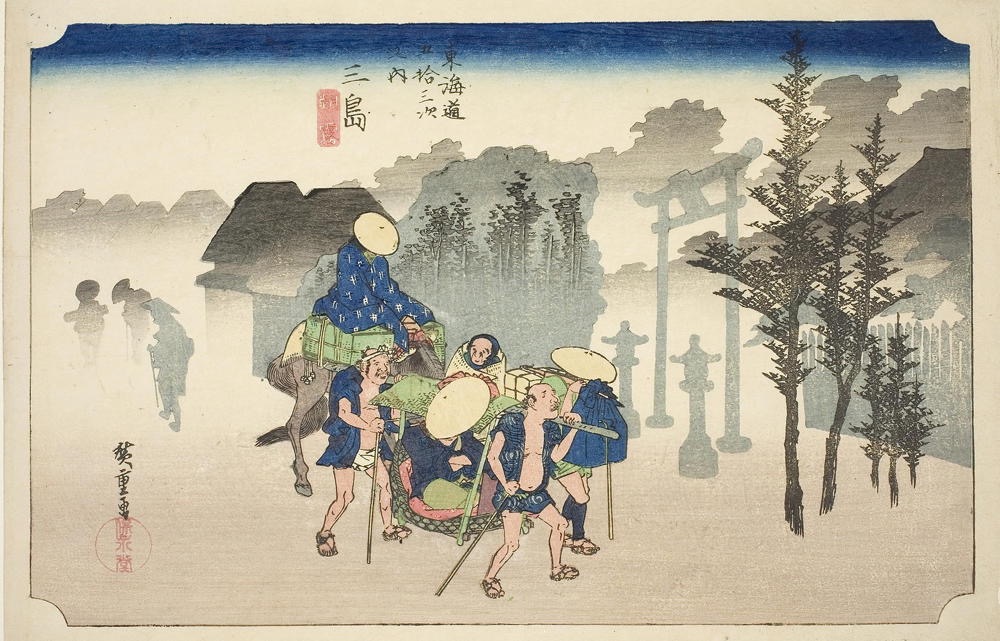
Utagawa Hiroshige 歌川 広重
Mishima: Morning Mist (Mishima, asagiri),
from the series “Fifty-three Stations of the Tokaido Road
(Tokaido gojusan tsugi no uchi),” also known as the Hoeido Tokaido
(c.1833/34)
"Finding it might forfeit its prize."
Prosperity doesn’t necessarily breed complacency. As a colleague confided to me, “I believe that most who are prosperous become quickly committed to the belief in being entitled and are driven to fear that someone will take away their prosperity. Of course, as with most beliefs, this is unprovable.” Nor does Prosperity necessarily breed defensiveness. The Prosperous might remain less than perfectly free to choose what to do, whatever their motive. I propose that Prosperity alone might hardly influence choice. The heart still wants whatever the heart wants, though it might be that Prosperity renders some of those wants to seem more achievable than poverty might, for instance. Prosperity might open possibilities without necessarily guaranteeing achieving anything. In my personal experience, Prosperity encouraged me into Seeking what had previously seemed out of my reach. This, too, qualifies as belief, and as such, proves nothing conclusively, other than accurately representing my personal experience.
The Muse might be a better example, for she’s definitely a seeker.
Slippers
Utagawa Hiroshige 歌川 広重
Sojo Henjo,
from the series “One Hundred Satirical Poems (Kyoka neboke hyakushu)”
(19th century)
"Prosperity returns on the littest cats' feet, too, leaving familiar footprints."
Prosperities come and go with some regularity. The Prosperity I enjoy this morning seems unique, different than any previous one, and I could probably say this about any morning, any Prosperity, were I paying close enough attention to discern any differences. I’m mostly not paying all that close of attention because, like you, I have ten thousand distractions vying for my narrow awareness, and I am not always the most perceptive person on the planet. My Prosperities seem far too easy to take for granted. I rarely celebrate them, even though each and every one, if enumerated, should qualify for at least a participation trophy for showing up. They mostly find me unaware and unappreciative of just how deep down fortunate I surely must be. If this does not constitute a crime, I’m innocent. Otherwise, I’m certainly guilty as sin and fully worthy of some sort of punishment.
I started this series, fifty-some mornings ago, noticing that our Prosperity seemed to have gone missing.
Weekly Writing Summary For The Week Ending 08/13/2026
Utagawa Hiroshige 歌川 広重
The Whirlpools in Naruto Strait, Awa Province (Awa Naruto no fukei)
(1857)
This week’s Prosperity dispatches arrived as the series moved from civic urgency into personal witness and domestic intimacy. The writing ranged from the philosophical resignation of Quarter to the genuinely felt depth of Charity, from the Hubrisimiliation of a faucet set screw to the autobiography of Initiation, from the Believing that powered an Amazon open house to the Motleys that constitute the reliable indicators of Prosperity’s presence. The Muse fixed the faucet from her wheelchair. The open-house protestor who swore he wouldn’t go inside eventually shuffled in anyway, but asked nobody any hard questions when faced with the opportunity. The wardrobe mistress's responsibilities still seem bottomless. The series found this week that Prosperity’s most reliable indicators are rarely the ones anyone would choose to display.
Thank you for following along!
Motleys
Utagawa Hiroshige 歌川 広重
Badger,
from the series “Mirror of Stone Rubbings of Views of the Provinces”
(Kohon meihitsu ishizuri kagami)
(Not Dated)
"Motleys might be the most reliable indicator of Prosperity's presence."
Prosperity seems to attract collections of things. The Muse collects Franciscan Appleware crockery, a pattern that began almost on a whim when I started fondly reminiscing about my mother’s Aunt Stella’s collection that I lost in my second divorce. I have a small collection of D-handled shovels that I maintain for no good reason other than that I favor them above the straight-handled kind. Our linen closet holds no linen, but exists more as an archive of our changing tastes in sheets and towels over the last thirty years. I have a friend who claims to own dozens of Tony Bahama tropical print shirts, bought to cheer himself up or on whims. I have a closetful of shirts distinguished by their very similarity; most are long-sleeved blue chambray. I tend to wear the same-looking clothes every day, with little actual variety. The Muse, on the other hand, has dozens of similar-looking “tops”, in a variety of colors, and a similar range of choices of pants and shorts. Her collection of clothes hardly qualifies as a collection, given the Motley range of styles and colors therein.
While The Muse recovers from her broken ankles, I have been trying to fulfill the role of wardrobe mistress since she can’t access her dresser or closet.
Believing
Utagawa Hiroshige 歌川 広重
A Lion Training a Cub
(c. 1832/34)
"…the first sweet or savory taste of a Prosperity finally emerging."
As The Muse and I prepared to attend the long-awaited Amazon Web Services Open House, a fresh anti-data center Reel appeared in my Facebook feed. I have been observing the opposition making public fools of themselves since they started protesting. They have performed every derivative activity with which generations of protestors before them had undermined their arguments. They misrepresented with the usual vengeance. They seemed to love to take information out of context, as if the state with the oldest and most mature environmental agency in the country could be equated to states with numbingly more primitive permitting standards and practices. Washington ain’t Virginia. They also characterized Amazon Web Services, arguably among the most environmentally engaged corporations on the planet, with data to prove it, as inveterate liars. Their message to not trust Amazon came across as “Don’t Trust Us,” instead. The latest message seemed to properly encapsulate their entire campaign. It said that they were going to attend the open house, but not go inside, and ask hard questions, but the spokesperson promised not to believe a word they received in response.
Their campaign came into full focus in that instant, or a few moments later, after I’d recovered from my stunned silence.
Initiation
Utagawa Hiroshige 歌川 広重
Tea Kettle,
section of a sheet from the series “Mirror of Stone Rubbings of Views of the Provinces”
(Kohon meihitsu ishizuri kagami)
(Not Dated)
"I became Prosperous the day I realized that I could choose, and did."
The question eventually enters the conversation: How does one become Prosperous? The more common answers seem to omit something significant, focusing as they usually do on the obvious. But I’ve come to believe that Prosperity might be more like a guild than an individual achievement, and that there must probably be a multitude of ways to achieve this status, none by birthright. Being raised in a Prosperous family rarely prepares anybody to actually achieve Prosperity, for it seems to take more than mere familiarity to meaningfully succeed at it. Ten thousand subtleties influence this particular achievement. It apparently cannot be bestowed or inherited, for one might well inherit wealth or social position, but maintaining such a place with requisite grace qualifies as more of an art form, and not a necessarily easy one for some to come by. Prosperity seems an exacting designation, one requiring some maturity and dedication, hence the nagging question that eventually slips into the conversation: How does one become Prosperous?
My first marriage was not a promising one Prosperity-wise.
Hubrisimiliation
Utagawa Hiroshige 歌川 広重
Dragons Among Clouds
(1844)
"…humiliated into a begrudging silence again."
Prosperity has a way of attracting possessions. If one’s not extremely careful and cautious, these can accumulate to become suffocating. Short of outright hoarding, possessions can come to possess us, and they inevitably become harsh taskmasters. Among their most onerous expectations lie the necessary periodic maintenance. Nothing about achieving Prosperity prepares anybody for what becomes necessary to maintain their resulting possessions in something approaching original operating order. Even the kitchen faucet requires some infrequent maintenance, its very infrequency rendering this essentially impossible for the merely Prosperous to successfully accomplish. Still, a kind of hubris can overtake the Prosperous, the sort that temporarily convinces them that, if only due to their Prosperity, they might be capable of successfully engaging in DIY-ing, Doing It Yourselfing. They probably aren’t.
The primary reason we will never have household nukes generating our residential energy lies in this first principle of Prosperity, that the Prosperous tend to get these preposterous notions that possession somehow bestows the ability to maintain, when it might at best inflict that obligation.
Charity
Utagawa Hiroshige 歌川 広重
A Golden Pheasant amid Snow-Covered Bamboo on a Steep Hillside
(c. 1840)
"Charity always begins at home, but it rarely ends anywhere near there."
Charity begins at home, but it never ends there. Charity seems to be the consistent means by which the Prosperous attempt to share their good fortune, however modest. This seems to be the ironclad principle universally practiced among the Prosperous. Some insist that they’re just giving back, but regardless of the underlying motive, the Prosperous give. They give “of” their time as well as their treasure. Each holds a few charities as well-deserved, and they act to preserve their missions. Some of these claim to be Christian, but increasingly, it seems, secular organizations have entered the charity business, and not for profit, though I suppose there are those charities who are in it for the money. These milk the government for subsidies, then spend less than they’re subsidized to provide their services, or they extract hefty handling charges that do more than reinvest in the advertised mission. But even the charlatans sing the same tunes in the same keys. Real or pretend, they extend assistance to the “less fortunate.”
A Prosperous person’s chosen charities are in many ways their identity.
Quarter
Utagawa Hiroshige 歌川 広重
Oystercatchers
(c. 1833/34)
"Hold your Prosperity lightly lest it break you when it slips out of your hands."
Prosperity definitely has its privileges, but practical limits seem to exist on how many and where. It can certainly provide the means to afford a relatively comfortable, if not necessarily carefree life, though not everything necessary to achieve and maintain that end can be inherited or purchased, or, indeed, possessed. The Prosperous remain vulnerable to most of the usual suspects. Hunger might only rarely cast a shadow across its porch, but misfortune shows no friends or natural enemies, and offers Quarter to pretty much nobody. Prosperity was never a guarantee of any happily-ever-after storylines. It might even amplify the sense of devastation at a loss, since the Prosperous do seem to possess more to lose than others. The Pre-Prosperous might not miss what they never acknowledged they possessed. The Prosperous miss their losses. They cost.
Practicing Prosperity tries to teach the Prosperous to hold their good fortune gently.
Weekly Writing Summary For The Week Ending 08/06/2026
Utagawa Hiroshige 歌川 広重
No. 32: Seba,
from the series “Sixty-nine Stations of the Kisokaido
(Kisokaido rokujukyu tsugi no uchi)”
(c. 1835/38)
This week’s Prosperity dispatches arrived as the series found its philosophical center and then tested it against civic reality. The writing ranged from the tentative conclusions of Classifying to the identity function of EnoughIsEnough, from the legal and economic argument of Moritoria to the behavioral portrait of CheapShots, from the panoramic civic lament of Anti-Prosperity to the warmly domestic homecoming of City-State. The series stood before the County Commission this week, delivering the sole anti-moratorium argument against a curious flood of anti-data center support. It also returned home to find Prosperity waiting, as it always has, in the Villa Vatta Schmaltz.
Thank you for following along!
City-State
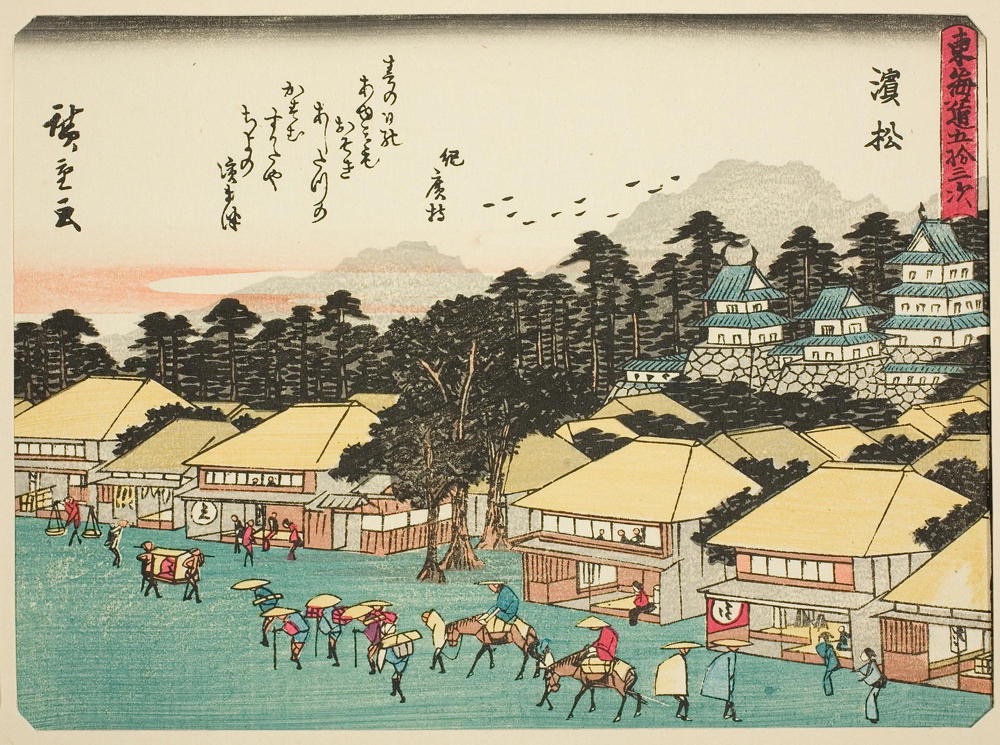
Utagawa Hiroshige 歌川 広重
Hamamatsu, from the series “Fifty-three Stations of the Tokaido (Tokaido gojusan tsugi),”
also known as the Tokaido with Poem (Kyoka iri Tokaido)
(c. 1837/42)
"I'm certain that anywhere I find Prosperity lurking fully qualifies as my home and castle while I'm there."
I think of Prosperity the way I think of an Italian City-State, a kind of autonomy, an anchor, an identity. In the same way that a person’s home, however humble, represents their castle, Prosperity serves as both the source and expression of cultural social standing. Each family in my neighborhood, a blessedly mixed configuration almost entirely unlike any gated community, inhabits their unique castle. Each, as they say, gets to be the asshole in their castle, holding an independence rare among the Pre-Prosperous. Even the very wealthy, who might live in actual castles, seem to be more owned by their relatively palatial palaces than inhabiting them. My neighborhood includes owner-occupied places next to rentals, older homes with more recent construction tucked in between on what was most certainly once the larger places’ original properties. The orderliness here does not seem overwhelming. It’s certainly not enforced by anything other than each inhabitant’s sense of civic decency. I, for instance, feel guilty if I miss mowing my lawn for a few days after it really should have been mowed, for this clutter seems an offense to the neighborhood’s tranquil sense of its own Prosperity.
For a few years, one neighbor, who lived just to the left of my castle, left his place derelict.
Anti-Prosperity
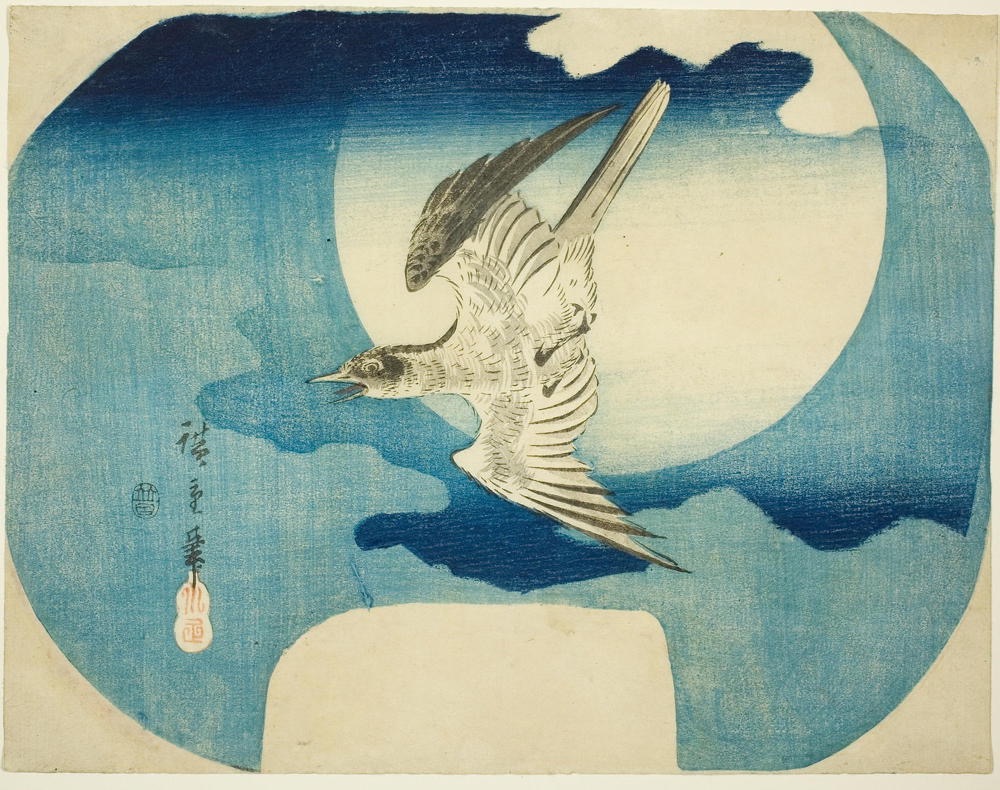
Utagawa Hiroshige 歌川 広重
A Cuckoo Against the Moon
(c. 1843/46)
"…what's to become of our once prominent Prosperity after we've managed to Anti- every alternative out of the realm of existential possibility?"
It seems to have become fashionable to oppose virtually any proposition. I blame the radical conservative MAGA movement for basing their politics entirely on opposition and thereby encouraging what might have always been a passion seething beneath the surface of the appearance of respectability. They opposed progress because it seemed to upset their overly delicate sensibilities. They encouraged long-discarded theories and practices in lieu of embracing modernity, which they at least pretended to believe represented evil incarnate. From there, it was a short portage to a place where any decency could be easily and convincingly opposed as either woke, whatever that was, or stupid, which never really qualified as an argument. They were opposed, whatever it was, and supportive of little other than the usual vacuous dribble: free enterprise, America (first, last, and always), and tariffs. They opposed more than the usual suspects, but some fresh villains, too: freedom of speech, which apparently emboldens enemies, free trade, which reportedly renders us all paupers, and justice, which always seemed to them to hold the wrong criminals responsible.
As absurd as their anti-everything platform might have seemed, their tactics rubbed off on even the most dedicated of their opposition.
CheapShot
Marsden Hartley
Dogtown, Gloucester
(1934-36)
"Some days, this responsibility's easier to fulfill than on others."
I encountered a Pre-Prosperous person yesterday. She was explaining how she’d delivered what I instantly recognized to be a CheapShot to a potential benefactor. Why would anyone ever consider committing such a crime? That answer must be above my pay grade, though I can imagine a nearly infinite number of justifications my Pre-Prosperous friend might offer if asked. She would doubtless consider her gift a fair trade, repayment for a previously committed trespass or, more likely, a prepayment for a yet-to-be-committed but threatened-in-her-mind wrong. She always seems to be striving to keep an invisible scale balanced. She’s the auditor, the accountant, and eternal bookkeeper seeking only fairness, but exclusively from her perspective. She seemed to have been outclassed but was unaware of the imbalance, except, of course, to sense an imbalance favoring her. It didn’t. Everywhere she goes, she seems to encounter the same damned situation. People don’t seem to respect her. They often disappoint. Go figure! Isn’t this precisely the behavior we’ve come to expect from the Pre-Prosperous?
Many forms of Pre-Prosperity exist, though I dare say that they might be classifiable along the lines of the seven deadly sins, with many ancillary less deadly categories for the less seriously afflicted.
Moritoria
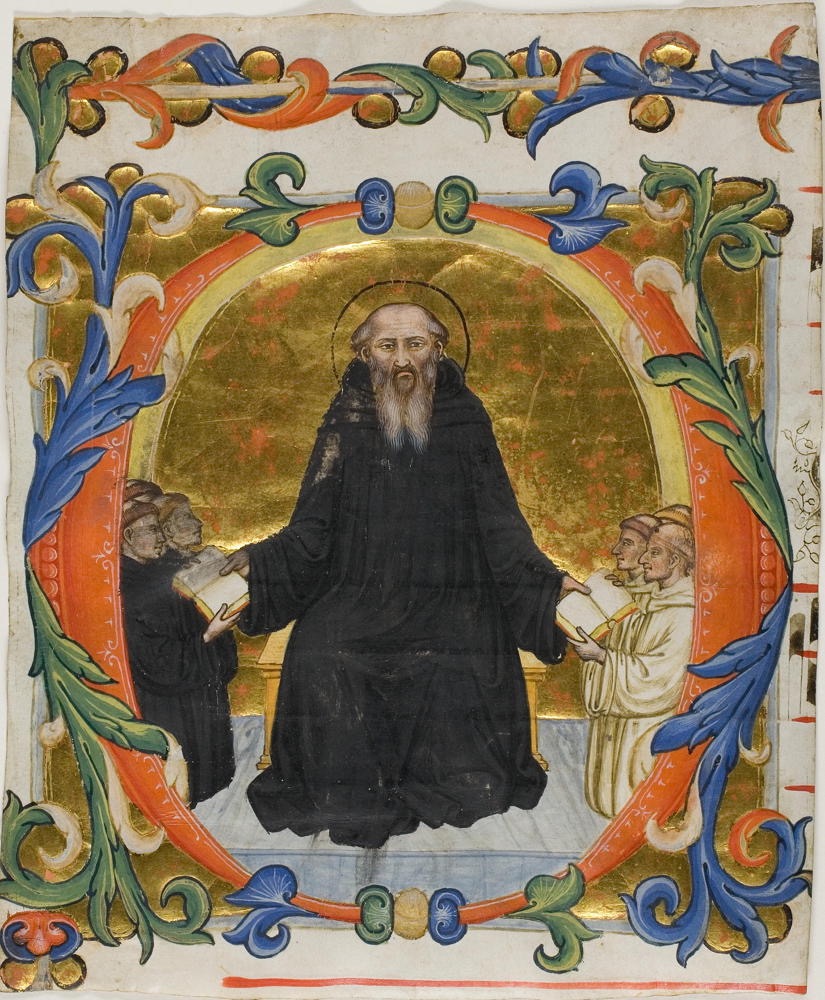
Martino di Bartolomeo
Saint Benedict Presenting his Rule to Benedictine and Cistercian Monks
in a Historiated Initial “O” from a Choirbook
(1394/95)
"…Moritoria are not regulatory achievements and do not deserve to be mistaken for them."
The Washington State Democratic Party approved a platform plank at their recent state convention that calls for a one-year moratorium on all data center construction in the state. I considered this plank extremely self-contradictory and a clear threat to Prosperity, especially since the party didn’t also immediately declare itself Internet Free and revert to operating as it did in the nineteen-sixties, before the intertubes connected everyone and everything. Apparently, some political consulting firm, trolling around for hot issues Democratic candidates could coalesce voters on, advised that an anti-data center perspective could attract otherwise indifferent voters to the cause, whatever that was. Data centers have become the favorite whipping boys of pretty nearly everybody, even though reliable sources suggest that most of the economic activity in the nation over the past few years has stemmed in some way from data center development. Those who insist that we must mature by despising our family of origin might easily explain this data center revulsion as a normal stage of emotional development, roughly akin to turning fifteen years old. It feels as contentious.
Prominent among the proposals for what to do about data centers stands the idea that they might be discouraged by municipalities simply declaring Moratoria on their development.
EnoughIsEnough
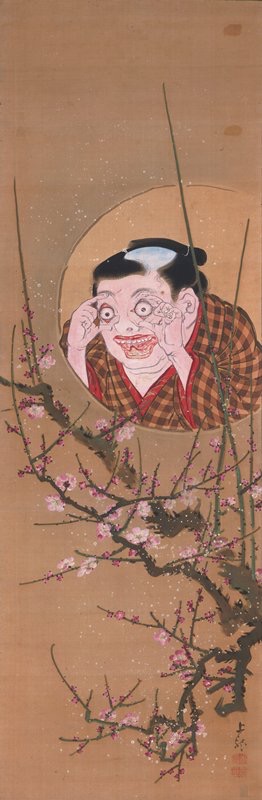
Mihata Jōryū
Peeking Boy
(1830s)
"Those who more than occasionally experience Enough have already won whatever race they once ran."
Contrary to the popular idiom, Enough is not always Enough, not for everyone. For some, Enough never was nor ever will be Enough, as I detailed in my NextWorld Story, Enough, from February 2025, which described the world emerging after we foolishly elected our current incumbent, a series that has proven to have been remarkably prescient. Prosperity seems to accompany that pleasing sense of enoughness. Whether that sense predates Prosperity or results from achieving it, I lack adequate data to say. I do sense, though, that the Prosperous well understand the theory as well as the practice of Enough to the point of exemplifying this odd little identity function. For them. Enough fully qualifies as Enough, always. The prosperous know satiation, and so actively seek to avoid it. The merely rich or simply wealthy seem to lose accessibility to their off switch. Like sharks, they live unloved, unsatisfiable and unrequited. To not know Enough means you can never stop swimming.
The Prosperous therefore experience love as well as attraction, though not usually to the point of obsession.
Classifying
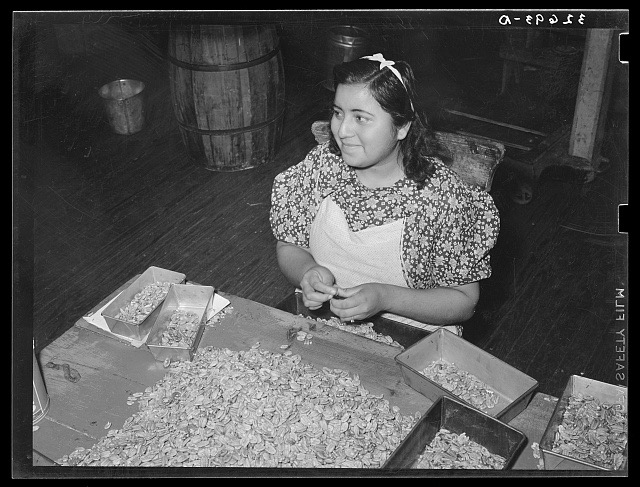
Russell Lee,
United States. Farm Security Administration
Classifying pecan meats. Pecan shelling plant. San Antonio, Texas
(1939)
"…I must be the source of all the Prosperities inevitably surrounding me."
This is not just a game. I have been considering Prosperity, mine as well as ours, for just over forty days and nights now, a suitably Biblical time span, and I am drawing two tentative conclusions, since I can’t seem to decide anything conclusively, nor should I. The first, which I have previously already heavily hinted at, must be that Prosperity only exists as a plural rather than a singular entity. Sanity insists that it always be understood as a multitude rather than as a singular state. It exists only in array. This translates into an understanding that no Prosperity ever stands alone. When I spot a Prosperity, this means that more must be lurking nearby. Prosperity seems to exclusively travels in flocks, herds, schools, or pairs, never “batch.”
The second tentative conclusion I simply must draw from my inquiry so far might seem as if I’m somehow cheating, and truth told, I might be cheating if Hoyle is judging.
Weekly Writing Summary For The Week Ending 07/30/2026
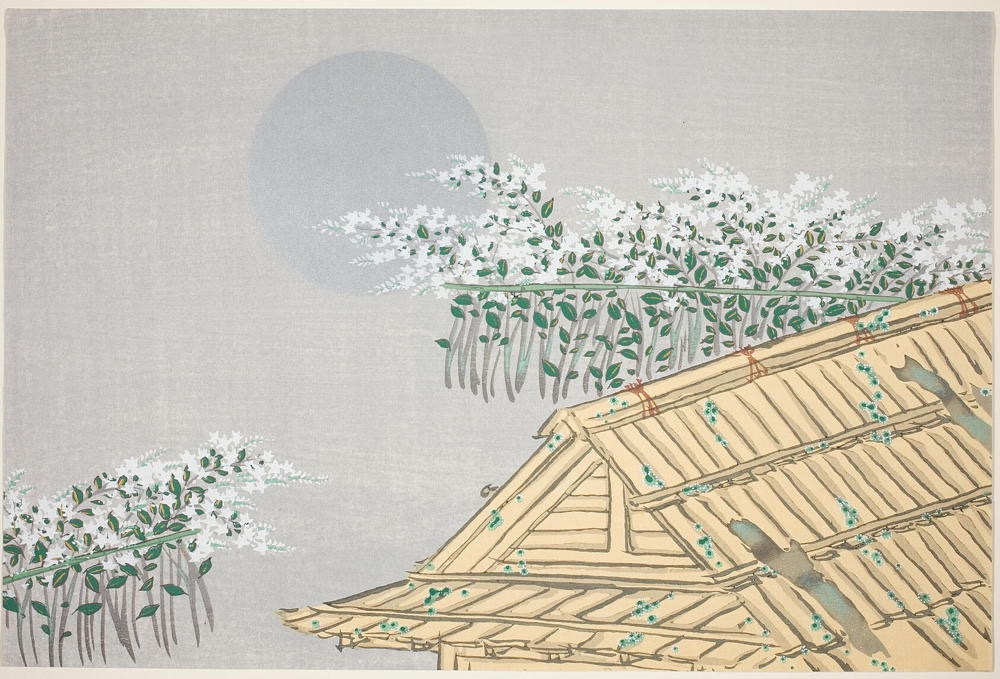
Kamisaka Sekka
Moonlit Scene with Hut and Flowers,
from the series “Worlds of Things (Momoyogusa)”
(1909/10)
This week's Prosperity dispatches arrived as The Muse settled into her dining room recovery center, and I slipped into the familiar role of Nurse Jane Fuzzy Wuzzy. The writing ranged from the slow cruise of InPassing to the firmware-induced disaster of PitchingCodes, from the radical egalitarianism of H-e-a-l-i-n-g to the civic act of Choosers, from the miraculous appearance of Angeli to the philosophical reframe of PreProsperous. The series discovered this week that broken ankles attract angels, that H-e-a-l-i-n-g keeps its own counsel, and that the billionaire class remains stubbornly PreProsperous. The Muse is already removing her own boot unaided. The Angeli are settling in for a productive engagement.
Thank you for following along!
PreProsperous
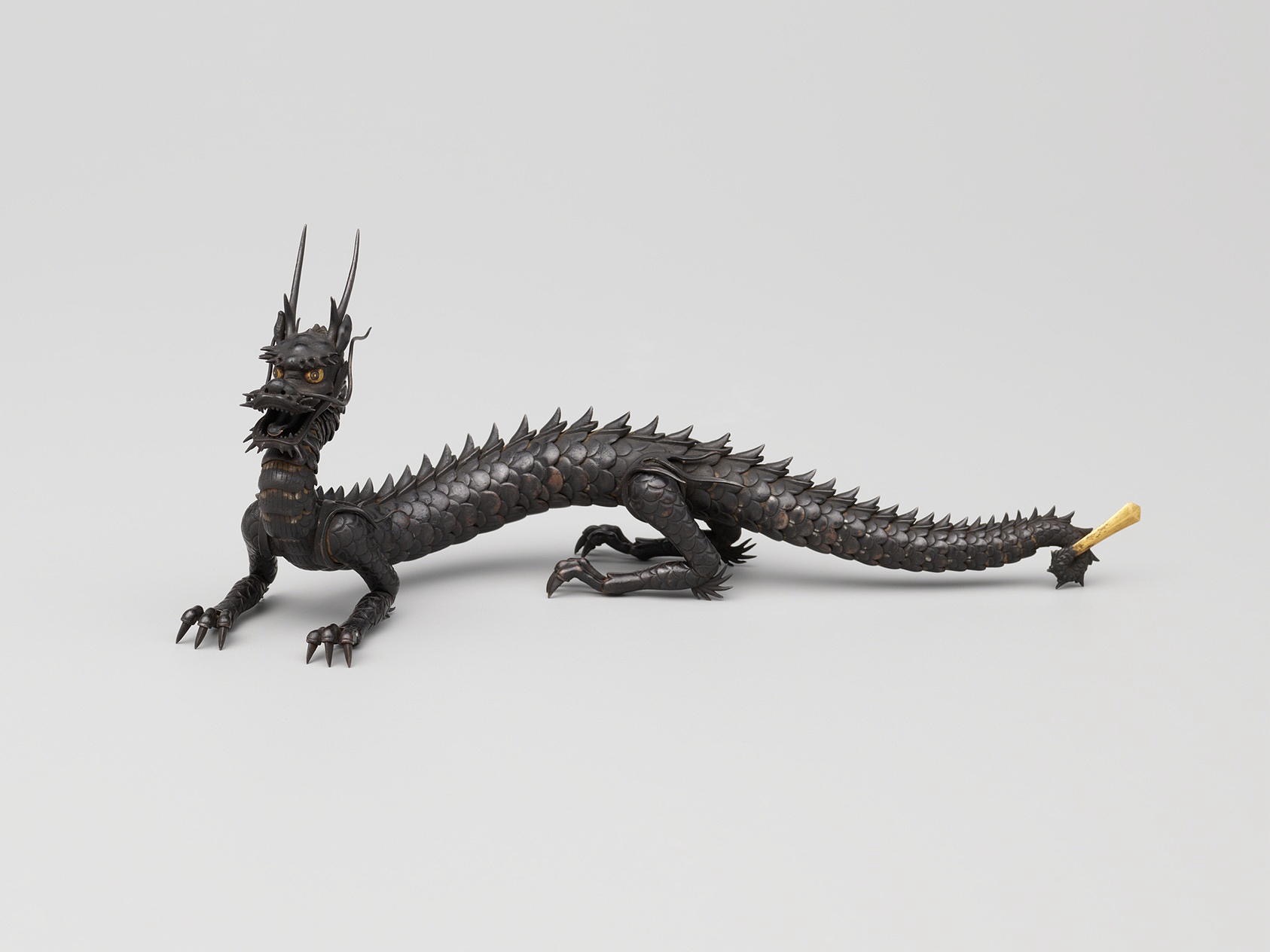
Myochin School
Japanese, active late 19th century
Articulated Dragon
(c. 1880)
"With successes like that, who really requires failure?"
You might have noticed the very wealthy, the billionaire class, reliably behaving preposterously. This behavior highlights a key dichotomy between wealth and Prosperity. While wealth requires control of vast financial resources, Prosperity doesn’t, or doesn’t necessarily require great wealth. It might be easier, stealing this metaphor from the Bible, for any run-of-the-mill camel to pass through a needle’s eye than for the extremely wealthy to ever experience Prosperity, or so their public behavior suggests. Prosperity seems to be mostly mindset, and only partly contingent on possessing anything resembling excess wealth.
Just look at what the very wealthy tend to do when encountering a budget, for instance.
Angeli
Kamisaka Sekka
Kesa
(late Edo period (1789–1868), early 19th century)
"I ascribe that recovery to the presence of Angeli…"
As for angels, they seem the most mysterious presences. They are said to exist without much in the way of physical evidence. They’ve received ample literary mention over the centuries without leaving foot or fingerprints. They might most often appear when really needed, bringing with them some form of salvation. Their biggest gig was the night Jesus was said to have been born, rousing shepherds and encouraging otherwise skeptical wisemen. They managed a physical presence in that mythical manger, and glory really shone around, according to eyewitness testimony. Otherwise, they regularly appear in statuary and classical paintings, inevitably wearing halos. Popes and potentates have traditionally insisted that their decorators employ Angeli to lend a sense of divine association. Generally speaking, the more terrible the king, the more they relied upon Angeli images to sanctify their tyranny.
An early twenty-first-century person might never encounter an angel, even in passing.
Choosers
Kamisaka Sekka
Cranes
(Late 19th, Early 20th Century)
“Autocracy only ever works after The People have convinced themselves they’re beggars rather than Choosers.”
Beggars can’t be Choosers, or so my mother insisted. She implied that if you’re not Prosperous, you’re relegated to having to take whatever’s left over after the Choosers have satisfied themselves. This notion seems the opposite of self-determination, that bedrock principle this Democracy was founded upon. This seems the belief of the dedicated second-class citizen, who, all E Pluribus Unum aside, understands the position they inhabit in polite society and won’t raise a fuss at a little inequity between friends or fellow citizens. It defines complacency to know the rules were set up against your own best interests and to support them anyway as a self-sacrificial civic responsibility. Beggars can’t be choosers. That’s just the way life is.
The Prosperous, though, do get to choose.
H-e-a-l-i-n-g
Kamisaka Sekka
Mt. Fuji
(1920s-30s)
"Out of many, one: Pluribus Unum, dammit!"
Healing might be the most egalitarian activity humans ever engage in. It knows no privilege or favor. It moves exclusively at one seemingly inexorable pace regardless of anybody’s relative Prosperity. It keeps its own counsel that everyone must accept and that they just get to guess at. The doctors and therapists predicted six to eight weeks before The Muse’s broken ankles might be fit for use again, but that projection was tempered with a terribly deliberate ‘more or less’ neither of us missed. Someone suggested that acupuncture might shorten that time by a week or more, but, honestly, why bother? Healing wasn’t supposed to be either a race or a competition. There’s nothing to be won if one heals faster or slower than the average, which trends toward the inexorable. There might be something worth learning either way, though.
Healing belongs in that class of human activities of which no human can ever become the master.
PitchingCodes
Kamisaka Sekka
A Walk Around the Paddy Fields,
from the series “A World of Things (Momoyogusa)”
(1909/10)
"…another snake satisfyingly gnawing on its own tail."
Prosperity attracts an ever-increasing number of so-called smart stuff. Smart® being a designation rather than a definition. So-called Smart® stuff sure seems stupid sometimes, in the same way that Artificial Intelligence intends to be interpreted with the emphasis on the Artificial part. What passes for Artificial Intelligence® barely registers as clever in practice, but the shady art of branding demands that capabilities always be inflated. Smart® cars were just tiny. Smart® phones weren’t really phones at all. Smart (no ®) people just seem self-aggrandizing, for they sure seem just as stupid as the rest of us put together in practice. So it always was and, as near as I can tell, so it will probably always be.
Our new Smart® irrigation system controller, trademarked “Irrigreen”, failed us during our recent absence.
InPassing
Kamisaka Sekka
All Kinds of Butterflies, Vol. 1
Publisher: Unsōdō
(February 1908)
"… might it just slip by unaware that it was ever anywhere special?"
Washington Highway 28 up and out of East Wenatchee, Washington, in the direction of Quincy, terrifies me. It’s a standard sixty-per-hour two-lane that climbs up through orchards and precipitous views, with a few passing lanes to drain off the race car drivers’ frustrations when they find themselves behind drivers like me, freely exercising their Prosperities. I feel the sensation of the highway tilting at odd angles, as if trying to shake me off one of those impressive cliffs overlooking Crescent Bar or The Gorge Amphitheater and into the Columbia River far below. I drive this road slow, continually feeling as if I’m oversteering. I accumulate a line of Speed Racers behind me who seem dissatisfied with my frantic-feeling forty-five.
I understand that for many, even vacation driving amounts to just another segment in a never-ending race car race.
Weekly Writing Summary For The Week Ending 07/23/2026
Kamisaka Sekka
All Kinds of Things, Vol. 1
(April 1903)
This week’s Prosperity dispatches arrived through the most consequential week of the series so far. The writing ranged from the self-knowledge of Stingy to the book signing revelation of Discovering, from the fragility of Damnocles to The Muse’s literal BreakPoint on an uneven Wenatchee curb, from the WrestlingAngels who populated an impossibly long afternoon of hospital logistics to the Ghostlies haunting a smoky, uncertain present. The sword of Damnocles fell this week — not as metaphor but as fact. The series has been preparing for exactly this moment for thirty-three installments.
Thank you for following along!
Ghostlies
Kamisaka Sekka
Longevity Dance
(1910s-20s)
"…after a period of swirling smoke obscuring past along with potential."
Wenatchee, Washington, the self-proclaimed Apple Capitol of the World, turned out to provide the perfect backdrop for The Muse’s fell swoop and resulting Prosperity transformation. It was ungodly hot there that week, with forest and range fires encircling and intermittent strong winds relentlessly pumping obscuring smoke. The surrounding foothills, brutal barren mountains to my eye, faded in and out of focus, in and out of apparent presence, appearing mostly ghostly rather than in any way substantial. I had previously spent no time in the area, so it served as a near-perfect blank canvas upon which to represent whatever I might imagine about our future and present. Following The Muse’s BreakPoint, I imagined plenty but of little substance. Our accustomed Prosperities had abandoned us there in this curiously welcoming wasteland, opening us to suggestions of replacements.
Our imaginations were encumbered by all we had experienced before.
WrestlingAngels
Kamisaka Sekka
Lion dancer
(1920s)
"…an inevitable side effect of switching out former Prosperities for some cranky new fresh ones, of WrestlingAngels."
Fresh Prosperities do not necessarily quietly surrender themselves into existence. The process more closely resembles WrestlingAngels, for while they might eventually surrender, they rarely do so quietly. Fresh Prosperities might be said to be inherently noisy, fussy, as if equal parts impatient and impertinent, aching more to be conquered than accepted. Perhaps they are chartered under a variant of the No Free Lunches Rule, which seems to insist upon satisfying some twisted notion of worthiness before acquiescing into any acceptances. Those who insist that they somehow deserve any Prosperity seem ready and waiting for some form of rude awakening, for, like angels themselves, Prosperities are nobody’s pushovers, and might well insist upon disturbing conditions, not the least of which includes accepting the budding realization that Prosperities get to choose who wins and who loses them. Since not a single beneficiary in the history of this universe so far, ever once deserved their eventual Prosperity, every angel’s insistence upon deciding for can prove to feel at least alarming, often worse.
When The Muse managed to break both ankles in one literal fell swoop, the resulting BreakPoint left a formerly stable Prosperity gasping.
BreakPoint
Kamisaka Sekka
Noh Scene: Hagoromo
(1920s-30s)
"…might some surprising Prosperity settle in for the duration of even this?"
That Sword of Damnocles works in seemingly inexorable ways. Each Prosperity, as I’ve already proposed, stretches only into finite if indefinite space. Each inevitably ends. This nature encourages the convection that inspires fresh Prosperities to emerge from within an often deep sense of catastrophe or loss. The most important things happen at the least convenient times. This homily has been an article of faith underlying all of my many Prosperities over at least the last three decades, and, upon more careful reflection, most probably for much longer. I believe that at any moment, an event could occur that could utterly upend every expected trajectory, opening previously unimaginable possibilities. Yesterday, The Muse quite literally stumbled into one.
She was exiting a bus after taking a tour of another Port’s properties as a part of a scheduled Port Commissioner gathering.
Damnocles
Kamisaka Sekka
Samurai
(1920s)
"Most of them must be lost in use."
We, natives of the Inland Pacific Northwest, were blessed with some of the most beautiful wild country in the world. Since we were the last part of this continent settled, we have also been the last despoiled, though our scenery’s eventual demise seems certain. Through recent summers, wildfires have become more common, and each burn turns its victim into a generational eyesore. Indeed, its virginity will never be restored. Burn woodland covered in many-centuries-old forest, and you’re left with a ghost. No one now alive will see that parcel recovered. Neither will their grandchildren.
In our valley, wheat fires seem by far the most common, and while they destroy, the crop was likely insured, and the land will be returned to productive use the following year with fresh potash fertilizing whatever’s planted.
Discovering
Kamisaka Sekka
Fishing Village,
from the series “A World of Things (Momoyogusa)”
(1909/10)
"I suspect the Quantum plane recognized my presence, as did I."
Once I started Discovering my Prosperities, my discoveries began to expand in earnest. The exercise was apparently not merely a matter of Discovering another Prosperity, but of stumbling upon others, many others. Having only started Discovering these additional Prosperities, I lack sufficient sample size to declare the potential I might have plugged into, but this series appears limitless from here. An unknown number of undiscovered Prosperities seems to stand before me now. I cannot see into any future, but this unknown certainly feels as if it’s infinite from here. Infinite could mean the equivalent of unknown. I need not necessarily interpret it as being an unimaginably large number. A single unknowable will do, but the potential seems much greater than any finite number, even though I could not possibly know how many additional Prosperities might be necessary to maintain this sense of infinite potential. I might estimate as many as an odd billion or so.
My point in even mentioning this phenomenon might be to merely highlight the accompanying feeling.
Stingy
Kamisaka Sekka
Plovers Flying Across a River above Snow-Laden Reeds (Fuyu no Kawa),
from the series “Worlds of Things (Momoyogusa)”
(1878)
"…especially when in the presence of behaviors that just irk the crap out of us."
Prosperity might encourage generosity, but not automatically, never inexorably. Some seem to respond to it by suddenly turning inexplicably Stingy, as if the very presence of plenty prefaced a threatening shortage. This response does not seem at all uncommon and almost seems expected sometimes. I learned to respect others’ apparent Prosperity, to tiptoe around its perimeter with extreme care without assuming an overflowing cup inside. Those in the finest houses seemed more likely to stiff me when I went collecting for their newspaper subscription, often short of “change,” and expecting me to return to get paid. Those who lived in more ramshackle houses tended to be more generous. I was never really moved to wonder why, if only because I didn’t really want to understand. I figured I was witnessing some psychological syndrome manifesting, and that I might be better off not knowing the details behind it, lest it be contagious and spread by sharing poisoning knowledge of it.
Stingy might be an extreme form of self-protection, and, as with many of the more common forms of self-protection, it seems, at root, self-destructive.
Weekly Writing Summary For The Week Ending 07/16/2026
Jules Bastien-Lepage
Mower Honing a Scythe
(1878)
This week's Prosperity dispatches arrived in a week that ranged from the moral architecture of ResponsibleFor to the liberating grace of Freely, from the Fleeting Prosperity of Portland's lost most recent golden years to the non-Mammon discovery of an ancestor's homestead patent, from the faith-based initiative of MakingSpace to the fish tacos and wildfire of Bounty. The road trip that found Evan and Sara Parker Wallace's eighty acres in Umatilla County — and nearly stranded us inside an evacuation zone — produced this week's essential installment. Prosperity simultaneously means Bounty and danger. Lightning doesn't need to strike in the same place twice to leave an indelible mark.
Thank you for following along!
Bounty
Jules Breton
The Song of the Lark
(1884)
"Lightning doesn't need to strike in the same place twice to leave an indelible mark."
By Mid-July, the Sweet Onion harvest is about over. My own modest patch needs pulling. We eat fresh this time of year, with Sockeye Salmon and the ever-present Steelhead readily available. The Muse’s cucumber crop seems happier than we’ve ever seen one, thanks to her new drip irrigation system. The fig bush has almost become a tree, continually splashed by the backyard pond fountain. It groans under the presence of an unprecedented number of rapidly ripening fruits. These are a reassuring green with the most alluring pink flesh inside. I decide that we’ll have fish tacos for supper and buy a bag of small, freshly made Masa tortillas for the purpose. A grilled eggplant, slices thoroughly saturated with olive oil before I set them on the top grill rack, completes the menu.
The salsa seems similar to what I’ve concocted before, with only the precise contents different.
MakingSpace
Kamisaka Sekka
All Kinds of Things
Color woodblock printed book
Publisher: Unsōdōexpand_less
(Vol. 3, April 1903)
"…I will need to make some space for a miracle to occur."
Aging must be the process by which I successively outgrow stuff. Yesterday, I finally culled three pairs of jeans I once believed that I might one day fit into again. Yesterday, inexplicably, I finally acceded to the should-have-been-easier truth that I wouldn’t be fitting into them again. I set them aside. Suddenly, my pants drawer had more than enough space for my remaining wardrobe. The Muse mentioned that she probably had a few things to add to my collection destined for the Goodwill, and all was just a little better with our world, or at least, finally threatened to be better. I had retained some prior Prosperity which had been steadfastly preventing fresh Prosperities from entering. Even if I wasn’t itching to acquire any Prosperity, those remnants had rendered my present more cluttered than Prosperous feeling. I had probably been demonstrating some principle to myself then.
Often, I finally figure out something I had been trying for ages to get myself to understand.
Mammon
Kamisaka Sekka
The Six Immortal Poets,
from the series “Worlds of Things (Momoyogusa)”
(1909/10)
"Might this realization have been my purpose in beginning this inquiry in the first place?"
The word Prosperity immediately conjures up visions of money wealth, often, by logical extension, also images of stuff that requires money wealth to acquire. The Prosperous do, often, possess lots of stuff, more than what the struggling seem to acquire. Indeed, the lust for stuff that can only be acquired with money often proves to be the undoing of those who struggle to achieve Prosperity, as if they necessarily need money to achieve what might pass for it. Such convictions might be common to members of any acquisitive society such as ours, for aren’t we hammered with messages designed to convince us that we must acquire or suffer horrible consequences? Heaven forbid that we ever find ourselves falling ever further behind Those Damned Joneses!
But the array of stuff that might be acquired by money, and, indeed, money itself, including credit, covers perhaps the most infinitesimal part of what Prosperity might fully entail.
Fleeting
Kamisaka Sekka
Oxherd Flutist,
from the series “Worlds of Things (Momoyogusa)”
(1909/10)
"Prosperity seemed to come so easily then. Now, it seems Fleeting. "
A quick trip over to Portland never fails to remind me just how Fleeting Prosperity can seem. Indeed, all history seems like a mere flash of memory along that more-than-familiar route. We pass places I fondly remember from my own pre-history, forever transformed by what came and went alongside me. It seems that much of my life occurred along that two-hundred-forty-five-mile route: good, bad, and even a little of the ugly, for those, like me, who were raised in the Inland Northwest were never quite able to completely separate ourselves from the sea. We more or less routinely traversed the barren Columbia Plateau to enter the Cascade fairy land and on into country that seemed endlessly green. Everything seemed so clean there, the brown, barren Earth replaced by cooling rains and a soothing rainforest. It seemed downright British over there.
I later lived in Portland, moving there in the year this country turned 200.
Freely
Kamisaka Sekka
Seven Gods of Good Fortune
(1920s)
"… liberating everyone involved."
Prosperity increases the possibility of simply giving stuff away. Once I’d accumulated plenty, I occasionally exceeded my ability to properly appreciate and maintain some of my previously precious possessions. What I had seen as essentials sometimes became more like burdens. An occasional yard sale balanced this scale, where my Prosperity translated into an ability to make somebody a really great deal on something they needed much more than I did. The Muse and I eventually abandoned the usual pretext for conducting such sales and dispensed with putting price tags on anything, explaining to anyone who stopped to browse that everything was going for the same low price: Free! Not even that price guaranteed that everything found a new home, but we completely eliminated the commercial hassle usually associated with such undertakings. When we relocated from Maryland to Colorado, we gave away the larder refrigerator and the hide-a-bed in the basement mother-in-law rooms. We felt instantly lighter when we passed those burdens into somebody else’s delighted care.
Yesterday, I finally managed to give away a patio table that had been gathering grime in what was originally intended as a flowerbed beneath the sideyard's enormous Snowball hedge.
ResponsibleFor
Kamisaka Sekka
Moon over Musashino,
from the series “Worlds of Things (Momoyogusa)”
(1909/10)
"…vulnerable to every odd pebble inadvertantly flying around."
Responsibilities shift when Prosperity appears. Before, the arc of responsibility might have extended no further than one’s self, if even that far. Afterward, it inevitably becomes ever more expansive and more inclusive, often extending far beyond personal home and hearth. Those unprepared for this shift might feel put upon when it happens. When did they suddenly become responsible for everybody else? The worst might even curse their new dependents, wondering why they can’t stand on their own damned hind legs and fully support themselves for a change. These are useless questions bordering on deflections, for if successfully deployed, they might lead the newly prosperous into preposterous positions, undefendable under any condition. This has absolutely nothing to do with religious conviction, but plays into principles included even in the decidedly feral Laws of the Jungle. One need not embrace communism to comprehend to whom and to what one must be ResponsibleFor.
At root, it’s simply self-preservation to help support one’s civilization, each of which inexorably includes both owners and renters, along with a few apparent deadbeats incapable of even supporting themselves.
Weekly Writing Summary For The Week Ending 07/09/2026
Kamisaka Sekka
Courtiers’ Carriages,
from the series “Worlds of Things (Momoyogusa)”
(1909/10)
This week’s Prosperity dispatches arrived on the Fourth of July and kept arriving through a week that ranged from political fury to philosophical depth to barefoot mourning. The writing moved from the Phreedom of the incumbent’s Mount Rushmore performance to the elusive nature of the Promising, from the composter’s quiet testimony in TheHeap to the expanding universe of Affording, from the NoThings that populate our lives to the SymbolicProsperity found on bookshelves and in the soles of absent barefoot shoes. The series found its most intimate register this week. The foundation holds.
Thank you for following along!
Good For A Goose

Comeuppance (29)
Decency (90)
Decency Unscrolling (1)
EndDays (92)
Exiled (90)
Fambly (93)
FollowingChapters (93)
Grace (92)
Humor (2)
iAlogue (1)
Letters to the Editor (1)
NextWorld (91)
Personal (18)
Prosperity (94)
Steam Festival (4)
Unscrolling (89)
Vaporized (6)
Work (16)
September 2026
August 2026
July 2026
June 2026
May 2026
April 2026
March 2026
February 2026
January 2026
December 2025
November 2025
October 2025
September 2025
August 2025
July 2025
June 2025
May 2025
April 2025
March 2025
February 2025
January 2025
December 2024
November 2024
October 2024
September 2024
August 2024
July 2024
June 2024
May 2024
April 2024
March 2024
November 2006
October 2006
September 2006
August 2006
July 2006
June 2006
May 2006
April 2006
March 2006
February 2006
January 2006