Weekly Writing Summary For The Week Ending 03/19/2026
Attributed to William A. Mitchell: Rack Picture for Dr. Nones (1879)
The final writing week of my Unscrolling Series snuck up on me, even though I could have sworn I was paying close attention. I’d hoped to bring it in for a near-perfect three-point landing, but then I can never know until after I land whether or not that will prove possible. I feel very positive about how this series seems to be ending, with the JuryStillOut. This last week, I waded through Plopaganda into ConspiratorialCertainties. I felt like DickTracy tracking down the usual suspects. I created my most romantic story title ever with FlurriesWithTheCertaintyofSnow, though it spoke to neither flurries nor snowfall. I declared the Nature of Social Media and ended wiser than I’d started this series, thirteen long weeks ago, just before Christmas. Thank you for following along!
JuryStillOut
Juan Gris: Still Life (1922)
"It holds deeper purposes than escape and addiction."
Before the judge in the landmark Social Media case unfolding in Los Angeles, while I created this Unscrolling Series, released the jury to begin their deliberations, he instructed them that they would not be deciding using Section 230 of the Communications Decency Act of 1996, a foundational law that generally shields online platforms, websites, and users from liability for content posted by third parties. This law did not apply to these deliberations because the case was not about product liability per se, but platform engineering and design rather than content. Should Meta and YouTube have known their social media services posed a danger to children? Were their designs negligent in this way? These must have been challenging questions because after weeks of prosecution and a week of deliberation, the jury remains out.
In closing arguments, the plaintiff’s attorney harangued the defendants for profiting from users’ attention, comparing their features to a Trojan horse.
Nature
Henry Fuseli, artist; Moses Haughton, engraver:
The temple of nature: Frontispiece
from the Collection:The temple of nature; or,
The origin of society: a poem, with philosophical notes
(1803)
Carl H. Pforzheimer Collection of Shelley and His Circle, The New York Public Library. "The temple of nature: Frontispiece" New York Public Library Digital Collections. Accessed March 18, 2026. 'https://digitalcollections.nypl.org/items/8f556120-c604-012f-eb75-58d385a7bc34'
"…a singularity of sorts, utterly unusable."
It seems to be the Nature of things that they become ever more complex as they age. Maturity rarely brings clarity. It most often introduces obfuscations unimaginable earlier, as if accompanying sophistication. Social Media seems destined to become even more of whatever it was before. Through upgrades and legislation, specifications will more than merely morph over time, but will very likely utterly transform these platforms into the unrecognizable, and for some, into utter unusability. We’ve seen these evolutions before, and they do not bode well.
If Social Media presently seems mildly distracting, it seems destined to become ever more so into the future, for its DNA seems to be programmed that way.
FlurriesWithTheCertaintyOfSnow
Utagawa Hiroshige 歌川 広重:
Sparrows and Camellia in Snow (c. 1831-33)
"The worms in our apples might keep us human…"
Social Media represents just another instance of us getting what we insisted upon but not what we’d expected. The chief difficulty with Social Media might lie in just those expectations, but then that diagnosis does not render either Social Media or human expectations exceptions to any rule, but rather exemplars of one immutable rule. We tend to expect in slim dimensions, suspending the understanding that everything simultaneously manifests in multiple dimensions. We usually clearly specify expectations on one or two of those many facets, leaving the bulk of them to manifest without specs, to essentially default to what usually happens. Then, what usually happens does happen. We routinely surprise ourselves with the shocking differences between what we asked for and what we received.
As near as I can determine, such outcomes have always been the case.
DickTracy
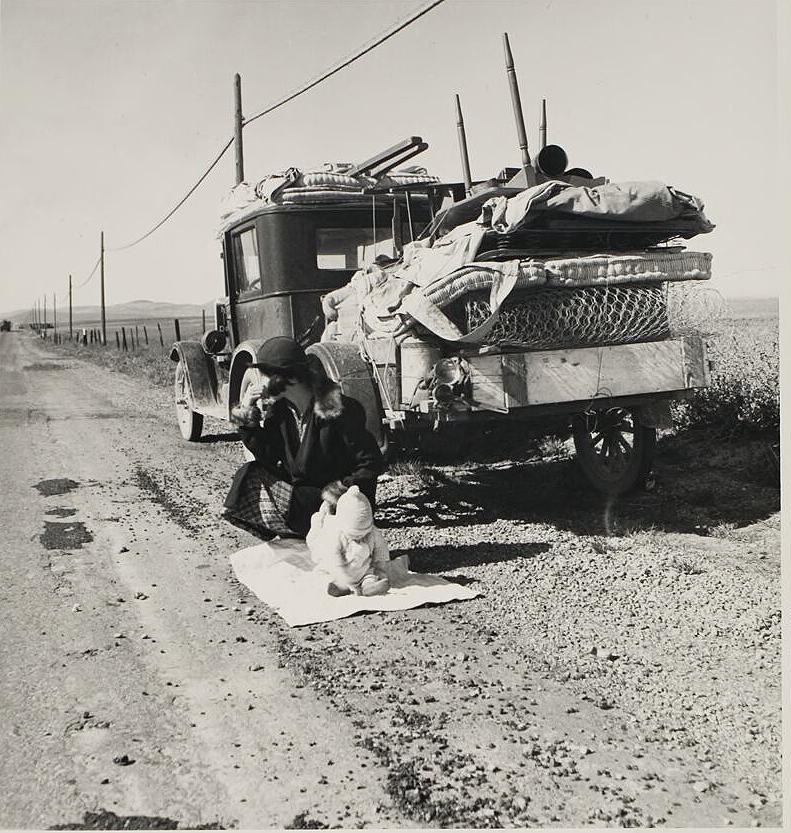
Dorothea Lange: Tracy (vicinity), California. Missouri family of five (1937)
"The human condition remains, perhaps improved but also little changed."
I remain amazed that my future has actually arrived. Dick Tracy’s two-way wrist radio, later TV, has caught up to me. It no longer qualifies as a distant fantasy, but my everyday lived reality. How could this be? Way back in the Dirty Thirties, when Chester Gould started creating Dick Tracy comics, long before I was born, my day-to-day existence today wasn’t even focused fantasy yet. Between Tracy and Buck Rogers, futures were endlessly projected, though those anticipations would prove to be far too modest to accurately represent the eventual actual technological progress, though two-way wrist radios contributed little to actual human progress. I’d contend that we seem little different, even if our lives today might not seem nearly as short and brutish. We remain contentious, maybe more so.
A careful reader of Dick Tracy would catch the character’s unshakeable faith in human goodness, though Tracy would often have to resort to violence to achieve a laudable end.
ConspiratorialCertainties
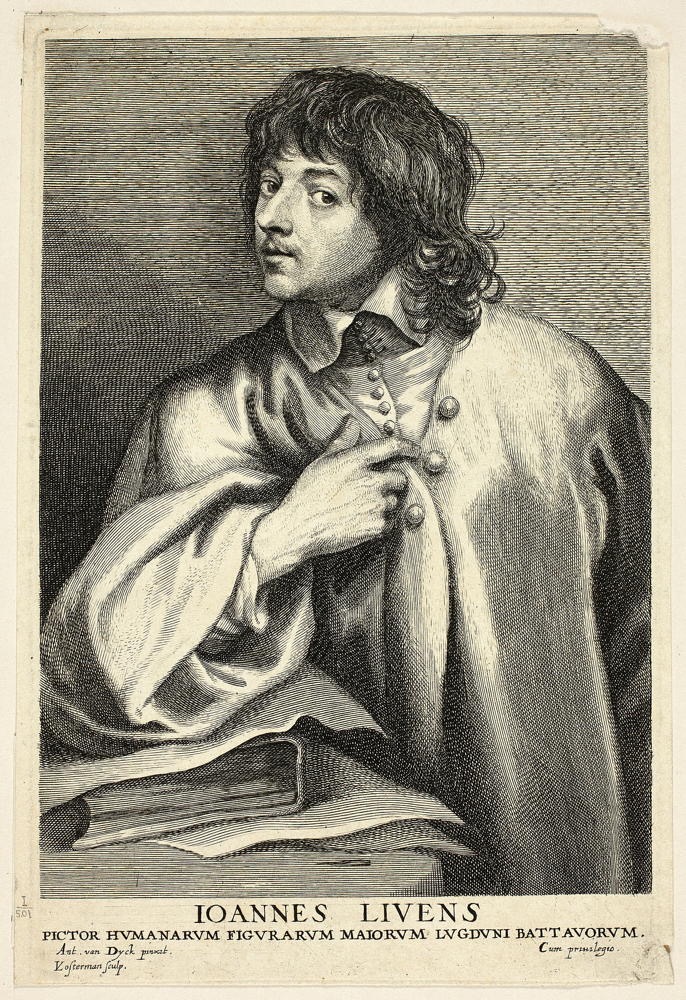
Lucas Emil Vorsterman: Jan Lievens (1630/45)
"The meanings could not be clearer if they were written on the mirror he's pretending to peer through."
After an uncertain number of iterations, the speculative might become a certainty, as the previously unknowable slowly becomes routine. So have conspiracy theories gone in what seems in retrospect like a remarkably brief time. It seems like just yesterday, when that certainty still evaded us, when we genuinely felt blindsided by some fresh-ish revelation. We had no idea how low they could go, and we held out for the longest time, hoping that they and we might prove more trustworthy than we all became. It seemed like a game at first, to somehow concoct some fresh worst-case scenario before second-guessing our hard-won earlier conclusions. In the years before Jeffrey Epstein’s suicide became common fiction, we blythely disbelieved most of whatever the vast right-wing conspiracy served up because it beggared belief. Now we can be almost one hundred per cent certain that whatever they declare describes one hundred per cent the opposite of whatever might actually be there. Conspiracy theories have become reliable ConspiratorialCertainties.
Conspiracy theory has become clinical certainty, though the stories still seem to be delivered backwards.
Plopaganda
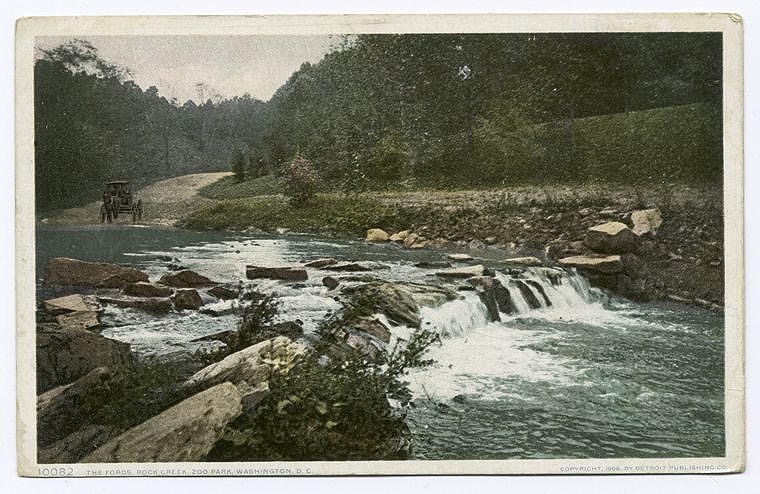
The Fords, Rock Creek Zoo Park, Washington, D. C.
Detroit Publishing Company postcards 10000 Series
(1898 - 1931)
The Miriam and Ira D. Wallach Division of Art, Prints and Photographs: Photography Collection, The New York Public Library. "The Fords, Rock Creek Zoo Park, Washington, D. C." New York Public Library Digital Collections. Accessed March 14, 2026. (https://digitalcollections.nypl.org/items/c18e35e0-c62e-012f-caa8-58d385a7bc34)
"Social Media's way more scary than it first appears."
This world has never provided a better medium for spreading disinformation than our present Social Media system. Not that the system isn’t trying to improve itself, not to reduce the proliferation of deliberately misleading crap, but to improve its overall efficiency in disseminating it. So far, attempts to encourage self-regulation have resulted in responses ranging from Meta’s insistence that any attempt at regulating Social Media speech amounts to too much to the EU’s conclusion that their attempts at regulating have not produced the systematic behavioural change it was designed for. The difficulty seems to lie in Social Media’s design. The outrage and algorithmic engagement Social Media relies upon to profit produce the same dynamics that encourage propaganda to spread. Further, most Social Media firms are based in the United States, which has traditionally viewed Social Media speech as protected under its First Amendment.
I liken immersing myself in my Social Media stream as similar to Health and Human Services Secretary R. F. Kennedy, Jr. swimming in Washington DC’s famously polluted Rock Creek, which is essentially an open sewer.
Weekly Writing Summary For The Week Ending 03/12/2026
Amedeo Modigliani: Caryatid: Rose and Blue (1912–14)
This writing week, I entered the final glide path for this Unscrolling Series. My purpose no longer remains the mystery it was when I began, and yet I have not yet discovered the full meaning of this excursion. I have learned, or I believe I’ve learned, that my purpose here was never to learn how to stop scrolling, however much I might have aspired to achieve that end when I began. I realized last week or the week before, that Unscrolling would become gratefully unattainable, another one of those innocent aspirations the Gods rarely satisfy. No need to wonder why, for that becomes obvious in the failing effort to succeed. At some indefinite point, success becomes what I would have earlier characterized as failure, and all continues to be righter than I ever suspected with this world.
I began this writing week investigating one of the founding memes of this meme-laden era, Meta’s ultimately discredited MoveFast/BreakThings motto.
SmallSlanders
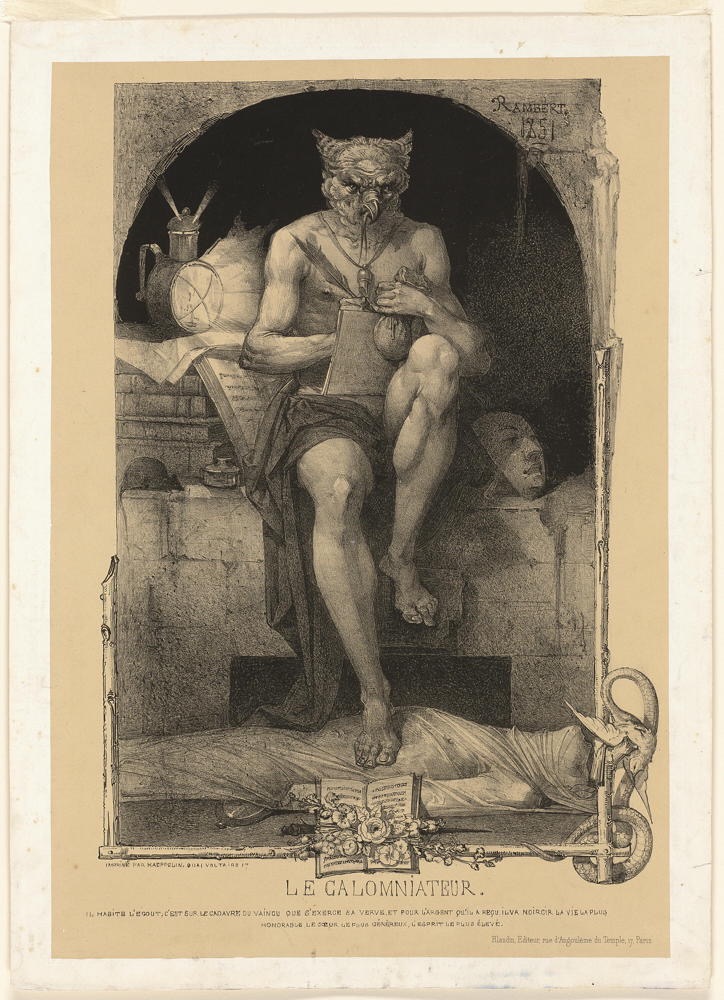
Charles Rambert: The Slanderer (1851)
"…therein lies its rub."
Early American newspapers were filled with slanders great and small, though their limited distribution rendered them relatively benign. Thomas Jefferson famously railed on about the destructive nature of the popular press, yet still concluded, “Were it left to me to decide whether we should have a government without newspapers, or newspapers without a government, I should not hesitate a moment to prefer the latter.” The press never suggested it was anything more than the first draft of history, anyway, rather than anybody’s final word. That history continues unfolding today in all of its original contention and more. Social Media easily amplifies SmallSlanders into much broader coverage. Even a half-baked lie can today even more quickly circumnavigate the globe before truth puts on his shoes. Some days, it seems as though truth cannot find its shoes and so simply slumps back into snoozing. I worry about the SmallSlanders and find them continually unsettling.
The Muse has finally managed to get sideways with some portion of her constituency.
UnEnlightenment

Calligraphy by Mishkin Qalam:
The Name of "Baha'ullah" in the Form of a Rooster (1887-1888)
Creation Place: Middle East, Iran
"…we haven't always insisted upon this in our Social Media presence."
Could it be that Social Media, as presently practiced, creates a pervasive disharmonic resonance? Instead of vibrating at a renewing frequency, might it vibrate all over the place, amplifying not coherence, but incoherence incarnate? This seems to be the case. Worse, the incoherence seems to be spreading. It would have been unthinkable for our current incumbent to have ever been elected dog catcher, let alone President, even in our most recent pasts. We’ve elected scoundrels before, but never one so absolutely incoherent, one apparently incapable of even acknowledging the presence of even our most self-evident rights. He commits greater crimes than those his presumed perpetrators committed when arresting them, and calls that even. He violates the emolument clause with more than mere impunity. He continually violates simple human decency. He personifies the context within which Social Media rages.
Never before in the history of this world had such a powerful potential presented itself.
SelfDiscipline

Ambition; a journal of inspiration to self help, [Cover] (February, 1902)
International Correspondence Schools (Publisher)
General Research Division, The New York Public Library. "Ambition; a journal of inspiration to self help, [Cover]" New York Public Library Digital Collections. Accessed March 10, 2026. (https://digitalcollections.nypl.org/items/39f65f90-c608-012f-027d-58d385a7bc34)
"Well-produced but vacuous undertakings."
Living in our time requires perhaps more SelfDiscipline than at any previous time in history. Just in my short lifetime, the latitude I have enjoyed for choosing for myself has expanded exponentially, and with that ever-expanding freedom, came the equally-expanding necessity of extending my ability to discipline myself. Fifty years ago, I would joke that the radio reception was so poor along a stretch of what was then called Interstate Eighty North across northern Gilliam County, Oregon, along the mighty Columbia River Gorge, that the only accessible station played only Gary Puckett and The Union Gap tunes, with the very occasional Marilee Rush. Today, I complain when my satellite radio kicks out when the basalt rimrock interrupts reception along that stretch. I have instant access, in season, to live hometown announcer play-by-play from each and every team in Major League Baseball, in either English or Spanish. Sorting from among such overwhelming choices demands a whole bunch of SelfDiscipline.
Some turn on their television the instant they get up in the morning.
Episidiodic

Dorothy Dehner: Damnation Series: Aspect of the Episode (1946)
"This creates a different context for living than I was expecting."
Either life mirrors art or art mirrors life. It might not matter which. I believe that both occur so that it might prove impossible to ever tell whether the chicken or the egg arrived first. Life certainly imitates art; otherwise, fashion would not influence any of us. It also seems obvious that art at least attempts to imitate art, however imperfectly. It used to be, or it certainly used to seem as though I lived within a rather grand narrative arc. I lived in the middle of some greater adventure, definitely heading somewhere, making history along the way. These days, my life seems less cinematographic, hardly a short story. I live rather like a Social Media stream, in a series of unrelated episodes without much in the way of any grander plotline.
Some thinkers have ascribed this sense, increasingly common, to simple aging.
AayEye
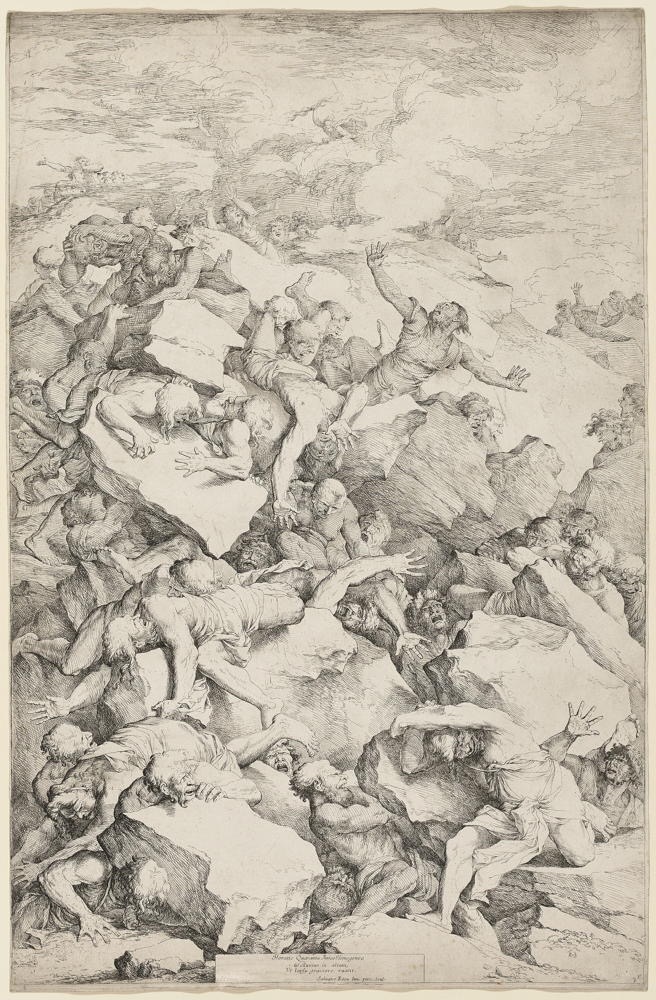
Salvator Rosa: The Fall of the Giants (1663)
"We're stuck in some middle."
The artificial seems to underpin much of what passes for Social Media, most prominently, the curiosity called Artificial Intelligence, or AayEye. As a concept, AayEye has been attracting interest since nobody remembers when, with perhaps more insistence that it always was and still remains impossible because we believe intelligence to be a solely human capability. Some controversy seems understandable, though, because as machines have acquired abilities that used to be considered evidence of intelligence, those abilities have been removed from the list of evidence of intelligence, if only because the very fact that a machine can perform them must mean by definition that they cannot be evidence of intelligence. Our definition of intelligence has perhaps been the greatest change brought about by advances in AayEye.
We seem to better understand what intelligence isn’t than whatever it might actually be.
MoveFast/BreakThings

Unidentified Artist: Things in Space/Space in Things (1942-1949)
"This concludes today's lesson in engineering futures."
"Move fast and break things" was the original internal motto and core engineering philosophy for Facebook (now Meta). Coined by Mark Zuckerberg, it prioritized rapid development, risk-taking, and innovation over stability, guiding the company's culture until it was updated to "Move fast with stable infrastructure" in 2014. Business Insider (2/16/2022)
Social Media giant Meta’s first motto might seem both ironic and telling when considered from today’s distance from its founding. Then, it was young and filled with itself and hope, believing itself to already be master of a universe not yet concocted. Like anybody, its founder believed he could create his own rules of engagement because he was blazing trails. The history of such development has always been paved with just this sort of arrogance, the belief that reality was theirs to define rather than to align themselves to. This tiny perspective shift has been turning grand intentions to shit since way back before Egyptian times. If anything, moderns have only become more adept at deluding ourselves.
We might create seemingly sparkling new futures, but we also inadvertently concoct their eventual Achilles Heels.
Weekly Writing Summary For The Week Ending 03/05/2026
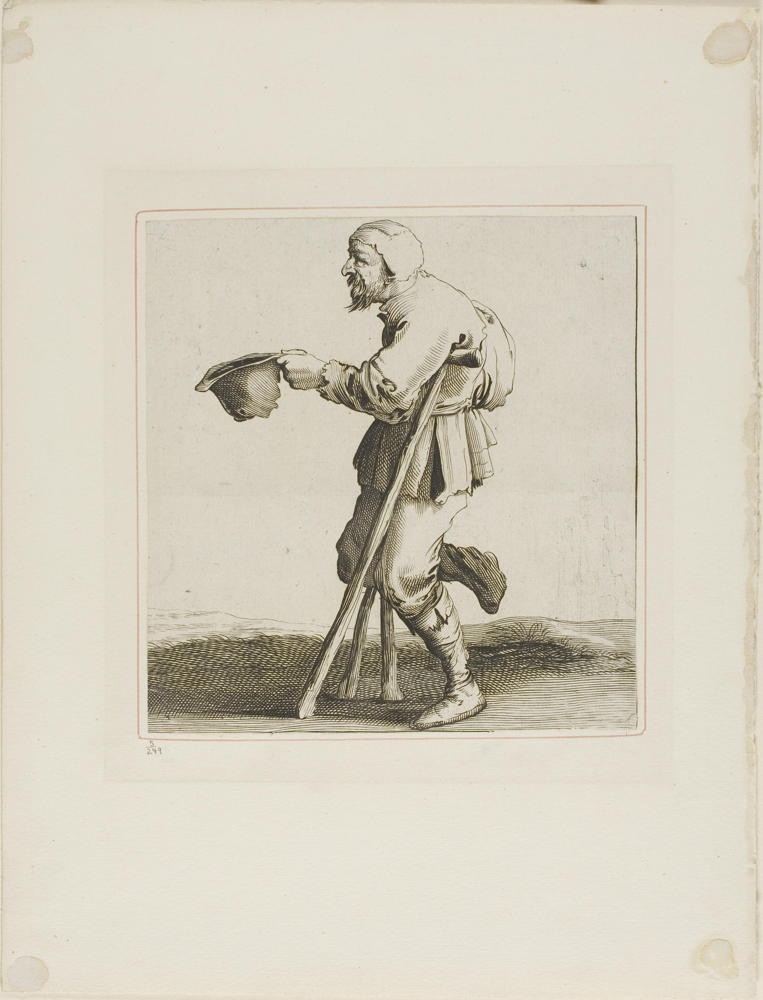
Pieter Jansz Quast: Lame Beggar Asking for Alms,
from T is al verwart-gaern [It’s already confusing]:
(n.d.; Artist's working dates 1612–1650)
This Writing Week marked the transition into the final scant three weeks remaining in this Unscrolling Series. I realized—or, re-realized—that I would not be abandoning my scrolling as a result of my investigating into my nefarious habit or addiction. I’m coming to accept that scrolling amounts to a part of modern living. I should not feel surprised if it sometimes seems to suffer from the same self-importance that encourages most everything these days. It seems to be fairly integrated, however much it’s occasionally hated. I scroll in greyscale now, and I doubt that I’ll ever return to color display on my iPhone. I know, greyscale hides some essential detail. That’s precisely why I chose it. Scrolling devils seem to lurk within full-color display.
I began this writing week acknowledging that technology seems destined, if not necessarily designed, to go off TheRails.
Cloud
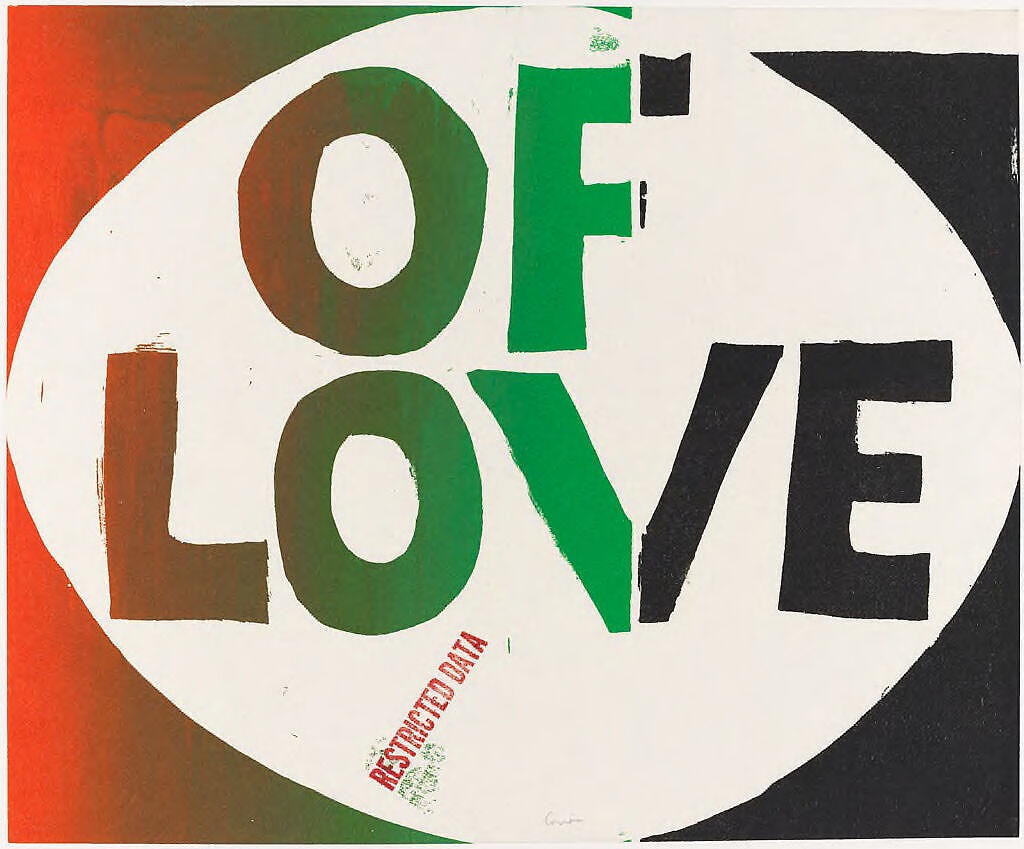
Corita Kent (Sister Mary Corita): of love (1967)
Persistent Link: https://hvrd.art/o/328973
Physical Descriptions: Screen print
Dimensions: 38.1 × 45.7 cm (15 × 18 in.)
Inscriptions and Marks: Signed: l.c.: Corita
(not assigned): Printed text reads: OF LOVE
RESTRICTED DATA [stamped in red ink]
Standard Reference Number
Corita Art Center Cat. #67-42
Harvard Art Museums/Fogg Museum, Margaret Fisher Fund
© Courtesy of the Corita Art Center, Immaculate Heart Community, Los Angeles / Artists Rights Society (ARS), New York
— — —
"Those who fear our future fear themselves."
My iPhone draws my attention like a manic Van Gogh. I can hardly look away, but that tiny display holds almost none of what attracts my attention. Much of what attracts me resides somewhere else, off in what’s referred to as The Cloud. That Cloud contains much besides moisture. Ask your favorite AI engine, which also resides in The Cloud, to describe the kinds of data commonly found there, and you’ll receive a dizzying array of data types, most of which I can guarantee you’ve never heard of before. They represent the ecosystem from which your scrolling emerges. Scrolling couldn’t exist without this cloud’s contents, and those contents could not exist without that amorphous Cloud.
The Cloud serves as the metaphor for what we know as Data Centers.
Rumor
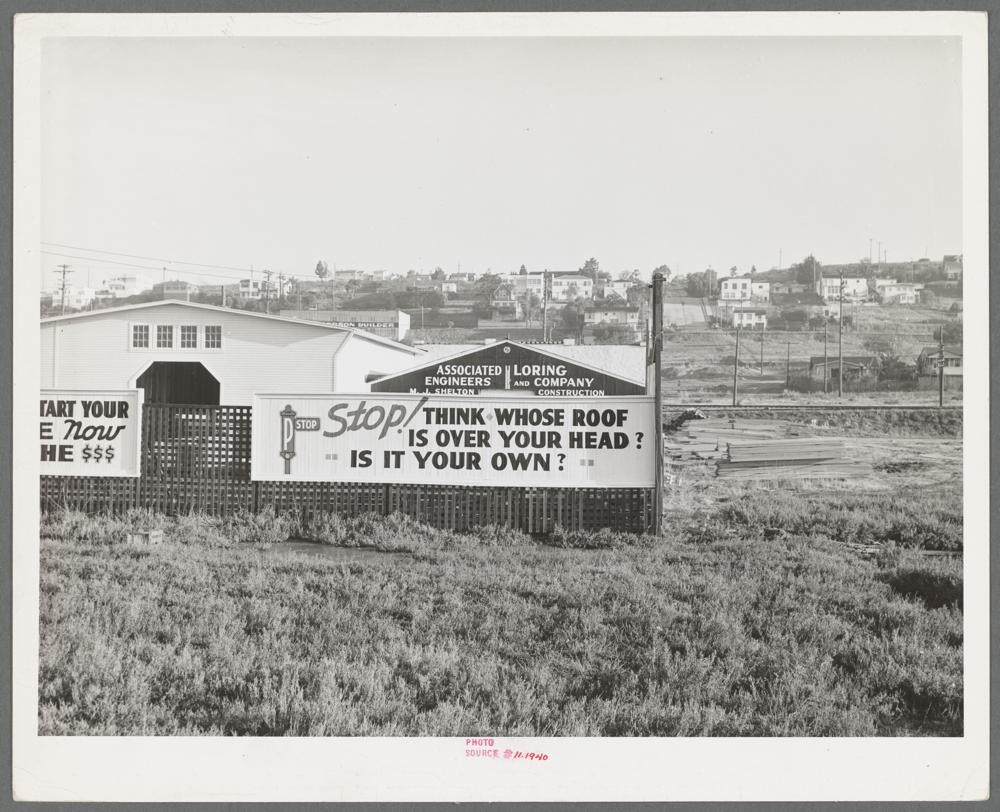
Russell Lee: "Sign at lumber company. San Diego, California. Building supply companies in San Diego are doing a tremendous rush business and there are rumors (unverified) of shortage in building materials." [Farm Security Administration Photographs] (12/1940)
The Miriam and Ira D. Wallach Division of Art, Prints and Photographs: Photography Collection, The New York Public Library. "Sign at lumber company. San Diego, California. Building supply companies in San Diego are doing a tremendous rush business and there are rumors (unverified) of shortage in building materials" New York Public Library Digital Collections. Accessed March 4, 2026. (https://digitalcollections.nypl.org/items/140a3880-7017-0137-9e01-05b46baa16fe)
"Rumors of information's demise on social media have been greatly exaggerated."
Rumor seems to be the very stuff of Social Media. While doubtlessly, many postings contain provable facts, fact-checking has never been a requirement or a significant element governing social media posting. I think of it as a slightly focused form of crowd-sourcing, as if a coherent gist could be derived by blindly repeating approximations. Some postings fully qualify as wild, not even attempting reliability—many intended only to rile—while others have received relatively rigorous proofing. One cannot reliably determine which postings are which, so it behooves the peruser to presume that every posting qualifies as little more than the rumor it most probably is. The only onus occurs when someone mistakes a probable rumor for an immutable fact, and that’s the straw that repeatedly bends social media’s camel’s back.
This situation’s no different than perhaps the most tragic of the many literary misinterpretations, the one where people interpret their Bible as literal history.
PostTruth
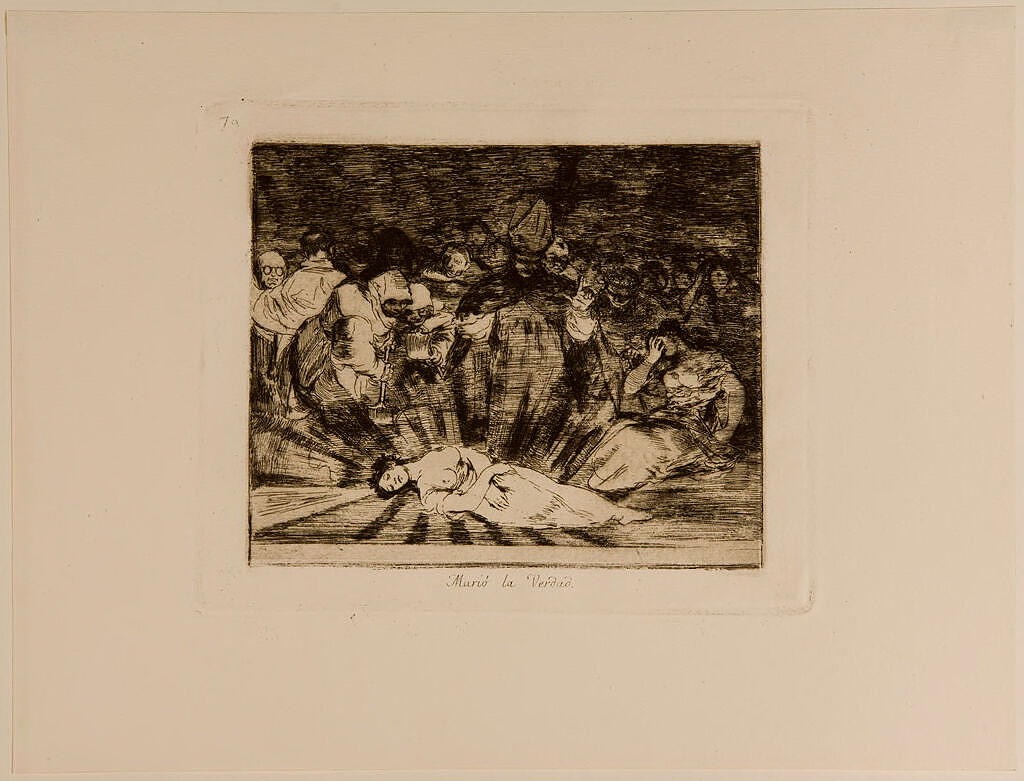
Francisco José de Goya y Lucientes: Truth Is Dead
Other Titles: Series/Book Title: Los Desastres de la Guerra, 79
Series/Book Title: The Disasters of War
(18th-19th century)
"Social Media ultimately seems simply nihilistic, an homage to PostTruth meaninglessness and little else, even though it attracts engagement."
Perhaps the single most compelling reason to avoid engaging in social media lies in the lies it spreads. Its engagement model does not distinguish between good and evil, truths and lies. Whatever attracts attention, encourages engagement, and engagement embodies the whole purpose of its existence. Lies reliably rile potential audience, thereby encouraging engagement. Repeated ad infinitum, a PostTruth context emerges, inverting historical measures of goodness. Where truth was once widely believed to be superior to fiction, the once sharp distinction eroded into what became, in practice, a superior fiction, trumping truth for many intents and purposes. If value directly correlates to hits, and hits relate most to lies, then goodness follows this trajectory, too. Truth holds little currency in any PostTruth society.
We each saw this coming.
UnNews
Samuel Putnam Avery (Collector)
Charles Emile Jacque (Etcher)
Auguste Delâtre (Printer of plates):
Un homme dans une cave. [A Man in a cave.] (1842)
The Miriam and Ira D. Wallach Division of Art, Prints and Photographs: Print Collection, The New York Public Library. "[Un homme dans une cave.]" New York Public Library Digital Collections. Accessed March 2, 2026. (https://digitalcollections.nypl.org/items/6d488120-c611-012f-7b0d-58d385a7bc34)
"There's nothing new under this sun."
Social Media has become an egalitarian’s dream come true. Imagine a space wherein everyone can be a writer if they choose, even a journalist, without the questionable benefits of training. Where every opinion finds a ready audience and every otherwise mundane happenstance can be publicly celebrated. Where world events can be dissected without being constrained by facts, and headlines can scream whatever they please without fear of being challenged. Think of it as the Wild West with coffee service.
It’s almost a full-time job just searching out the few pinpoints of truth, though following those does not guarantee that the algorithm will reliably serve them up in the future.
SickDay
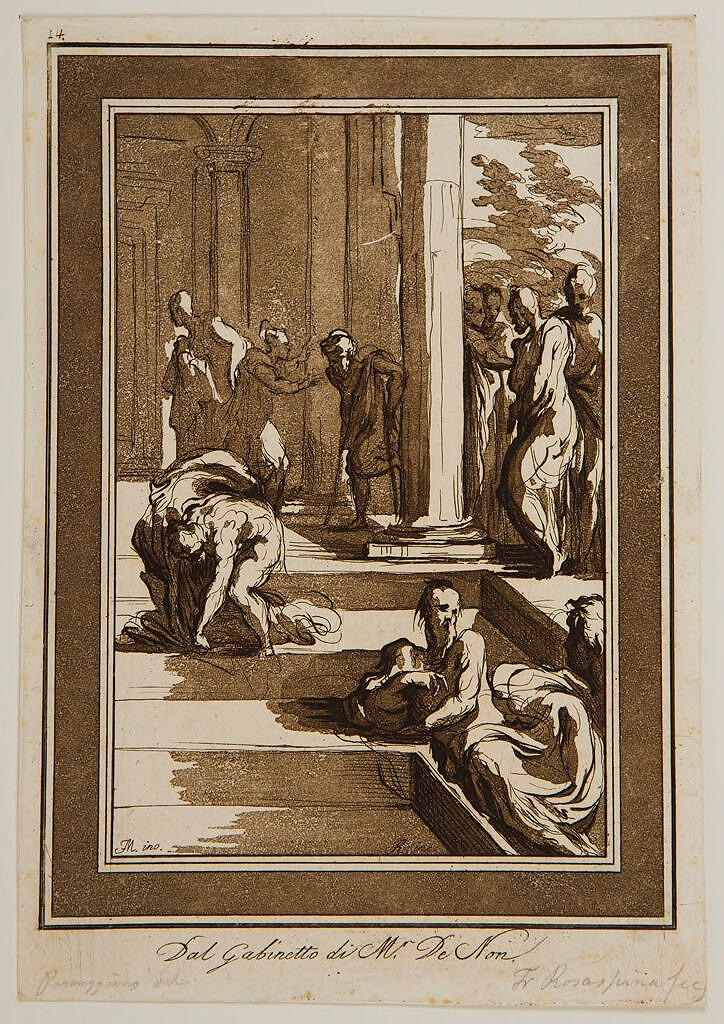
Francesco Rosaspina: Healing the Sick (18th century)
"Engage in some extended scrolling and call me the next morning if you're ever experiencing a SickDay."
I must have already apologized at least once for my short-sightedness in naming this series Unscrolling, for that title presupposes something. It strongly suggests that the underlying purpose of these stories must necessarily be to eradicate scrolling, when that was never my entire objective. Yes, I admit that I sought to reduce my scrolling habit, which had, at times, overwhelmed me. I couldn’t always control that urge to access my social media feeds, but that alone couldn’t have motivated me to dedicate an entire quarter to such an endeavor. Scrolling seems only intermittently annoying. It’s not destroying my life. It often contributes important benefits, one of which appeared yesterday when I experienced one of the rare visits of a SickDay disrupting my semi-sacred routine.
Since the damned pandemic, I continue to curtail my circulation out in the general population.
TheRails
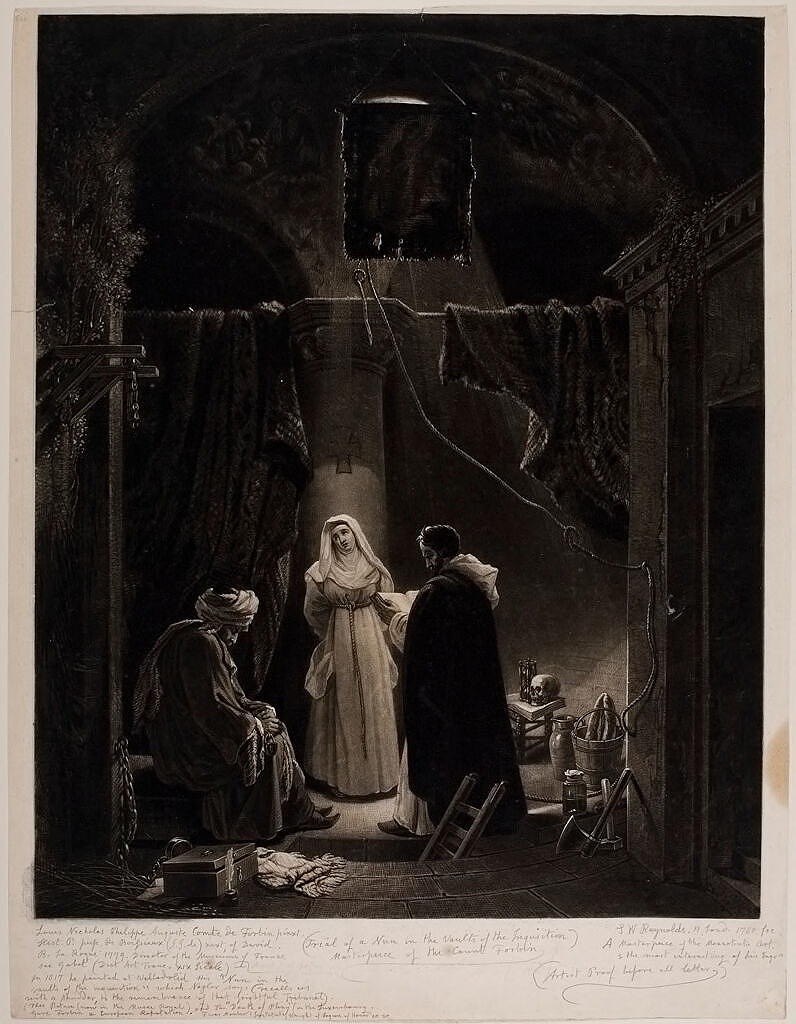
Samuel William Reynolds I:
Trial of a Nun in the Vaults of the Inquisition (19th century)
"It was never my intention to become a tester for Unscrolling technology."
It might be true that all technology comes to market before either the technology or the markets are truly ready. Without some experience, limits cannot be knowledgeably drawn. Without a few failures, edges aren’t obvious. The early adopters take much of the brunt, buffered by a blythe ignorance that they’re exposing themselves to experiences nobody could have possibly imagined. The more complex the context, the more this principle seems to hold. Boeing can’t seem to release an airplane that reliably flies the first few times. I long ago resigned myself to duck and cover whenever a new release was announced, for it has become certain that even “necessary security and reliability” updates will inevitably end up degrading some functions. We seem to have achieved levels of complexity that render us incapable of properly testing anything before releasing it on a justifiably wary and suspecting public.
The landmark social media case in LA got around to the plaintiff’s testimony this week.
Weekly Writing Summary For The Week Ending 02/26/2026
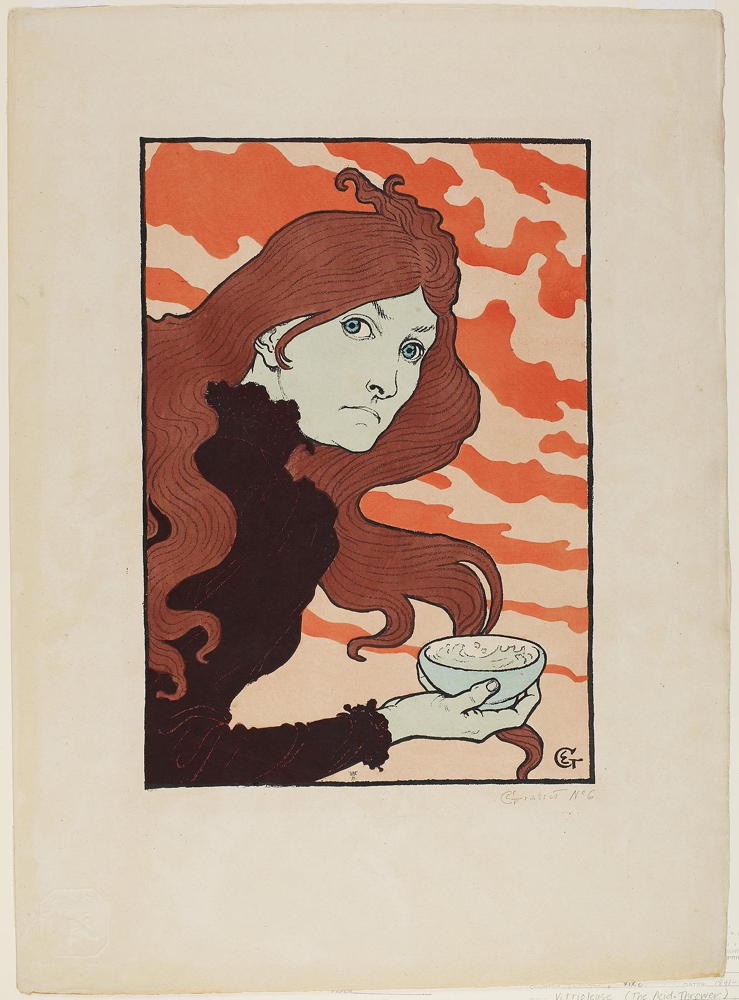
Eugène Samuel Grasset: Vitrioleuse (The Acid Thrower) (1894)
This writing week found me entering the final third of this series. The first third always finds me struggling to understand what in the heck I’ve gone and gotten myself into. The second third, a more comfortably consistent theme emerges. The final third serves as the most masterful portion of the investigation. I’m finally feeling comfortable in my Unscrolling skin. I have been discovering and somehow managing to express my abiding intentions. Even rough starts can become smooth landings.
I began this writing week reporting on how social media seems to be very skilled at BreakingNews.
InstantaneousExpertise

Unidentified Artist::
Nuestra Señora de Belén con un retrato de donante indígena
Our Lady of Bethlehem with Portrait of an Indigenous Donor
(18th century)
Nuestra Señora de Belén, a patron saint of the city of Cuzco, Peru.
Convent of Santa Clara.
"We should be justly proud of our accomplishments…"
Social Media has introduced the greatest volume of instant experts in the history of this universe. Before, expertise came through patient practice, sometimes through apprenticeships. It might take decades before a novice could be properly considered to be an expert, even in their own mind. Now, a simple search can place the apparent wisdom of the ages in the palm of one’s hand. This does not even require a lengthy attention span. One might be wise to question such easily acquired skills, but such commodities have come into common commerce now. Any conversation, especially one with even the sparest hint of controversy, will attract at least one offering their well-intended InstantaneousExpertise.
The internet exists as a most convincing collection of seemingly everything.
Tribes
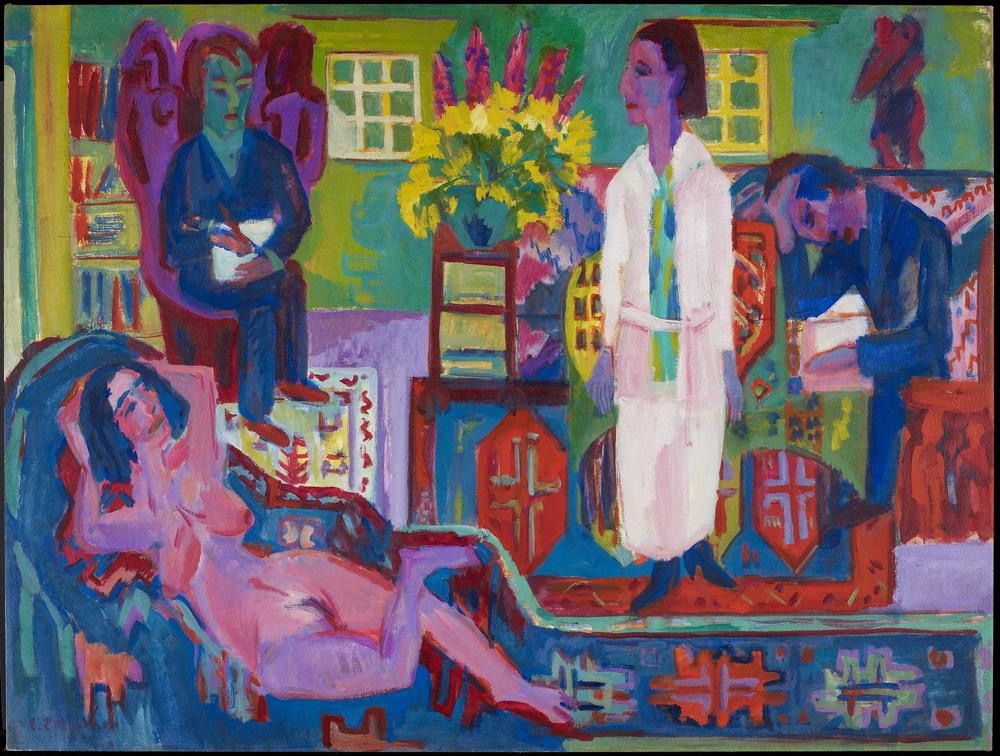
Ernst Ludwig Kirchner: Modern Bohemia (1924)
"It might not yet be too late to choose another fate."
Modernity has been a concerted move away from the tribal toward the more universal. Equality, fraternity, and liberty were impossibilities as long as some people were considered naturally better than others. Of course, conservatives always faunched at these aspirations, for they believed tribal identities had been bestowed by God. Which God was beside the point because each tribe firmly believed that only their God was legitimate, and the rest were clearly pretenders or outright frauds. Secular societies were unprecedented two hundred and fifty years ago. It seemed for a time that the secular would surely succeed where kings and commissars had failed, but then the ultimate level playing field arrived, dragging social media behind it, and we commenced to re-fragment.
The tribes became almost immediately self-evident.
FakeNews
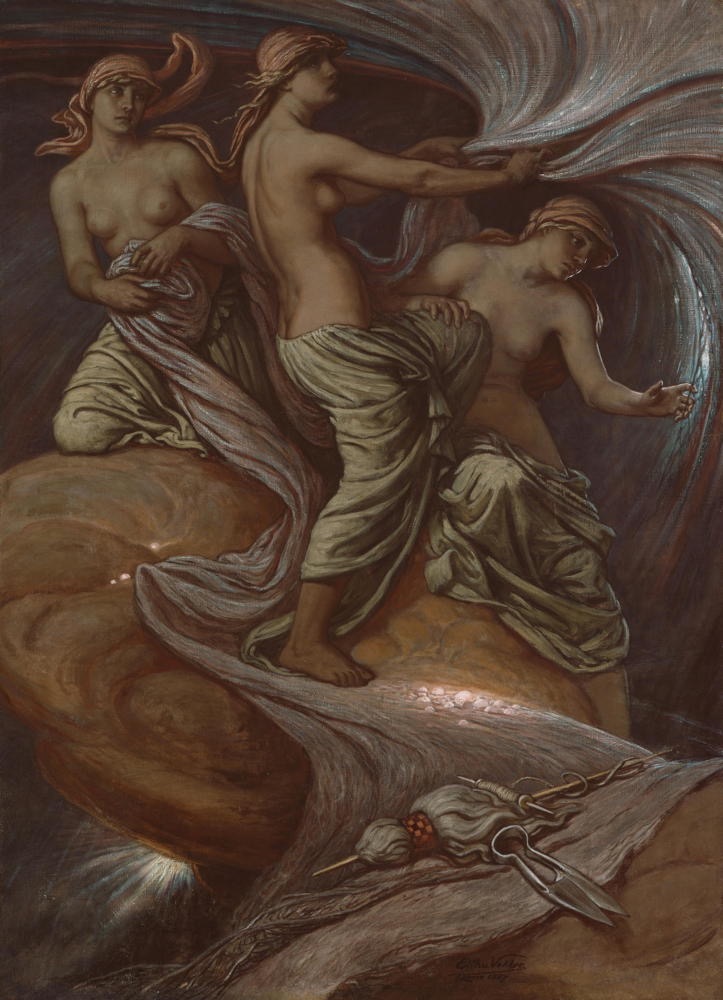
Elihu Vedder: The Fates Gathering in the Stars (1887)
ABOUT THIS ARTWORK
Elihu Vedder depicted the three Fates of Greek mythology working the thread of life: Clotho spins the thread, Lachesis fixes its length, and Atropos cuts it at the appointed time of death. Their symbolic tools—spindle, distaff, and shears—rest in the foreground, emphasizing the Fates’ decisive role in matters of life and death. Vedder adapted this painting from an illustration he had designed for an 1884 publication by Edward FitzGerald—a translation of the work of 11th-century poet Omar Khayyám, The Rubáiyát. Vedder was attracted to mysterious, visionary subject matter. Here, he explored metaphysical questions of life, death, and afterlife, subjects at the core of Khayyám’s poetry.
"If its content was all proven to be true, it couldn't draw a respectable crowd."
Social media has been the playing field upon which the whole concept of FakeNews proliferated into the baseline reality it has come to be today. Our incumbent rode FakeNews’ coattails into high office, where he employed this once fringe concept to utterly debase our federal government. He dealt almost exclusively in confounding paradoxes, playing the role of the barber who shaves all the men, and only the men, who don’t shave themselves. His every utterance double-bound. It was eventually inevitable that he never once committed a truth, and yet he still managed to get himself re-elected. This astounding result describes the curious power FakeNews wields. It also might explain the ever-burgeoning popularity social media continues to enjoy.
You might have thought that any media so infused with falsity would have been swiftly abandoned, but this has not proven to be the case.
VastWasteland
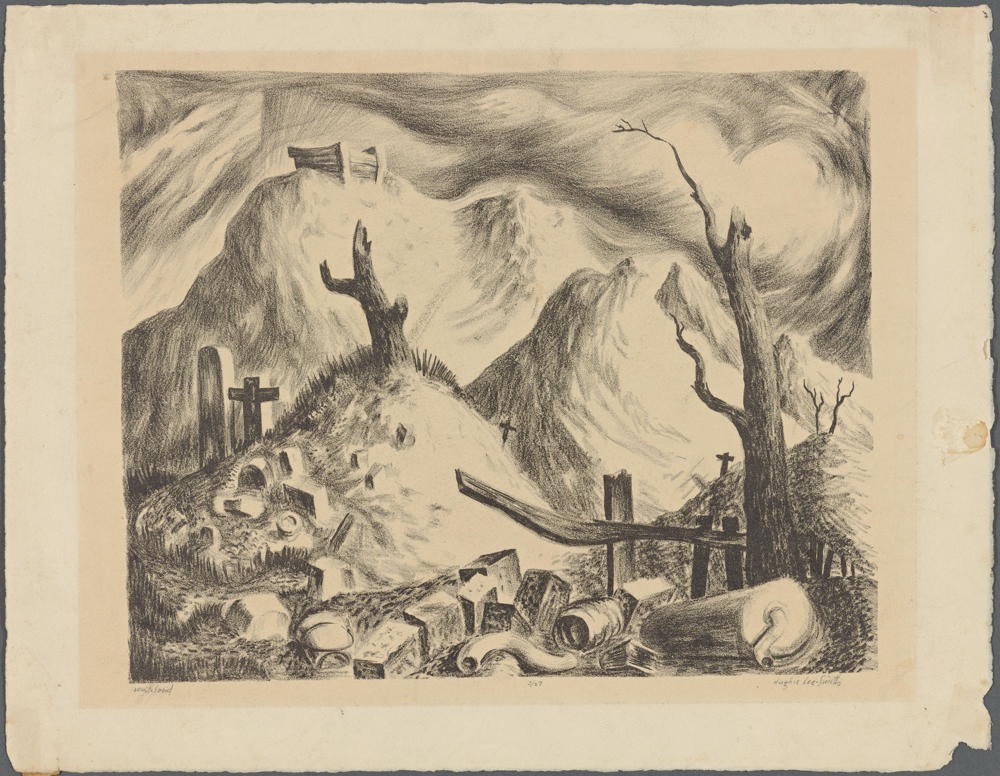
Hughie Lee-Smith: Wasteland
Works Progress Administration (WPA) Art
United States. Works Progress Administration (Sponsor)
(1939)
Schomburg Center for Research in Black Culture, Art and Artifacts Division, The New York Public Library. "Wasteland" New York Public Library Digital Collections. Accessed February 23, 2026. (https://digitalcollections.nypl.org/items/ccb33860-fe37-0131-598a-58d385a7b928)
“…probably damned whatever we choose to log into.”
The great American public has always strongly preferred VastWastelands as our sources of entertainment. We have never been all that high-minded. Sure, there have always been pockets of actual culture lurking around the margins of our society, but we’ve only rarely allowed that culture to dominate our leisure. In Frontier America, the tavern attracted more patrons than any theater, fistfights always had more witnesses than did concerts, and even public hangings were generally judged superior uses of time to any alternative. It was no surprise when the marvel of broadcast radio, then television, quickly turned into just another VastWasteland. We should express no less surprise as we realize that we’ve just gone and done it to ourselves again. Social media might be best understood and acknowledged to be the latest instantiation of humanity’s longest-lasting tradition, for we have also transformed what might have been the highest of high culture into another rather run-of-the-mill VastWasteland.
I won’t bemoan this outcome, but merely acknowledge it.
FutileResistence
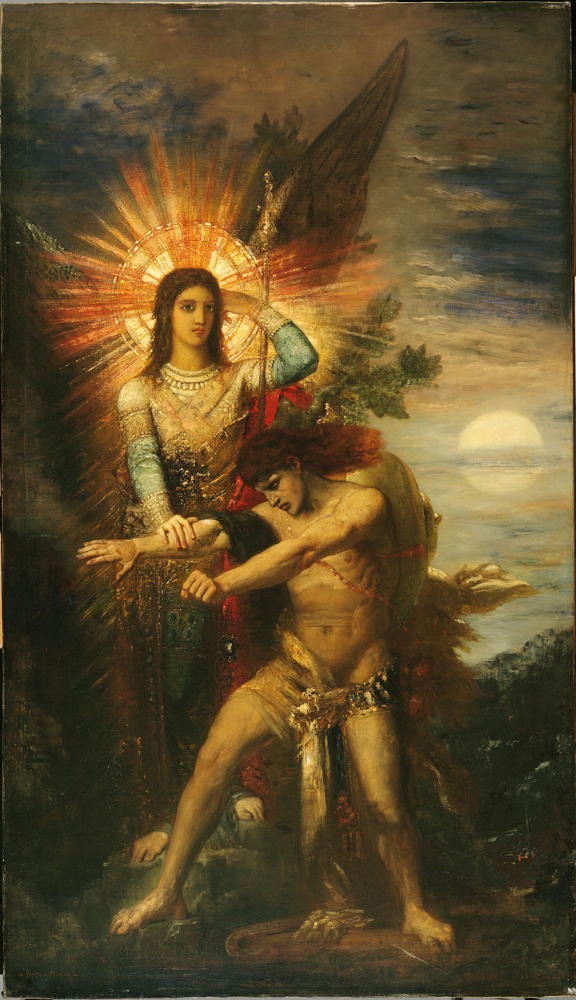
Gustave Moreau: Jacob and the Angel (1874-1878)
"At least there's no toll taker, trying to assess me for roaming now."
I have a long and perhaps overproud history of resisting technological change. I have not yet successfully completed the leap from analogue to digital, and I not so secretly hope never to fully consummate that leap. When cell phones first came into fashion, my partners forced one onto me. I was never able to complete a call. I’d try, but get no further than some toll collector who’d explain that I was roaming. Roaming was apparently a minor felony punishable by an immediately calculated and extracted financial penalty. This served as a necessary gate through which a caller had to pass to successfully connect. I’d declined the invitation and go find some landline payphone to complete the connection. My partners insisted that the phone would prove to be convenient, though it never once was.
Later, once that technology had advanced beyond the roaming phase, The Muse leased an early model of a smart smartphone.
BreakingNews
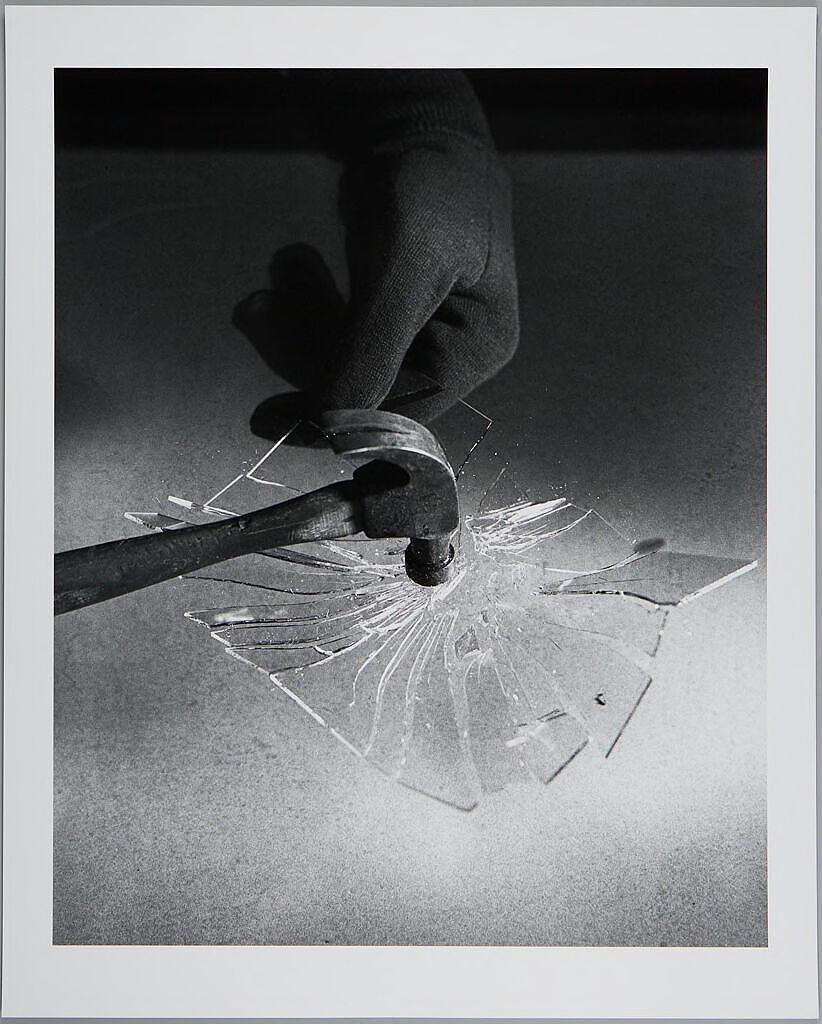
Harold Edgerton: Hammer Breaking Glass (1933)
"This future sure seems unduly fragmented."
I find myself almost exclusively turning to social media for my BreakingNews. I haven’t tuned into a local television news broadcast in nearly five years. I don’t have access to CNN, Fox, or MS-Now on TV, or even access to the network television news broadcasts. I will, on occasion, still tune into NPR if I’m near a radio when news breaks, but I have been increasingly bee-lining to my social media feeds when I catch a whiff of something important occurring. I most often get those whiffs from my social media feeds, too, though I’ve grown increasingly cautious. The proliferation of deepfakes there means that I often check the credibility of the URL behind whatever seems to be breaking. I, sadly, often find the questioned URL carrying the BreakingNews to be broken.
The news itself seems broken by social media.
Weekly Writing Summary For The Week Ending 02/19/2026
Étienne Claude Voysard: Printemps [Spring] (18th century)
This writing week saw the tone of this series shift from the personal toward the more general. I began following the jury trial of Meta and YouTube, who have been accused of trading in products harmful to children, from in here to out there. Out there, the world seems fairly preoccupied with presumptions about itself, notions not yet quite proven by experience or validated by science. We seem to be passing through an initiation with the outcome not yet certain.
I began by noting how large companies tend to come in only one of two flavors: Boobs or Sonsabitches.
BigMan
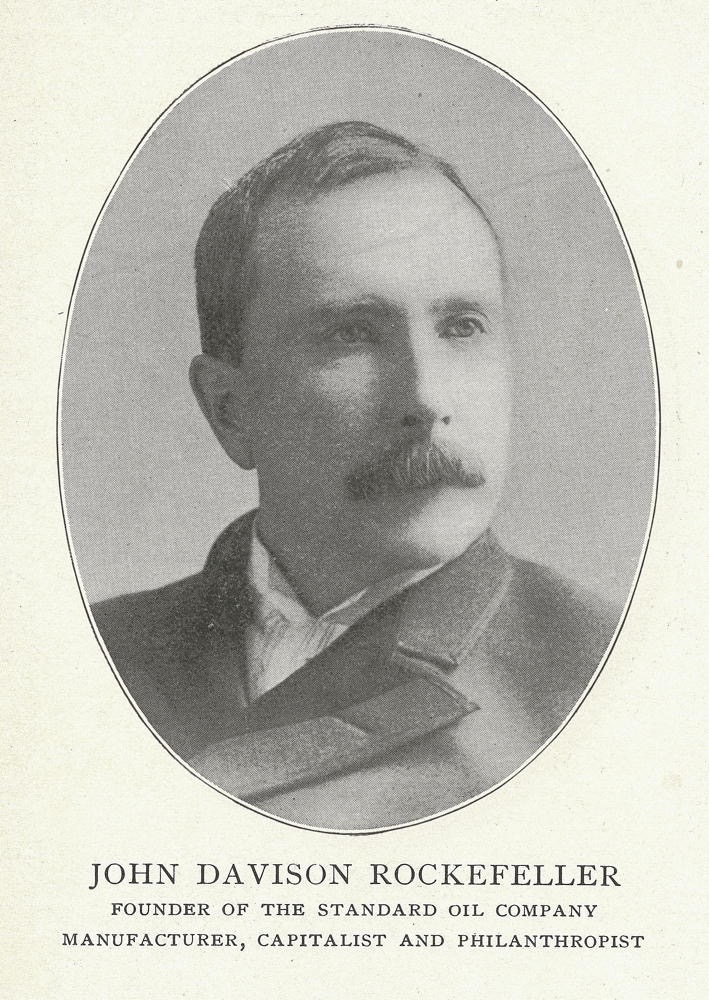
Moses King, Compiler & Publisher: John Davison Rockefeller (1899)
Irma and Paul Milstein Division of United States History, Local History and Genealogy, The New York Public Library. "John Davison Rockefeller" New York Public Library Digital Collections. Accessed February 19, 2026. (https://digitalcollections.nypl.org/items/87f79b40-86d4-0131-769f-58d385a7b928)
“The value of its services explains why so many use them so much, not ‘clinical’ addiction.”
The bellwether trial involving Meta and YouTube eventually reached the point where the BigMan was called as a witness. Mark Zuckerberg serves as the BigMan this time, in the same role that a long succession of big men served before. John D. Rockefeller was as nasty a competitor as was ever born, though he managed to soften his image later in life, after he’d shrunken, by handing out dimes to street urchins while delivering little sermons of something he never mastered himself: thrift. Andrew Carneigy was an equally heartless capitalist before he chose to donate much of his ill-accumulated wealth in the form of libraries, generating great goodwill. Zuckerberg’s not yet achieved sufficient dottage to be seen as a benefactor, though I’m sure he contributes plenty to various charities, none of them amounting to anything threatening his personal billions.
It’s a tough time to be an oligarch.
InternetSmart
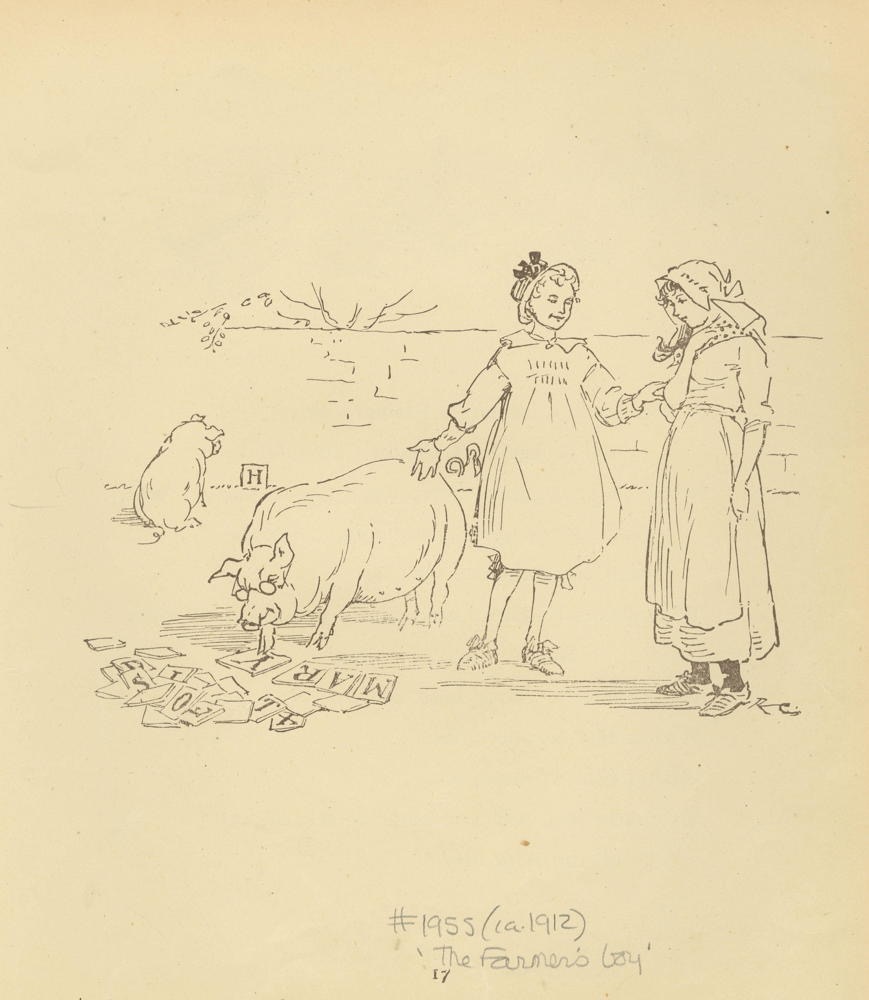
Unknown Artist: A smart pig—Caldecott -- Farmer's boy (1912)
The Miriam and Ira D. Wallach Division of Art, Prints and Photographs: Picture Collection, The New York Public Library. "A smart pig" New York Public Library Digital Collections. Accessed February 18, 2026. (https://digitalcollections.nypl.org/items/b197e850-c5bb-012f-0e24-58d385a7bc34)
"…repeated social media use has introduced a much broader swath of the population to this sort of experience than has previously existed."
Our continued compulsive use of social media probably produces several secondary outcomes. I might scroll for distraction, entertainment, or information, but once subject to so much visual and auditory experience, I very likely absorb stuff without being totally aware of what. Social media seems to have been largely constructed out of memes, imitation genes. These tend to be visual and verbal summarizations, shortcut representations capable of transferring some semblance of understanding without much in the way of scholarship or studying, resulting in knowledge perhaps best described as iconic. The goodness or badness of whatever’s so represented almost always seems obvious. Memes accumulate like strings of very limited knowledge, often knowledge without any underlying understanding. Ideas seem like things, easily, even preconsciously classified, and recalled with such immediate dexterity that they manifest without much in the way of questioning accompanying.
This largely visual learning process mimics how one adopts prejudice.
HabitAddict
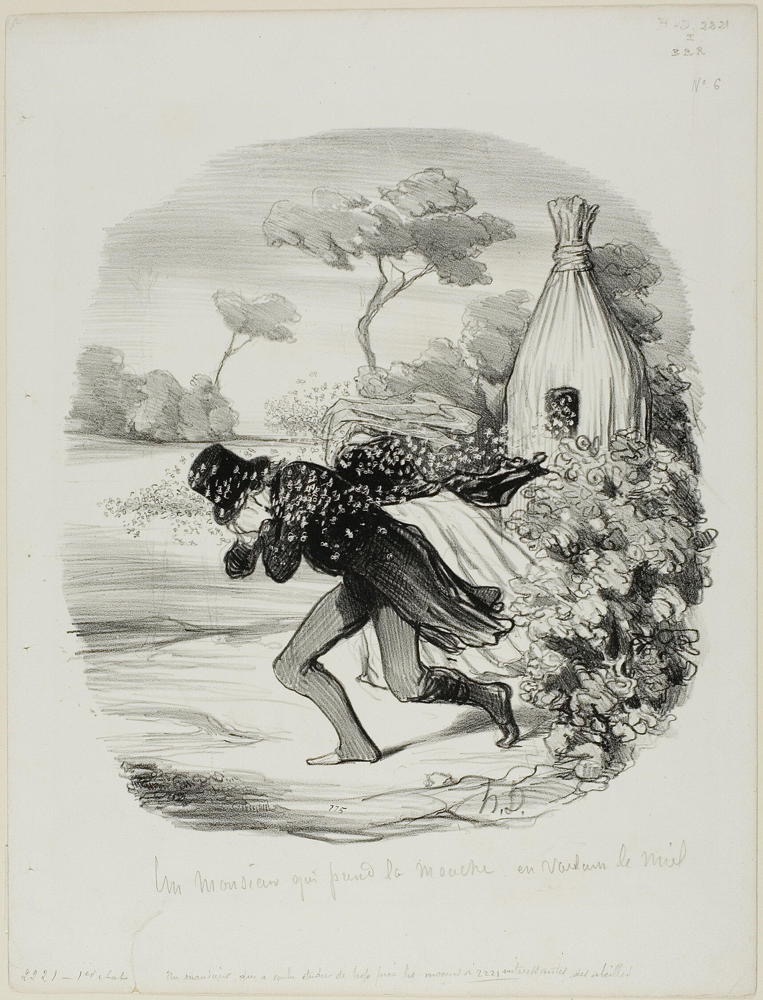
Honoré Victorin Daumier:
A Gentleman Who Wanted to Study the Habits of Bees too Closely,
plate 6 from Pastorales (1845)
"I'm just not complying with their wishes at the moment."
"It is fascinating that so many Instagram users believe that they are addicted when, according to clinical criteria, the risk of addiction is relatively rare." [Anderson, I.A., Wood, W. Overestimates of social media addiction are common but costly. Sci Rep 15, 39388 (2025). https://doi.org/10.1038/s41598-025-27053-2]
The science assessing social media use does not appear to have entered its infancy yet.
SpecificRisks
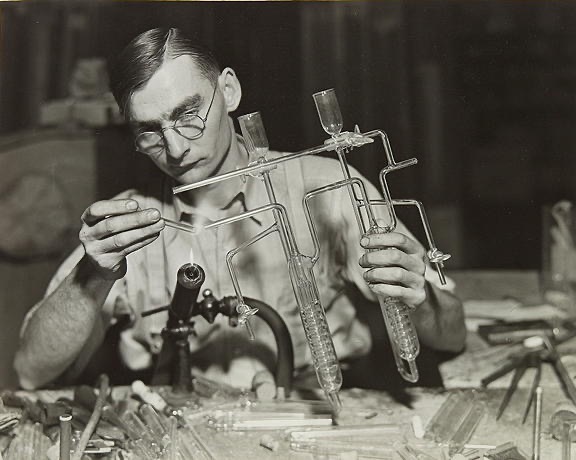
Lewis W. Hine:
Making Apparatus for Laboratory, Glass Works, New Jersey (c. 1937)
"This world remains in flux."
The European Commission recently found that TikTok’s addictive design appears to be in breach of the Digital Services Act, a landmark 2022 legislation designed to create a safer digital space by enforcing accountability, transparency, and user safety on online platforms, social media, and marketplaces. It mandates content moderation, bans certain targeted ads, and imposes severe penalties for non-compliance, with special obligations for “Very Large Online Platforms” (VLOPs). VLOPs can be assessed up to 6% of their total gross annual revenue for violating the Act. This announcement must have sent chills up whatever passes for spines in the Googles, Facebooks, and TikToks of this world.
These findings are not based upon a single study, but upon interpretations of several inquiries and formal studies performed with varying degrees of rigor.
UnusualConvergences
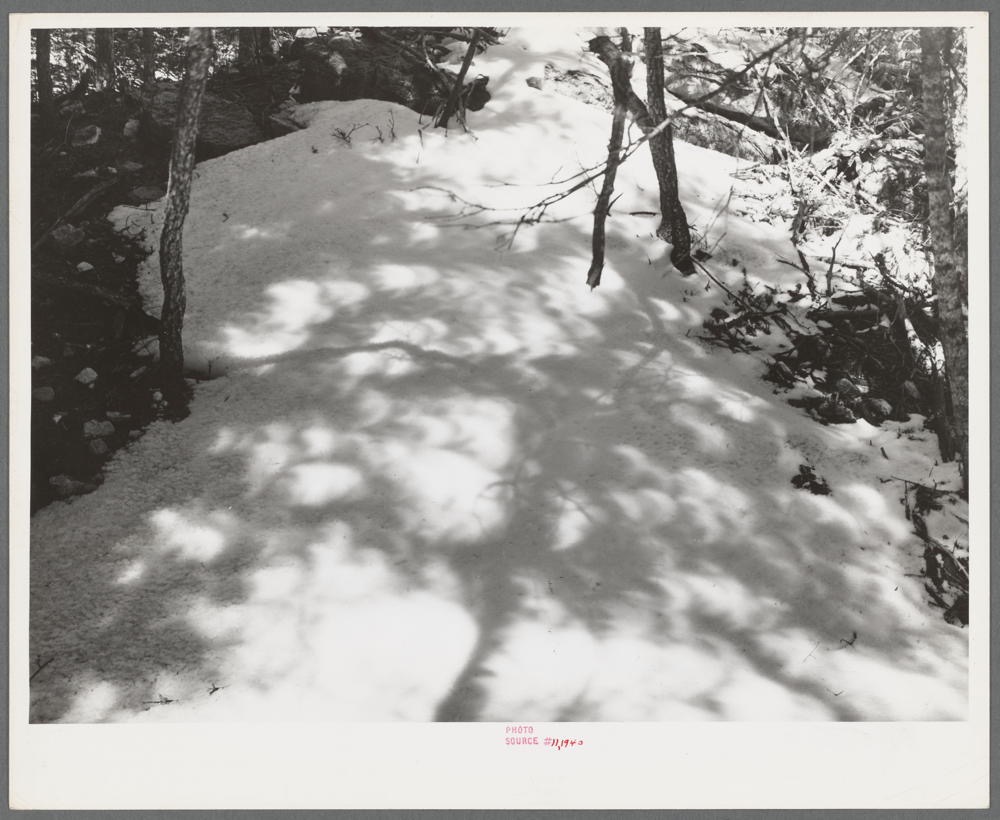
Russell Lee: Shadows on the snow in the mountains in Bernalillo County, New Mexico. The unusual crescent shaped light in patches in the shadows were caused by the eclipse of the sun (04/1940)
United States. Farm Security Administration (Sponsor)
The Miriam and Ira D. Wallach Division of Art, Prints and Photographs: Photography Collection, The New York Public Library. "Shadows on the snow in the mountains in Bernalillo County, New Mexico. The unusual crescent shaped light in patches in the shadows were caused by the eclipse of the sun" New York Public Library Digital Collections. Accessed February 15, 2026. (https://digitalcollections.nypl.org/items/ba84e0f0-4993-0137-010c-2971ff3091f6)
"We have become our own foreign adversary now."
Scrolling has seemingly suddenly taken an historically outsized role in current affairs. Hardly a newspaper can be published without some story harkening into some aspect of social media. Our president uses his own private social media platform as the primary conduit for disseminating government information. True to its social media nature, much of that information amounts to deliberate mis- and disinformation. In 2024, Congress passed, and President Biden signed into law, the Protecting Americans from Foreign Adversary Controlled Applications Act (PAFACAA). It was intended to address national security concerns regarding TikTok’s ownership by the Chinese company ByteDance. The act identified some critical risks that they insisted necessitated a forced sale or ban of the platform.
Congress feared that the Chinese government might employ its national intelligence laws to compel ByteDance to share so-called sensitive personal data of more than 170 million American users, including location and biometric identifiers.
Boobs&Sonsabitches
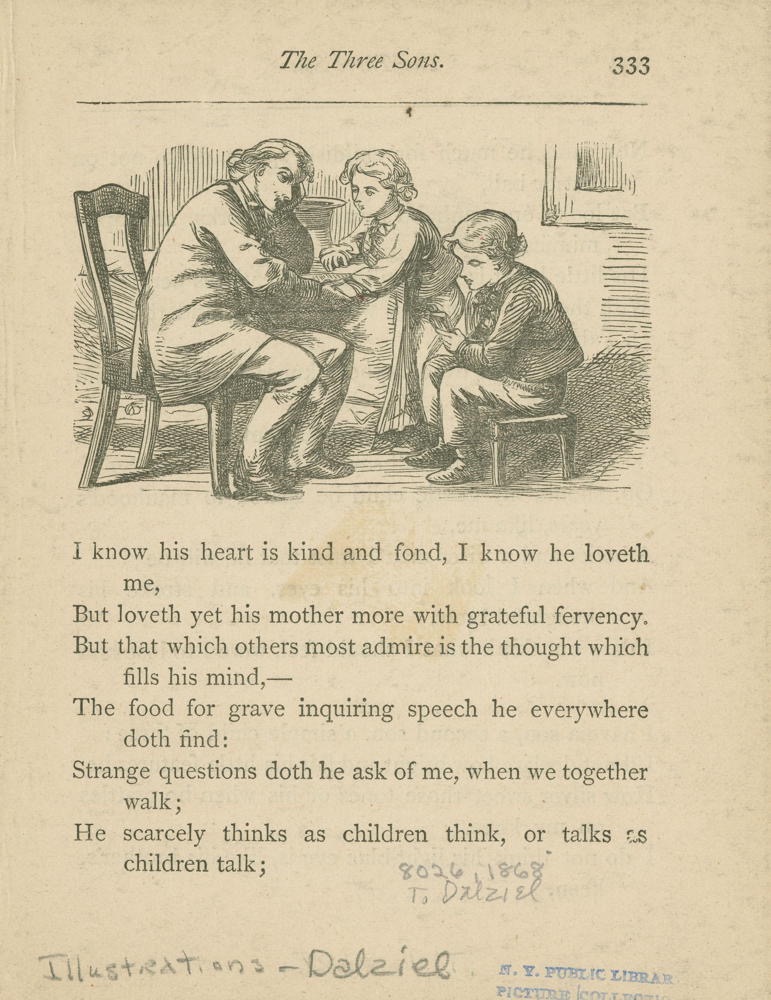
Thomas Bolton Gilchrist Septimus Dalziel:
Illustration of "The three sons" by poet John Moultrie (1868)
The Miriam and Ira D. Wallach Division of Art, Prints and Photographs: Picture Collection, The New York Public Library. "The three sons." New York Public Library Digital Collections. Accessed February 14, 2026. (https://digitalcollections.nypl.org/items/faee0690-c5bb-012f-199f-58d385a7bc34)
"These are who we’ve entrusted our precious attention spans to."
Who are these people we so easily entrusted with our precious attention spans? Most of us had no clue how precious our attention spans might have always been until technology made it practical to distract them. But even given that technology made mass distraction a practical possibility, who might find tapping into that an attractive occupation? Cue the thoroughly modern corporation. Such an occupation seems to demand a certain sense of presumption beyond what any technological capability might impart. A sense of privilege and self-possession might enable one to engage in any of the snoopier professions. One spies on lesser beings, not on equals; on fools. One must identify as a spy, an occupation that hardly lends itself to gentile persuasion. One lurks, often under misleading pretenses, and draws attention away from one’s actual operations. The providers of such services tend to grant themselves expansive labels: Meta, Google, Amazon, and X come readily to mind, names that provide little hint at what might pass for day-to-day operations going on under their hoods, but hint at the enormous and infallible.
They seemed the very soul of accommodating at first.
Weekly Writing Summary For The Week Ending 02/12/2026
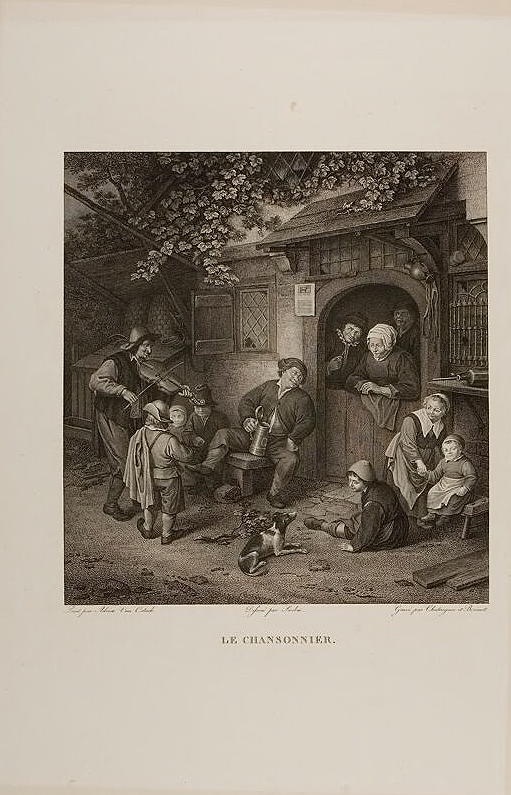
Alexis Chataigner: The Ballad Writer (19th century)
At the start of every writing week, I wonder what might rise to any level of importance that would warrant writing about it. This world has thus far been benevolent in that respect. I daren’t second-guess or stiff-arm whatever might manifest, lest I jinx the whole operation. This writing week turned out no different—a faith-based initiative executed by someone not necessarily infused with faith. I never know until I post, and often not even then, if I’m being true to my intentions and moving this curious ball further afield. I strongly recommend to anyone who might be interested that they consider becoming anything other than a writer, but if they choose writing—or writing chooses them—to befriend that urge. It’s either friend or enemy, neither obviously.
I started this writing week trying to distinguish between real and “Reel” life, not entirely successfully.
Predation
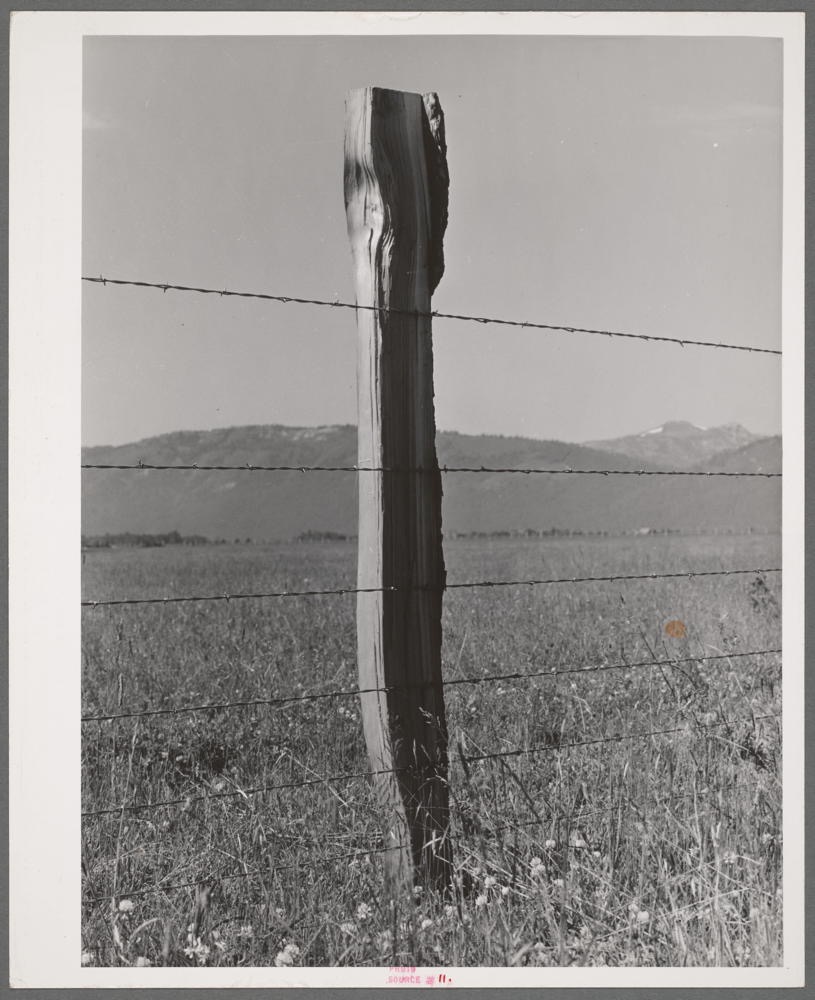
Russell Lee: Fence on Cruzen Ranch. Valley County, Idaho. AAA (Agricultural Adjustment Administration) has painted out this fence as being an outstanding type for ranch use. It keeps out predators (wolves, etc.), the wire is stapled loosely to allow for expansion (06/1941) United States. Farm Security Administration (Sponsor)
The Miriam and Ira D. Wallach Division of Art, Prints and Photographs: Photography Collection, The New York Public Library. "Fence on Cruzen Ranch. Valley County, Idaho. AAA (Agricultural Adjustment Administration) has painted out this fence as being an outstanding type for ranch use. It keeps out predators (wolves, etc.), the wire is stapled loosely to allow for expansion and" New York Public Library Digital Collections. Accessed February 12, 2026. (https://digitalcollections.nypl.org/items/f54aa060-84a2-0137-2a98-29e7943b6d77)
"Our lust for Utopian futures reliably produces their opposite."
In the beginning, there was a civilization aching to spawn a better one. It produced an infant with tremendous potential but carrying the same curse its parents held, for they were predatory, just as their offspring would most certainly be. Though they had long dreamed of transcending their nature to amplify their better angels, devils continued to haunt them. They had proven themselves capable of great compassion as well as appalling Predation, as would their offspring. The child seemed anything but wild at first, fragile and vulnerable, but it grew bolder as it came to cover more ground. It began in academia before breaking into commerce, then on into what it deceptively called Social Media. It remained capable of producing great goodness but often proved disappointing. It attracted trolls almost immediately, and frauds. Let the browser be wary, and they were.
The children came with their innocence intact, easy prey for even the laziest predators.
Content/Context
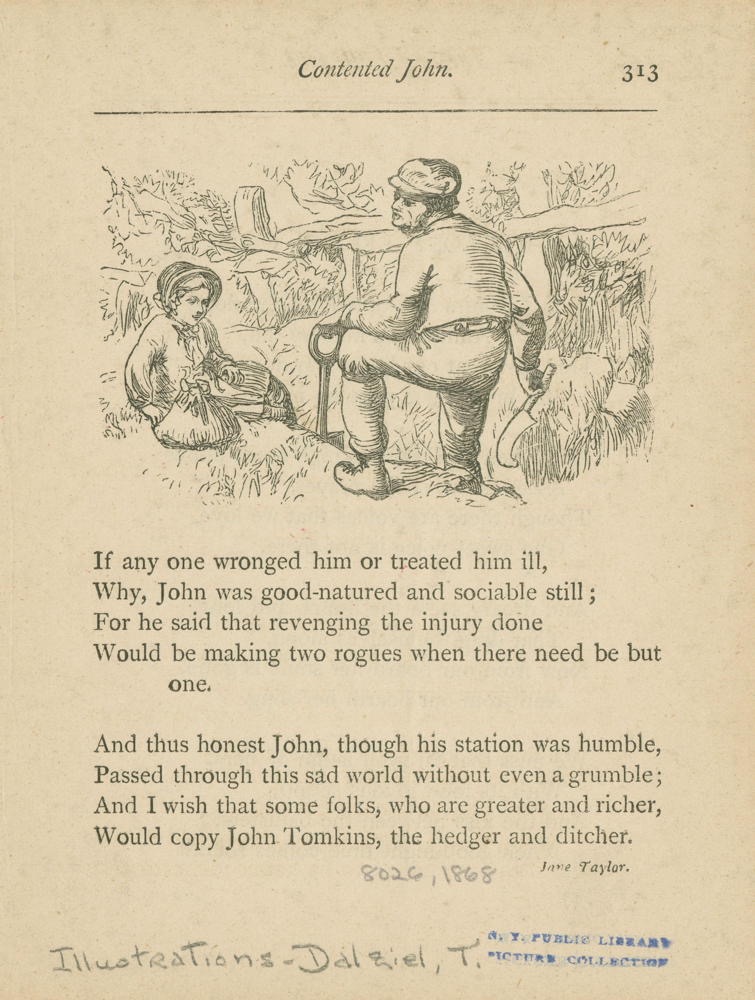
Thomas Bolton Gilchrist Septimus Dalziel, (Artist)
Dalziel Brothers (Wood-engraver):
Contented John. (1868)
Content: Illustration of "Contented John" by poet Jane Taylor.
Source Note: The children''s poetry. Being a selection of narrative poetry for the young; with illustrations by Thomas Dalziel, engraved by the Brothers Dalziel. 1868) Dalziel Brothers , Engraver. Dalziel, Thomas Bolton Gilchrist Septimus (1826-1906), Illustrator.
The Miriam and Ira D. Wallach Division of Art, Prints and Photographs: Picture Collection, The New York Public Library. "Contented John." New York Public Library Digital Collections. Accessed February 11, 2026. (https://digitalcollections.nypl.org/items/fa2a2ba0-c5bb-012f-990f-58d385a7bc34)
— — — —
"We can't seem to stop ourselves from coming back again and again to such contexts."
The plaintiff in the breakthrough social media lawsuit against YouTube and Meta, now taking place in Los Angeles, has introduced a novel approach to the proceedings. Internet “content providers” like Meta and YouTube have thus far operated under an act of Congress immunizing them from liability for content posted by third parties. Since both YouTube and Meta thrive largely as Context providers, with a few exceptions, they’ve survived accusations that their moderation excused offensive materials. The law explicitly assumes good faith moderation and that they cannot be treated as the publisher or the speaker of any information provided by another information content provider. This law, Section 230 of the Communications Decency Act of 1996 (47 U.S. Code § 230), has been referred to as the law that built the internet, for Congress created it to encourage the growth of the internet and to foster free expression. It has succeeded, though at some cost.
Many have expressed frustration when platforms like X, formerly Twitter, and Facebook, published lies and hate speech before elections, proclaiming exemption due to § 230 protections.
OpeningStatements
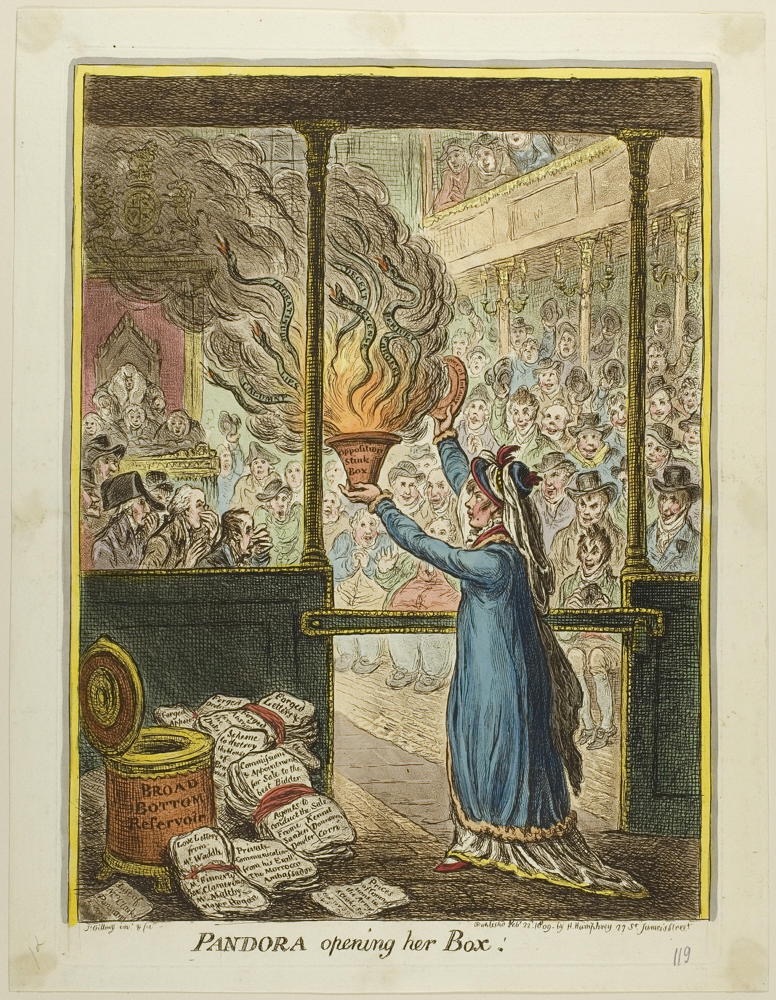
James Gillray: Pandora Opening her Box (published February 22, 1809)
published by Hannah Humphrey
"Progress moves more slowly than molasses."
The attorney for the plaintiffs delivered his opening statement in what PBS described as “a lively display.” He asserted that the case is “easy as ABC,” which he said stands for “Addicting the Brains of Children.” Simple as his case might be, he was nonetheless unable to complete his OpeningStatements before the lunch break. The defense, of course, denied every allegation, and so the process began. This is how we determine reality in the twenty-first century, just the way we did it in the prior centuries, for we demand proof, not necessarily beyond any reasonable doubt, but enough to compel the checkbooks to come out and cough up. Two of the wealthiest corporations in the history of corporations stand accused of deliberately engineering dependence in adolescents. I suspect they’ll be found guilty as charged.
We have always been cranky when it came to protecting consumers.
GreaterThan
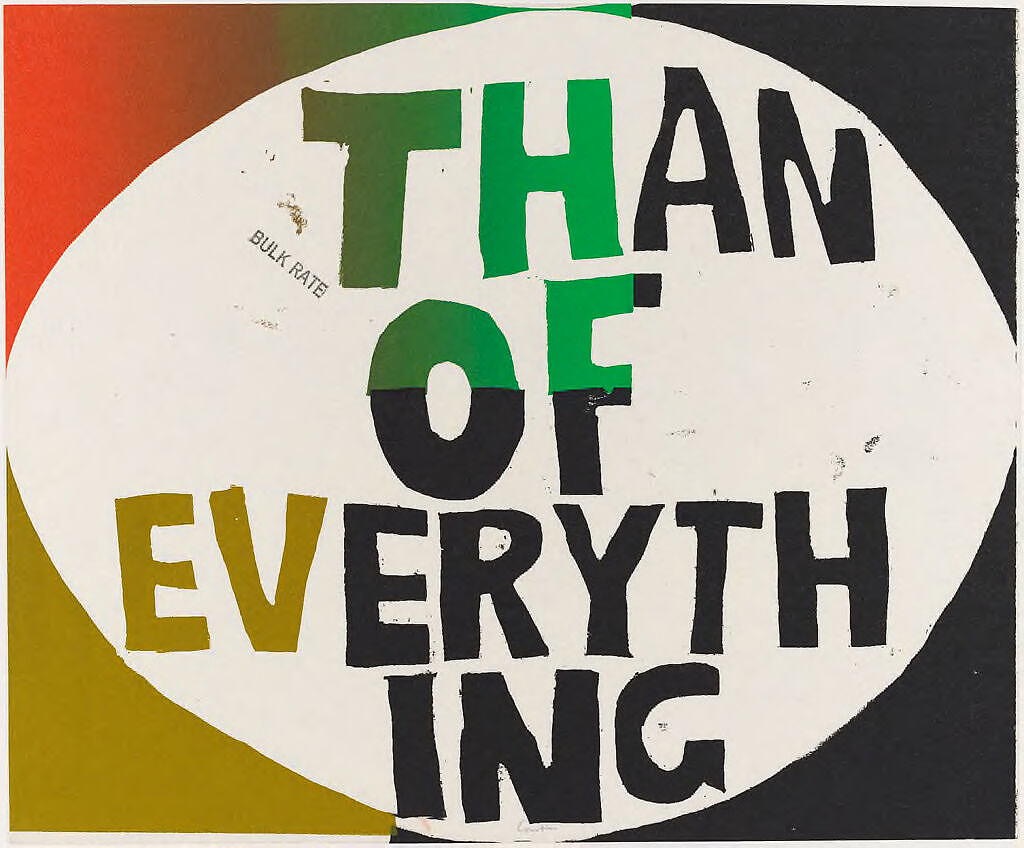
Corita Kent (Sister Mary Corita): than of everything (1967)
Inscriptions and Marks
Signed: l.c.: Corita
(not assigned): Printed text reads: THAN OF EVERYTHING
BULK RATE [stamped in black ink]
© Courtesy of the Corita Art Center, Immaculate Heart Community, Los Angeles / Artists Rights Society (ARS), New York
"(They don't speak the language.)"
I should have been more careful with how I characterized social media, for nothing was ever quite what it appeared to be. We each feature layers, each consequential but no single one ultimately definitional. We are always and inevitably a melding: yin and yang, helpful as well as utterly helpless, useless yet ultimately useful. Our nobility lies in precisely these dichotomies rather than along any margin or within any conclusion. Some days, perhaps even most days, social media sure does seem beyond redemption, yet abandoning it, even for its proven shortcomings, could only erase any possibility of any hope of redemption. Repeating ad nauseam, which might be the only way any such defensive strategies ever get repeated, creates a world of formerly hopeful alternatives, discredited in practice. We inevitably create a world of also-rans and disappoint ourselves.
Hope was never intended to resolve itself. It exists solely for its own sake.
Checkiningin/CheckingOut
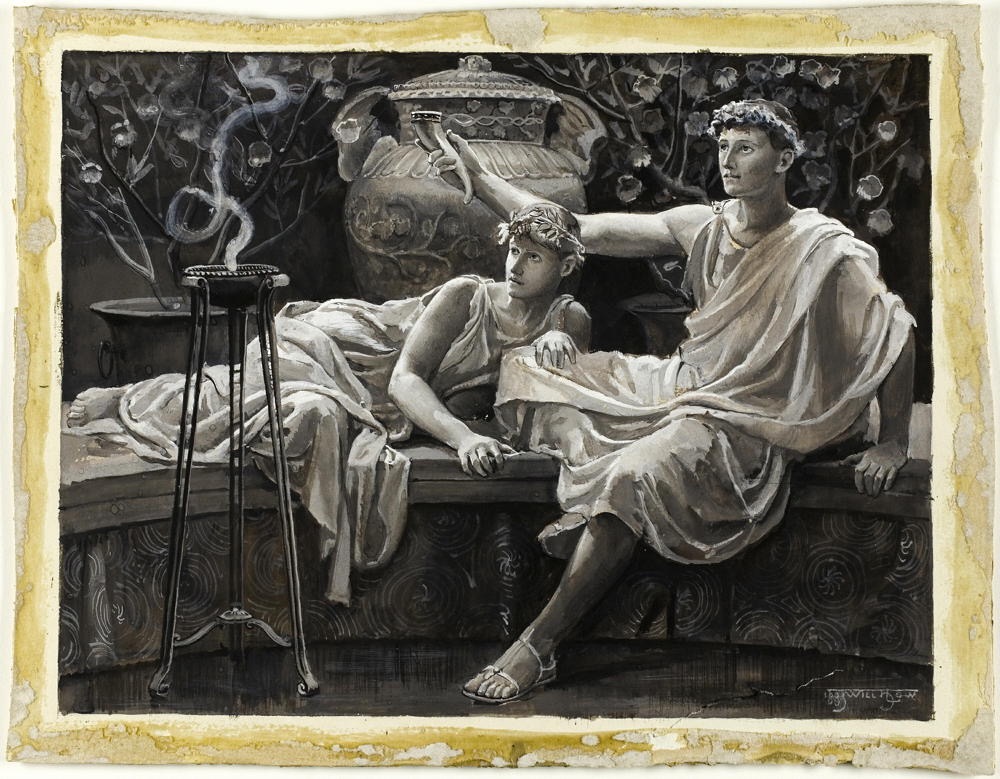
Will Hicok Low:
Checking His Love Trance, a Cup He Took Full Brimm’d (1885)
"I still feel compelled to check in from time to time
and seem to possess no reliable defence against Checking Out before I exit."
It seems to be the nature of social media that the mere act of checking in insidiously transforms into a form of checking out. All intentions aside, once inside, things naturally guide the eye to other, often unrelated, entries, before a trance completely overtakes the proceedings. I might consequently feel lucky to make it back out of there alive, though I sometimes feel as though I exclusively exit as some form of undead. Not quite dead yet, I wash up like an exasperated, if better-informed fish. I will have inevitably gained some remarkably arcane knowledge, often the kind with no obvious practical application, though somehow nonetheless supremely satisfying, as if I’d gorged on popcorn or salad dressing. My palate will feel temporarily satisfied without growing much more sophisticated.
My CheckingIn/CheckingOut boundary becomes my primary dichotomy. I seem unable to maintain a stable relationship between seeking important information an
ReelLife
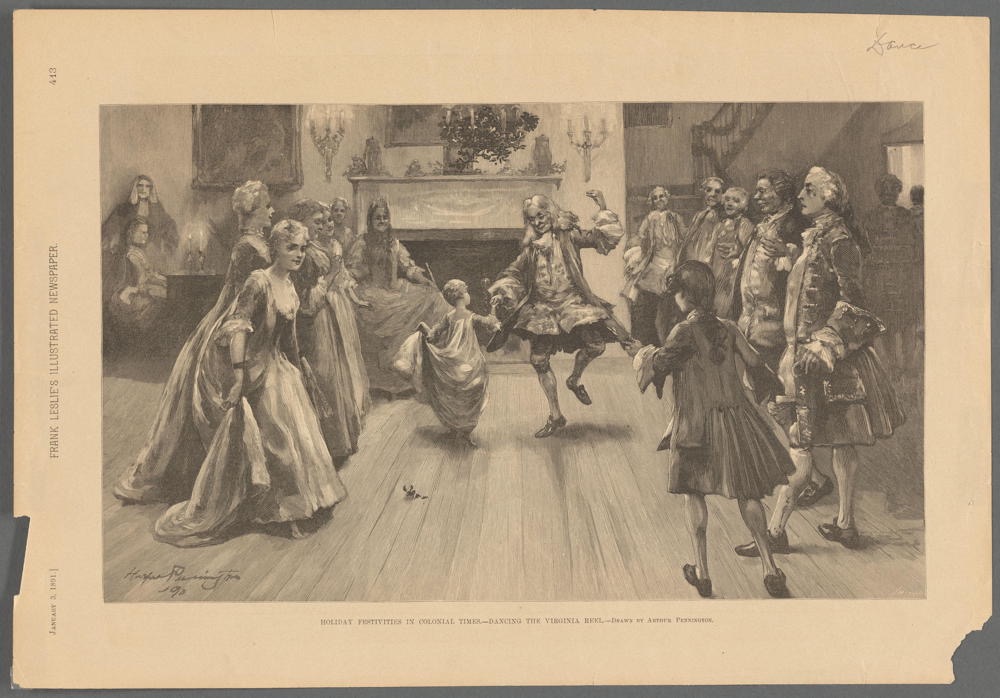
Harper Pennington: Holiday festivities in colonial times; dancing the Virginia reel (1891-01-03)
COLLECTION
Prints depicting dance
Theatrical dancers in groups or more than two but not in a ballet or theatrical dance scene
Josephine Butler collection of dance prints from illustrated periodicals
Jerome Robbins Dance Division, The New York Public Library. "Holiday festivities in colonial times; dancing the Virginia reel" New York Public Library Digital Collections. Accessed February 7, 2026. (https://digitalcollections.nypl.org/items/24c44fb0-f763-013b-db97-0242ac110002)
“Maybe all life qualifies as representational,
merely so many shadows on those cavern walls.”
Real life has always paralleled unrealistic representations of itself. The differences were explained as poetic or metaphoric, since no mirror image can ever be true to its image’s source. The mirror fiddles with perspective, but it provides access to experiences otherwise impossible. We somehow thrive in spite, or perhaps because of, obvious imperfections. The purists among us might deride the representations as not being “real”, though they certainly inhabit a 1820s real-enough space of their own. A novel might be fictional but still adequately-enough represent its subjects.
Social media’s little different, though it does prominently display some rather glaring contrasts.
Weekly Writing Summary For The Week Ending 02/05/2026
Wenceslaus Hollar: Spring (1644)
This was the writing week I dreaded since at least Christmas, though I found ample reason to celebrate before it finished. I discovered a fresh holiday, one capable of blessing rather than reliably damning me. This was a week of revelation. I conceded this week, with the petunias still alive and roses budding, that this might actually come to be the winter where winter never visited. We’ve had a few frosty mornings, but nothing sustained enough to set our gardens very far back on their knees. I mowed lawn this week.
I continued reframing my scrolling habits by ReadingBooks. I dabbled in a little StrategicForgetfulness, and stumbled into genuine realization by Trolling instead of scrolling my social media for a change, resulting in some serious change.
DigitalDespots
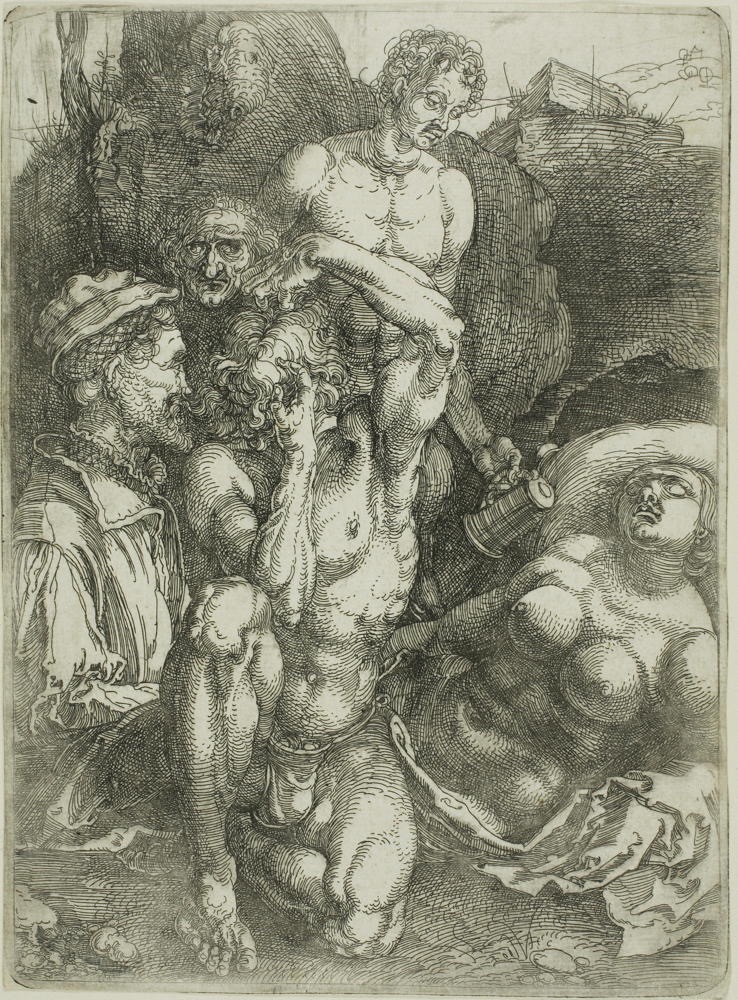
Albrecht Dürer: The Desperate Man (1515–16)
"There seems to be few viable alternatives. Caveat emptor here."
Was it always the case that the exercise of free speech rights attracted dedicated despots? This seems to be the case with our ‘internets.’ That space seems brimming with budding as well as practiced despots plying their slippery trade. The ratio of authenticity to absolute bullshit seems impossible to assess, but the presence of despotism there seems, finally, to be a given. It’s not just the Russians playing poltergeist, either, but what might appear to be upstanding business and political figures. Who isn’t suspected by someone? Whose motives are pure? The chief difficulty of any free speech medium might be that it encourages people to speak freely rather than circumspectly. Free speech has never been the same as loose talk, and social media seems to tolerate altogether too much loose talk. Is this the proper price for this franchise?
The greatest gift The Gods gave humans was the blesséd inability to read each other’s minds.
Macrocosm
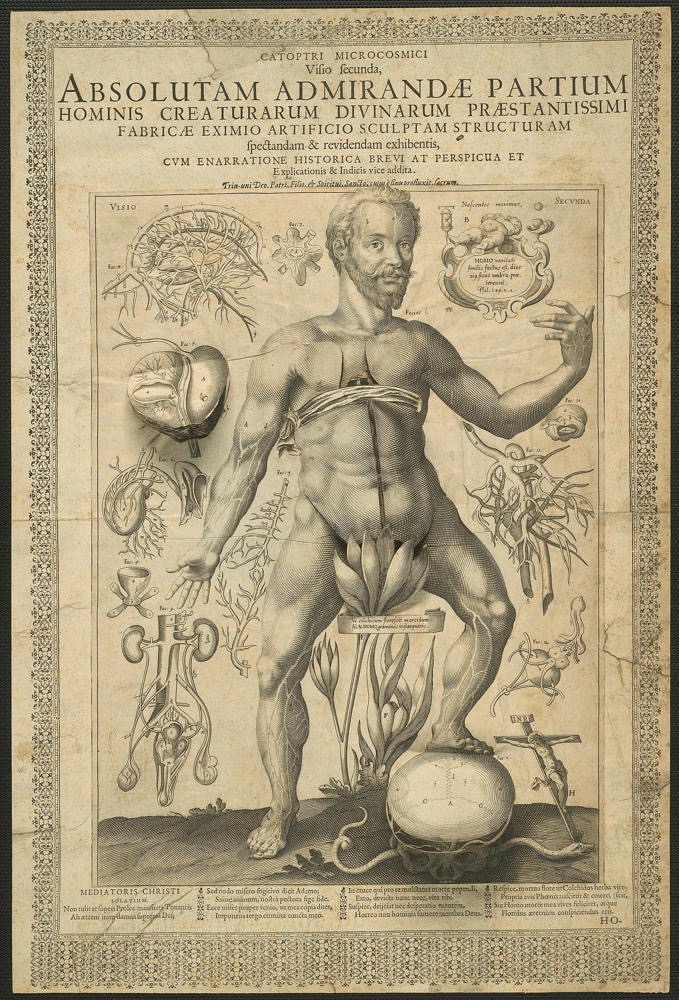
Lucas Kilian: Second Vision, from Mirrors of the Microcosm (1613)
"On my better days, I catch reassuring glimpses of it."
In the beginning was an idea, a concept expansive enough to encapsulate everything. As that idea spread, it began decomposing into constituent pieces, not because these were necessary, but because each represented choices, and because they seemed to better serve somebody or some constituency. The cynical, as they often do, eventually co-opted the more idealistic. They insisted that a system capable of connecting could easily accomplish division. They proposed creating profit centers. They encouraged shady operators to promote patent medicines and conspiracy rumors, certain to attract and entertain the least discerning. They encouraged trolls. The most progressive invention in the history of humanity became the primary engine of repression. Social media retains the DNA of its hopeful founders, though its stewards long ago largely chose cynicism because it offered greater revenue potential. Have we forgotten the originating whole? Has the medium lost its soul?
Each platform serves as a microcosm of the originating Macrocosm’s whole.
EssentialServices
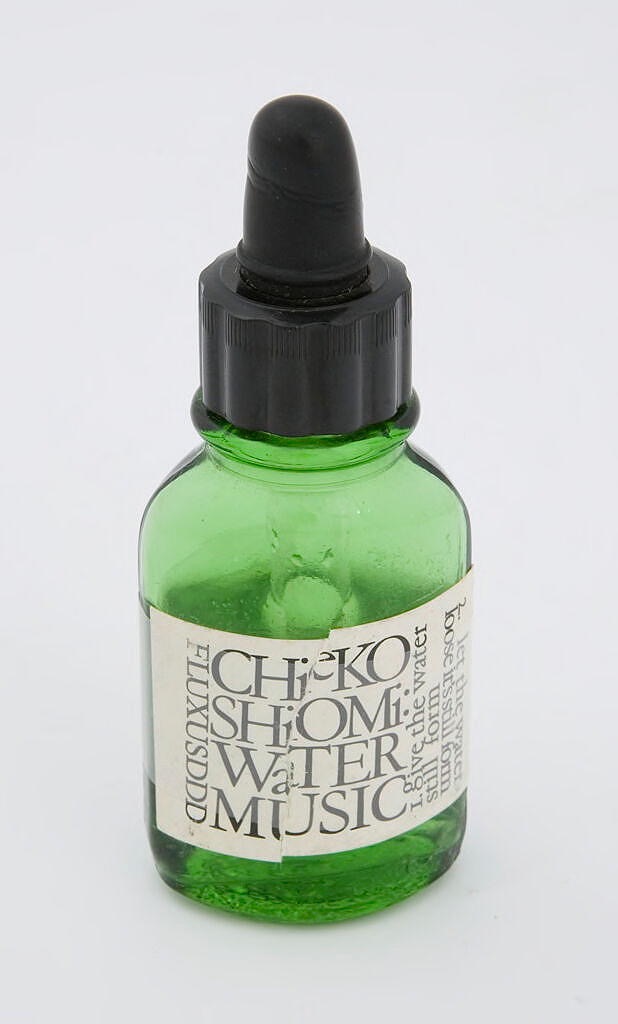
Mieko (Chieko) Shiomi, George Maciunas: Water Music (1964)
"Scrolling can serve some incredibly useful purposes, sometimes even EssentialServices."
I sincerely apologize for starting this series under what I should have known would turn out to become false premises, but each of my series so far has eventually stumbled into this same realization. I might conclude that non-false premises can’t coexist with serious series writing, since some of their purpose should rightfully and properly remain in actually discovering something. I couldn’t have known precisely where the falsity might emerge, only that it would inevitably emerge and, in doing so, turn me into, if not a liar, then a perveyor of partial truths. Absolutists, those who only peddle in complete truths, might not actually exist, so at least I might consider myself in reasonably good company. If my purpose was to discover something, I required some partially-baked basis upon which to initiate my search.
The issue might never be whether premises prove to be false or not.
Trolling
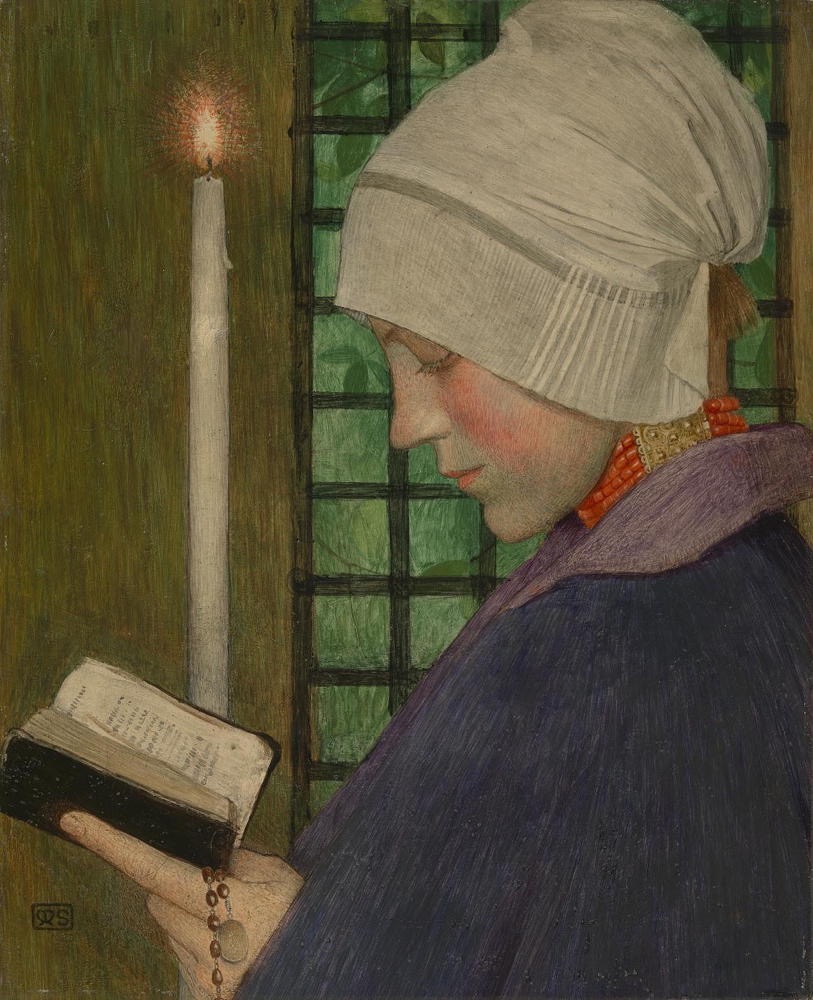
Marianne Stokes: Candlemas Day (1901)
"Her influence seems as eternal now as the Yew, and as paradoxical, too."
Today is the day I’ve been dreading since at least Christmas. For the last four years, I have anticipated this day with deep gloom, recognizing that there would be no way to sidestep the experience. It would come, wreaking havoc, then depart, leaving me worse for the experience. This seemed to be my curse, since this date will forever be the anniversary of my darling daughter Heidi’s suicide. Speaking with an old friend a week ago, I recounted my dreary January experience. He advised that I find some way to celebrate on that day. Celebrate her existence rather than her absence, he advised. February’s full of celebration days: Groundhog Day, Fat Tuesday, Ash Wednesday, and Presidents’ Day. It’s Black American Month, too, and Heidi was always touting how she was a citizen of the world, not merely an American. Now, she’s a citizen of the universe, and her presence continues to stick with me, her family, and her many colleagues. She’s become a force of history.
That she chose February 2 to depart this realm struck me as painfully ironic, for it seems to be the date that celebrates the promise of resurrection.
StrategicForgetfulness
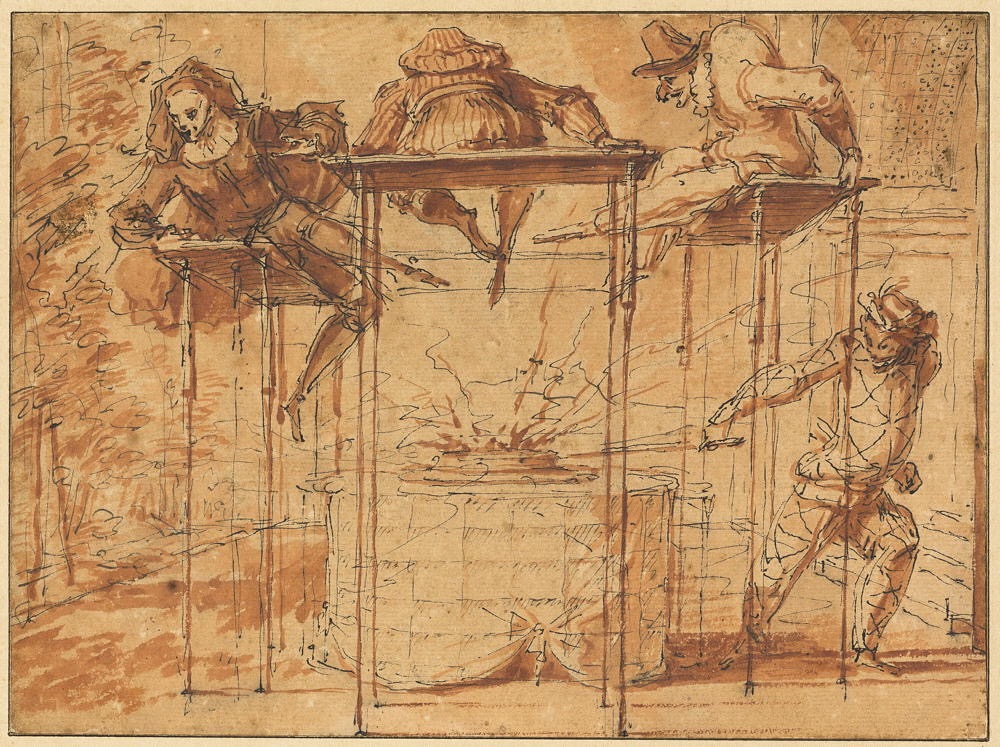
Claude Gillot: Harlequin Espirit Follet: The Comedian’s Repast
(c. 1700–1715)
"…forgetting my phone on purpose when I'd most often accomplish that by default."
However I might try to slice the challenge, Unscrolling still seems difficult. It carries the usual difficulties associated with trying not to do something, a philosophical impossibility if not necessarily a physical one. It might just as well be impossible for all the success I seem to engender whenever attempting to accomplish it. Not even my very best intentions, freshly shaved, showered, and dressed in clean jeans, seem capable of succeeding very often, and even then, it seems more accidental than intentional. Still, I accept accidental as a valid tactic, except I cannot will an accident any more than I seem to be able to not do something as seemingly innocuous as scrolling. Maybe I’m hopeless.
Hopeless or not, I don’t seem to yet be beyond leveraging my budding forgetfulness towards this end.
ReadingBooks
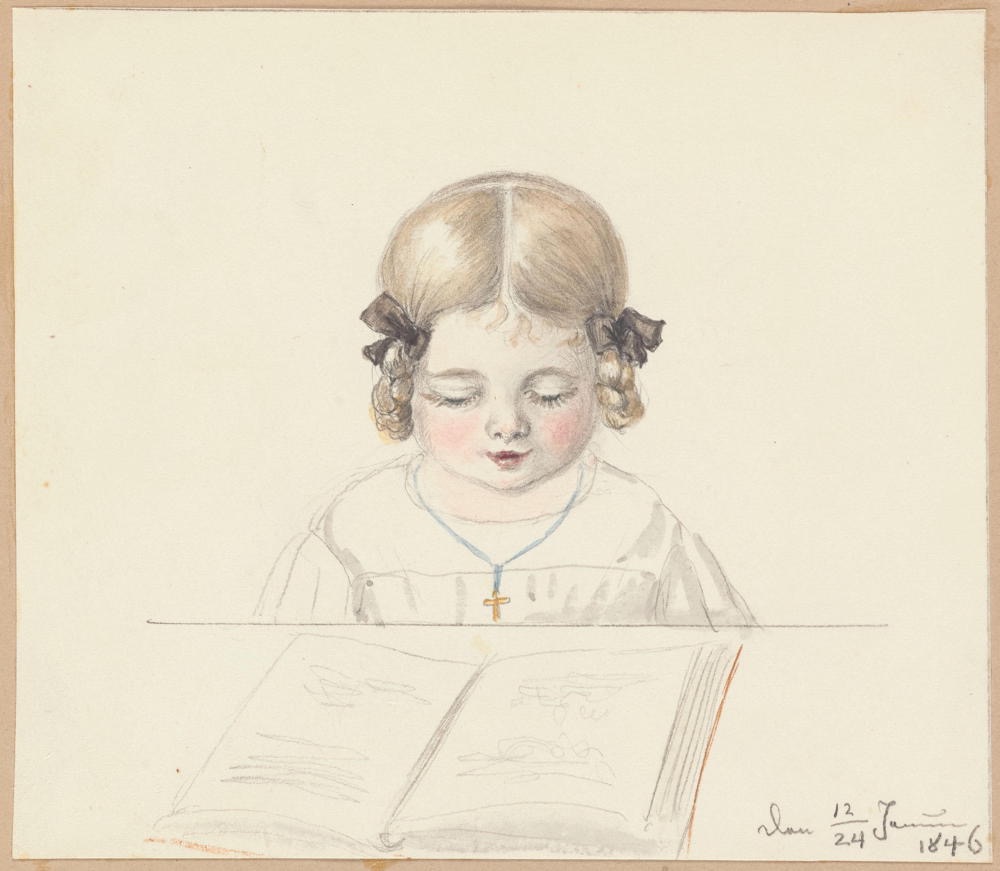
The Belevskii-Zhukovskii Collection of manuscripts, photographs,
drawings, books and printed ephemera
Vasilii Andreevich Zhukovskii family album:
Girl (Alexandra) reading a book (1846)
The Miriam and Ira D. Wallach Division of Art, Prints and Photographs: Art & Architecture Collection, The New York Public Library.
"Girl (Alexandra) reading a book" New York Public Library Digital Collections. Accessed January 31, 2026. (https://digitalcollections.nypl.org/items/0a3ba380-6a47-0135-7c5f-1dfb8ba095ee)
"I will revert to the literary for a change."
Unscrolling seems to demand alternative activities. If I’m dedicating myself to at least reducing my scrolling, to what might I reasonably assign the time I gain from the shift? Modern life has always insisted upon some attention being directed toward visual engagement. This might include anything from theater to ReadingBooks, but are either of those occupations really any different than scrolling? I mean, they can both serve as distractions and might well become problems if over-engaged in. Right? Television, in its infancy, was feared for its addictive trance-inducing qualities. Theater, too, might serve as an escape from rather than into anything useful. I contend that scrolling social media serves a unique and as a uniquely dangerous purpose, wholly unique from any of its analogue precursors. It’s different.
Social media scrolling seems to be an infinite activity.
Weekly Writing Summary For The Week Ending 01/29/2026
Kobayashi Kiyochika 小林清親: Braving the Bitter Cold,
Our Troops Set Up Camp at Yingkou (1895)
Published by Matsuki Heikichi 松木平吉 (1836 - 1891)
I wish every writing week would leave me feeling as though I’d discovered as much as I managed to stumble upon this writing week. I troll for insight, but I’m not always rewarded for my efforts. Writing this series feels very much like fishing. Some streams, some weeks, hold many fish, while others prove to be fallow. I’m not quite foolish enough to think of myself as a masterful fish attractor. I show up, mustering some hope for the best, and I feel genuinely blessed when my gumption’s rewarded. This week seemed a mother lode in comparison to most.
I sense my originating presumptions shifting, as any originating presumption should.
Civil-Liability
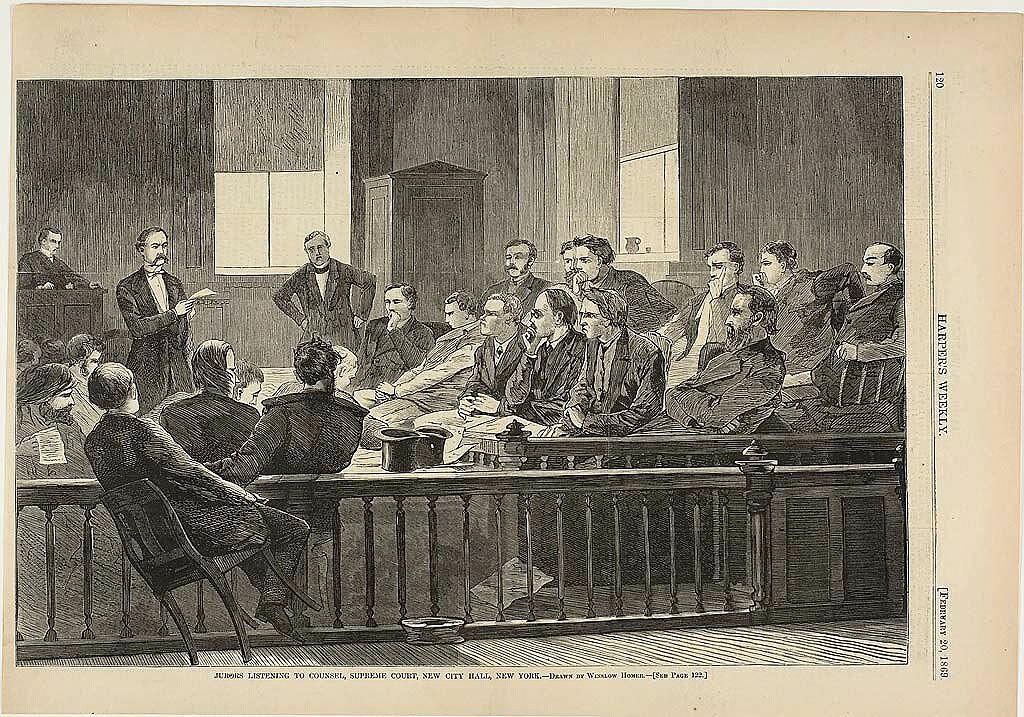
Winslow Homer: Jurors Listening to Counsel,
Supreme Court, New City Hall, New York (published February 20, 1869)
"Stay tuned. We all might end up on the payday side of some future class action."
This week, in January 2026, marks the start of what might prove to be a new era in the history of social media in the United States. A civil suit brought by a 20-year-old woman, identified as “K.G.M.”, who created a YouTube account at age 8, then joined Instagram at 9, Musical.ly, now TikTok, at 10, and Snapchat at 11, finally comes before a jury. Her lawsuit claims she became addicted to the social media sites as a child and experienced anxiety, depression, and body-image issues, including attempted suicide, as a result. TikTok and Snap, the parent company owning Snapchat, settled with the plaintiff before trial began. The remaining defendants will claim protection under a federal shield law, Section 230 of the Communications Decency Act of 1996, that has thus far protected them from liability for what their users post online.
K.G.M. seeks monetary damages and will reportedly present a case based upon similar arguments that resulted in huge settlements against Big Tobacco in the 1990s, when companies like Philip Morris and R.J. Reynolds were accused of hiding information about the harms of cigarettes.
Dooming
Sir Edward Burne-Jones:
Perseus and Andromeda, study for The Doom Fulfilled (1875)
"Dooming seems to inevitably become self-fulfilling."
As our economy slumps, one segment remains robust. The Doom Industry has been achieving new heights monthly, as each successive performance outstrips the previous. The market for handbaskets has likewise proven robust, with demand up and supplies reduced in each of the prior twelve months. Both the doomposting and doomscrolling segments of the industry have been thriving, thanks in no small part to our administration that continues to steadfastly—some suggest valiantly—refuse to properly administer even the smallest functions. No analyst needs to dig very deep to find reinforcing data. Every headline, as well as each obscure footnote, screams demise. If only we could tout such performance from the balance of our economies. Unfortunately, we cannot.
The Doom Industry grew in parallel with the internet.
OutCivility
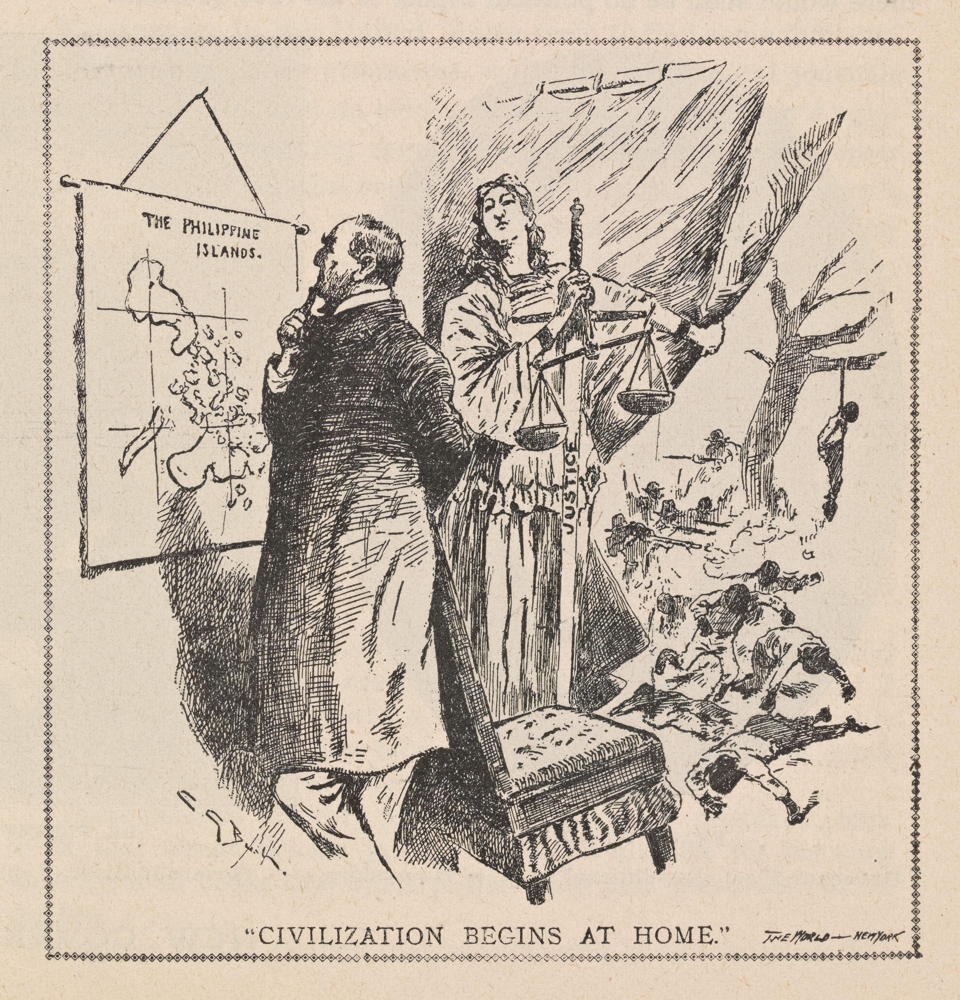
Charles Green Bush: "Civilization begins at home." (11-26-1898)
General Research Division, The New York Public Library. (1898 - 1938). "Civilization begins at home." Retrieved from (https://digitalcollections.nypl.org/items/baced180-c607-012f-777f-58d385a7bc34)
"Civility can only be meaningfully measured in eons.
It inescapably tries our patience."
Perhaps the major complaint I hear against social media in general and scrolling in particular harps about the incivility found there. People, freed of face-to-face constraints, speak altogether too freely, as if civility didn’t actually matter, as if the rules of engagement had suddenly been suspended. This complaint seems unquestionably true. We do do that to each other: sister to brother, neighbor to neighbor, stranger to stranger. Who hasn’t failed to catch themself before committing some public truth probably much better left unspoken? Who hasn’t had to crouch way down, failing to avoid some judgmental frown, or been the source of the same aimed toward some other sinner, as if they’d never failed in public themself. We seem to have known no shame when we shame, to alone stand innocent of anyone’s blame. The primary criticism of social media might be that it too effectively amplifies our hypocrisy.
Leaving Facebook won’t cure this because Facebook was never the cause.
TheCuriousCase...
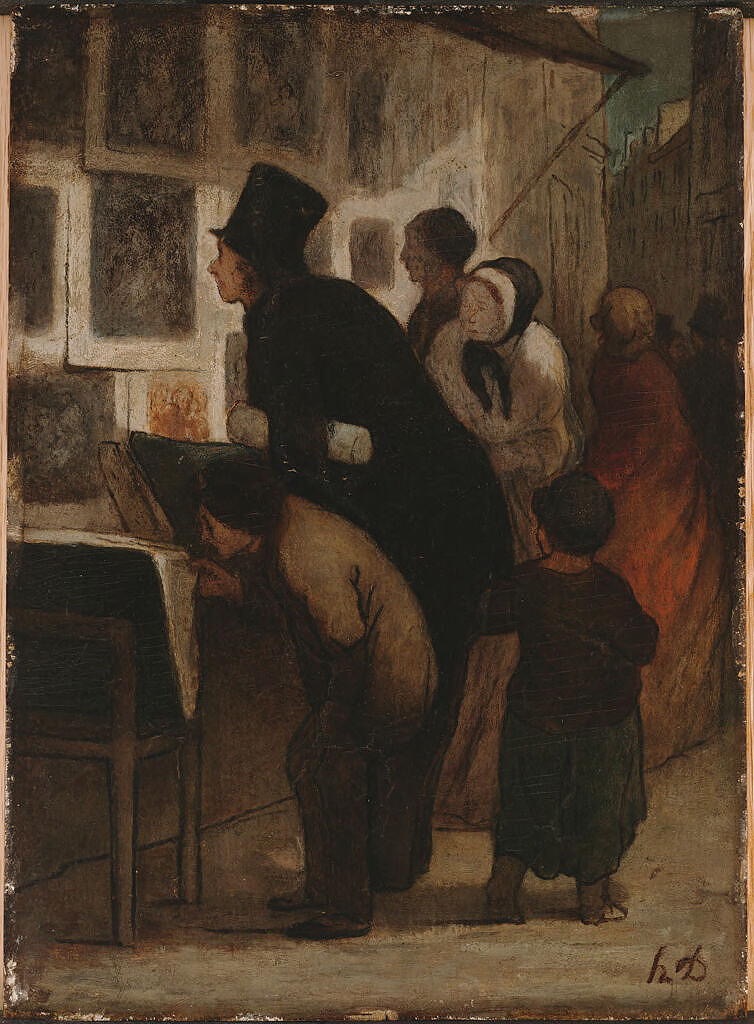
Honoré-Victorin Daumier: The Print Amateur
[L'Amateur de Gravures / Les Curieux à l'Etalage…]
Alternate Title: The Curious at the Display (c. 1855)
"A marriage created in purgatory."
During The Damned Pandemic, I discovered Heather Cox Richardson’s reassuring voice. In daily “letters,” which she posted to then-budding social media, she debunked the craziness espoused by the then-inhabitant of the Oval Office. I found her to be quietly reassuring and authoritative. She brought her deep understanding of history to the party, usually leaving me feeling better oriented as to how my situation fit into broader historical contexts. She became irreplaceable.
With that incumbent’s surprising return to elected office, her voice took on fresh vehemence, since said incumbent immediately set about trying to make America Stupid Again again.
InHere OutThere
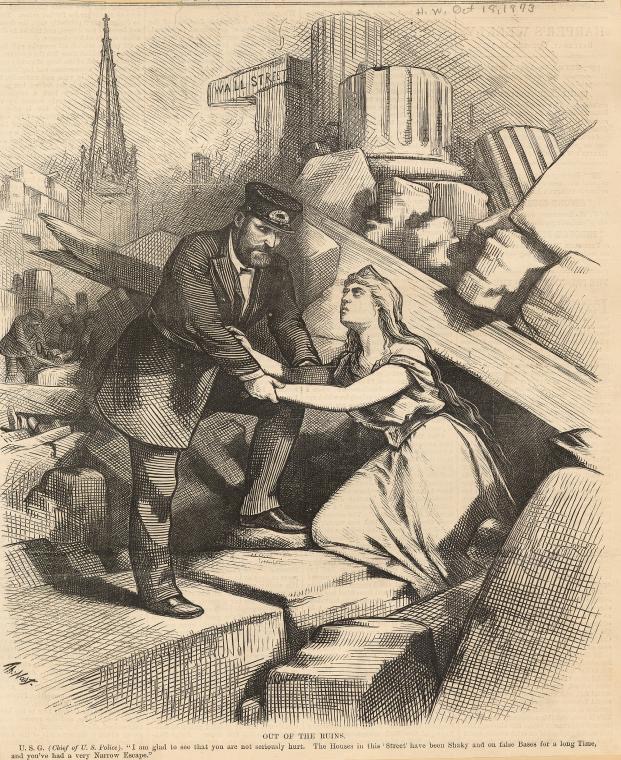
Thomas Nast: Out of the ruins... (10-18-1873)
"I seem satisfied to accomplish no more than to gape at shadows playing on some utterly imaginary wall."
Social media scrolling fiddles with the In Here/Out There boundary. Firmly focusing on the media via any device induces a convincing illusion of In-Hereness. It sure seems then as though the real world—by which I refer to the flesh and blood world—was Out There and the distantly disembodied virtual world was the more intimately personal one. This effect might amount to little more than a figure/ground misattribution if it weren’t for the broader and deeper ramifications stemming from this situation. I guess that video games can induce the same effect, where their user inhabits the projected world more confidently than they inhabit their own body. Normal activities of daily living might go begging in favor of feeding the non-sentient presence. Schools have begun confiscating students’ cell phones in acknowledgment of just this influence. For whatever reason, virtual existences seem to be terribly attractive in ways that can ultimately prove to be self-destructive.
The self in this face-off voluntarily surrenders to its virtual counterpart.
JungleTelegraph
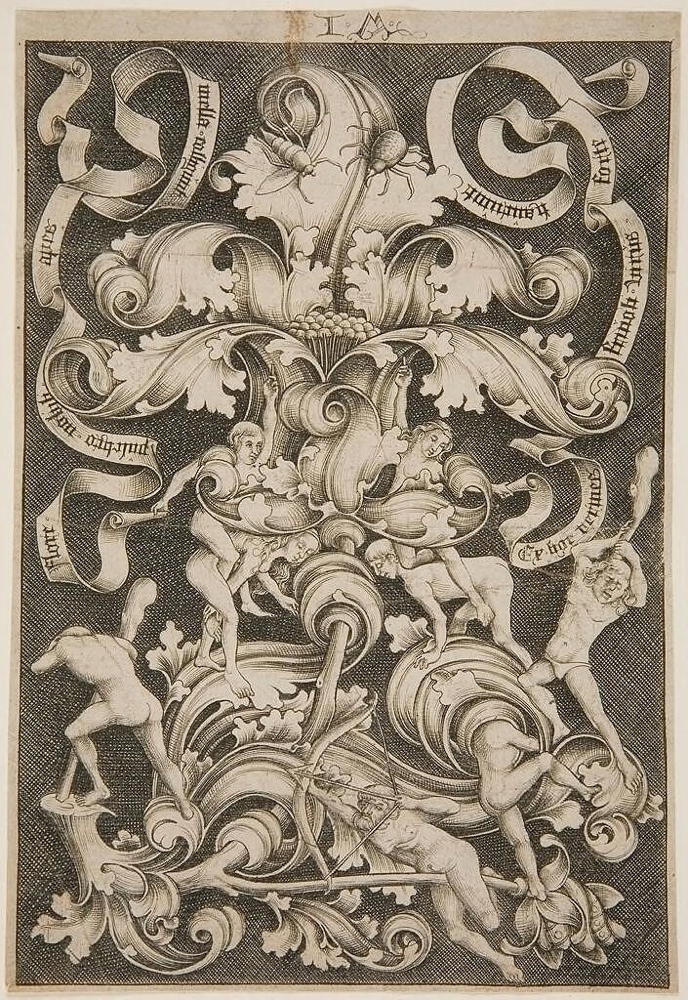
Israhel van Meckenem the Younger:
Wild Men Climbing to the Flower of Love (15th-16th century)
"What harm could it possibly do to learn that Tarzan's on the move again?"
Somewhere within every Tarzan movie ever made, some group would go on the move. Background jungle sounds would increase, but not so much that any non-native would notice. Every inhabitant seemed to get involved. Elephants would trumpet and monkeys chatter, lions would roar, and alligators splatter. The purpose of the commotion would be a form of primitive communication that seemed to transcend language, for every animal: human, hippo, and reptile, seemed perfectly capable of passing on the message, which would remain deeply encoded. Tarzan, of course, having been raised in the jungle, was perfectly conversant, so he could translate. He knew, for instance, when the bad guys began their inevitably failing pursuit because his animal allies would keep him informed. When he’d swing off on his conveniently separated vine highway, word would spread so his passage wouldn’t surprise anybody but the bad guys.
Our social media serves as our JungleTelegraph today.
Weekly Writing Summary For The Week Ending 01/22/2026
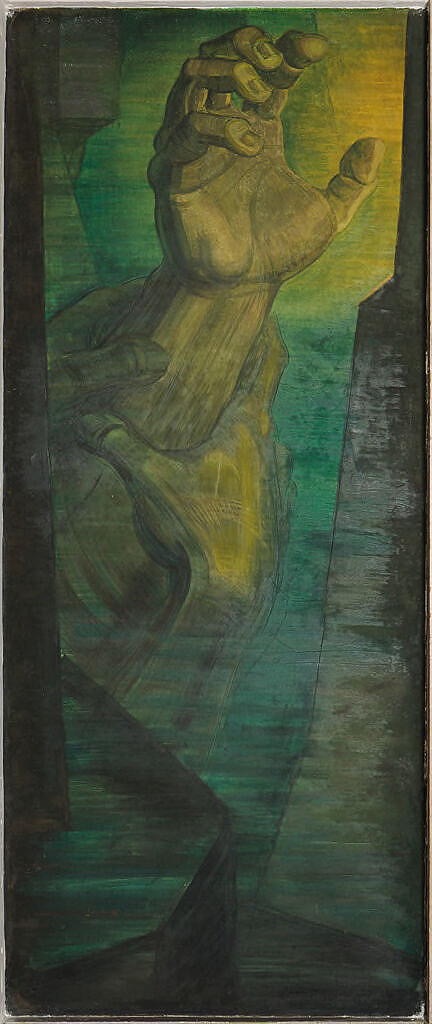
Lewis W. Rubenstein:
Scene from the Niebelungen Legend: Alberich's Hand (1935-1936)
This writing week found me even more fully engaging in the curious occupation of Unscrolling. I began the week KillingTime, an activity I characterized as sometimes necessary, perhaps essential. I next noted the Spurious Premises social media offers, though they sure don't seem all that spurious when I encounter them while scrolling. I noticed and reported on how scrolling seems perfectly suited as an activity for the Powerless, and that, perhaps, it's "just" a symptom rather than a problem. I then declared the enormous difference between simply ceasing and genuinely Desisting, insisting that desisting often proves impossible. I introduced the Witness/Participant balance, which seems currently out of balance to me. I ended this writing week insisting that scrolling social media amounts to spying on myself. Thank you for following along as I try to understand this obsession we seem to so vehemently rely upon.
Surveillance
Simon Guillain: "A famous spy!," plate 77.
Series/Book Title: Cries of Bologna [Una spia famosa] (17th century)
"We probably deserve anything stemming from our sorry reasoning."
In late April 2024, President Biden signed the Protecting Americans from Foreign Adversary Controlled Applications Act, a bill passed by both houses of Congress in response to the abuses of TikTok’s Chinese parent company, ByteDance. The Act insisted that the company had systematically spied on American citizens, using TikTok as its medium of intrusion. The Act banned TikTok in the United States after January 20, 2025, the date of Trump’s second inauguration. The Trump administration refused to enforce the law as one of its first formal acts, later forcing ByteDance to sell TikTok in a transaction from which Trump was reported to have profited. Consequently, TikTok has gained even greater presence in our social media environment, without reassurances that it won’t continue its Surveillance on American citizens, and without an ounce of enforcement of the provisions of that act of Congress.
Perhaps the most disturbing aspect of our national scrolling habit might lie in this underlying, corrupting quality.
WitnessProtection
Attributed to Jacob de Wit: Druids Cutting Mistletoe
(Artist's working dates 1715–1754)
"…what once seemed fair enough and fairly well balanced now sure seems fairly poorly balanced."
I might be destined to play catch-up for the rest of my life with little hope of actually catching up to anything. I hold the sorry distinction of having imprinted on ways of existence that no longer exist, and very likely will never exist again. I, myself, am not yet obsolete, but many of my understandings and coping mechanisms have definitely gone the way of the goony bird. I remember, for instance, a certain balance between my role as witness to these proceedings and my role as a participant therein. In those days, I achieved balance through much more participation than through witnessing. Witnessing was more of a passing part of my existence. I was much more of a participant. Television, of course, steadily eroded the historical boundary between participant and observer, even more determinedly than had radio before it. I remember my elders warning me, much as I later warned my own progeny, that they were in danger if they spent too much of their potential participatory time decomposing, witnessing in front of the boob tube.
The phone in each of our pockets makes the old black-and-white boob tube look absolutely brilliant, and our early witnessing in front of it seems downright participatory in comparison.
Desisting

Jan Toorop:
Image Design for a Poster, Wagenaar’s Cantata ‘The Shipwreck’ (1899)
"Ceasing's relatively easy. Desisting's inevitably difficult and often impossible."
Unscrolling belongs to a rather unique class of objectives, the Negative Space ones. Each features the character of nonexistence as its premise. They never aspire to attain or acquire, but to rid themselves of something. What might precisely replace that unwanted element never gets mentioned in its title. These provide no hint, not the barest clue of what might do as a replacement for the unwanted element, just that its purpose extends no further than elimination of that space presently containing that unwanted item. In our case, through this series, I’ve labeled our negative space objective “Unscrolling.” Notice how it declares only what it doesn’t want. It wants to undo scrolling, whatever that might entail.
The most curious property of every negative space objective might be its apparent, even obvious simplicity.
Powerlessness
Randolph Caldecott:
"This is the cow with the crumpled horn, that tossed the dog."(≈1912)
The Miriam and Ira D. Wallach Division of Art, Prints and Photographs: Picture Collection, The New York Public Library. "This is the cow with the crumpled horn, that tossed the dog." New York Public Library Digital Collections. Accessed January 19, 2026. (https://digitalcollections.nypl.org/items/751bf0f0-c5bc-012f-99fe-58d385a7bc34)
"We engaged in passionate revolution and found that it rendered us Powerless…"
Social Media seems to be the perfect means for the Powerless to interact. It requires no physical presence. One can safely cower in their individual redoubt without exposing any vulnerable surfaces, yet still maintain a fairly convincing illusion that they’re communing. One might post radical ideas without fear of anyone reacting with much more than disembodied comments, easily discounted. It seems to out-virtualize virtual, a place to call in one’s presence and distantly engage. It provides a spare illusion of interaction, but in comparison to nothing, it proves convincing enough for our general intents and purposes. No need to stand at the podium to speak to power when one can more conveniently email in that criticism. Why look anyone square in the eye if you can anonymously spy on their personal life? Why make amends when you can just unfriend in response to disagreement?
Social Media makes for a perfect playing field for insurgents.
SpuriousPremises
Artist unknown
[spurious signature of Zhao Mengfu (1254-1322), dated 1301]:
A Hunt in the Mountains of Heaven
(Late Ming /early Qing dynasty, 17th century)
"They wandered so far from truth that they cannot relate to it anymore, if they ever could."
The social media world’s content seems defined by an overwhelming presence of SpuriousPremises. It seems unabashedly not whatever it declares itself to be. Headlines routinely misrepresent content. Content often gets continued to pages containing only advertising, rarely the rest of even an enticing story. Pages one might care to revisit usually disappear without leaving even the hint of a trace of their permanent location. Advertising, haphazardly curated for maximum offense and irrelevance, usually interrupts any content threatening to be of real interest. Even the more trusted commentators seem to care more about commanding viewers to subscribe to their channels than they seem interested in imparting their touted important information. They almost always bury their ledes behind an indeterminate length of barely relevant and uniquely uninformative pre-ramble. I can count on the fingers of one hand, with fingers left over, social media posters who avoid such antics.
I like to think of myself as an exception to these apparently otherwise ironclad principles of social media engagement.
KillingTime
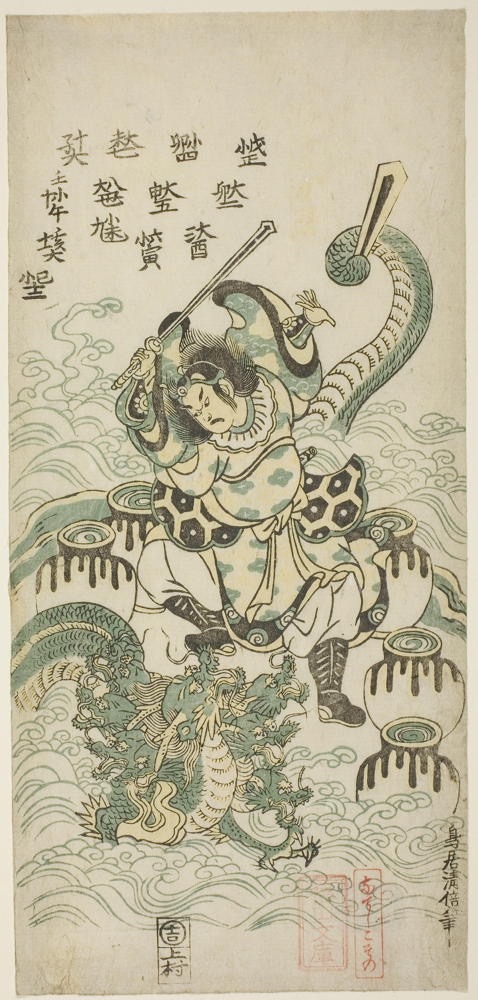
Torii Kiyomasu II:
Susano-o no Mikoto Killing the Eight-headed Dragon (1748)
"…ressurect something crutially important in me by Killing off some of my extra time."
I arrived at the venue an hour and a half early. The annual Chamber Music Festival had started the night before with a string quartet delivering Benjamin Britten, starting at six o’clock. I had presumed, without confirming, that the Friday evening performance at a different venue would start at the same time, but I was wrong. The festival organizer approached me, asking if I felt as though I’d arrived a little early, since nobody but the two of us and that night’s quintet were present, the quintet warming up with a little Mahler on the makeshift stage. He welcomed me to stay and listen to the sound check, but I ducked out the door instead, heading back to The Schooner, which I’d left in a remarkably great parking spot.
I had some time to kill.
Weekly Writing Summary For The Week Ending 01/15/2026
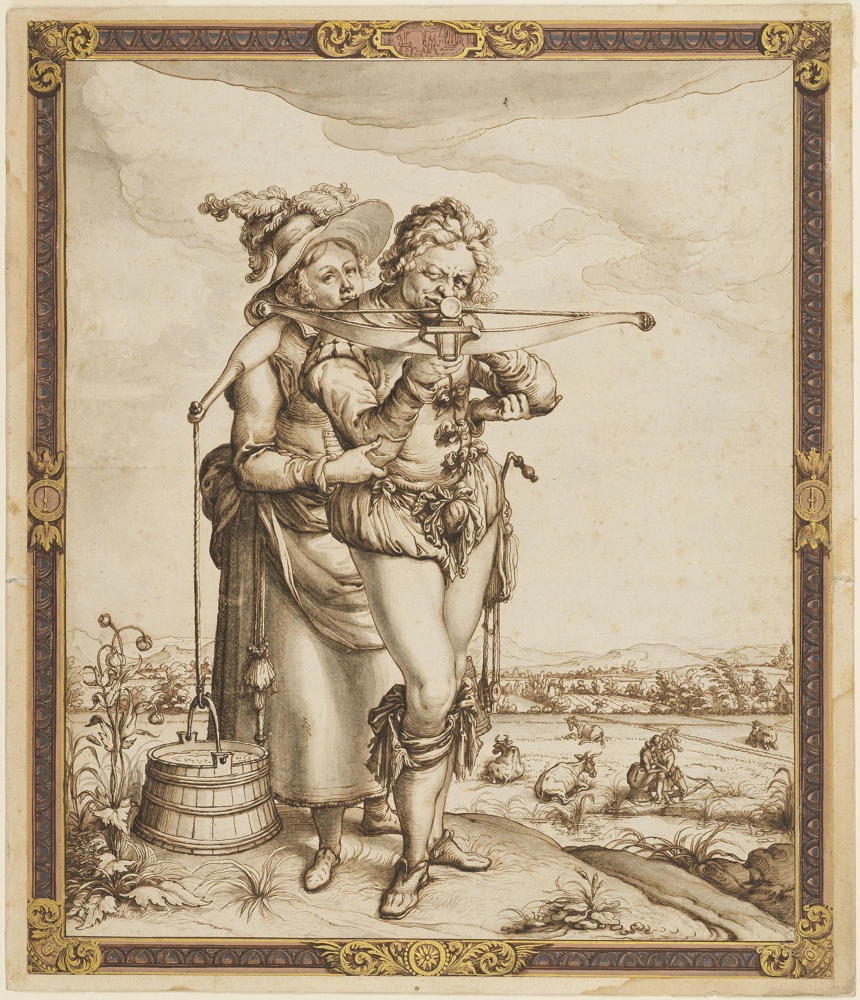
Jacques de Gheyn II: Crossbowman Assisted by a Milkmaid
(c. 1600-1610)
This writing week sure seemed as if I started making steady progress. Each story opened up a fresh realization about the nature and practice of Unscrolling. Doomscrolling was not what I had presumed it entailed. Unscrolling hasn’t been either. I began this writing week commenting on how ungrokable social media content seems to be for me in “Ungrokkability.” I then noticed that doomscrolling never qualified as my work. I reported that I had discovered a Distraction Hierarchy and that distractions don’t necessarily have to be negatives. I commented in passing on the sense of Immediacy I see in social media content and access. I noticed that some memes, perhaps most, carry a sense of Self-Evidence. They seem unquestionable and rarely encourage much in the way of questions. I ended this writing week reporting how Vulnerable I tend to feel just before I resort to doomscrolling. Thank you for following!
Vulnerable
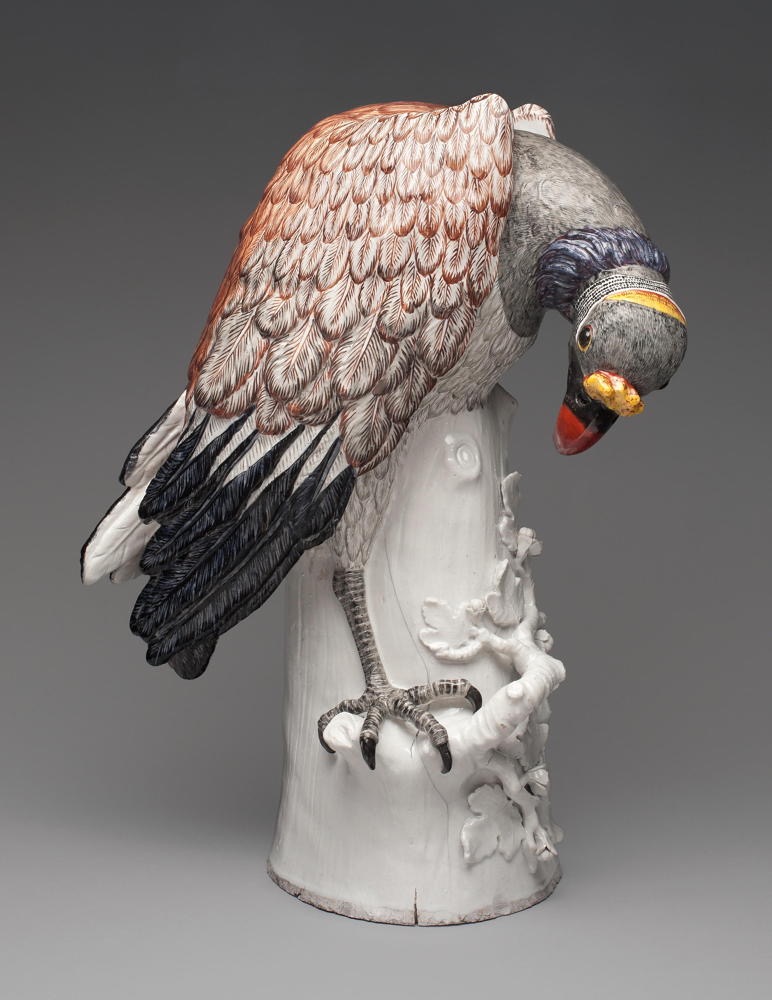
Modeled by Johann Joachim Kändler: King Vulture (1734)
Meissen Porcelain Manufactory (1710–present)
Meissen, Electorate of Saxony (now Germany)
ABOUT THIS ARTWORK
As elector of Saxony and king of Poland, Augustus II (r. 1694/97–1733) presided over the ambitious transformation of his capital, Dresden, through advances in architecture, the arts, science, and technology. Produced beginning in 1710 through royal sponsorship and funding, Meissen porcelain was an exclusive luxury good of its time. Around 1728 Augustus conceived of replicating the animal kingdom in porcelain for display in a Baroque palace that he was transforming into a showcase for his collections of Asian and Meissen ceramics. This porcelain zoo was intended for the long gallery on the main floor of the palace. By 1733, the year the king died, more than thirty different models of birds and almost forty animals had been made, many by the sculptor Johann Joachim Kändler, who worked at Meissen from 1731 to 1775. Kändler drew this vulture from life, which allowed him to animate his work with the creature’s quintessential spirit. Such porcelain animals remain the most vivid expression of Augustus’s wish, as elector and king, to possess and rule over the natural world.
"Every minute I'm not scrolling my social media,
I'm looking out for encroaching Federals."
Now that I’ve started reducing my social media scrolling, I’m noticing some things that were invisible before. Back when I was still more or less mindlessly engaging in scrolling, I’d failed to notice the feeling associated with initiating another scrolling session. Hell, I’d hardly noticed when I started scrolling again. I would usually notice I was scrolling after I had been scrolling for some indeterminate period of time, like awakening from fitful sleeping. Now that I’m more deliberately regulating my scrolling, I seem more capable of feeling and of noticing. The sense I get as I slip into another trance-like session feels like one of extreme vulnerability, bordering on desperation. I often feel stymied, and then, as if I’m incapable of independent action, I feel co-opted. When I experience this state, scrolling envelops me like a protective older sibling. I notice that I feel this way a lot lately.
Our incumbent seems as though he’s designed his whole administration to induce just this sensation on the general population
Self-Evidence
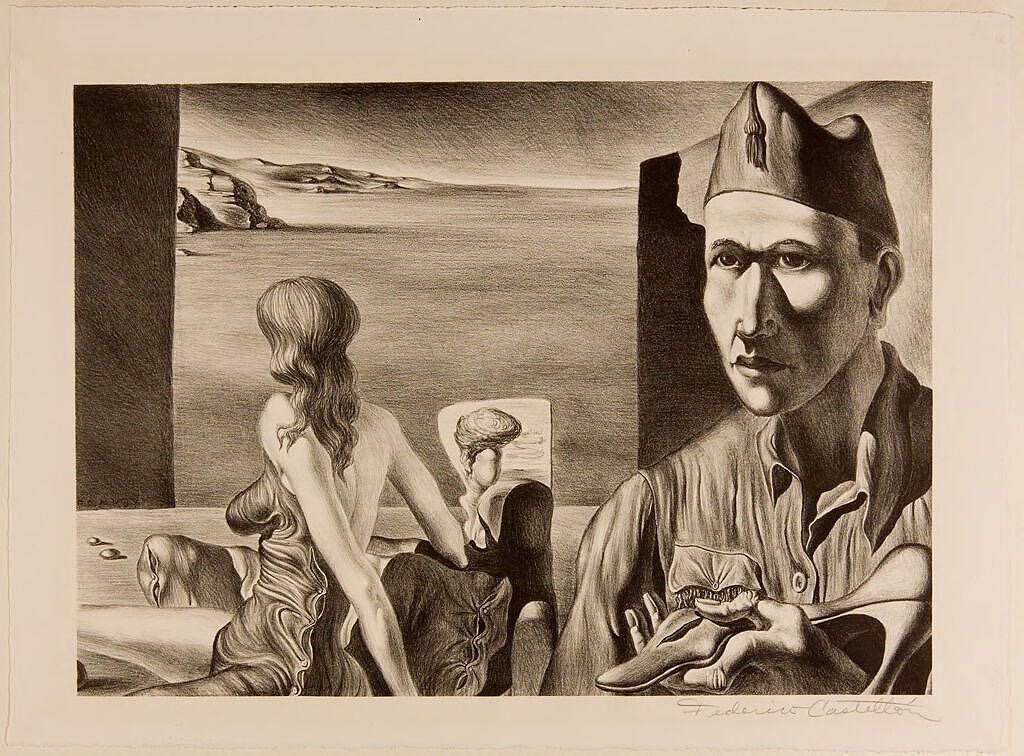
Federico Castellòn: Self-portrait (20th century)
"Disconnecting from the twenty-four/seven reinforcement machine has been helping me see what wasn't otherwise self-evident, and what, disturbingly, was."
The very impermanence of social media messaging fuels the need for almost constant repetition of certain themes. Depending upon what each user’s algorythm presumes, unique reinforcements of prominent messages continue virtually continuously: continually and virtually. This repetition results in certain concepts, “memes”, taking on a unique quality. They enter the realm of Self-Evidence. They require no proof. They inspire no questions. They become givens. For those not initiated in a particular strain or dialect of these babies, the result can seem completely disorienting. Messages seem to start somewhere in the middle, producing incoherence. For those inculcated, though, the memes hardly require repeating. They seem to be echoed more for the purposes of reinforcing than declaring, for their assertion, their very certainty, seems Self-Evidently correct. Nobody for whom they’re targeted finds any reason to question what they presume. They presume virtually everything.
Doom Scrolling serves as an essential element of this Self-Evidence.
Immediacy
Giovanni Battista Moroni: Portrait of an Ecclesiastic (c. 1557)
"…the journey seems deliberately designed to lead us nowhere but to keep us endlessly coming back, a Modiüs Strip existence."
Social Media has managed to project a space where neither future nor history exists. It exhibits in a moment, for that moment. It produces no memory nor projects any gonna-be. It exists only for the instant encountered. Once experienced, it might just as well never have been. It takes living in the moment, one click less retentive. It’s outdated before you can finish a single serving, never to return. Because of this, it lacks apparent purpose, deeper or otherwise. It deals exclusively in the superficial. It seeks only attention: not recognition, certainly not retention. It counts its presence in clicks, that most ephemeral of all presences. It collects flashes of fleeting acknowledgement, disembodied, timeless, useless for other contexts.
Try to create a list, in ascending time sequence, of your own postings to your own private Facebook group.
DistractionHierarchy
Unknown Artist: Publisher's proof of the publications of L. Prang & Co.
: Trade card depicting a distracted waiter (1876 - 1890, Approximate)
"Both scrolling and unscrolling must be gold-plated…"
I have been guilty in this Unscrolling Series of implying that distractions are necessarily bad, when they’re most decidedly not necessarily so. This culture thrives on distractions. I dare say that our economy would be in much worse shape than it already is if we were to suddenly abandon our distractions. Shopping itself, a necessity for sustaining life, often serves as a distraction for many, a reliable treatment against encroaching boredom. It might even seem that our occupations serve more as distractions from our distractions than something we seek to merely distract ourselves from. I can see the possibility of describing distractions as the hierarchy they might be in our minds. I see some as beneficial and others as evil, though in total, they might appear roughly equal in their contribution to the quality of my experience. More than mere spacers between the more consequent components of existence, we might have evolved to the point where the various elements of our existence serve as distractions from each other: distractions spaced by distractions. As Ghandi never said, “It’s distractions all the way down.”
I might have unfairly singled out our social media scrolling as regrettable.
MyWork
Pablo Ruiz Picasso: The Blind Man (1903)
Other Titles:
Original Language Title: Mendiant
Former Title: The Blind Beggar
Alternate Title: L'aveugle
© Estate of Pablo Picasso / Artists Rights Society (ARS), New York
The Harvard Art Museums encourage the use of images found on this website for personal, noncommercial use, including educational and scholarly purposes.
"I need to stumble upon it by myself…"
Scrolling was never MyWork, but a distraction from it. MyWork, however humble and modest, has always felt sacred to me, even if not to anybody else. I figure this is right and proper since nobody else can accomplish MyWork. MyWork seems at least as much a curse as a blessing in the same way that anyone might deep down revere and despise even their greatest gift. Nobody else ever gets to experience MyWork from my perspective, and it often seems lame from over here, however brilliant or not it might appear from over there. I will never experience MyWork from anyone else’s perspective, and nobody else will ever see it from mine.
The time I spend scrolling around my social media threads cannot be spent engaging in MyWork.
Ungrokability
Aubrey Vincent Beardsley: The Mysterious Rose Garden (1894)
"I have no great need to resolve any of the greater or lesser mysteries in life."
My greatest humiliation I experienced when finally pursuing higher education occurred quite innocently, in a beginning Calculus class. Why the university imagined that anyone pursuing a business degree might need calculus was not for me to question, for I quite literally knew nothing about higher education. I was fortunate to have been deemed Not College Material by my high school guidance counsellor, so for seven years, I’d never questioned whether or not I should pursue a degree. That decision was thankfully made for me when that kindly counsellor convinced me that I was not suitable. I set about planning my life around that possibility until seven years after high school graduation, when my first career stalled out, and I grew weary of working casual labour jobs. I decided that I might prefer to wear a tie to work instead.
I just enrolled in the closest state university, which accepted me sight unseen.
Weekly Writing Summary For The Week Ending 01/08/2026
Kogout, N: Happy New Year (1918)
Publisher: Lit. Izd. Otdela Politupravleniia Revvoensoveta Respubliki
NYC Public Library Collection: Harold M. Fleming papers
Russian Revolutionary Era Propaganda Posters
This writing week began with the most innane act a government can ever engage in, the violation of a neighboring country's territorial integrity. Make no mistake, this was nothing other than a forcible rape of decency; however the perpetrators might argue their innocence. I figure the act will just render them that much easier to impeach when that time comes, and it's definitely coming. I was wrestling with saying "No!" and making it stick before acknowledging that Flurries of useful information fall in even the otherwise most innane social media scrolling. I noticed how what was once news has turned into Speculation, then realized that I scroll my social media searching for Validation. Why have I been searching so for validation? I concluded that I have been actively Procrastinating, if that concept isn't too contradictory. I set about unprocrastinating, by which I mean that I started doing something I'd been actively avoiding. That felt better. I ended this writing week marveling at how social media encourages people to Make rather than take Sides. Thank you for following along!
MakingSides
Dorothy Dehner: Family Group (1954)
© Dorothy Dehner Foundation for the Visual Arts
"…they create the losers they compete with…"
If it takes two to tango, it also takes two to tangle. Two opposing sides seem capable only of erecting impassable barriers. Of course, they’re also capable of creating cooperation, but our social media environment seems powered by opposition more than by cooperation. This situation seems tragic, since opposition often leaves little room for thriving. One struggles instead under a steady diet of squabbling and worse. Many take these conflicts seriously, as if they had more substance than any argument could ever properly contain. It might not matter who’s to blame for this continuing and even escalating situation, who’s wrong and who’s right. I’m more interested in understanding what’s left once we’ve divided ourselves by MakingSides.
We were not necessarily born with dichotomous brains.
Procrastinating
Allart van Everdingen: Reynard disguises as monk and distracts cock
Series/Book Title: Reynard the Fox [Reinecke Fuchs] (17th century)
"Progress is Procrastinating, finally turning outwards."
Once I admitted to having been seeking Validation when scrolling, I began wondering how it came to be that I needed to seek so much validation. Yes, the damned pandemic had robbed me of some sources of external validation, but it had not stranded me in the middle of some interaction desert. I had long employed social media for much, perhaps the bulk, of my interactions, since my work had taken me far from home and I hadn’t reported to an office in many years. I started working virtually before the internet, before I even acquired a cell phone; hell, before there were even cell phones for me to acquire, so I was well accustomed to being alone much of the time before that damned pandemic visited. What about that event left me suddenly so apparently needy that I sought so damned much social media-sourced validation? This seemed a perfect question until I eventually managed to track down a parallel thread to my story. Something else had emerged around about when that damned pandemic appeared. I had begun writing these series.
As those who have been following my stories already know, I hold myself responsible for writing and posting a fresh story each morning.
Validation
Hendrick Martensz. Sorgh: The Lutenist (1661)
A young man is singing and playing the lute on an open veranda. Where the woman’s thoughts have wandered is a mystery. The music and the theme of the paramours Pyramus and Thisbe in the painting in the background suggest that harmonious love is the subject. Yet the work may also be a warning against impulsive lust. Both interpretations are equally valid.
— — —
"I doubt that heaven awaits those who get saved from pursuing their purpose."
Before I conclude that scrolling through my social media feeds amounts to an unconditional waste of my time, I might be wise to consider my underlying purpose for being there in the first place. I did not end up there because I held a deep desire to waste my precious time. Nor was I necessarily an unwilling victim, or even a victim at all. I realize that I was pursuing something important there, and that I might have even found it, however overshadowed in foreboding or misgivings, by which that result might have been accompanied. Remember, this behavior pattern emerged during the darker and most isolated periods of my existence. I’d never, before that damned pandemic, spent so much time in agonizing isolation. I strongly prefer introversion, so pandemic isolation might have brought the best of times to my experience, but it didn’t. It brought existential dread instead, with no obvious outlet. I could still get out, but only if dressed like a bandit and maintaining strict distancing. I’d never seen the faces of more than half the people I interacted with every week. I felt terribly isolated!
I began convening my weekly Zoom Chat then, a practice I continue every Friday morning even unto these days.
Speculation
Unknown Artist: Color Reconstruction: Ahuramazda in the Winged Disk
21st century reconstruction of 5th century BCE original)
Gallery Text
Carved from brownish limestone, the Persepolis sculptures were painted and sometimes further enhanced with gold overlays as well as blue inlays imitating the semiprecious stone lapis lazuli. The color reconstruction you see here, made of plaster with acrylic paint, is based on close examination and scientific analysis of the original relief fragment (1943.1062) displayed immediately outside this gallery [in gallery 3460].
The incised star patterns are revealed by “raking” light, which illuminates the surface from a low angle. Traces of bright red cinnabar (mercury sulfide), green malachite a copper carbonate), and Egyptian Blue (the oldest synthetic pigment) are visible with the naked eye. Similar depictions, notably on glazed brick reliefs, provide further clues, but the reconstruction remains partial and speculative. As proposed, the coloration of the winged disk recalls inlaid gold jewelry. This may well have been the intended effect, heightening the splendor of what is most likely a representation of the god Ahuramazda.
Harvard Art Museums/Arthur M. Sackler Museum, Museum Collection
Object Number
1943.1062.X
— — —
"I work much harder now, trying to become informed."
The few decades between when broadcast television supplanted radio as this country’s primary news source and the proliferation of first cable, then social media-based outlets replacing broadcast TV, the content of what passed for news changed. More properly, the content of what passed for news transformed into what Walter Cronkite could not have claimed represented anything even remotely resembling “the way it is,” if, indeed, it ever had. I fear expectations failed to shift in unison with that change; however, so many people continue to believe that what passes itself off as news today resembles what used to pass muster as news. It doesn’t. A slow erosion of reportage was replaced with what I might most generously label Speculation. Explanations of what just happened were supplanted by descriptions of what might occur and what might have occurred: reportage became Speculation.
When Faux (Fox) News branded itself as “news”, new ground was broken.
Flurries

Claude Monet: Sandvika, Norway (1895)
ABOUT THIS ARTWORK
Claude Monet’s trip to Norway in 1895 was perhaps the most physically taxing of all his many painting campaigns. Touring the country with his stepson Jacques Hoschedé, who lived in Christiania (now Oslo), he was awestruck but initially frustrated in his search for good motifs amid the snow. Nevertheless, he painted 29 Norwegian scenes during a two-month stay. These included at least six views of Sandvika, a village near Christiania whose iron bridge may have reminded Monet of the Japanese bridge at his home in Giverny.
— — —
"Then I feel glad for my little social media addiction."
It’s not that scrolling only produces distraction. It also produces fantastic information, sometimes far superior to anything accessible before the unfortunate downfall of journalism and the rise of so many blogging platforms. Though blogs gained their initial popularity as a conduit for various nefarious conspiracy theorists, they have since attracted plenty of more credible contributors, some of whom the algorythm even allows me to access. Just when I’ve about convinced myself that scrolling cannot be justified, something actually happens out there in what still passes as the real world. Suddenly, all the foreground filled with idle speculation masquerading as news disappears, replaced by some actual reports from actual fields. For a change, and if only for a little while, mainstream breaking news matches the streaming contributors, and my scrolling manages to bring some events into actual focus. It was always tough to access adequate information surrounding any breaking news. In the old days, I’d frantically switch between the three available broadcast channels, trying to glean additional incremental bits of actual information. Now, of course, I just continue scrolling through what my algorythm serves.
The primary problem with any addictive substance lies in its beneficial qualities.
No-ing

Rembrandt van Rijn: Self-portrait ( c. 1628)
Gallery Notes: Even as an inexperienced young artist, Rembrandt did not shy away from experimenting. Here the light glances along his right cheek, while the rest of his face is veiled in shadow. It takes a while to realize that the artist is gazing intently out at us. Using the butt end of his brush, Rembrandt made scratches in the still wet paint to accentuate the curls of his tousled hair.
"…I'd take my marbles home while mumbling"Good riddance!" under my breath."
It might be that I scroll to try to identify shifting power. In times as volatile as these, advantage seems to be continually shifting. Any news cycle, any odd minute, might hold evidence of where power might be shifting next. Our incumbent, widely acknowledged idiot that he has proudly proven to be, shifts focus more frequently than he farts, so he creates much churn in the channels, and so sparks my near constant interest. Scrolling sometimes seems like reading a truly terrible novel I can’t bear to set down for a minute, completely beyond my volition. I might need permission to stop, though from whom such permission might come seems like another fundamentally unanswerable question. This brings an old understanding into suddenly sharper focus.
In my youth, I believed that power came from granted permission, that somebody powerful could bestow the authority for something to happen, and that it consequently did.
Weekly Writing Summary For The Week Ending 01/01/2026
Sebald Beham: Little Buffoon with Scroll (1542)
This writing week was the first full writing week of posting my new Unscrolling series. Over its course, I felt myself starting to grasp whatever might have moved me to choose to expound on this topic at this time. Long-time readers might remember that a year ago, I was starting my series on what I labeled NextWorld, the world likely to emerge from our incumbent taking the oath for an office he never intended to fulfill. I started that series ignorant of its purpose but found the experience eventually morphing into being suitably satisfying, nonetheless. Each series starts off like this, in near-total ignorance, before starting to trend toward a deeper understanding, usually in the first full week of the investigation.
I began this writing week acknowledging the garish colors that social media almost exclusively trades in, and what that means for credibility.
StockholmSyndrome
Jesse Torrey: Kidnapping,
American slave trade: or, An account of the manner in which the slave dealers
take free people from some of the United States of America, and carry them away
(1822) Reprinted by C. Clement and published by J. M. Cobbett
"We all seem to be coping near the edge of our native abilities now."
This being January 1st, New Year’s morning 2026, I am reminded that none of us inhabit our present or proceed into our future completely willingly. Each of us might have preferred to slow down the inexorable progression of time at times, if not halt it altogether. Especially during good times, which we learn from personal experience, always prove to be fleeting. No, time moves in only one direction, and it drags us along as if kidnapping us. We come to inhabit a once-upon-a-time future we wouldn’t have chosen, thereby challenging our always emerging, though never quite mature enough coping mechanisms, sometimes to our detriment. For my generation, the so-called Baby Boomers, the emergence of computing and its many associated industries has proven to be the most disconcerting. We realize, as I suppose only someone who remembers before times could, just how far from our imagined future our actual future has fallen. Computing didn’t turn out the way we’d dreamed it.
No future ever arrives as previously imagined, though, so my generation’s no different than any prior.
TheAlgorythm
John Singer Sargent: Sketch of Sir Edward John Poynter (Aug 5 1913)
"…cursing TheAlgorythm every inch of the way to nowhere again. And again."
If a common villain emerges from everyone’s scrolling stories, it’s undoubtedly TheAlgorythm. This mysterious presence is said to make the decisions about what any odd accessor might see in their social media feed. It doesn’t matter which individual feed gets mentioned, its underlying algorythm gets blamed for choosing what’s presented for our obsessive/compulsive perusal. This seems perfectly justified if only because TheAlgorythm works in such mysterious ways. It’s said to do this or that, indifferent to any user’s underlying needs. It feeds upon what it needs first, last, and, reportedly, always. It seems to operate well beyond reason, far beyond any logical justification. Not randomly, though its operation might sometimes easily be mistaken for random generation. It appears to operate more randomly than random could, and probably does. It’s a black box with whatever anyone might imagine operating inside.
It serves up a curious mix of frustration and satisfaction.
2ndOrderDistractions
Johann Georg Wille: The Distracted Observer (1766)
"What's my 5% solution? What's yours?"
Each era sets a tone, a rhythm for living in that time. Obama brought hope for a liberal democracy wounded by two terms of pseudo-conservative idiocy, for instance, and Biden’s time reinstituted a sense of decency, which, predictably, set the corrupt class absolutely crazy. This brings us to our current era, where our leader, above all else, specializes in distracting himself. I doubt that he’s completed as many thoughts as he’s completed sentences, by which I mean there’s absolutely no evidence that he’s ever successfully completed either. Predictably, his milieu proves to be communicable. It probably isn’t an accident that we’re suddenly suffering from severe bouts of distraction disorders. Sure, we started seriously distracting ourselves during the COVID years—remember who the incumbent was then?—but it took some practice and serious repetition before it turned into a discernible problem, just in time for old, reliable Mr. Distraction to take office again.
This theme provides personal insight into the self-esteem of our oh-so-fearful leader.
Antidotes
George Minne: Kneeling Youth with a Shell (1923)
Gallery Text
Minne was a leading figure in European turn-of-the-century symbolism, which posited explorations of interiority, spirituality, and the unconscious as antidotes to the materialism of an industrialized society. The figure of the kneeling youth was a recurrent motif in Minne’s oeuvre, and this one’s serpentine figure and downcast face evoke a state of contemplation and solitude, if not melancholy. The omission of naturalistic details, like musculature or individualized toes, abstracts the depiction of the youth’s body. This slim and angular figure exemplifies the artist’s sculptural style, which was celebrated for its synthesis of the elongated figure of the Gothic with the contemporary decorative style of Art Nouveau.
— — —
"Living inescapably involves getting used to noticing what's missing in our lives."
Most of us seem to more or less automatically revert to magical thinking when we encounter something we perceive to be a problem. We resolve the difficulty by a priori imagining the existence of a solution, even though full solutions appear to be rare in both the literature as well as in our lived experience. We might be able to ameliorate some of the worst effects this problem produces, but full remission only rarely, if ever, gets achieved. For instance, I have heart disease. Don’t fuss, the worst it has ever gotten for me was a few high blood pressure readings. No apparent damage. So, of course, I thought I’d dodged that bullet. My doctor advises that I have not dodged anything but some of the more troubling symptoms. He pointed out that my continuing prescriptions mean that my heart disease continues, too, albeit in some form of suspension, and will continue for the balance of my life. There is no cure.
Many of the “solutions” we experience seem to be of similar character.
Greyscale

Lucian and Mary Brown: Untitled [baby on scale] (1955)
"My life seems both harder and better when lived in Greyscale."
Our world was never given to present itself in oversimplified blacks and whites. Every dichotomy amounts to a lie, an oversimplification intended to amplify difference rather than similarity. Likewise, our world was never given to present itself in garish colors as if it were a Vincente Minnelli movie, another oversimplification intended to downplay difference and dazzle the eye—more entertainment than information.
Real life, if I even dare speak of reality in these times, lies somewhere between these two common extremes, in what I might refer to as the Greyscale, where shadow and light highlight both similarity and difference, and distracting dazzle seems more properly muted.
Kodachrome
A friend and reader sent me the article and I immediately switched my phone to B&W. Slip over here for more ...
Weekly Writing Summary For The Week Ending 12/25/2025
William Hogarth: The complicated R____n (1794)
This writing week tacitly included my annual Christmas poem-writing exercise, where I try to write a dozen or so (more or less) Christmas poems between Solstice and Christmas morning. This always adds a bit of stress to a season that already seems to bring stressors, but it enables me to avoid shopping. I also ended my Decency series, which I consider to have been a completely successful excursion into the source and character of a widely misunderstood choice freely open to each of us. I also began a fresh series—albeit on typically wobbly wheels—Unscrolling. I will probably find my balance before Epiphany, or at least, it usually happens that way.
I began this writing week considering the opposite of selfishness, selflessness, the very soul of decency as I’ve come to understand it. I then ended that series and opened the fresh Unscrolling series, where I will attempt to understand and curtail what might have become a dangerously self-destructive habit shared by many of us: mindless scrolling through our largely newsless newsfeeds. I stepped into what I labeled the First Infinity, the one that lies beyond what had become habitual, unseen, and in need of more experience. I then explored the remarkable absence of news in my so-called newsfeeds. Whatever happened to urgency and importance? I then peeked into the source of my current scrolling practice, the Covid shutdown, and noticed what sure seems like an addiction. I ended this writing week by characterizing scrolling as a way to employ randomness to address a hollowness. Perhaps the hollowness could be the underlying issue.
Weekly Writing Summary
Selfullness
“I’ll be studying and learning this lesson for the rest of a halfway Decent lifetime.”
This Decency Story finds me reminding myself of my duty to practice a Decent Selfullness.
Brian, a highly capable and kind leader, worked tirelessly, neglecting his own well-being. After accumulating excessive vacation time, he took a sabbatical, ultimately leaving his job. In his new role, he embraced a more balanced approach, prioritizing self-care and allowing others to lead, finding greater fulfillment in his work.
Paul Cézanne: Self-Portrait (1898)
——
DecencyUnscrolling
“…hello to a fresh strange bedfellow…”
This Decency Story contains the ending coda of my Decency series and the opening salvo in a fresh series: Unscrolling.
I conclude my Decency Series, reflecting on the importance of choosing decency freely and its potential to create good fortune. I then introduce a new series, Unscrolling, exploring the impact of social media and streaming services on information consumption and my own struggle with distractions. I aim to either embrace the streaming culture or become a social media hermit through this new series.
Unknown Artist: Scroll 2: Nezumi no soshi emaki (1600 - 1650) Nara [?], Japan
——
1stInfinity
“I wonder what I so passionately and, ultimately, passively sought there.”
This Unscrolling Story starts unfolding the space within which unscrolling takes place, exploring a 1stInfinity that appears after exiting the scrolling universe.
In this Unscrolling Story, I describe the overwhelming nature of infinite possibilities, comparing it to Giordano Bruno’s concept of infinite worlds. I argue that while scrolling offers a seemingly infinite stream of information, it ultimately leads to a loss of time, relationships, and genuine engagement. I'm choosing to limit my scrolling, embracing a new sense of freedom and the opportunity to engage meaningfully with the world around me.
Giovanni Battista Tiepolo: The Apotheosis of Aeneas ((c. 1765)
——
News
“Few of yesterday’s urgencies ever came to pass.”
his Unscrolling Story finds me searching for the News that’s lost in my newsfeed.
In this Unscrolling Story, I express disappointment with the current state of news media, finding it sensationalized and lacking in substance. I reminisce about the days of NPR, which I once found informative and reliable, but now perceive as lacking credibility. I feel overwhelmed by the constant barrage of information and am losing interest in staying informed.
Robert Dighton: Well Neighbour-- What’s the News?,from A Set of Heads (c. 1795)
——
ClosingIn
“One might never notice what’s not present in their life as a result of their scrolling addiction.”
This Unscrolling Story finds me ClosingIn on my scrolling addiction. Revisiting the source cures nothing, but it clarifies.
During the Covid shutdown, scrolling became a consuming activity, providing a sense of connection and community. Initially a harmless habit, it gradually escalated into an addiction, replacing hobbies and higher-order engagements with endless entertainment. The subtle nature of scrolling addiction makes it difficult to recognize its negative impact on one’s life.
Ann Nooney: Closing Time (1937-1742) Works Progress Administration (Sponsor)
——
Serendipity
“…we can curl up in wonder…”
This Decency Story finds me in steerage, wondering how my interests got Excluded when hospitality became an industry.
In this Unscrolling Story, I compare the aimless scrolling of social media to a desperate search for Serendipity, a random payoff in a world lacking hope and upward mobility. This lack of hope, exacerbated by economic inequality and political decisions, has led to a generation seeking satisfaction in fleeting, intangible experiences. I argue that this “scrolling epidemic” is a coping mechanism for a society deprived of meaningful opportunities.
Anthonie Willem Hendrik Nolthenius de Man: Wheel on a pole (1814)
——
A Less Than Perfect Christmas Poem
Merry Christmas, Happy New Year, this season seems to be overflowing with expectations of great joy. I find those expectations more onerous than uplifting, for I do not know how to create joy. For me, joy just happens. It properly must be a surprise or it doesn't qualify as joy, so I cannot will it or otherwise engineer it into being. Merry and happy seem similar, both difficult to impossible to create and probably fruitless to insist upon. Insisting that another be happy seems like a reliable recipe for inflicting misery.
How about wishing someone a reflexive Christmas or a satisfying New Year? These adjectives could make reasonable targets without seeming so darned oppressive. Burdened with the command to be happy, I feel a little desperate, especially when I'm just not feeling it. My mom would advise turning that frown upside down, as if facial expression controlled mood. It was well-intended encouragement even if it never really worked.
I managed ten new Christmas poems this year. Here's one of them:
The Christmas Eve Trudge
I began writing these Christmas poems
more than twenty-five years ago
to avoid experiencing what I’d come to call
The Christmas Eve Trudge.
The Trudge resulted from unrequited searches
for that perfect present for that perfect person,
a common side-effect of seeking perfection
and one I almost universally experienced then.
I figured that if I stopped shopping
rather than stopping seeking perfection,
that I’d magically lessen the opportunity
to experience the resulting depression.
The incongruity of reliably experiencing
Such sadness while preparing to celebrate
the widely-advertised happiest day of the year
drove me to tears and worse.
It drove me into the irrationality
that encouraged me to write my poems instead,
in the delusional belief that I might thereby
avoid experiencing The Trudge.
My error might have been multifaceted, though.
It could have also resulted from my conviction
that Christmas should properly be, and was,
the happiest day of the year.
It wasn’t, or had never been in my experience.
It was rarely the saddest day of the year, either,
but never actually the happiest.
It was always a day of mixed emotions instead.
If, by chance, I received a delightful present,
my Christmas could, indeed, prove to be happy,
or, more properly, I might feel happy then.
But the chances of receiving such seem slim.
More likely, I’d receive what someone truly
believed would “make me happy,” but didn’t,
resulting in my reconsidering our relationship.
We clearly didn’t know each other all that well.
And this realization sobered me considerably.
It didn’t “make me” feel sad, just reflective.
I’d accept the present under the given conditions
and move on to life’s next little discouragement.
Happy New Year always promised recovery
from any Christmas disappointment,
so I survived, though I still feared The Trudge.
Writing poems instead of shopping did nothing …
To help me avoid The Trudge, though,
because it was also a feature of poem writing.
Attempting the perfect poem for the perfect person
also induces what pursuing perfection always does
… The Trudge. The problem was perfection
and always was.
Let me wish you a less than perfect Christmas
and Christmas poem, this and every future year!
12/22/2025
©2025 by David A. Schmaltz - all rights reserved
Serendipity
Anthonie Willem Hendrik Nolthenius de Man: Wheel on a pole (1814)
A wagon wheel on a tree trunk, with garments, a jug and a tub on it. On the right a chicken.
— — — —
"…an undifferentiated dopamine rush, and then another."
My scrolling most closely resembles stumbling. I move relatively directionless. If not necessarily so at first, eventually. I lose whatever thread of coherence with which I might have begun scrolling, then commence to seeking some Serendipity instead. I feel hopeful, as if I might surprise myself, though I sort through a raft of crap before, finally, eventually stumbling upon something vaguely satisfying. That seems to be the reward for the aimless wandering, a clear waste of precious time, paid off for with some Serendipity, a discovery I couldn’t have possibly held a specific intention to find. I receive a random payoff after taking an equally random walk. Once I’ve extracted the goody off that one, I’m likely to continue scrolling with the tacit intent of repeating that satisfying discovery with something different but identical, ad infinitum.
What happens when an economy, a society, quietly but inexorably leaches out the ability of its citizens to expect?
ClosingIn
Ann Nooney: Closing Time (1937-1742)
Works Progress Administration (Sponsor)
"One might never notice what's not present in their life as a result of their scrolling addiction."
Scrolling started in earnest during the Covid shutdown. It didn’t start immediately, but it seemingly inexorably grew to consume an inordinate amount of a typical day. What can I say? The library suddenly felt risky. The television doesn’t work in our house until after sundown. The Muse was working remotely—first in the basement, then, after we relocated back home, in her back-of-the-second-floor office. There was little else to do, or so it seemed, and the illusion of connection fed what would become a full-blown addiction. I’d finish my work before seven a.m., then look at the day stretching out before me before immersing myself into the only activity left that would have me.
That world delivered convincing cues that I was doing something.
News
Robert Dighton: Well Neighbour-- What's the News?,
from A Set of Heads (c. 1795)
"Few of yesterday's urgencies ever came to pass."
I no longer understand what constitutes news, if, indeed, I ever did know. It apparently had something to do with urgency and importance, neither of which criteria much of what passes as news satisfies today. The “all the news that’s fit to print” NYTimes fills its pages with little urgency and seemingly less importance daily. I still subscribe, if only to maintain access to an outlet that doesn’t just pretend to be in the news business, unlike most of the offerings piggybacking on social media’s coverage. Every little blemish seems to qualify as News to many of those. I long ago refused to engage on Twitter, now ‘X’, not only because I never figured out how to use it, but also because it seemed an unseemly outlet for sharing anything serious. News, I still firmly believe, must be serious business or it’s not a business at all.
Fox (Faux) News created an infotainment product, if not an infotaintment one.
1stInfinity
Giovanni Battista Tiepolo: The Apotheosis of Aeneas ((c. 1765)
Gallery Notes: This bozzetto, or preparatory sketch, was part of Tiepolo’s designs for the fresco ceiling of the Guard Room in the Royal Palace in Madrid, which was executed by his large workshop. The artist excelled at manipulating perspective and color to create dramatic compositions in which space seemingly recedes toward infinity. Here he combines two events derived from Virgil’s Aeneid. The first is the promised deification of the Trojan hero Aeneas, who is depicted in red rising to the Temple of Immortality, accompanied by winged personifications of Victory and Justice. The second is the appearance of his mother, Venus, who is clad in white at the upper right of the painting. Along with the Graces, she presents Aeneas with arms forged by her lover Vulcan, who supervises their making below. Tiepolo gradually lessened his use of earthly reds from the bottom to the top of the composition, which exaggerates its dramatic effects.
— — —
"I wonder what I so passionately and, ultimately, passively sought there."
In the 16th Century, Giordano Bruno argued for the existence of infinite worlds within infinite worlds. He was burned at the stake for his trouble, yet we recreate his speculation each time we try replacing one habit with another. Scrolling, for instance, seamlessly immerses us in an infinity, one in which space and time lose meaning. This easily becomes all-consuming, so high a priority that we can neglect everything else without remorse, without even noticing. The time when I first chose to limit my entry into the scrolling infinity, the first thing that occurred to me was a sense of nearly limitless time. My most prominent limit had essentially evaporated, leaving me with a fresh sense of infinity. Unlike the infinity I inhabited when scrolling, which had gone beyond my conscious awareness, this 1stInfinity overfilled my consciousness. I felt a real sense of excess. I couldn’t yet grasp what to do with it.
I suspect that this sense will diminish over time, as fresh infinities cast shadows over this latest, freshly discovered one.
DecencyUnscrolling
Unknown Artist: Scroll 2: Nezumi no soshi emaki (1600 - 1650) Nara [?], Japan
"…hello to a fresh strange bedfellow…"
As I neared the end of my Decency Series, I, as usual, began fretting about what might follow. By the eightieth installment of any series, my sense of its content has become a permanent resident. I no longer fret about what to write next because the flow has become inexorable. One installment follows another without requiring overmuch conjuring. But I end each series on the upcoming equinox or solstice, so when the winter solstice started casting shadows, I began my usual fussing again. I had finally become accustomed to where I was going just in time to reach my agreed-upon dead end. What comes next?
Whatever comes next will later seem a prescient choice, but in those moments before I decide, it looks as if I should be hiding from rather than warmly embracing my future.
Good For A Goose

Comeuppance (33)
Decency (90)
Decency Unscrolling (1)
EndDays (92)
Exiled (90)
Fambly (93)
FollowingChapters (93)
Grace (92)
Humor (2)
iAlogue (1)
Letters to the Editor (1)
NextWorld (91)
Personal (18)
Prosperity (94)
Steam Festival (4)
Unscrolling (89)
Vaporized (6)
Work (16)
September 2026
August 2026
July 2026
June 2026
May 2026
April 2026
March 2026
February 2026
January 2026
December 2025
November 2025
October 2025
September 2025
August 2025
July 2025
June 2025
May 2025
April 2025
March 2025
February 2025
January 2025
December 2024
November 2024
October 2024
September 2024
August 2024
July 2024
June 2024
May 2024
April 2024
March 2024
November 2006
October 2006
September 2006
August 2006
July 2006
June 2006
May 2006
April 2006
March 2006
February 2006
January 2006