HabitAddict
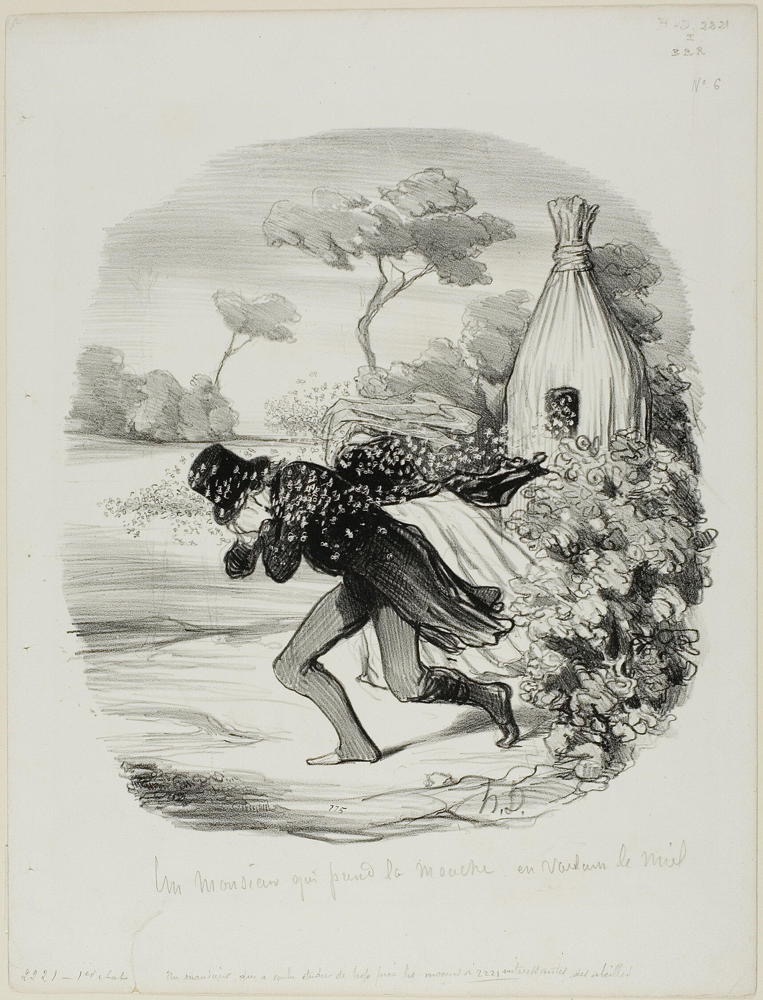
Honoré Victorin Daumier:
A Gentleman Who Wanted to Study the Habits of Bees too Closely,
plate 6 from Pastorales (1845)
"I'm just not complying with their wishes at the moment."
"It is fascinating that so many Instagram users believe that they are addicted when, according to clinical criteria, the risk of addiction is relatively rare." [Anderson, I.A., Wood, W. Overestimates of social media addiction are common but costly. Sci Rep 15, 39388 (2025). https://doi.org/10.1038/s41598-025-27053-2]
The science assessing social media use does not appear to have entered its infancy yet. It seems to be barely fertilized instead. Measures have yet to evolve. Meanings have not yet solidified. We are embedded within an ecosystem we failed to prepare for, indeed, one we failed to consider whether we needed to prepare for. It has arrived anyway, and we’ve already created dependencies we hadn’t foreseen or even imagined we might acquire. As usual, we’re redesigning on the fly, unable to meaningfully interrupt continued use even when we sense that might be the best response.
In this world, we’re more than apt to jump to unwarranted conclusions. We’ve been busily creating misleading labels that will stick for generations, like “tin” cans and “tin” foil did. We are actively learning how to misrepresent our experience because we have no chance of properly representing it to ourselves yet. It might be best if we could just forestall concluding anything yet, to admit that the jury’s still actively considering, not yet deciding, but this has never been our way. We adopt immature technologies and design our infrastructures to solve different problems than those our experience will ultimately present to us. We will waste an inordinate amount of money and time arguing about problems that will require no resolution, like “radiophobia” in the 1920s, when people passionately believed broadcast radio waves caused illness. Social media might have more myths than facts at this point in its evolution. It will continue evolving.
Typical of these effects, the above-quoted study concluded that the likelihood of a person acquiring an actual addiction to social media might typically be around 2%. The likelihood that a frequent, habitual user might self-diagnose their use as an addiction might be many times that threshold. What’s the difference between habitual and addicted? There’s the rub. The study employed the most common metrics for measuring addiction, while those self-diagnosing used colloquial terms. They felt addicted, and so they convinced themselves they were, even though the typical negative side effects of stopping use never manifested. Further, this study found that those who diagnosed themselves as addicted found it much more difficult to control their habitual use than those who characterized their use as habitual. Once they affixed the addicted label to their own behavior, their struggle came to more closely resemble an addict’s. Curious.
Studies will continue to evolve. As organizations seek to control what sometimes seems utterly out of control, expect to see a variety of means employed, with science perhaps representing the most modest contributor. Litigation will very likely define more limits than science ever manages to discover. Insurance companies will very likely presume liabilities under some abundance of caution and seek to mitigate those perceived risks, whether or not science confirms their existence. Nations have already forbidden social media use by children, and it’s only reasonable to presume more and even broader controls will come over time, again, probably driven more by popular opinion than scientific reasoning. We’ve seen this movie before, and we know that the plot never changes and the drama never ends.
I feel reassured to learn that I’m probably not as addicted to my social media feeds as I might feel, that I can act to curtail whatever I feel might qualify as problematic use. I will probably not suffer health-damaging withdrawal symptoms. No worlds will end when I suspend some social media subscription, except the largely imaginary one scrolling on my screen. The study I cite above defines excessive social media use as anything exceeding three hours per day. Whether I log more or fewer hours apparently depends upon what I prefer. Those tech billionaires might have tried to get me hooked on their product, but they’ve apparently failed. That’s not to suggest they’re not still trying. I’m just not complying with their wishes at the moment.
©2026 by David A. Schmaltz - all rights reserved

Good For A Goose

Comeuppance (31)
Decency (90)
Decency Unscrolling (1)
EndDays (92)
Exiled (90)
Fambly (93)
FollowingChapters (93)
Grace (92)
Humor (2)
iAlogue (1)
Letters to the Editor (1)
NextWorld (91)
Personal (18)
Prosperity (94)
Steam Festival (4)
Unscrolling (89)
Vaporized (6)
Work (16)
September 2026
August 2026
July 2026
June 2026
May 2026
April 2026
March 2026
February 2026
January 2026
December 2025
November 2025
October 2025
September 2025
August 2025
July 2025
June 2025
May 2025
April 2025
March 2025
February 2025
January 2025
December 2024
November 2024
October 2024
September 2024
August 2024
July 2024
June 2024
May 2024
April 2024
March 2024
November 2006
October 2006
September 2006
August 2006
July 2006
June 2006
May 2006
April 2006
March 2006
February 2006
January 2006