InternetSmart
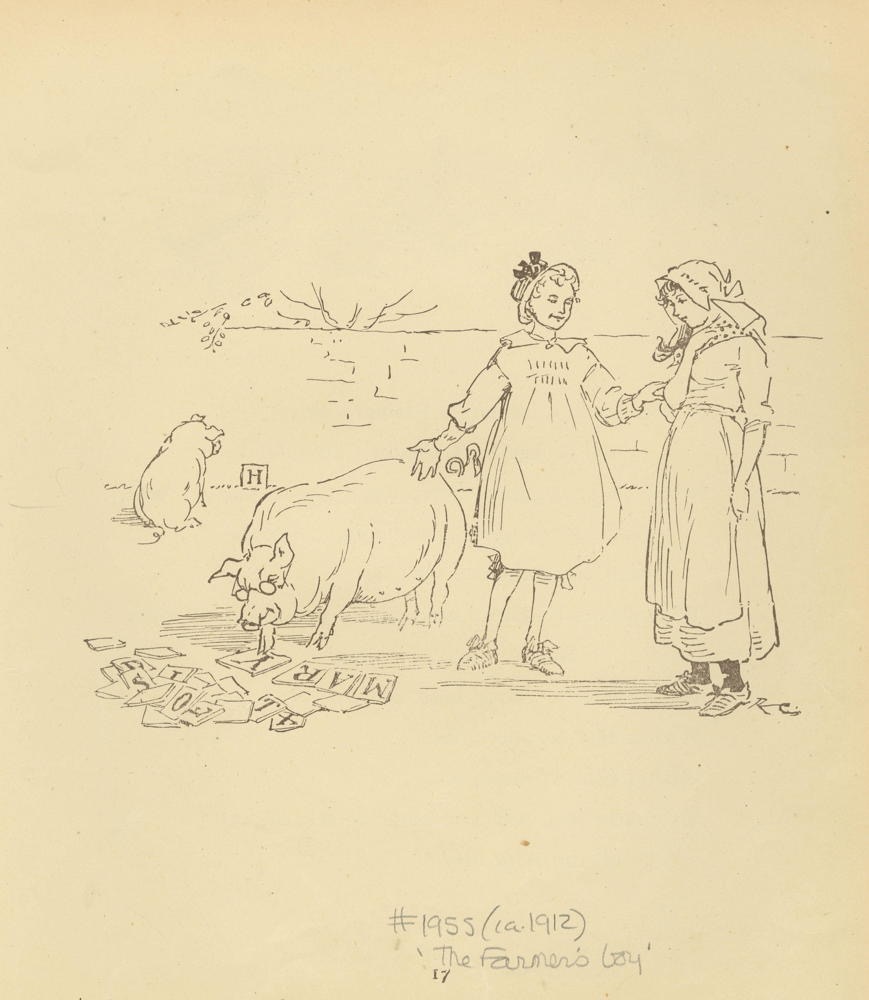
Unknown Artist: A smart pig—Caldecott -- Farmer's boy (1912)
The Miriam and Ira D. Wallach Division of Art, Prints and Photographs: Picture Collection, The New York Public Library. "A smart pig" New York Public Library Digital Collections. Accessed February 18, 2026. (https://digitalcollections.nypl.org/items/b197e850-c5bb-012f-0e24-58d385a7bc34)
"…repeated social media use has introduced a much broader swath of the population to this sort of experience than has previously existed."
Our continued compulsive use of social media probably produces several secondary outcomes. I might scroll for distraction, entertainment, or information, but once subject to so much visual and auditory experience, I very likely absorb stuff without being totally aware of what. Social media seems to have been largely constructed out of memes, imitation genes. These tend to be visual and verbal summarizations, shortcut representations capable of transferring some semblance of understanding without much in the way of scholarship or studying, resulting in knowledge perhaps best described as iconic. The goodness or badness of whatever’s so represented almost always seems obvious. Memes accumulate like strings of very limited knowledge, often knowledge without any underlying understanding. Ideas seem like things, easily, even preconsciously classified, and recalled with such immediate dexterity that they manifest without much in the way of questioning accompanying.
This largely visual learning process mimics how one adopts prejudice. It begins with what only seems obvious. It grows with repetition. So much the better if it’s delivered, as many memes seem to be, humorously. Ironically also works, though its additional entrendé will very likely be missed by many. Sarcasm, too, tends to improve meme retention but at the cost of comprehension. Memes seem to be, preconsciously, absorbed quite literally at face value. They seem to mean precisely what they appear to say, without much, if any, ambiguity. Absorbed memes quickly solidify into fixed knowledge, typically unquestioned because their original absorption raised no critical questions. I’ll label the resulting knowledge InternetSmart, a unique sort of intelligence with which we tend to cope poorly.
InternetSmart seems like second-hand intelligence. It’s comprised of concatenations of distillations, with reference and source material only rarely accompanying. This sort of intelligence is therefore terribly fragile. Within the domain from which it came, it might pass muster, but taken further afield, such as in even a slightly different context, it tends to mislead more than inform, and mislead in a truly terrible, essentially invisible fashion. Iconic memory contains mostly unquestionable certainty. It was knowledge swallowed whole, without much in the way of cogitation or contemplation. It’s disconnected information, resembling nothing so much as the scrolling an algorithm might produce. Conclusions drawn from iconic memory often cannot be questioned, for to question them threatens their holder’s very identity. That which was originally swallowed whole contains no constituent parts and cannot be decomposed or fascily reconsidered. It’s like something a snake swallowed.
The InternetSmart have classified their world into satisfying categories. Goodness and badness seem obvious, just as obvious as stupid seems in anyone not sharing their particular set of memes. Things retain the iconic identity memory assigns, and might seem impossible to redefine. Once concluded, a concept becomes tied to one’s identity. With iconic memory, tribal membership becomes easy to ascertain, for every member sees the world through similar eyes, similar social media. The nature of social media, though, disallows groups of people from developing nearly identical internal representations. The algorithm works more randomly than that. Sure, some cult members might limit their scrolling to the official social media channels, but almost everyone’s somewhat scattered across the virtual world. This behavior might explain why scrolling social media so often produces feelings of deep loneliness and nostalgia for seemingly simpler times.
InternetSmart is a savant’s intelligence in that it’s almost entirely memory-driven rather than resulting from abstract reasoning. It’s rigid. It tends to be primarily focused upon a single aspect and built out from there: i.e., some self-classify as “technical” and others as “non-technical.” The specialty also serves as their proud prejudice. The technical harbor great misgivings about the intelligence of those who identify as non-technical, and even the non-technical might view themselves in an inferior light because they haven’t mastered enough Easter Eggs to smoothly navigate the great mother internet. I believe that repeated social media use has introduced a much broader swath of the population to this sort of experience than has previously existed. This might be more feature than problem, but the divisiveness in modern society seems to suggest that we’re thus far coping poorly with this introduction. I’ll be looking at some of the practical ramifications of this shift in upcoming installments.
©2026 by David A. Schmaltz - all rights reserved

Good For A Goose

Comeuppance (31)
Decency (90)
Decency Unscrolling (1)
EndDays (92)
Exiled (90)
Fambly (93)
FollowingChapters (93)
Grace (92)
Humor (2)
iAlogue (1)
Letters to the Editor (1)
NextWorld (91)
Personal (18)
Prosperity (94)
Steam Festival (4)
Unscrolling (89)
Vaporized (6)
Work (16)
September 2026
August 2026
July 2026
June 2026
May 2026
April 2026
March 2026
February 2026
January 2026
December 2025
November 2025
October 2025
September 2025
August 2025
July 2025
June 2025
May 2025
April 2025
March 2025
February 2025
January 2025
December 2024
November 2024
October 2024
September 2024
August 2024
July 2024
June 2024
May 2024
April 2024
March 2024
November 2006
October 2006
September 2006
August 2006
July 2006
June 2006
May 2006
April 2006
March 2006
February 2006
January 2006