Cloud
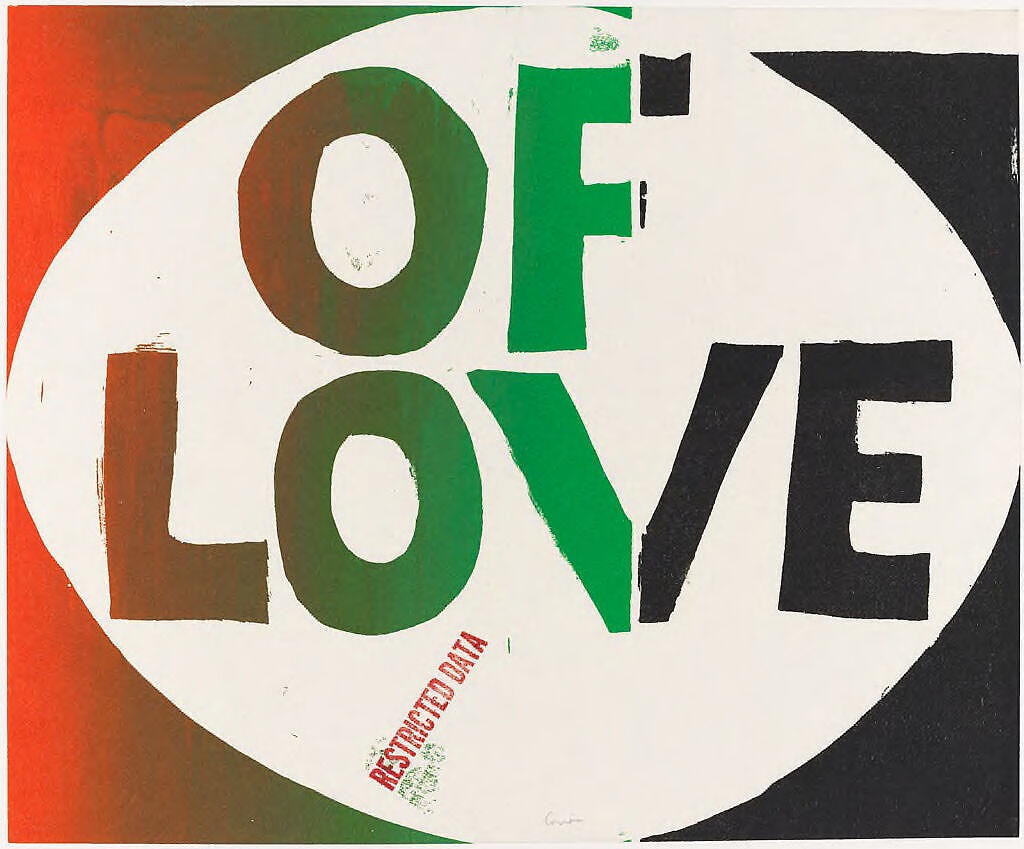
Corita Kent (Sister Mary Corita): of love (1967)
Persistent Link: https://hvrd.art/o/328973
Physical Descriptions: Screen print
Dimensions: 38.1 × 45.7 cm (15 × 18 in.)
Inscriptions and Marks: Signed: l.c.: Corita
(not assigned): Printed text reads: OF LOVE
RESTRICTED DATA [stamped in red ink]
Standard Reference Number
Corita Art Center Cat. #67-42
Harvard Art Museums/Fogg Museum, Margaret Fisher Fund
© Courtesy of the Corita Art Center, Immaculate Heart Community, Los Angeles / Artists Rights Society (ARS), New York
— — —
"Those who fear our future fear themselves."
My iPhone draws my attention like a manic Van Gogh. I can hardly look away, but that tiny display holds almost none of what attracts my attention. Much of what attracts me resides somewhere else, off in what’s referred to as The Cloud. That Cloud contains much besides moisture. Ask your favorite AI engine, which also resides in The Cloud, to describe the kinds of data commonly found there, and you’ll receive a dizzying array of data types, most of which I can guarantee you’ve never heard of before. They represent the ecosystem from which your scrolling emerges. Scrolling couldn’t exist without this cloud’s contents, and those contents could not exist without that amorphous Cloud.
The Cloud serves as the metaphor for what we know as Data Centers. These dystopian, concrete, windowless buildings hum with invisible activity. They might not quite qualify as scrolling’s soul, though they might best represent its spirit. Much of what occurs when we’re scrolling is disembodied. It doesn’t actually reside in any specific anyplace. The data and associated processes are distributed between various Data Centers for security and other purposes. The presence we sense when we’re scrolling only exists in amorphous virtual space. It’s largely an illusion designed to both attract attention and preserve space. Attempting to trace the physical source of any specific interaction, including financial transactions, proves frustrating, for scrolling seems to be a virtual phenomenon that occurs precisely nowhere specifically.
Data Centers have attracted more attention than their owners ever intended. They were supposed to be invisible. Their appearance alone screams mid-century Soviet dystopia. They seem like utility incarnate, with no effort put toward appearances or aesthetics. They appear absolutely utilitarian and so, alien to every eye. We’re not supposed to think about or care about whatever occurs inside. We think they’re eyesores because they are. They consume seemingly vast amounts of energy. Older models also manage to use a lot of water for cooling. Those employed to teach Artificially Intelligent agents, who learn by perusing very large data sets, can produce surges in demand at inconvenient times. Depending upon local regulations, which are still all over the universe and largely irrational, households in the area of a Data Center can experience sharp increases in their electricity rates with no apparent benefit. Some Data Center operators have learned how to steal from the poor to get richer.
Local opposition to these Data Centers has grown to a fever pitch as our incompetent administration cancels renewable energy generation efforts. The resulting pinch will eventually cause energy prices to rise steeply, not necessarily the fault of Data Centers directly, but of incoherent energy policies. Still, we couldn’t conduct a Zoom meeting without our integrated networks of Data Centers. They exist as the absolutely essential invisible underpinning of all things scrolling, and what’s not scrolling these days? My thermostat employs the freaking Cloud, as does our Schooner’s entertainment and navigation system. As rain was once touted as following the plow, these days, prosperity seems to follow the introduction of Data Centers. They ain’t going away. They’ll be proliferating, though, fortunately, even they seem to be learning exponentially how to provide their services with ever smaller footprints. Maybe they’ll eventually become essentially invisible.
The torches and pitchforks appear whenever a new Data Center gets proposed. People fear environmental degradation. They should fear underregulation more. It’s possible to construct and operate a Data Center without devastating or even deeply impacting the surrounding environment. There’s so freaking much money in Data Center operation that the one proposed for our corner of the state pencils out like we discovered a Permian Basin beneath us. Billions! If we’re smart, and not just Data Center smart, not merely artificially intelligent, we could leverage our Data Center into genuine rain following our ever-aging plows. A hundred and more years ago, the farm kids migrated to the cities to find prosperity. Now, it seems that prosperity might be moving some operations here to transform farmers and their farms, bringing swarms of electrons and a few dystopian buildings to serve as the rain. Those who fear our future fear themselves.
©2026 by David A. Schmaltz - all rights reserved
Good For A Goose

Comeuppance (31)
Decency (90)
Decency Unscrolling (1)
EndDays (92)
Exiled (90)
Fambly (93)
FollowingChapters (93)
Grace (92)
Humor (2)
iAlogue (1)
Letters to the Editor (1)
NextWorld (91)
Personal (18)
Prosperity (94)
Steam Festival (4)
Unscrolling (89)
Vaporized (6)
Work (16)
September 2026
August 2026
July 2026
June 2026
May 2026
April 2026
March 2026
February 2026
January 2026
December 2025
November 2025
October 2025
September 2025
August 2025
July 2025
June 2025
May 2025
April 2025
March 2025
February 2025
January 2025
December 2024
November 2024
October 2024
September 2024
August 2024
July 2024
June 2024
May 2024
April 2024
March 2024
November 2006
October 2006
September 2006
August 2006
July 2006
June 2006
May 2006
April 2006
March 2006
February 2006
January 2006