WitnessProtection
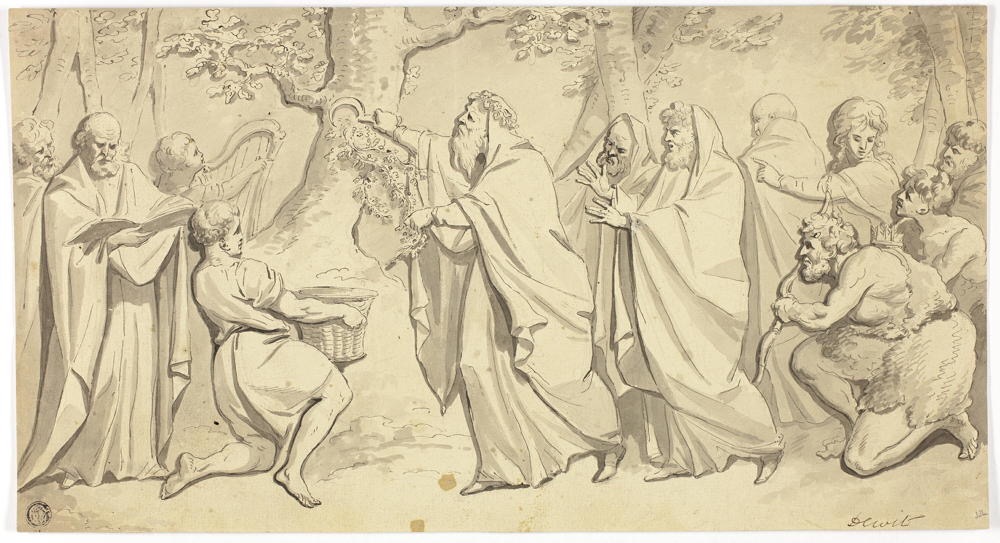
Attributed to Jacob de Wit: Druids Cutting Mistletoe
(Artist's working dates 1715–1754)
"…what once seemed fair enough and fairly well balanced now sure seems fairly poorly balanced."
I might be destined to play catch-up for the rest of my life with little hope of actually catching up to anything. I hold the sorry distinction of having imprinted on ways of existence that no longer exist, and very likely will never exist again. I, myself, am not yet obsolete, but many of my understandings and coping mechanisms have definitely gone the way of the goony bird. I remember, for instance, a certain balance between my role as witness to these proceedings and my role as a participant therein. In those days, I achieved balance through much more participation than through witnessing. Witnessing was more of a passing part of my existence. I was much more of a participant. Television, of course, steadily eroded the historical boundary between participant and observer, even more determinedly than had radio before it. I remember my elders warning me, much as I later warned my own progeny, that they were in danger if they spent too much of their potential participatory time decomposing, witnessing in front of the boob tube.
The phone in each of our pockets makes the old black-and-white boob tube look absolutely brilliant, and our early witnessing in front of it seems downright participatory in comparison. Before streaming, everyone had to tune in together to take in a spectacle, so our witnessing then would today seem like no more than a mildly disconnected form of participation. The evening when man first walked on the moon was more like attending a performance than merely witnessing from a distance. Living rooms were filled with people. The event was massively communal in a way that nothing comes close to matching today. Now, we’re closeted witnesses, clearly not in any way even distantly participating in what we witness. We live more vicariously now than we ever imagined living before. Historical events felt personal when they occurred instead of like distantly disembodied reportage. I was actually there when that first step was taken on the moon, and I had a roomful of witnesses with whom I could validate my experience. Events seem to occur at greater distances now.
I can’t say that this change consequently qualifies as bad. It doesn’t necessarily suggest that I should invest heavily in handbaskets. I am not doomed due to my witness/participant balance shifting so far to the left. I remain free to engage in any number of activities, and I am not yet enjoined to have to witness anything I don’t choose to see. If my witness/participant shift has a cause, it’s in my own hands and has been largely a matter of me choosing for myself. I might argue that certain conditions more or less forced my hand, but I know the truth. I am long-familiar with the enemy. I know him to have always been me. If I want a different witness/participant balance, that choice remains in my control. Much in the same way that I once avoided homework in favor of watching the latest episode of “My Mother The Car,” I still choose perhaps the greater of two evils when tempted to engage with my social media feeds. The boob tube might have become smaller and more personal, but I’m still the boob.
Ancient Greeks probably railed on their children about the dangers of watching too many performances rather than engaging as actors in the plays. Without primary experience, the secondary experiences merely witnessed might well lose some of their impact. Representations of roses carry no scents at all other than those dredged up from memory of some prior primary experience. An out-of-balance witness/participant boundary seems destined to undermine some significance, though that might just be my antiquity speaking. I do not know for certain whether an optimal witness/participant balance even exists, though I can swear that I sense an encroaching absence with the growing presence of secondary and tertiary experiences outweighing primary participation. Rome was not built in a cave.
It might be that the future I will never witness will not remember there ever having been anything even remotely resembling a witness/participant balance. It might be that humanity’s future was already destined to be increasingly lived vicariously, and that this constitutes positive evolutionary progression, survival of a different fittest. I feel fairly certain that the way I live would have both delighted and disgusted my forebears, who somehow managed to thrive long before boob tubes had even been imagined. Plato spoke of shadows cast on cave walls. Absent readily accessible caverns, we today have handheld machines capable of standing in for them. We can seemingly access the world while securely sequestered within our closets. One day, we may choose to simply forego primary existence in favor of some exotic flavors of virtual experience. And we might be better as a species for that. Far be it from me, an increasingly ancient ancestor of my present self, to declare whether there will still be a Hell then or even a need to frantically purchase more handbaskets. I can only say that what once seemed fair enough and fairly well balanced now sure seems fairly poorly balanced. ‘Twas probably always thus.
©2026 by David A. Schmaltz - all rights reserved
Good For A Goose

Comeuppance (31)
Decency (90)
Decency Unscrolling (1)
EndDays (92)
Exiled (90)
Fambly (93)
FollowingChapters (93)
Grace (92)
Humor (2)
iAlogue (1)
Letters to the Editor (1)
NextWorld (91)
Personal (18)
Prosperity (94)
Steam Festival (4)
Unscrolling (89)
Vaporized (6)
Work (16)
September 2026
August 2026
July 2026
June 2026
May 2026
April 2026
March 2026
February 2026
January 2026
December 2025
November 2025
October 2025
September 2025
August 2025
July 2025
June 2025
May 2025
April 2025
March 2025
February 2025
January 2025
December 2024
November 2024
October 2024
September 2024
August 2024
July 2024
June 2024
May 2024
April 2024
March 2024
November 2006
October 2006
September 2006
August 2006
July 2006
June 2006
May 2006
April 2006
March 2006
February 2006
January 2006