Weekly Writing Summary For The Week Ending 04/23/2026
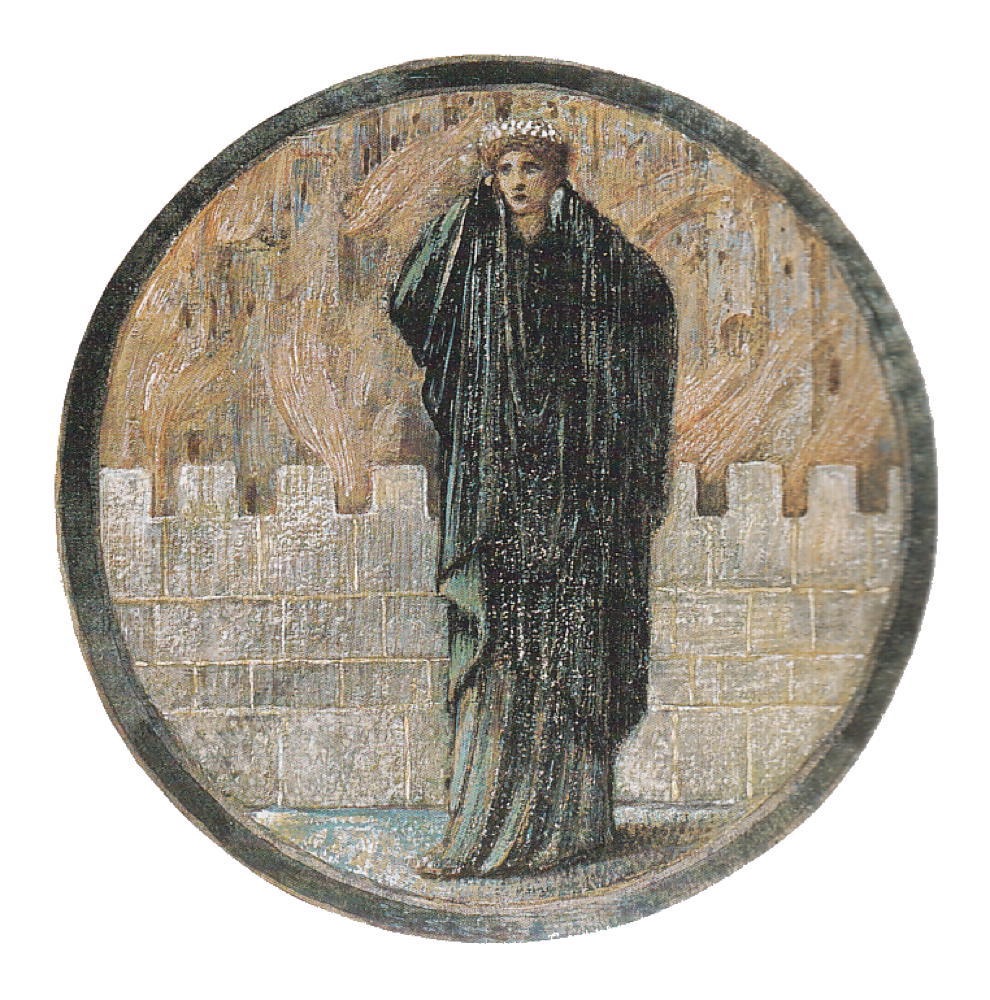
Sir Edward Coley Burne-Jones:
Helen's Tears'
(Between 1882 and 1898)
This week's EndDays dispatches moved from disorientation to defiance, from the poisoned noise of deliberate falseness to the quiet dignity of pea-shelling, from the billionaire class's ravenous absence of Enoughness to a small-town civic supper where a librarian earned a blown-glass heart on an engraved stand. The week asked what sustains a serious person when the signals arriving from the world can no longer be trusted at face value, and found its answers not in grand political resolution but in dirt, in preparation, in recognition, and in the stubborn practice of generous interpretation.
Thank you for following along!
— — —
Weekly Writing Summary
TangledWeb
“They’re sunk.”
I navigate my way through these EndDays not quite blindly, but nearly.
In this EndDays story, I described my growing inability to trust my own senses, a cattywompus disorientation produced by sustained exposure to deliberate falseness. I acknowledged that I remain a simple man, prone to accepting signals more or less at face value, who finds himself thrown off when up arrives as down. This administration’s news conferences seem organized not to disseminate light but to spread darkness and amplify that day’s fresh set of bald-faced lies. I asked myself what urge still propels me to translate what might simply be absolute nonsense into something at least useful for navigation. There might be no deeper significance to what was always just irrelevant. They’re sunk.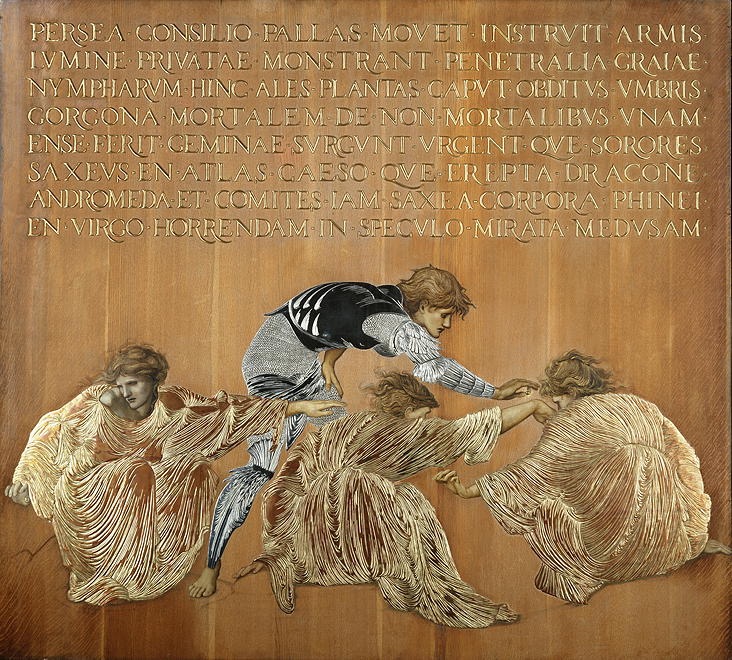
Sir Edward Coley Burne-Jones: Perseus and the Graiae (c. 1877)
“Oh, what a tangled web we weave, / When first we practice to deceive” Sir Walter Scott, Marmion
——
Enoughness
“There might not be a large enough ‘enough’ to ever regain that once lost balance.”
The last forty years have witnessed a steady erosion of what we might acknowledge were decent values.
In this EndDays Story, I traced the long arc of how the billionaire class’s absolute absence of Enoughness became a systemic condition, weaponized through euphemism and meme, recruited its own victims into defending it, and ultimately consumed the very consumer economy it depended upon. The MAGA contingent was coached into a backward insurrection, blaming immigrants for an erosion of living standards caused by the very politicians they were coerced into supporting. Acquisition became a mindless reaction, voracious not to satisfy any hunger but to encourage an ultimately unquenchable one. A generation or three of being treated as they have treated the rest of us will not likely rebalance a society that has lost its sense of Enoughness.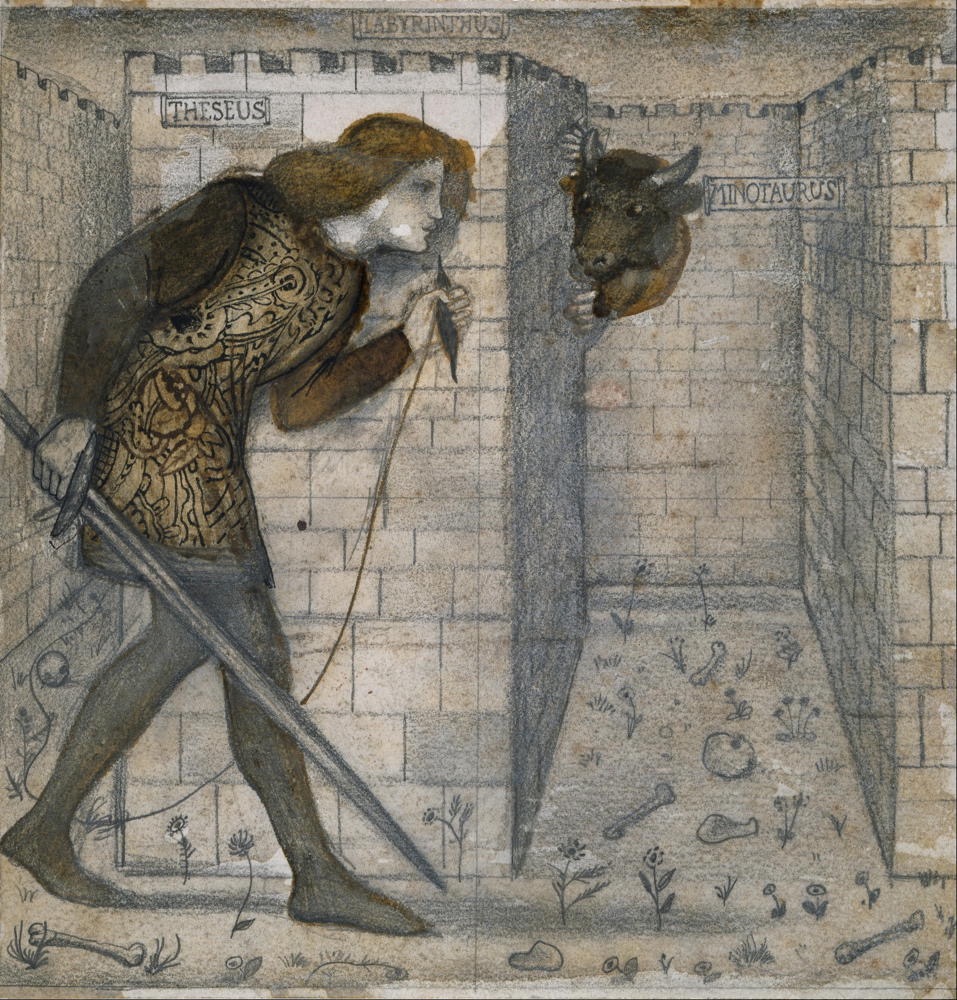
Sir Edward Coley Burne-Jones: Tile Design - Theseus and the Minotaur in the Labyrinth (c. 1861)
—
Dirt
“I’m Just Visiting here.”
I engage hesitantly, reverently.
I spent Sunday afternoon on my knees in the raised bed adjacent to The Muse’s Marion berry patch, pulling and pushing the handplow through decades of amended soil, planting Walla Walla Sweet Onion sets with powdered bone meal and genuinely loving embraces. I described myself not as a homeowner but as a steward, someone who knows every square inch of this soil and has crawled across it more than once or twice. That soil holds a better portrait of me than my accumulated catalog of writing from the same period. The morning glory will not submit to anything I’ve thrown at it, returning with insistence to remind me that mastery was never on offer. I own nothing in this world. I’m Just Visiting here.
Sir Edward Coley Burne-Jones: Study for ‘The Sleeping Knights’ (About 1870)
——
Impreparation
“Amen, again, with real damned purpose this time!”
EndDays time seems short, as if a clock was winding down or the universe itself was wearing itself out.
In this EndDays Story, I recognized that I’d been existing in a hand-to-mouth state, maintaining my sacred routine without any compelling horizon to prepare toward. The upcoming irrigation system installation provided that horizon — a liberation that would allow me to sustain my gardens on a fraction of the water I’d previously used and spare me the task of setting hoses at three on midsummer mornings. Preparing for it required moving a shitload of decorative pebbles, cleaning possum leavings off stored garden hoses, and filling half a dozen cat litter tubs with pebbles to handtruck out of the trencher’s path. I worked myself to a satisfying exhaustion. I must maintain my own agenda, as if that broader, over-publicized public one couldn’t possibly matter. Amen, again, with real damned purpose this time.
Sir Edward Coley Burne-Jones: The Garden of the Hesperides (Circa 1880)
——
Recognizing
“If only we could remember this inescapable fact and more frequently act upon it.”
No week passes without The Muse, in her Port Commissioner role, being invited to some ceremonial supper or solemn civic society gathering.
I accompanied The Muse to a small town civic supper where we took a table with a lovely family — a retired Corps of Engineers hydrologist from Evanston, Wyoming, and his wife, Sara, who manages the little local library and had grown up not far from where The Muse and I once lived during our exile. The after program was set aside for Recognizing: Student of the Year, Employee of the Year, and Citizen of the Year, each receiving a blown glass heart on an engraved stand. Sara was declared Employee of the Year for her efforts organizing that library. We left, having lost the dessert raffle, as renewed as if we’d been declared Citizens of the Year ourselves. None of us live inconsequential lives. If only we could remember this inescapable fact and more frequently act upon it.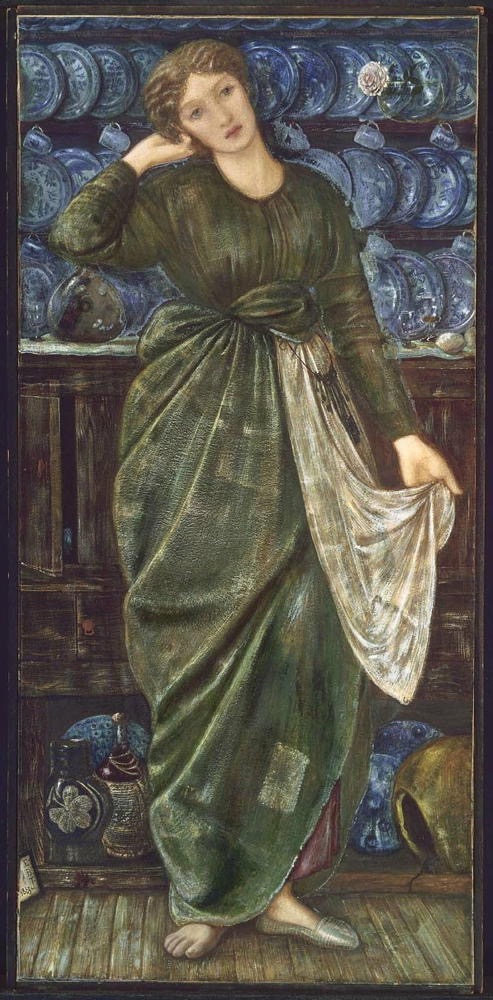
Sir Edward Coley Burne-Jones: Cinderella (1863)
——
ReceivingWisdom
“Maybe we find our underlying connections beyond disconcerting.”
Who knows how wisdom visits?
The Muse returned from a public meeting having bailed — she’d entered to find the opposition already loaded with rebuttals before their opponents had even begun presenting, seeking not dialogue but dominion. I blamed the meme-ification of civic conversation, the Repuglicans and the Russians having flooded social media with imprinting images and phrases that replaced thinking with transplanted ideology. The Muse’s response has been to invite stone-throwers to sit down and hear her thinking, practicing generous interpretation as an active and demanding discipline. Wisdom insists there’s always something missing from every conclusion. We are more tenaciously interdependent than we could ever be decisively independent. Maybe we take sides to hide from what’s too obvious to us. Maybe we find our underlying connections beyond disconcerting.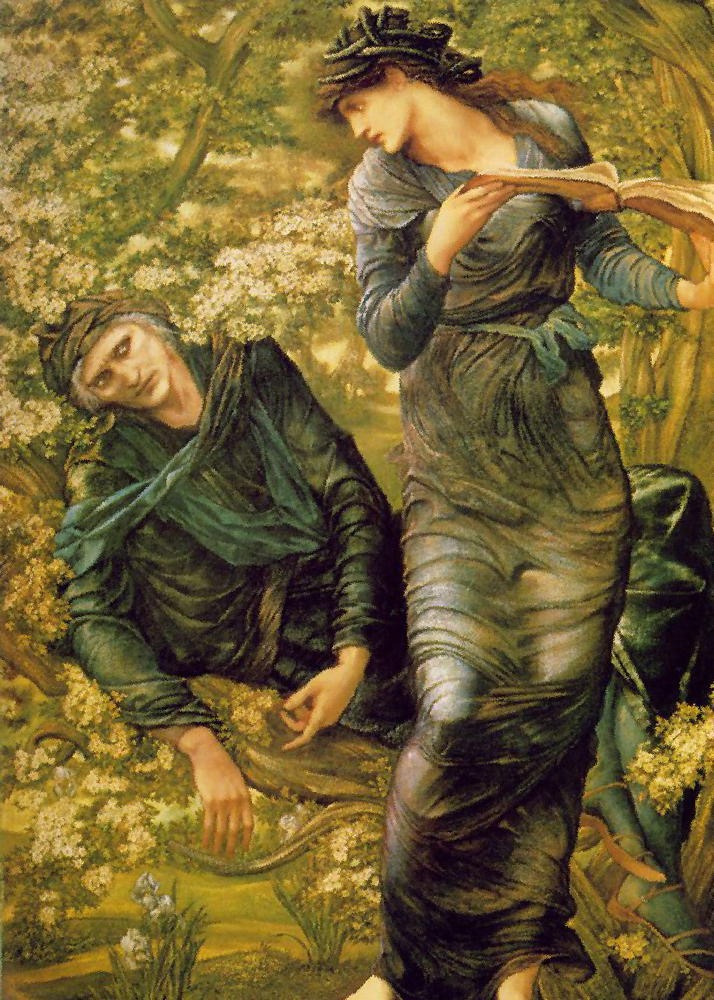
Sir Edward Coley Burne-Jones: The Beguiling of Merlin (1874)
——
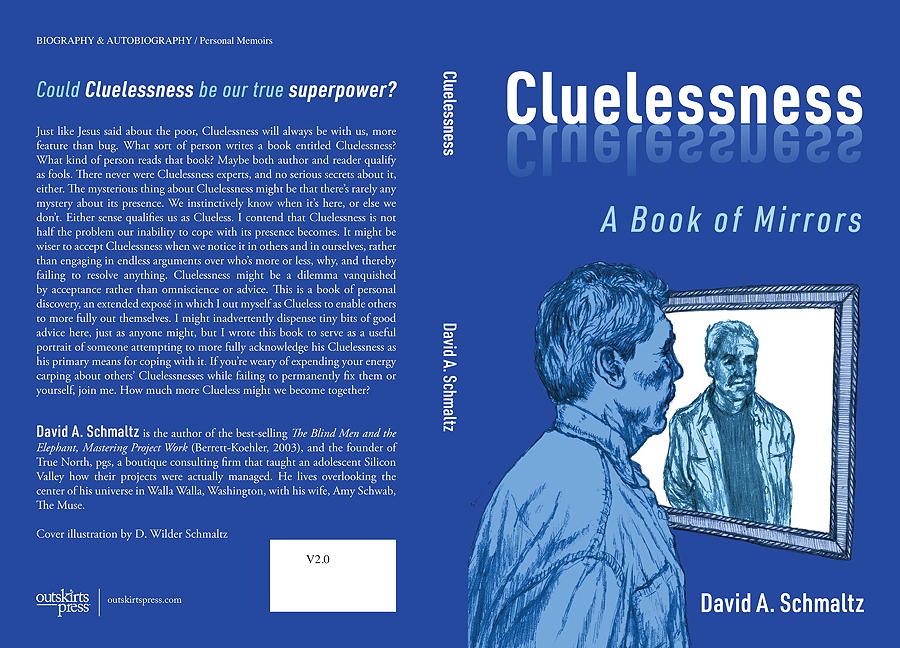
ISBN: 9781977279651
I'm Published!!
I learned late yesterday afternoon that I’m a published author again, with a twist. The circuitous route by which I managed to pull off this accomplishment continues even unto and beyond publication. Because a lag exists between availability and the many distributors’ catalogue updates, it will be a week or more before the work becomes available to order. It will ultimately be available to order everywhere! Then, it will have been both published and widely available. Then I can have another celebration. After the first certified unsolicited sale, I could convene one more.
It might sound trivial, but I feel most grateful for my many collaborators who assisted in creating this most unlikely publication. From my original struggle to even classify the work to the final Claude®-assisted promotional blurb, this really did require a community to create and launch. My role as author seemed the easiest to fulfill. I didn’t need to worry about copyediting, for instance, and not only because every author naturally assumes the role of their own worst copyeditor. I hired an experienced professional who was recommended by a friend of a friend of mine: family. And so it seemed for most of the players through this performance. We were less hired guns than daughters and sons of ones in some way related to me and to each other. That a work called Cluelessness could produce such essentially flawless performances astounds me. We have, indeed, become a community connected by Cluelessness, which is not nearly as odd or as unusual as it might sound.
Now the adventure continues in some semblance of earnestness. I will be promoting this work, but more importantly, I will be asking you to promote the work, too, through your networks of families and friends. The media universe remains obtuse, essentially unapproachable, except for this one tiny/enormous exception. We each have networks that overlap with others. A ping here might resonate across multiple of these tiny/enormous universes, a whisper quite literally heard around the world. Once the work’s available, I’ll announce and ask you to just let your virtual next-door neighbors know. We can let the universe take most of the promotion from there.
Here’s the promotional blurb I published here last week. I’ll find a place on my blog for this introduction to live more permanently.
Cluelessness: A Book of Mirrors by David A. Schmaltz
What kind of person writes a book about Cluelessness? Not someone who has conquered it. Someone still living within it, noticing it daily, and finding that the real difficulty was never the Cluelessness itself but how poorly most of us cope with its inevitable presence.
David Schmaltz has spent decades observing the ways humans navigate a universe far more complex than any of us can fully comprehend. In Cluelessness: A Book of Mirrors, he turns that observation inward, offering ninety short essays that catch the author — and the reader — in the act of not knowing, misreading, over-planning, under-noticing, and stumbling forward anyway.
This is not a self-help book. There are no twelve steps, no prescriptions, no promises of transformation. It offers something rarer: a sustained, wry, warm-hearted investigation into what it actually feels like to be a finite human being embedded in an infinite, indifferent, and occasionally delightful universe. Schmaltz writes about cooking for a crowd without sleeping the night before, about the studied Cluelessness that lets us ignore what we cannot afford to know, about the difference between problems and difficulties, about why driving the speed limit might qualify as a moral act, and about why the most important things we were ever taught arrived without anyone noticing the teaching.
He considers the seductive comfort of StudiedCluelessness, the paradox of KnowingBetter, and the quiet dignity of maintaining one's convictions in a culture that rewards getting away with things. He explores what it means to truly cope with impossibility, why the pursuit of excellence so often guarantees mediocrity, and how the humble public library became the last genuinely decent institution in American civic life. The essays range across daily life — traffic jams, grocery runs, church league softball, learning to cook, reading too many library books — and into larger questions about democracy, competition, truth, liberty, and what it means to make any difference at all. Each story functions as a mirror, angled just so, offering the reader a glimpse of themselves going about their own daily Cluelessness.
Schmaltz writes from the tradition of the great American essayists — observant, self-deprecating, philosophically ambitious without pretension, and genuinely funny without trying too hard. His is a voice readers quickly trust because it never claims to know more than it does. He describes this work as philosophical, autobiographical, historical, and fictional all at once. The label fits. These essays think carefully, emerge from a specific life, document a particular American moment, and hold their facts lightly enough to let deeper truths through.
By the end of Cluelessness, the reader has spent time with someone genuinely attempting to live with integrity, curiosity, and good humor inside conditions no one fully understands. That turns out to be excellent company. The book doesn't solve Cluelessness — it couldn't, and it knows it couldn't — but it offers something more useful: the reassurance that we are all, as Schmaltz puts it, Clueless on this bus, and that coping with that reality a little better might be everything we've got.
For anyone who has ever suspected that the experts don't know much more than the rest of us — and found that suspicion oddly liberating rather than terrifying.
I employed Claude.ai, a commercial AI-powered text editor, using it to perform repetitive copy/pasting work and to create the above story summaries, prompting with: “Please briefly summarize this story in the first person while retaining the original voice.” I manually copy-edited each result.
Thank you, as always, for following along!
©2026 by David A. Schmaltz - all rights reserved

Good For A Goose

Comeuppance (19)
Decency (90)
Decency Unscrolling (1)
EndDays (92)
Exiled (90)
Fambly (93)
FollowingChapters (93)
Grace (92)
Humor (2)
iAlogue (1)
Letters to the Editor (1)
NextWorld (91)
Personal (18)
Prosperity (94)
Steam Festival (4)
Unscrolling (89)
Vaporized (6)
Work (16)
September 2026
August 2026
July 2026
June 2026
May 2026
April 2026
March 2026
February 2026
January 2026
December 2025
November 2025
October 2025
September 2025
August 2025
July 2025
June 2025
May 2025
April 2025
March 2025
February 2025
January 2025
December 2024
November 2024
October 2024
September 2024
August 2024
July 2024
June 2024
May 2024
April 2024
March 2024
November 2006
October 2006
September 2006
August 2006
July 2006
June 2006
May 2006
April 2006
March 2006
February 2006
January 2006