TacitComeuppance
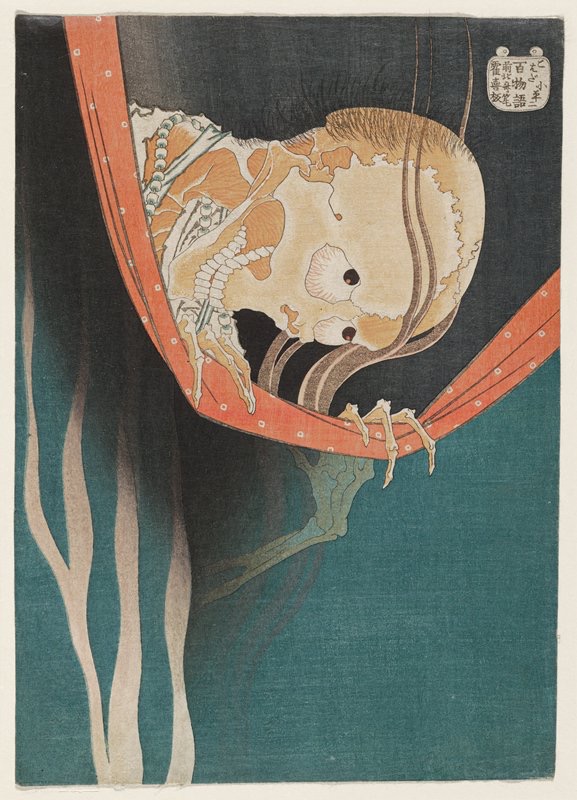
Katsushika Hokusai 葛飾 北斎, Publisher: Tsuruya Kiemon
The Ghost of Kohada Koheiji
(c. 1831–32)
"…those burdens must remain as tacit as any primary experience never chosen."
I usually think of a Comeuppance as an overt event, an active, observable verb, one of those actions often classified as equal and opposite, a tangible result. But in this story, I want to consider a separate and more common kind of Comeuppance, the kind that, once I mention it, might seem shockingly familiar: The TacitComeuppance. These occur as a result of choices or, perhaps, of events. Because I chose to go West, I tacitly forfeited every opportunity to experience East. That eastern extent of my former possibility, therefore, became forever inaccessible to me. Whether I forewent great good fortune or avoided catastrophe must, then, remain forever unknowable to me, except, of course, through imagination. That road not taken might well take on a mythical magnitude, a sense that it must have been beneficence foregone or a curse, but nonetheless lost.
I experience these as tacit events, if tacit doesn’t render them too indistinct to count as events. In my quieter moments, I find access to legions of these: notions of what might have been if only, regrets for what never actually existed. I sometimes grieve these lost experiences, the chances I chose not to take, the certainties that ultimately blinded me to a possibility I was never able to achieve personally. “I coulda been a contender.” These pseudo memories sometimes overwhelm and render me mute and feeling relatively worthless. I might have been, I begin, and my thoughts lead me down into a shadowy space where ghosts of Christmases never past exist as tangible as any actual memory.
I raise this topic now because I was wondering about our incumbent’s shadow past. Oh, I understand that he has a raft of actual secrets, past experiences that he has seemingly dedicated himself to never disclosing, at least in public, if not necessarily to his shadowy midnights of his soul, assuming he ever had or still possesses one. I suspect these not-nearly-tacit experiences haunt him plenty, but I suspect he would feel even more haunted if he had access to all he actually missed. The life he was too busy distracting himself to commit. When I think of my most precious memories, I suspect that our incumbent never gained access to such primary experiences. He was probably “too busy” to attend any of his kids’ births. I’d bet he’s never once experienced a routine family evening, where nothing very special happened except that reassuring glow that comes only from engaging in a routine with people you hold dear.
He glues golden baubles on his office walls where he’s seemingly always holding court. When does he ever take time to inhabit the mundane, meaningful world most of us hold as most precious? He seems always to be over-compensating. The degrees to which he stretches suggest that he feels he has much to overcompensate for, more than my meager little imagination can muster or my meager little foregone experiences properly conjure. I register his cruelty to others, but I cannot honestly grok the depth to which he has wounded himself with piss-poor choices. Just the seemingly simple choice of flamboyance over humility must have taken more than its weight in gold baubles to counterbalance, and there’s seemingly never any point where he can ever repay the debt those choices inevitably incurred. They exist as either regret or forgetfulness, as exhibited by an eighty-year-old adolescent frantically dancing as if he’s still partying like it’s 1981 and disco still reigns supreme.
King Lear had nothing on our would-be king, who has few expressions left besides his dismissive sneers. Experience might not wear anyone out nearly as effectively as the absence of certain pivotal experiences. Those who choose to inhabit that stage, who hold themselves judged by endless trials in the fickle court of public opinion, those who sincerely attempt to show their continuing superiority in those ways, forego the magic and mystery that almost everybody else routinely experiences. The ones who would be king might well achieve that pauper’s dream but never seem to find much lasting satisfaction there, for such roles lack essential substance. Those who somehow manage to become the kings nobody was ever born to become lose more in the transaction than they ever gain. Real kings understand that their title brings more obligation than opportunity, more ghosts than friends, and less life than that experienced by the least commoner paying a little attention.
We each carry at least our share of TacitComeuppance, the real price of the choices we largely innocently made. Those with a record of more malicious choices must carry the largest burden of TacitComeuppance. Many might never suspect the costs they incurred, for it requires a little enlightenment to notice this particular sort of Comeuppance. That awareness, especially if it comes after a long ignorance, can be crushing, for there’s never any possibility of recovering any road never taken. Whether that realization becomes tragic or merely enlightening probably depends on something unmentionable. We each carry such burdens, and we mostly must carry them silently, for those burdens must remain as tacit as any primary experience never chosen.
©2026 by David A. Schmaltz - all rights reserved
Good For A Goose

Comeuppance (29)
Decency (90)
Decency Unscrolling (1)
EndDays (92)
Exiled (90)
Fambly (93)
FollowingChapters (93)
Grace (92)
Humor (2)
iAlogue (1)
Letters to the Editor (1)
NextWorld (91)
Personal (18)
Prosperity (94)
Steam Festival (4)
Unscrolling (89)
Vaporized (6)
Work (16)
September 2026
August 2026
July 2026
June 2026
May 2026
April 2026
March 2026
February 2026
January 2026
December 2025
November 2025
October 2025
September 2025
August 2025
July 2025
June 2025
May 2025
April 2025
March 2025
February 2025
January 2025
December 2024
November 2024
October 2024
September 2024
August 2024
July 2024
June 2024
May 2024
April 2024
March 2024
November 2006
October 2006
September 2006
August 2006
July 2006
June 2006
May 2006
April 2006
March 2006
February 2006
January 2006