Real_Work
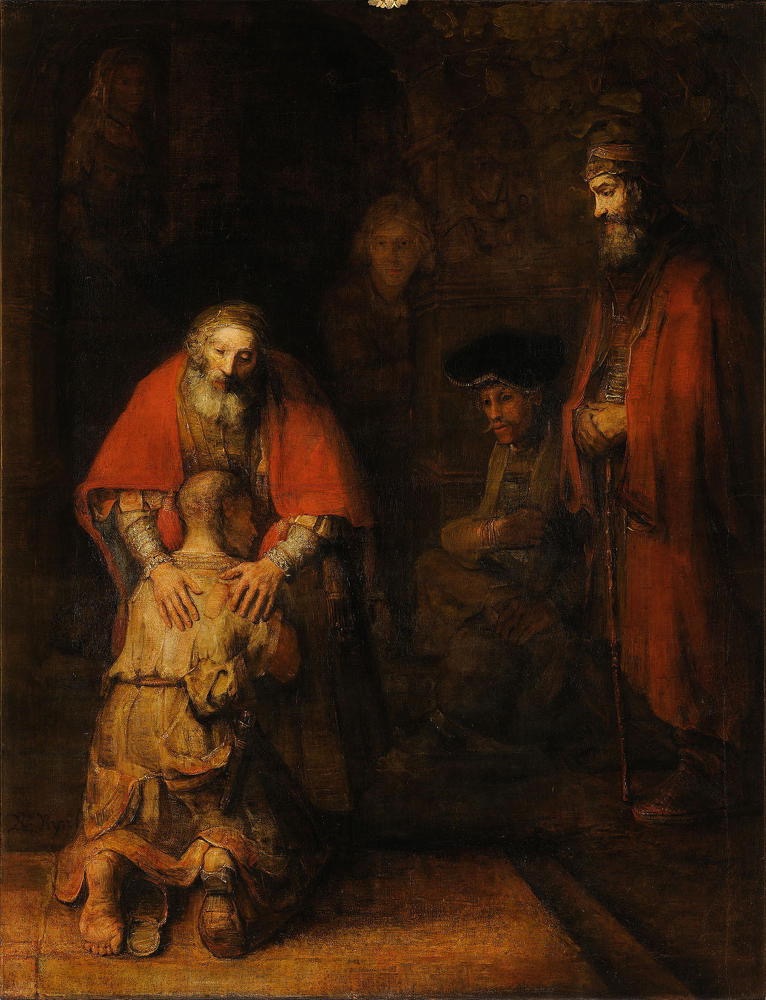
Rembrandt Harmenszoon van Rijn:
The Return of the Prodigal Son
(1668)
"…regardless of what any economist insists."
Most people in this country no longer engage in what our forebears would readily recognize as Real_Work. Real_Work once involved physical labor and was amenable to unambiguous measurement. An hour of labor created a certain indisputable volume of finished product. That product sold at a discernible price, enabling a clear assessment of the contribution a given laborer’s actions added to the ultimate value. High-value commodities reliably produced Prosperity, all other calculations being relatively simple. Almost nobody engages in this sort of labor/Prosperity trading anymore. We mostly work in teams today, sharing tasks and contributing rather than owning our own effort. Determining the value added requires layers of assumptions, none of which involves a finitely observable action. Time-and-motion studies long ago became meaningless measures of efficiency or effectiveness. Productivity has become an imaginary entity; Prosperity, an elusive objective.
Further, we seem to have grown some prejudices about what constitutes Real_Work. Our definition no longer matches our forebears’ understanding. Most of us held something similar to Real_Work in the years before we graduated from University. After that point, I started wearing a tie to work rather than Irish Setter boots, and my workplace more resembled a church than a factory or warehouse. I labored not from dawn until dusk, but more like regular banker’s hours. I worked for a company that never once dabbled in creating any tangible commodity. We created insurance policies and administered their functioning in the world. I supervised a group that accounted for premiums received by electronic bank transfer, a bloodless operation that never once required anyone to actually touch anything other than a keyboard and a telephone. One might make assumptions about the contributions each employee and their supervisor made to the successful administration of those contracts, but precise calculation was beyond even the most senior actuary’s ability.
Where, then, doth Prosperity come from if not from what our ancestors would have recognized as Real_Work? Your guess might be just as worthless as mine. We can make choices, more or less blind, but it seems clear that we need an alternative method to value effort beyond the old Blood, Sweat, and Tears technique. We rarely produce cubic furlongs of anything anymore, and even when we do, our marketplace seems far, far removed from the one my grandfathers would recognize. Many “workers” are salaried. They no longer labor by the hour. Many no longer even account for the hours they work, for with remote connections, the distinctions between working and not working have faded. I used to lug home a classic Mac in an enormous backpack to finish some work project. Now, we carry ready access in our pockets, and so we never really check in or out of work. We’re more Under Contract than actually employed, and we’re paid according to an agreement that does not depend on a time card, though an employer will often still require one, even knowing that its contents will have to be fictional to be useful. Work carries an aura of surreality today.
Prosperity seems to carry a similar fictional quality. It seems just as elusive as it seemed to my great-grandfathers. It insists on different rules of engagement, but it still seems, in principle, to be a keep-away game. Once upon a time, a common beginning for nursery stories, one maintained a career within a definite profession. Now, we fulfill roles and responsibilities, and seem to need to thrive on personal flexibility. We can reasonably expect to change careers multiple times throughout a work life, often on less than a moment’s notice. The AI layoffs are just the latest in what’s become a long history of serial displacement, each a born blood enemy of Prosperity. One must “reinvent” themself, as if one had originally invented themself, as if anyone held the skills, abilities, or experience to routinely successfully reinvent themself on less than a moment’s notice. The result seems ever more tenuous, teetering on the ragged edge of something not even distantly resembling Prosperity.
This amounts to Real_Work today. It seems hostile to Prosperity. It seems to offer neither stability nor reliability. What, precisely, are we supposed to depend upon to support our Prosperity if we continually get sent back to “Go”, but not to necessarily collect anybody’s $200? Ourselves? Prosperity must necessarily be a shared responsibility. Somebody can show up for work, but that act’s insufficient if there’s no work for them to show up for, or if that work doesn’t pay enough for that worker to experience Prosperity for themself. It’s not, in our presently abstract marketplace, necessarily a matter of anybody’s productivity anymore. Billionaires surely must be the least efficient entities in business and industry. Individual workers who, by the grace of somebody proven more benevolent than even the most grace-filled God, somehow manage to successfully reinvent themselves after rudely losing their former roles. Repeatedly. This must be The New Efficiency. Can it successfully replicate Prosperity?
Prosperity has become the most tenuous commodity in today’s economy. It’s nothing to base very much of anything on. Reinvention was never the skill it’s often touted to be. It’s a matter of chance and tenacity, with chance contributing more to successful results than will ever will. We continue to view our economy as if people engaged in Real_Work, even though we haven’t run it that way for more than a generation. Our reality has outrun our explanatory story, and our Prosperity suffers for this absence. People ask me if I’m retired. I insist I’m not, though I’m not gainfully employed. I haven’t been able to figure out how to squeeze money out of this economy in twenty years! If it weren’t for my patron, I would be out on the street or, more likely, dead. The Muse was always much more clever at reinvention, so Prosperity repeatedly visited her. I tagged along, doing my work, which adds not a cent to anybody’s Gross National Product, a backdoor sort of Prosperity, and Real_Work, regardless of what any economist insists.
©2026 by David A. Schmaltz - all rights reserved
Good For A Goose

Comeuppance (19)
Decency (90)
Decency Unscrolling (1)
EndDays (92)
Exiled (90)
Fambly (93)
FollowingChapters (93)
Grace (92)
Humor (2)
iAlogue (1)
Letters to the Editor (1)
NextWorld (91)
Personal (18)
Prosperity (94)
Steam Festival (4)
Unscrolling (89)
Vaporized (6)
Work (16)
September 2026
August 2026
July 2026
June 2026
May 2026
April 2026
March 2026
February 2026
January 2026
December 2025
November 2025
October 2025
September 2025
August 2025
July 2025
June 2025
May 2025
April 2025
March 2025
February 2025
January 2025
December 2024
November 2024
October 2024
September 2024
August 2024
July 2024
June 2024
May 2024
April 2024
March 2024
November 2006
October 2006
September 2006
August 2006
July 2006
June 2006
May 2006
April 2006
March 2006
February 2006
January 2006