ProsperityMachinery
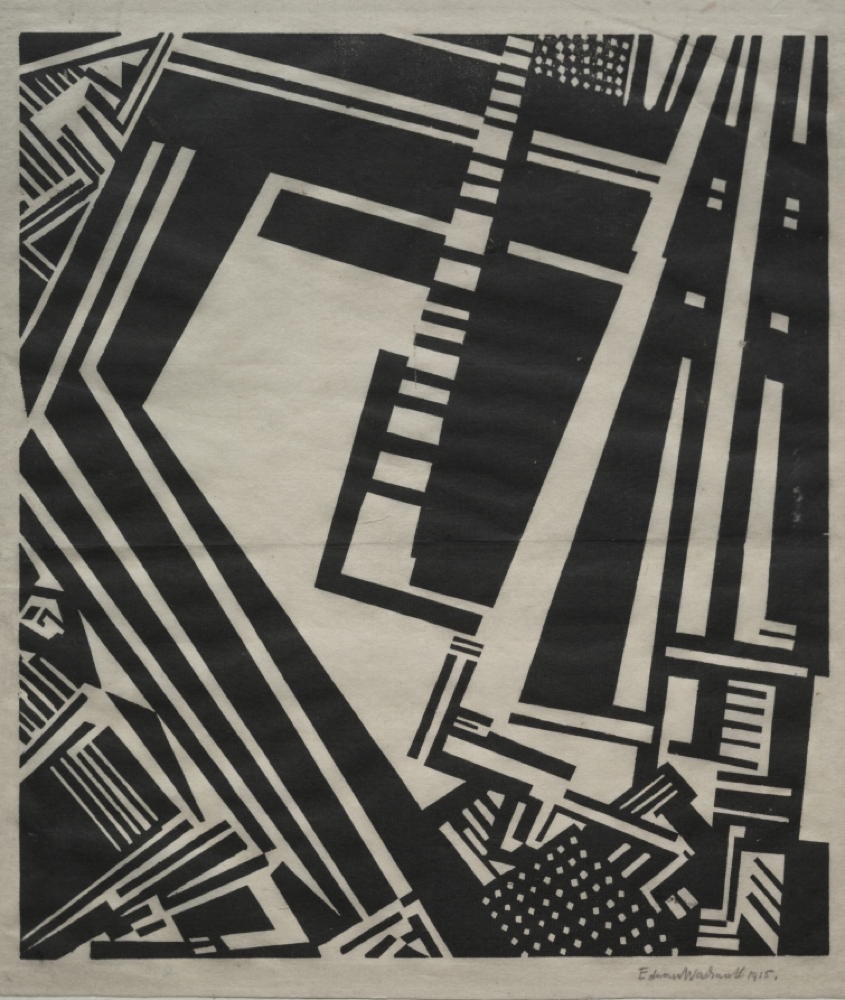
Edward Alexander Wadsworth
Illustration (Typhoon)
(1914–1915)
"…the least of what every Prosperity demanded in return."
Prosperity requires a vast company of supporting characters. It’s neither an island nor an isthmus, but an integrated element within recursive layers of ecosystem, some of which we’d really rather not acknowledge. If living requires some level of complicity, Prosperity seems to demand an even greater involvement in operations no sane person would ever volunteer for. Such seems to be Prosperity’s price. It’s not just laziness that insists we compromise ourselves in these ways, or convenience, for much of what our grandfathers never needed to consider has become essential to maintaining the Prosperity we’ve grown more than merely accustomed to. Many of these compromises—if, indeed, they can still be properly considered compromises—arise from genuine improvements which always bring along some number of unwanted externalities. The Villa Vatta Schmaltz had no indoor plumbing or electricity when it was built in 1907. This must be why the bathrooms are anything but spacious and inconveniently located. The upstairs bathrooms began their lives as a sleeping porch.
Much of the ProsperityMachinery we so utterly depend upon stays comfortably invisible to our daily lives. The landfill that dominates a draw Northwest of town was specifically located there so that the sight and especially the scents would be beyond the normal routine routes traveled by most of the citizens who use its services from more than an arm’s length distance. Much of the civic infrastructure seems similarly hidden. I attended a City Council Meeting earlier this year where a group of neighbors near our municipal sewage treatment plant complained that the repair, reported as behind schedule, couldn’t be finished soon enough, as far as they were concerned. They reported that their front porches literally smelled like shit. I felt grateful that The Villa sits upwind and on the opposite side of town from that damaged operation. I blithely flushed the toilet earlier, not considering that I was adding to those neighbors’ woes for my convenience.
Most of the damage we do when maintaining our Prosperity remains invisible to us, and deliberately so. Two generations ago and more, the inconveniences were more broadly distributed and poorly ameliorated. When I was a paperboy, more than sixty years ago, winter mornings smelled like burning coal. Later, a paper mill was built thirty miles away, and the sulfurous scent of that monster greeted me every morning. Then, in season, the whole town would smell of rotting onions during the end of our Walla Walla Sweet Onion harvest, and of rotting pea vines toward the end of every June. Now, we despise the inconveniencing wildfire smoke that seems to visit us every damned fire season. When The Muse’s parents moved into town from their farm, their new neighbors built a cattle feedlot on the property immediately behind their retirement home. The Muse remembers her mother’s ironic injunction, “It smells like money to me,” deflecting a harsh reality that their neighbor’s Prosperity visited upon them. It still smells like money there.
We have made genuine advances in moderating many of the more harmful externalities our Prosperities engender, though the Repuglican Party seems vehement that many of these amount to little more than job killers. The current administration, which has proven it can’t administer anything, has been cynically canceling some of our more sacred environmental successes. Perhaps the Cuyahoga will catch on fire again, as it did back when America was still “great,” or something. We had made great strides toward reducing greenhouse gas emissions until these clowns who firmly refuse to believe the overwhelming evidence of the existence of global warming came into majority power. They also stand steadfast against vaccinations and renewable electrical power, each of which represents positive ProsperityMachinery, though each also carries its own troubling externalities. If there’s no such thing as a free lunch, free breakfasts also seem entirely out of the question, though we needn’t necessarily pay out of our noses for sustenance.
For our own Data Center controversy, which I consider to be at root a ProsperityMachinery controversy, those opposed seem to ignore some fundamental facts of Prosperity. They complain of the proposed massive water use for a development that will use less water than what was consumed on that property before. They complain of violating a natural legacy on property that was fully environmentally reviewed less than two decades ago and passed muster. The property’s history hasn’t changed in the twenty years since. It seems as if they oppose Prosperity and the tax revenues we could really use, for our Prosperity is presently gasping. I don’t know how much longer our Prosperity can survive without some fresh Machinery. We’re presently down 500 living-wage jobs and heading further South, with little but the Data Center promising much of any long-term respite. It comes, of course, with no free lunches attached, either, but seems to promise the real possibility of reasonable compromises, which was always the least of what every Prosperity demanded in return.
©2026 by David A. Schmaltz - all rights reserved
Good For A Goose

Comeuppance (19)
Decency (90)
Decency Unscrolling (1)
EndDays (92)
Exiled (90)
Fambly (93)
FollowingChapters (93)
Grace (92)
Humor (2)
iAlogue (1)
Letters to the Editor (1)
NextWorld (91)
Personal (18)
Prosperity (94)
Steam Festival (4)
Unscrolling (89)
Vaporized (6)
Work (16)
September 2026
August 2026
July 2026
June 2026
May 2026
April 2026
March 2026
February 2026
January 2026
December 2025
November 2025
October 2025
September 2025
August 2025
July 2025
June 2025
May 2025
April 2025
March 2025
February 2025
January 2025
December 2024
November 2024
October 2024
September 2024
August 2024
July 2024
June 2024
May 2024
April 2024
March 2024
November 2006
October 2006
September 2006
August 2006
July 2006
June 2006
May 2006
April 2006
March 2006
February 2006
January 2006