PlayingChicken
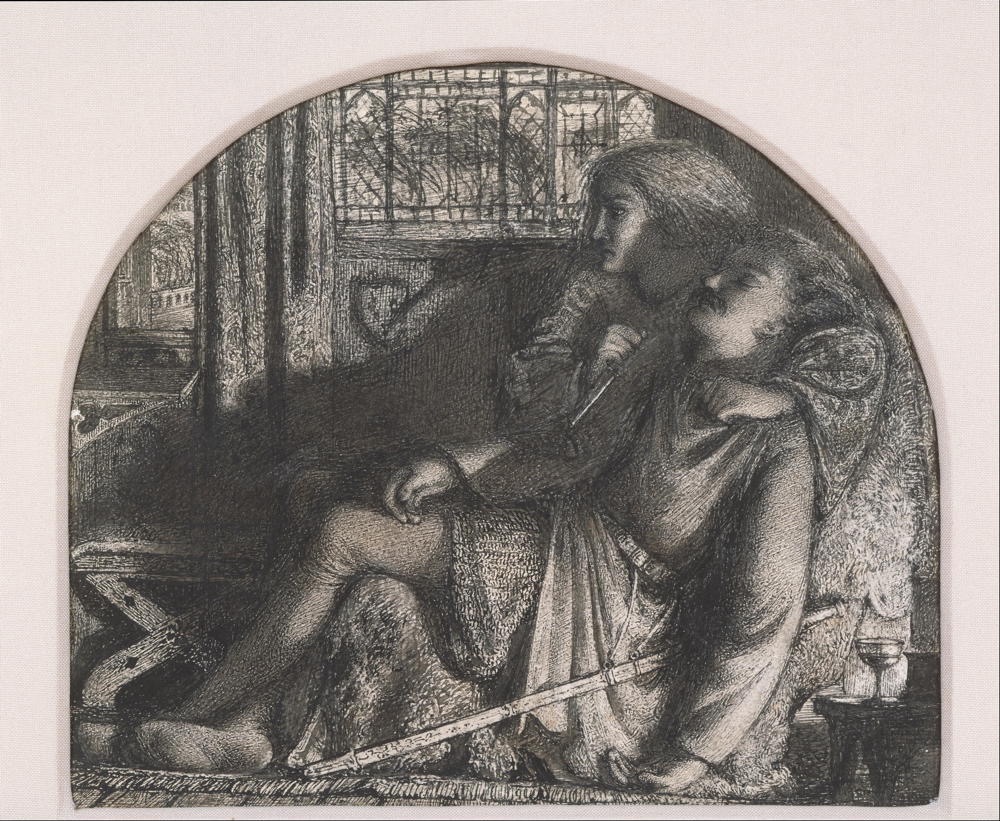
Sir Edward Coley Burne-Jones:
"I rose up in the silent night; I made my dagger sharp and bright"
(c. 1859-60)
"Their approach reliably produces little else but chicken shit."
I believe that I can successfully judge the relative maturity of someone by identifying the kinds of games they choose to play. The field of Transactional Analysis proposes that all humans engage in game-playing behavior, though not always deliberately. The inadvertent games might disclose even more about a person than any consciously chosen one, though. As outlined in the best-selling Games People Play by Eric Berne (Grove Press, 1964, ISBN 0-345-41003-3), a book criticized by many professional psychologists, identifying these games can provide both entertainment and discernment, giving a label and therefore a meaning to otherwise confusing behaviors. Who hasn’t found insight in finally interpreting an interaction as merely a Mind Game? In my hierarchy, the more childish games often seem to be favored by the less mature.
Among the least strategic possible games stands PlayingChicken. This contest employs brinksmanship to distinguish cowardice from bravery. In a classic PlayingChicken contest, two contestants drive toward each other as if intended to create a head-on collision. Whichever contestant swerves to avoid the crash gets labeled “Chicken,” a coward, and declared THE loser. If neither “chickens out,” and a collision occurs, neither gets declared chicken, but both lose. The only way to win when PlayingChicken comes from an opponent losing.
Win/Win can’t be allowed. It’s antithetical to the premise of these contests. It’s interesting to note, though, that the winner when PlayingChicken wins nothing but what I might call bragging rights. The winner can forever proclaim their opponent to have been “chicken” and have prima facie evidence that they once proved themselves to be a coward. Bragging rights ain’t much in terms of a payoff, unless the right to eternally demean an opponent seems like a valuable asset. Who might consider that right a valuable asset? A child. Certainly, no mature adult could see that right as valuable. Certainly.
Except adults can sometimes be fairly characterized as children in big people's bodies. The looks can be more than merely deceiving; they can be convincing. I find it personally difficult to imagine, or used to find it even more difficult to imagine, that a Very Important Person, like The President or The Pope, might embody the child in a Big Person body paradigm. I used to think that to achieve such positions, one would have necessarily needed to completely grow up, to have utterly vanquished their inner child, to enter a more mature sort of maturity than you or me might. The opposite might be true, though. I’ve found much more evidence that a quiet and unassuming adult has achieved maturity than I’ve found evidence supporting the notion that the rich and powerful necessarily have. Further, the quiet and unassuming have often seemed to remain in touch with their inner child that still survives inside without needing to revert to acting out to express otherwise squelched feelings.
I admit to being about eight-years-old some mornings. I wake up cranky and start sliding downhill from there. I usually find enough maturity by noon to eventually pass for an adult again, but I’m reminded that not all grown-ups do or can. Our incumbent presents as an eight-year-old in most contexts. When he attempts to perform as our president, for instance, he always appears to be “playing” president, playing dress-up in sloppy make-up and not quite convincing costumes. When he speaks, he quickly discloses both his intellectual and emotional maturity, often appearing angry about imagined slights and fantasy events. Above all, he seems addicted to PlayingChicken, engaging in seemingly mindless, meaningless brinkmanship when, as president, his job description strongly suggests that he carries the primary responsibility for engineering win/wins. He misinterprets the purpose of democracy every time he lines up another potential head-on collision with some enemy or friend.
Those who insist upon there being a loser end up playing an eternally losing game. In his Finite and Infinite Games (Ballantine Books, 1986, ISBN: 0-345-34184-8), author James Carse describes what he refers to as the two types of games. Finite Games, he insists, are played for the purpose of ending play. These produce ultimately meaningless losers and winners, and might well seem simply nihilistic. Infinite Games, he proposes, are played for the purpose of continuing play. One focuses upon improving play rather than on deciding who wins. Diplomacy and, indeed, politics can certainly be played either way. I would argue that they both qualify as necessarily infinite games that, if either side focuses solely upon winning, both sides ultimately lose. Much maturity seems to be required to engage as if winning doesn’t matter. The future of human existence, though, depends upon our leaders exhibiting just this sort of maturity. Those who insist upon always PlayingChicken insist upon playing an ultimately losing hand. Their approach reliably produces little else but chicken shit.
EndDays seem overfilled with people who were supposed to be responsible adults, mindlessly, reflexively playing finite games like Chicken. These contests seem meaningless and prove to be endlessly exhausting. Why watch a contest if I know from the outset that the result will ultimately prove to be meaningless? It cannot matter how much anyone spends to secure a meaningless victory, and the newly engaged Iranian conflict already exhibits most of the more obvious toolmarks of ultimate meaninglessness. That it might also spark some combatant to employ a nuclear weapon, and end the world, notwithstanding. The end of any world must necessarily prove to be meaningless, for it means forfeiting the means for judging anything, the most senseless kind of courage imaginable. I spend my EndDays mustering the courage not to play Chicken, hoping somebody might identify ways for everyone to win.
©2026 by David A. Schmaltz - all rights reserved

Good For A Goose

Comeuppance (19)
Decency (90)
Decency Unscrolling (1)
EndDays (92)
Exiled (90)
Fambly (93)
FollowingChapters (93)
Grace (92)
Humor (2)
iAlogue (1)
Letters to the Editor (1)
NextWorld (91)
Personal (18)
Prosperity (94)
Steam Festival (4)
Unscrolling (89)
Vaporized (6)
Work (16)
September 2026
August 2026
July 2026
June 2026
May 2026
April 2026
March 2026
February 2026
January 2026
December 2025
November 2025
October 2025
September 2025
August 2025
July 2025
June 2025
May 2025
April 2025
March 2025
February 2025
January 2025
December 2024
November 2024
October 2024
September 2024
August 2024
July 2024
June 2024
May 2024
April 2024
March 2024
November 2006
October 2006
September 2006
August 2006
July 2006
June 2006
May 2006
April 2006
March 2006
February 2006
January 2006