Freely
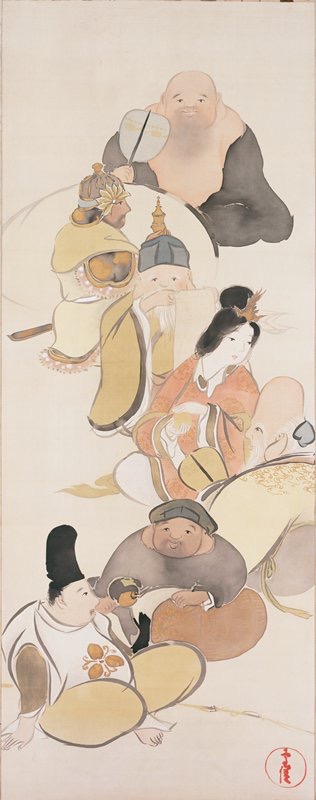
Kamisaka Sekka
Seven Gods of Good Fortune
(1920s)
"… liberating everyone involved."
Prosperity increases the possibility of simply giving stuff away. Once I’d accumulated plenty, I occasionally exceeded my ability to properly appreciate and maintain some of my previously precious possessions. What I had seen as essentials sometimes became more like burdens. An occasional yard sale balanced this scale, where my Prosperity translated into an ability to make somebody a really great deal on something they needed much more than I did. The Muse and I eventually abandoned the usual pretext for conducting such sales and dispensed with putting price tags on anything, explaining to anyone who stopped to browse that everything was going for the same low price: Free! Not even that price guaranteed that everything found a new home, but we completely eliminated the commercial hassle usually associated with such undertakings. When we relocated from Maryland to Colorado, we gave away the larder refrigerator and the hide-a-bed in the basement mother-in-law rooms. We felt instantly lighter when we passed those burdens into somebody else’s delighted care.
Yesterday, I finally managed to give away a patio table that had been gathering grime in what was originally intended as a flowerbed beneath the sideyard's enormous Snowball hedge. It had become Lawn Crap after we’d moved from Colorado, where we had a deck that seemed to have been made for it. It was too large for the Villa’s deck here, and if I had left it on the lawn, I would have had to move it every week to successfully mow. I’m convinced that one of the primary keys to happiness involves keeping the Lawn Crap to an absolute minimum, and to utterly eliminate it if joy’s the objective. Lawn Crap is anything that must be moved to successfully mow a lawn. To my mind, there’s never a good enough reason to justify Lawn Crap under any circumstance, so that patio table’s days had been numbered since we returned here five-and-a-half years ago. When our new neighbor, Heidi, moved into the recently refurbished rental across the street, I felt inspired to offer her that table. I immediately got extremely busy, so it was months later when I finally delivered, complete with the set of cushions The Muse had fabricated after we’d inherited it from a neighbor in Colorado. We parted with it for the same price we’d originally paid for it: not nothing, but Freely.
Few activities better demonstrate Prosperity than Freely flowing goods. Wealth might encourage commerce or, heaven forbid, competition, but Prosperity can support much more satisfying exchanges. It might not occur to one in the throes of a scarcity mindset to simply Freely give stuff away, but even they hold this most gratifying of the many competing superpowers. Something strangely validating occurs on both sides of such transactions. The giver lightens their load while the receiver, curiously, also lightens his, because anything Freely received adds nothing to anyone’s balance sheet or to the bottom line on their profit and loss statement. Such exchanges transcend business. They reinforce the notion, too often forgotten during trading frenzies, that we might be capable of caring for each other, and, especially, capable of caring for ourselves. Freely giving might be the finest self-esteem booster known to humans, far outstripping even the cleverest artistry of concocting any competing deal. Giving Freely might be the most sincere form of simply being human.
It might be that nobody ever truly owns anything until they feel they can afford to Freely give that thing away. Otherwise, additional compensation gets involved. That money must be for making up whatever’s lost in the transaction. We might call it revenue, profit, or loss, but it might be evidence that we had never really owned that asset, and that it had perhaps owned us by approximately the amount we felt we were owed in order to part with it. Make no mistake, I’m not arguing for treating every asset as a Freely exchangable good, only that those possessions we can Freely part with never successfully owned us, either. We had enjoyed a relationship untarnished by the sooty hand of commerce, more like family than business, more like spouses than business partners. I’ve happened upon a few forebears’ last wills and testaments. They always seemed petty, stating the value of a few extremely modest possessions, like an iron bedstead, perhaps once proudly prized by the dearly deceased. But the price of such things seemed meaningless in any broader scale of things. My sadly departed forebear had no use for the price of anything by then. Pass it on to the surviving spouse or neighbor and get on with it.
I woke feeling freshly Prosperous this morning, after carting that patio table and matching chairs and cushions over to the new neighbor’s no longer naked patio yesterday evening. She swore that she’d pay me back with a big box of her shortbread cookies, which I will appreciate but not account for as income earned or even stumbled upon. I have no desire to maintain a commercial relationship with my neighbor. Back when we lived in The People’s Republic of Takoma Park, Maryland, I was charmed by a common practice in our neighborhood there. Whenever someone performed what they labeled a mitzvah for another, The Beer Fairy would magically appear overnight, leaving a six-pack of the receiver’s favorite beer on their porch. Nothing was ever said in acknowledgement or appreciation, other than the simple declaration that that damned beer fairy had apparently been working the neighborhood overnight. In Native American culture, it’s common practice to anonymously gift an expensive Pendleton® wool blanket to one who’s done the giver a good deed. These gifts are never acknowledged, but absorbed without explicit recognition, just as it was given. These traditions of Freely giving maintain Prosperity’s dignity and grace better than any practice I can imagine, liberating everyone involved.
©2026 by David A. Schmaltz - all rights reserved
Good For A Goose

Comeuppance (29)
Decency (90)
Decency Unscrolling (1)
EndDays (92)
Exiled (90)
Fambly (93)
FollowingChapters (93)
Grace (92)
Humor (2)
iAlogue (1)
Letters to the Editor (1)
NextWorld (91)
Personal (18)
Prosperity (94)
Steam Festival (4)
Unscrolling (89)
Vaporized (6)
Work (16)
September 2026
August 2026
July 2026
June 2026
May 2026
April 2026
March 2026
February 2026
January 2026
December 2025
November 2025
October 2025
September 2025
August 2025
July 2025
June 2025
May 2025
April 2025
March 2025
February 2025
January 2025
December 2024
November 2024
October 2024
September 2024
August 2024
July 2024
June 2024
May 2024
April 2024
March 2024
November 2006
October 2006
September 2006
August 2006
July 2006
June 2006
May 2006
April 2006
March 2006
February 2006
January 2006