EntanglingWebs
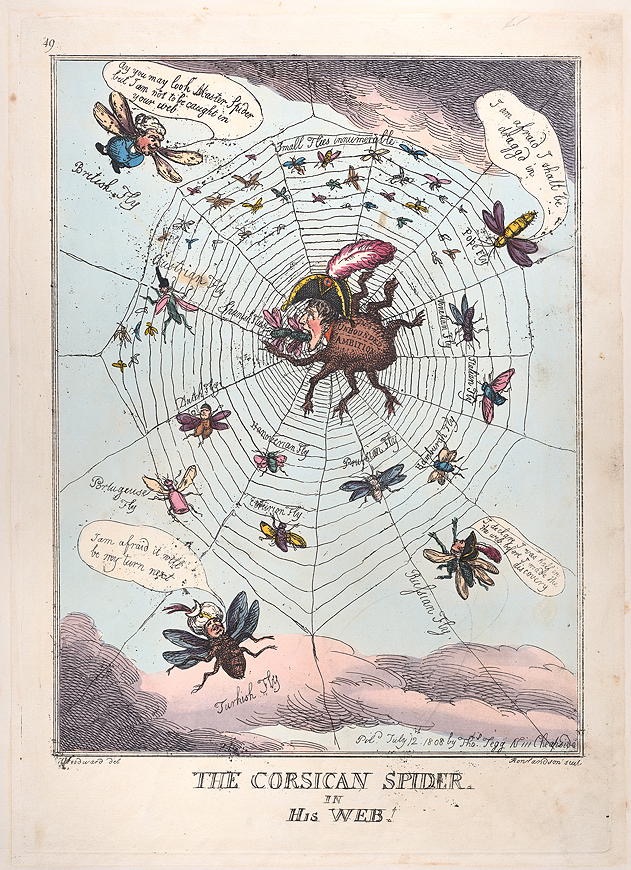
Thomas Rowlandson
:After: George Murgatroyd Woodward
Publisher: Thomas Tegg
The Corsican Spider in His Web!
(July 12, 1808)
"Dabble in tangled webs, and you will eventually end up tangling yourself."
Near the end of April of this year, while beginning my EndDays Series, I posted a story entitled TangledWeb. In it, I described how our administration incapable of administering anything conducted press conferences. I bemoaned having to interpret whatever was passed there as the opposite of what might have actually happened, and I complained about how strenuous this endless exercise had become for my wearying imagination. Opposites might attract, but they are rarely natively obvious. Further, I felt as though I was training myself in some perverse art by repeatedly attempting, and often failing, to properly interpret the probable negative from my natively positive position. I felt as though the exercise might be rendering me into more of a negative person than I ever intended to become. I ended that essay by declaring that our incumbent and his incapable administration were already done, finished, done in, though I sense now no small element of wishful thinking in this earlier insistence. Here we are, nearly six months later, and, if anything, this sideways administration specifically designed to avoid administering anything at all costs, continues tangling the webs they so ineptly weave.
Sir Walter Scott’s caution seems to be coming to fruition: “Oh, what a tangled web we weave, When first we practice to deceive.” I take a small exception with Scott’s characterization, though. The tangled nature of such woven webs isn’t usually the real problem. Who really cares how tangled anyone weaves their web? The difficulty comes when that tangled web becomes entangling, betraying the weaver, who might have innocently woven it that way, for a variety of decent reasons. When that web entangles, encumbering the spider, then the difficulty emerges. This might be a simple matter of reins management. Beyond a certain uncertain number of strands, no pair of hands can successfully manage the emerging complexity. Not even four pairs of hands, as in the case of the web-weaving spider, can manage infinite complexity, and tangled webs inevitably gain their complexity more easily than more straightly-woven ones. It seems inevitable that, eventually, tangled-web weavers will be overwhelmed by the fruits of their own labor.
Now I can return to support Scott’s intention. His point was that weaving tangled webs ultimately turns into the weaver’s Comeuppance, and so, it seems, has our hapless incumbent spider woven his. As the midterms approach, still a week and a half away as of this writing, a manic-appearing intensity seems to have been growing. Even the pretenses of the press conferences I complained about in TangledWebs are gone. What then seemed like simple misdirection has now descended into ultimate irrelevance. Most commentators cannot, for the life of them, describe the message our increasingly mumbling incumbent tries to pass. Further, that incumbent seems moved to spend even more time in public to “prop up” lagging Republican candidates running for once-reliably Republican Senate seats. He seems likely to lose both the House and Senate to his EntanglingWebs. The candidates seem decidedly unappreciative of the assistance they receive from their chief executive. After our incumbent delivers another of his signature two-hour “speeches,” his candidate loses a few more points in the polls. EntanglingWebs, indeed.
Every tangled web weaver in history probably began their career feeling as though they would always remain in control of their skill. Few, if any, could credibly believe they might ultimately betray themselves. They eventually became incredulous that such a fate could ever have befallen them. They did it to themselves. If I couldn’t keep track of the tangles as they doled them out, it must have been exponentially worse for their author, for he was clearly making up whatever stories he shared to get him through the press conference inquisition. He was placating in those moments, but he was also sealing his sorry fate. His comments couldn’t cross-foot. His plotlines contradicted themselves. His credibility, what little was left of what little he started with, only eroded further over time. His influence abraded further when he set out to prop up another of his hapless followers. His EntanglingWebs became his signature contribution to the midterm elections. The polls promise a well-deserved bloodbath, said the fly to the spider, for a change.
I tend to forget that what threatens me also threatens its author. Nobody seems all that powerful in quiet reflection. In the moment, in the middle of some trumped-up press conference, questions and answers can certainly seem important and genuinely threatening. And they might well be important and meant to threaten, but behind the words, insults, and deliberate deceptions runs a machine designed to be unworkable. One can never successfully placate into and beyond any infinity. Every tangled web anyone weaves might ultimately prove to be entangling. There’s really no better Comeuppance than the one the clever fly decided to weave for himself, to trap some seemingly hapless spider. The result seems more reliable than inexorable. Dabble in tangled webs, and you will eventually end up tangling yourself.
©2026 by David A. Schmaltz - all rights reserved

Good For A Goose

Comeuppance (34)
Decency (90)
Decency Unscrolling (1)
EndDays (92)
Exiled (90)
Fambly (93)
FollowingChapters (93)
Grace (92)
Humor (2)
iAlogue (1)
Letters to the Editor (1)
NextWorld (91)
Personal (18)
Prosperity (94)
Steam Festival (4)
Unscrolling (89)
Vaporized (6)
Work (16)
September 2026
August 2026
July 2026
June 2026
May 2026
April 2026
March 2026
February 2026
January 2026
December 2025
November 2025
October 2025
September 2025
August 2025
July 2025
June 2025
May 2025
April 2025
March 2025
February 2025
January 2025
December 2024
November 2024
October 2024
September 2024
August 2024
July 2024
June 2024
May 2024
April 2024
March 2024
November 2006
October 2006
September 2006
August 2006
July 2006
June 2006
May 2006
April 2006
March 2006
February 2006
January 2006