CountryClubCulture
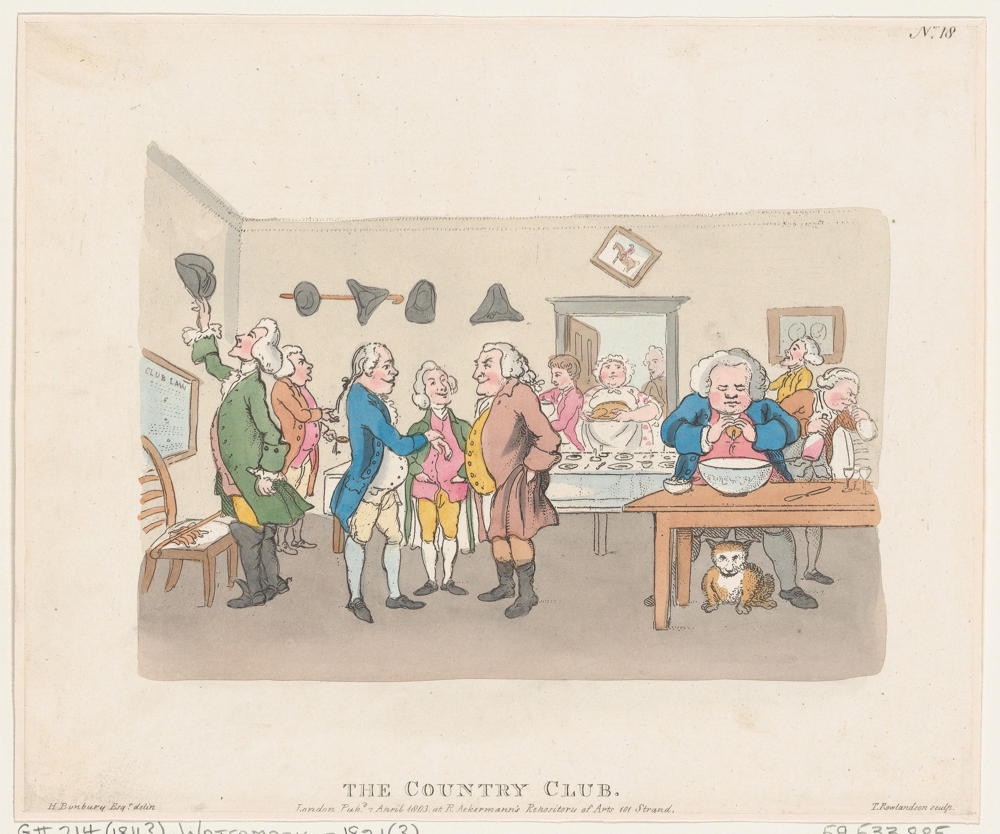
Thomas Rowlandson, Etcher
The Country Club
(April 7, 1803)
"Their Comeuppance has been stalking them for centuries."
The United States has always been divided by class, if by nothing else. As F. Scott Fitzgerald’s narrator stated in his 1926 short story The Rich Boy, “Let me tell you about the very rich. They are different from you and me.” Even if they aren’t really all that different, they certainly seem to want to be recognized as different, as exhibited by what appear to be their obviously exclusionary lifestyles. In every truly prosperous person’s portfolio lurks a country club membership, often treasured as validation of the difference they seem to need to assert so vehemently. Country clubs have storied histories as persistent bastions in overt opposition to any notion of E Pluribus Unum, for they were first and foremost exclusionary. Out of many, a select few were chosen, with a member typically inviting a desirable candidate, and the membership voting on whether to actually allow them in as a member. Historically, Jews, blacks, and other “undesirables” were excluded from consideration. These were originally white, male Christian institutions. Women could join as spouses of actual members. Fees were assessed based on each club’s status. Our local little version is not nearly as exclusionary as it once was, and relies upon self-selection to survive.
Today, anyone willing to cough up the $9,500 initiation fee and $440/month dues for a regular golf membership, with a $60/month food minimum, is welcomed. For Prestige clubs, entry criteria seem more onerous: initiation fees average $58,000 nationally, annual dues average around $10,700, and the industry’s fees rise 8-12% annually. Waitlists remain common—sponsorship by existing members, typically required. Beyond prestige, Invitation-only legacy clubs: Augusta National, Burning Tree, Winged Foot, Pine Valley, feature no published fee schedule, no inquiry process, and no waitlist that just anyone can join. You are chosen, period. Fees are rumored to be in the $150,000–$750,000 initiation range. Blackballing (one or two member objections killing a candidacy) operates through indirect social pressure rather than formal balloting in most cases now, though formal blackball systems existed historically and some persist.
The incumbent’s relationship to this culture interests me, for Comeuppance purposes. Our incumbent built his own golf clubs specifically because the established clubs, particularly in the Northeast, wouldn’t have him as a member. Mar-a-Lago and his other properties operate as ersatz country clubs where he controls admission, reversing the dynamic that once so effectively excluded him. He famously opened Palm Beach clubs to Black and Jewish members precisely because the old-line clubs that snubbed him didn’t, a genuine disruption of Country Club Culture that he has exploited politically ever since, even as his own clubs function as pay-to-play status environments not structurally different from what once excluded him. However they were founded, they served as the models for his eventual brand of populism, not populism for the people, but populism for the exclusive benefit of a selectively chosen few.
The Country Club Culture embodies economist Thorstein Veblen’s culture of conspicuous consumption. These days, those who exclusively enjoy a certain class of tax break tend to belong, for they are exclusionarily prosperous. They typically own and operate businesses that enjoy the liberal pass-through benefits extended only to business owners. How can they afford trinkets like fabulous cars, private planes, and second homes in Aspen? The IRS allows them to charge those costs as business expenses, a benefit for which they pay no taxes. As a class, members of the pass-through culture seem most militantly opposed to taxes of any kind, perhaps because their exclusive status depends on their not paying what anyone not a member might consider their fair share. Not only do they choose to belong to clubs that emphasize their superiority, but they also expect the rest of the actual taxpayers to reimburse them for their supposedly God-given privilege. This cohort lavishly spends on anything their lifestyle depends upon, which might explain why they tend to contribute so heavily to conservative political candidates, for “religious” reasons.
Once anyone’s identified as special, others might quite naturally seem like shit by comparison. What of those who could never imagine paying ten grand for something as worthless as a country club membership? Or those who wouldn’t ever choose to part with five hundred bucks a month just to sprinkle glitter on their ego? What of those poor devils? What’s to become of them? If it seems the Country Club Culture wastes a tremendous amount of very precious resources being conspicuous, it’s only because that’s precisely what they do, maybe all they ever do, well, that and work perhaps hardest to avoid paying anything like their fair share of taxes. They might work hardest to blackball those who might aspire to achieve their own version of an American Dream, which must seem like a nightmare to those, like our incumbent and his utterly dependent cohort, whose egos so utterly depend upon them being recognized as somehow special and inhabiting a pipe dream that exists far beyond any lousy E Pluribus Unum. This culture was never populist nor democratic, only, sadly, exclusionary. Their Comeuppance has been stalking them for centuries.
©2026 by David A. Schmaltz - all rights reserved

Good For A Goose

Comeuppance (29)
Decency (90)
Decency Unscrolling (1)
EndDays (92)
Exiled (90)
Fambly (93)
FollowingChapters (93)
Grace (92)
Humor (2)
iAlogue (1)
Letters to the Editor (1)
NextWorld (91)
Personal (18)
Prosperity (94)
Steam Festival (4)
Unscrolling (89)
Vaporized (6)
Work (16)
September 2026
August 2026
July 2026
June 2026
May 2026
April 2026
March 2026
February 2026
January 2026
December 2025
November 2025
October 2025
September 2025
August 2025
July 2025
June 2025
May 2025
April 2025
March 2025
February 2025
January 2025
December 2024
November 2024
October 2024
September 2024
August 2024
July 2024
June 2024
May 2024
April 2024
March 2024
November 2006
October 2006
September 2006
August 2006
July 2006
June 2006
May 2006
April 2006
March 2006
February 2006
January 2006