Commerce
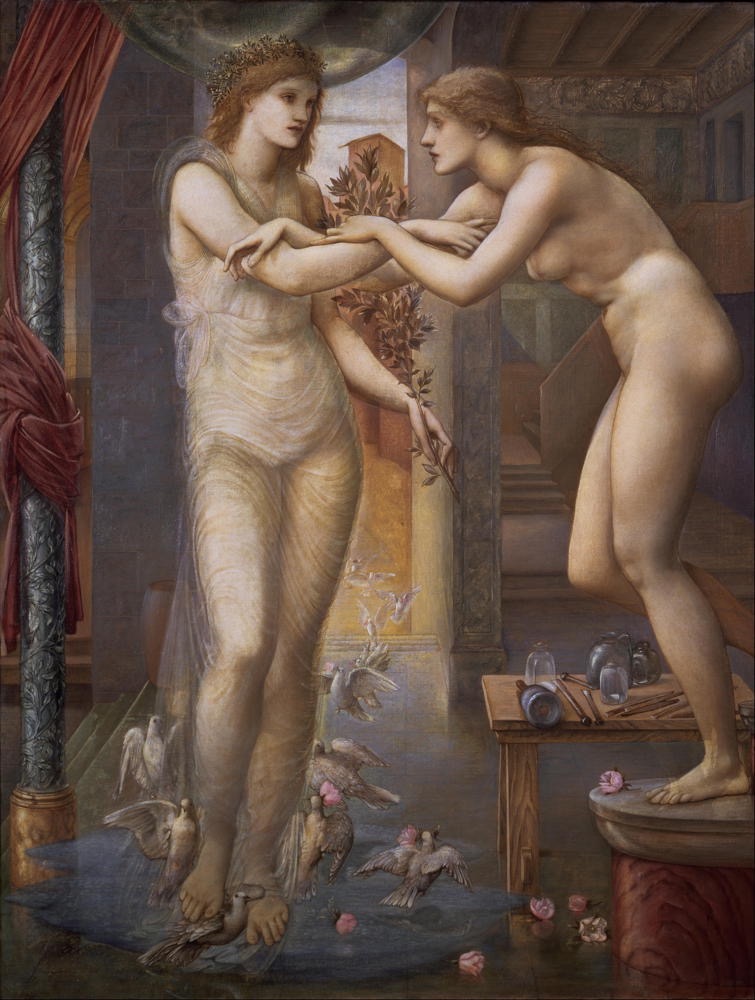
Sir Edward Coley Burne-Jones:
Pygmalion and the Image - The Godhead Fires
(1878)
"…Commerce there will likely be no better."
It has never been more difficult for me to simply buy something. I blame convenience for the terrible state of Commerce; few things remain accessible except online. More than anyone could ever desire remains available online, though the price of purchasing anything there might convince a shopper that it’s not really worth the accompanying hassle. Convenience brings hassles all its own, completely different than the more familiar yesteryear in-person shopping hassles. Finding a product has been simplified to the point that it’s essentially impossible to find a single instance of any item. Trying to find something invariably yields an overwhelming variety of that product, leaving the shopper confronted with the Paradox of Choice. Comparing two ot three alternatives can seem fairly easy for most, but winnowing down two or three dozen choices produces less a choice than a dilemma, one that seems to damn this shopper whatever I choose. I often decide that I didn’t sufficiently want that item when faced with this dilemma, so I quietly delete it from my shopping list, lest my choice somehow damn me. I tend to be better for whatever I never chose to purchase. That’s the essence of EndDays Commerce.
On those rare occasions where I decide to choose something, unseen externalities conspire to gang up on me. I will probably have to log into or onto some Shopping Cart App, of which there are an infinite variety, each named precisely the same and each operating very, very differently. Each asks the usual qualifying questions, but each requires its own unique syntax for responses. Each wants credit card information, but each parses it differently. It’s not at all uncommon for me to abandon my intention to purchase something because I cannot pass muster with the damned Shopping Cart App. When I abandon my attempt, I will have initiated a future series of innocent queries about whether I wouldn’t rather have consummated the purchase. These will continue nearly ad infinitum or until I finally tag them as junk so they’re routed to another queue in my email app. If I successfully complete the Shopping Cart App’s cross-examination, I’m likely to learn that shipping charges double the price I expected to pay. I don’t begrudge anyone having to pay for shipping something, but when the shipping charges equal or exceed the item’s price, I’m apt to abandon that near-success in favor of thriftiness. I decide that, after extensive cross-examination, I will probably be better off without that item. Thank you very much.
On those rare occasions when I successfully trevass (1) that last gauntlet and I receive the package I had convinced myself I’d wanted, it turns out to be almost completely unlike the item illustrated on that long-ago website I purchased it from. The size might be wonky, something I could have known in a second had I been able to put my grubby mitts on it before purchase. It could be the wrong color, texture, fit, or feel. A significant percentage of my purchases get rewrapped and returned to the USPS window. I rarely reorder.
I recently had to return some pairs of socks (wrong size, abominable texture, poor fit), but learned that the company charged a ten-dollar restocking fee on all returns. They would gladly refund 70% of the original purchase price, though, unlike the original, they wouldn’t charge postage for the return. Interestingly, the restocking fee amounted to just a little more than the return postage charge would have been. I wrote a letter complaining about their bait-and-switch customer service, only to have them assess a restocking fee for my trouble? I received a penitent response from their Customer Experience Director that didn’t mention their restocking fee policy, just regretted that they couldn’t satisfy me. A week later, they refunded the purchase price, less that damned restocking fee, of course.
I’d threatened to become not merely a dissatisfied customer, but an activist, dedicated to ensuring that nobody I knew would ever even consider buying socks from them. I had been offended, but two weeks later, I’ve almost forgotten that insult. New insults direct my attention ever forward. Living as I do near the end of every known logistics network, visiting a store in person is often not an option, unless, of course, I feel moved to rediscover all that our local retailers no longer stock. Just this week, I went looking for some heavy jute twine, once a staple during planting season but unavailable here at any price. I could have any number of inferior polypropylene impostors, but none of the genuine article. Online was hardly better, for the impostors dominated those sites, too. It was damnably difficult to judge a twine’s weight, too. Did I need a #2 or a #3 twine? I didn’t want rope, and the line between twine and rope became ambiguous online. I ached for a salesperson, someone who’d actually used the product and could offer a testimonial and much-needed advice. Few shopping sites offer such services, though snippy little chatbots have become enormously popular. They can rarely, if ever, answer a straightforward question about anything, though they are universally cheerful. Their cheerfulness tends to leave me aching to be an activist shopper again, dedicated to ensuring the company fails in its mission to replace jute with polypropylene. I am not in any way modern.
I usually leave my online shopping to The Muse, who faces few of the many challenges I encounter when shopping online. I acknowledge that I’ve entered my shopping EndDays. I am no longer in active acquisition mode. I will purchase, but only under duress, and only for a well-defined and necessary purpose. I never was much for buying geegaws, and I’m more likely to buy paint, for instance, than paint brushes. My infrastructure needs have largely already been fulfilled. I will fuss for months over purchasing a new pair of pants, so long that The Muse might finally feel moved to ask if I have any jeans that aren’t grass-stained on their knees when we’re entering some supposed to be semi-formal context. I blame it on Commerce, which has matured to the point that it’s essentially non-existent. I know, some people feel freed by EndDays Commerce. I feel oppressed. By the time I’m finished with this world, I suspect that this world will have had just about enough of my shenanigans, too. I will not be buying anybody’s pants when I’m in Heaven, and even fewer should I end up in Hell. I’m uncertain how I’ll tell, except that Commerce there will likely be no better.
(1) "trevass that last gauntlet" — is that intentional? It reads like a portmanteau of traverse and trespass, which actually captures the experience precisely. If inadvertent, it's worth keeping anyway.
©2026 by David A. Schmaltz - all rights reserved

Good For A Goose

Comeuppance (19)
Decency (90)
Decency Unscrolling (1)
EndDays (92)
Exiled (90)
Fambly (93)
FollowingChapters (93)
Grace (92)
Humor (2)
iAlogue (1)
Letters to the Editor (1)
NextWorld (91)
Personal (18)
Prosperity (94)
Steam Festival (4)
Unscrolling (89)
Vaporized (6)
Work (16)
September 2026
August 2026
July 2026
June 2026
May 2026
April 2026
March 2026
February 2026
January 2026
December 2025
November 2025
October 2025
September 2025
August 2025
July 2025
June 2025
May 2025
April 2025
March 2025
February 2025
January 2025
December 2024
November 2024
October 2024
September 2024
August 2024
July 2024
June 2024
May 2024
April 2024
March 2024
November 2006
October 2006
September 2006
August 2006
July 2006
June 2006
May 2006
April 2006
March 2006
February 2006
January 2006