Classifying
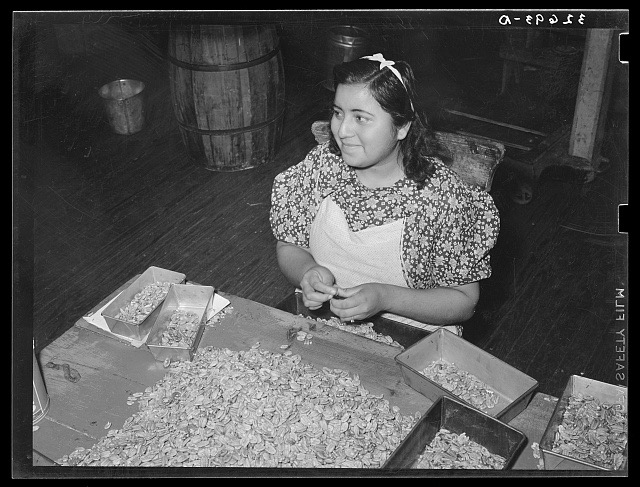
Russell Lee,
United States. Farm Security Administration
Classifying pecan meats. Pecan shelling plant. San Antonio, Texas
(1939)
"…I must be the source of all the Prosperities inevitably surrounding me."
This is not just a game. I have been considering Prosperity, mine as well as ours, for just over forty days and nights now, a suitably Biblical time span, and I am drawing two tentative conclusions, since I can’t seem to decide anything conclusively, nor should I. The first, which I have previously already heavily hinted at, must be that Prosperity only exists as a plural rather than a singular entity. Sanity insists that it always be understood as a multitude rather than as a singular state. It exists only in array. This translates into an understanding that no Prosperity ever stands alone. When I spot a Prosperity, this means that more must be lurking nearby. Prosperity seems to exclusively travels in flocks, herds, schools, or pairs, never “batch.”
The second tentative conclusion I simply must draw from my inquiry so far might seem as if I’m somehow cheating, and truth told, I might be cheating if Hoyle is judging. I am coming to believe that Prosperity results from Classifying, not from “merely” identifying it as adhering to some pre-existing definition. Prosperity can’t be so easily codified. It stays a felt sense however one tries to define it, perhaps recognized when seen, but, I suspect, far more often not recognized even when seen. Most often, not even distantly suspected. This suspicion means that virtually anything might qualify as Prosperity, or not. If this logic holds, it might just reinforce my earlier assertion that there’s “NoThing,” or even no such thing as Prosperity, if only because Prosperity never was, nor ever could have been, properly classified as a thing. It lacks any distinctive thingness, though that alone shouldn’t necessarily dissuade us from declaring its presence when we sense it.
We seem to believe that Prosperity simply must be extremely rare, but is it really? If it’s never singular, and derived by Classifying, then what prevents anything, any experience, any substance, from qualifying as somehow representing Prosperity’s presence? I conclude, tentatively if you prefer, this inference precisely because of those two tentative conclusions. Prosperity must surround us, ever and always, and its occasional or continual apparent absence, then, simply must represent a Classification error, rather than an actual absence. I admit that this conclusion, however tentative, might just serve to utterly eliminate any possibility for any actual Prosperity to exist anywhere, for if everything represents some possible form of Prosperity, doesn’t that mere notion nullify Prosperity’s potential existence, under the If It’s Everything, It’s Nothing Law of the Universe? Perhaps, I reply, but perhaps not.
I suspect that however numerous, Prosperities don’t compete with molecules, unless, of course, one Classifies molecules as another instantiation of Prosperity. In that case, though, wouldn’t every multitude also qualify? Atoms? Leaves? Sugar ants on the kitchen countertops? Wouldn’t each of these presences also qualify as Prosperities? Maybe so. Why not? Are we as a society in potential danger from acknowledged Prosperities surrounding us? It seems much more likely that we might be smothering under a curious absence of Prosperities when a simple Classification exercise might bring otherwise untold Prosperities into sharp focus. Perhaps any apparent absence of Prosperities amounts to serious misperception, and not just one any old Dr. Pangloss might too-easily embrace on its face. Classifying requires more discernment than that.
I am presently lousy with wildfire smoke, it being August in the Pacific Northwest, the month where we traditionally try to burn up or down our remaining forests and rangelands. Wildfire smoke represents a type of Prosperity nobody wishes upon themself, so it’s most often omitted from any list of Prosperities. But Prosperities can simultaneously represent curses as well as blessings, with heavy weightings along either opposing access. If I include even obvious curses in my Classifying of Prosperities, I create many more than I otherwise might have recognized. Why would I even try to expand my understanding of Prosperity to include such obvious calamities? I’m not sure why yet, but I’m working on it. I suspect that I cope poorly with even the most welcome Prosperities. Maybe I feel unworthy. Maybe I never learned how to graciously accept what I never suspected I deserved? Maybe not. Whatever, I suspect that I continue to cope poorly with my Prosperities, that each one I identify provides another opportunity for me to practice acceptance, and to, through iteration, come to better cope with my surprisingly many emerging Prosperities. I suspect that there are nearly endless opportunities, depending upon my own Classifying efforts.
I suspect that I’ve just opened up another new territory on this Prosperity Scrabble® board. Before, when I presumed Prosperity was singular and I recognized that I knew it when I saw it because I was preconsciously Classifying my experiences into Prosperities and others, I could live in humble ignorance of this true source of authority over my experience. I am learning how to cope with the overwhelming Prosperities apparently inevitably surrounding me rather than relegating myself to barely scraping by trying to identify the presumed relatively rare Prosperities that approach my orbit. I’m betting that my tentative conclusions, that Prosperities always manifest in plurals and that Prosperity results from how I’m Classifying rather than from how some random dealer in the sky distributes good fortune, might hold true long enough for me to more than tentatively conclude. How Prosperity actually is might not even matter after I discover that I must be the source of all the Prosperities inevitably surrounding me.
©2026 by David A. Schmaltz - all rights reserved

Good For A Goose

Comeuppance (29)
Decency (90)
Decency Unscrolling (1)
EndDays (92)
Exiled (90)
Fambly (93)
FollowingChapters (93)
Grace (92)
Humor (2)
iAlogue (1)
Letters to the Editor (1)
NextWorld (91)
Personal (18)
Prosperity (94)
Steam Festival (4)
Unscrolling (89)
Vaporized (6)
Work (16)
September 2026
August 2026
July 2026
June 2026
May 2026
April 2026
March 2026
February 2026
January 2026
December 2025
November 2025
October 2025
September 2025
August 2025
July 2025
June 2025
May 2025
April 2025
March 2025
February 2025
January 2025
December 2024
November 2024
October 2024
September 2024
August 2024
July 2024
June 2024
May 2024
April 2024
March 2024
November 2006
October 2006
September 2006
August 2006
July 2006
June 2006
May 2006
April 2006
March 2006
February 2006
January 2006