City-State
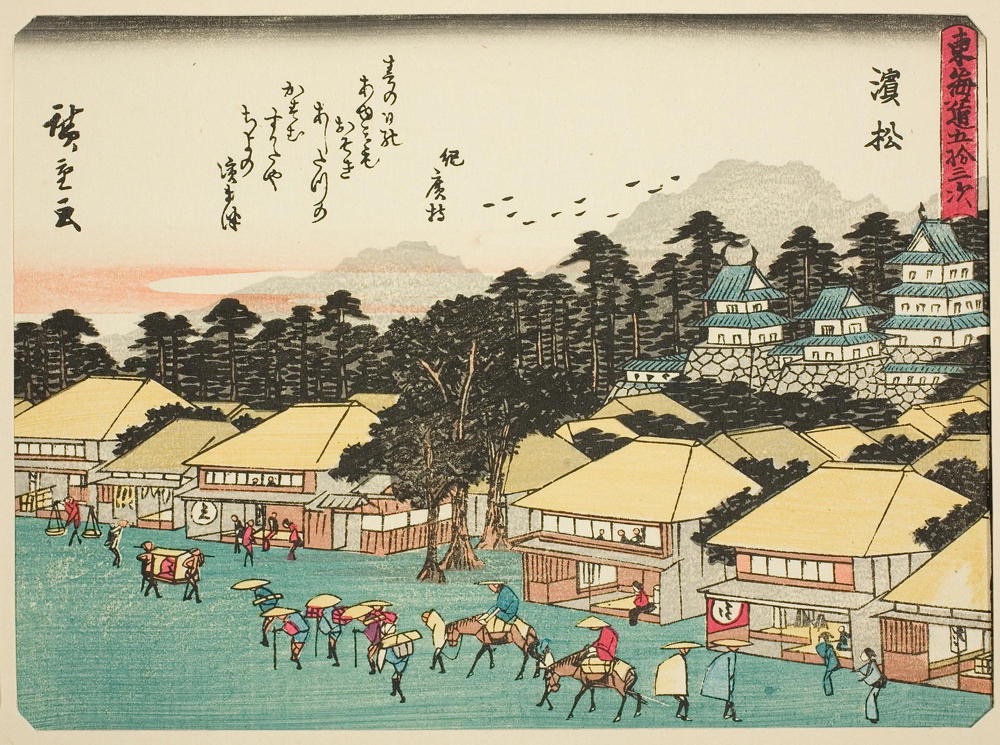
Utagawa Hiroshige 歌川 広重
Hamamatsu, from the series “Fifty-three Stations of the Tokaido (Tokaido gojusan tsugi),”
also known as the Tokaido with Poem (Kyoka iri Tokaido)
(c. 1837/42)
"I'm certain that anywhere I find Prosperity lurking fully qualifies as my home and castle while I'm there."
I think of Prosperity the way I think of an Italian City-State, a kind of autonomy, an anchor, an identity. In the same way that a person’s home, however humble, represents their castle, Prosperity serves as both the source and expression of cultural social standing. Each family in my neighborhood, a blessedly mixed configuration almost entirely unlike any gated community, inhabits their unique castle. Each, as they say, gets to be the asshole in their castle, holding an independence rare among the Pre-Prosperous. Even the very wealthy, who might live in actual castles, seem to be more owned by their relatively palatial palaces than inhabiting them. My neighborhood includes owner-occupied places next to rentals, older homes with more recent construction tucked in between on what was most certainly once the larger places’ original properties. The orderliness here does not seem overwhelming. It’s certainly not enforced by anything other than each inhabitant’s sense of civic decency. I, for instance, feel guilty if I miss mowing my lawn for a few days after it really should have been mowed, for this clutter seems an offense to the neighborhood’s tranquil sense of its own Prosperity.
For a few years, one neighbor, who lived just to the left of my castle, left his place derelict. He had lost his wife, and found he couldn’t stand to live in the house in which they’d raised their kids, so he moved out, and essentially abandoned his Prosperity, as I feel certain he felt that he had been abandoned by his wife. The place went to pot. He mowed the desiccated lawn twice a year, whether it really needed it or not. It became the source of most of the fresh dandelion seeds in this corner of the universe for a while, and I curse whatever curse had befallen him. The whole neighborhood suffered through those years. His neglect even contributed to the death of an ancient Maple, which finally gave up after years without being watered. Finally, somebody dedicated to restoring derelict homes convinced him to sell the property, and the buyer began the painstaking process of restoring the place to Prosperity. Now it’s a rental inhabited by a woman who owns her own boutique cookie company and occasionally gifts us with some of her curiously spiced shortbreads. That corner was returned to the Prosperous.
When The Muse and I lived in Colorado, back when we were in exile, most neighborhoods were ruled by Homeowner Associations. These were civilian compensations for the inability of the local governments to embrace the need for zoning regulations. Development would have been utterly haphazard had it not been for little localities enacting rules and holding themselves accountable. These arrangements are common and should be unnecessary if we could only rely upon everybody to abide by a certain minimum standard, but there always seems to be a few who interpret liberty to mean the freedom to maintain a few rusty, derelict cars in their front yard, so some enforcement seems necessary to maintain some sense of Prosperity. Mostly, their rules are commonsensical, though there always seems to be someone who interprets the rule book in literal Old Testament terms, seeking eye-for-an-eye vengeance rather than simple compliance. These people tend to be unwittingly Pre-Prosperous and mostly eventually get laughed off, though they can create havoc until they’re tamed. Prosperity need not command conformity.
I remember a scene in Steinbeck’s Grapes of Wrath, when the Joads managed to gain entrance into one of those sanitary government-run migrant camps. They felt as if they’d died and gone to heaven after living out of the back of their flatbed truck. Prosperity must be relative. The most humble digs can seem like the greatest gift, depending. Not depending upon how much, as Woody Guthrie suggested, dough, re, mi one has, but depending upon something far more permanent and abiding. That sense I feel when entering my castle, though I know more certainly than I can tell, that our Villa’s not really anything like an actual castle, or even a Villa, for that matter. I feel that sensation anyway. It slips up my spine. This place is mine and somehow inviolate, however otherwise humble. There really is no place even distantly resembling home. That sensation probably has little to nothing to do with the place. It’s the sense of Prosperity the place elicits. Even when The Muse and I were exiled from here, and in grave danger of losing the place to bankruptcy, this old house still held my attention in the same way it seemingly always had. Even when we were on the skids, our Prosperity still lived here, even in our forced absence. It was waiting for us here when we returned twelve tired dog years later.
The Italian City-State was a unique form of organization, egged on by the rugged geography of the place. The topography encouraged the sense that each locality was unique, because it was. Many of the earliest cities were built with castle-like walls surrounding them, some of which remain miraculously standing. Visiting Montefalco in Umbria, a deep sense of local Prosperity overwhelms me. The Muse and I wandered into a small cafe to find game roasting on an open fire. We ordered a simple meal expertly prepared, and we might have been the only two people in the world for the next hour. Outside, it was Italian cold and rainy, in the chilling way that only Italy seems to do cold and rainy. Inside felt Prosperous beyond comprehension. We occasionally muster that same sense of sublime isolation intimately connected to everything in the universe when we’re in our so-called Villa Vatta Schmaltz, at home. It might not be that anywhere I hang my hat is home, but I’m certain that anywhere I find Prosperity lurking fully qualifies as my home and castle while I’m there.
©2026 by David A. Schmaltz - all rights reserved

Good For A Goose

Comeuppance (13)
Decency (90)
Decency Unscrolling (1)
EndDays (92)
Exiled (90)
Fambly (93)
FollowingChapters (93)
Grace (92)
Humor (2)
iAlogue (1)
Letters to the Editor (1)
NextWorld (91)
Personal (18)
Prosperity (94)
Steam Festival (4)
Unscrolling (89)
Vaporized (6)
Work (16)
September 2026
August 2026
July 2026
June 2026
May 2026
April 2026
March 2026
February 2026
January 2026
December 2025
November 2025
October 2025
September 2025
August 2025
July 2025
June 2025
May 2025
April 2025
March 2025
February 2025
January 2025
December 2024
November 2024
October 2024
September 2024
August 2024
July 2024
June 2024
May 2024
April 2024
March 2024
November 2006
October 2006
September 2006
August 2006
July 2006
June 2006
May 2006
April 2006
March 2006
February 2006
January 2006