Bounty
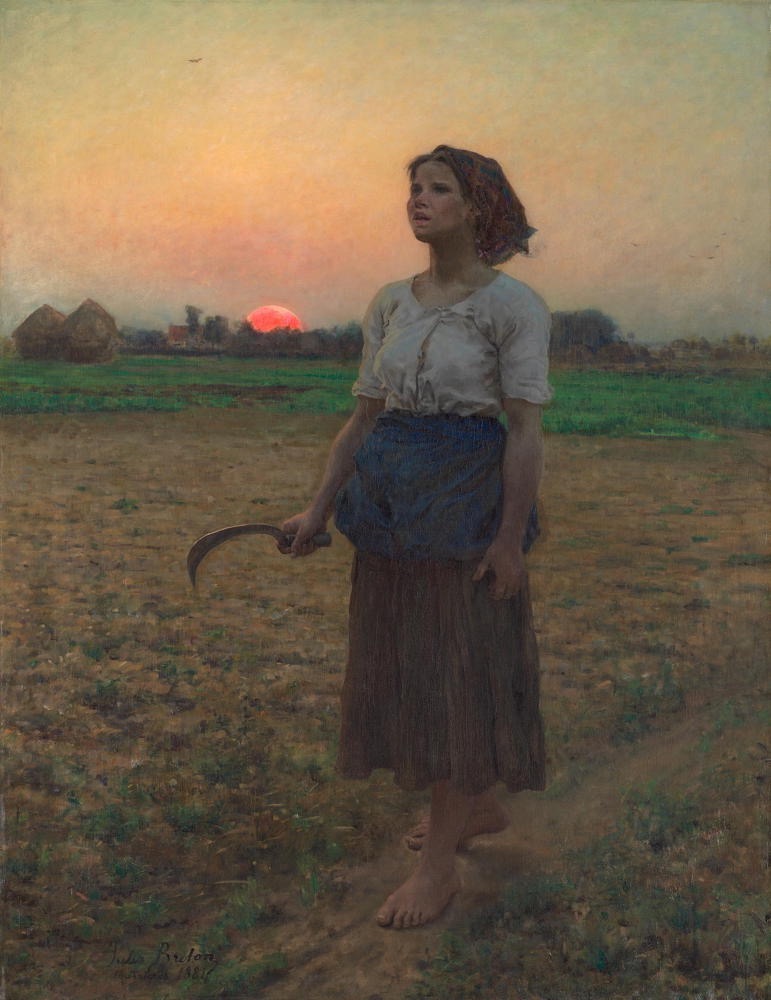
Jules Breton
The Song of the Lark
(1884)
"Lightning doesn't need to strike in the same place twice to leave an indelible mark."
By Mid-July, the Sweet Onion harvest is about over. My own modest patch needs pulling. We eat fresh this time of year, with Sockeye Salmon and the ever-present Steelhead readily available. The Muse’s cucumber crop seems happier than we’ve ever seen one, thanks to her new drip irrigation system. The fig bush has almost become a tree, continually splashed by the backyard pond fountain. It groans under the presence of an unprecedented number of rapidly ripening fruits. These are a reassuring green with the most alluring pink flesh inside. I decide that we’ll have fish tacos for supper and buy a bag of small, freshly made Masa tortillas for the purpose. A grilled eggplant, slices thoroughly saturated with olive oil before I set them on the top grill rack, completes the menu.
The salsa seems similar to what I’ve concocted before, with only the precise contents different. The basic recipe always remains the same: use whatever’s freshest and crunchiest, though individual items vary, depending. This one featured a peach, a cucumber, one huge Walla Walla Sweet Onion—in relatively large dice for maximum crunch—a few of those fine figs, chopped, a fresh Serrano pepper, a finely-chopped garlic clove, and fresh-squeezed lime juice. It was luscious, and the perfect mediator between the oily, tender fish flesh and the sweet, slightly chewy Masa tortillas. We settled in for a feast as a lightning storm started to move in outside. We even saw a little rain trying to moderate what had been an over-hundred-degree afternoon.
A wheat fire raged through the Southern end of the valley, and wild winds whipped branches, knocking off one of the front porch pillar petunia pots again, as usual. That morning, I’d finished priming the framework for the front porch back stairs, the final portion of the porch remodeling project we started two years ago next month. We’d called the contractor, pleading that our building permit was threatening to expire, and he donated his Saturday morning to restarting the effort. I’d spent the first part of two mornings with sweat dripping off my nose, sealing and priming his work, hoping to get two top coats on it before he returns to start adding treads and railings. I sweated through my painting clothes, recalling painting when we were on exile in humid Maryland, and felt a tremendous relief as I finished. Only two more mornings to go to complete that part of the job, if the rain can hold off and if I can face sweating off my nose onto my work again.
The Muse and I played hookey that afternoon. I had been aching to go find precisely where my grandfather’s grandparents had homesteaded, now that I’d found a BLM map with their claim highlighted. I’d done my research and the place seemed well within reach, so I was set to slip out, leaving The Muse to whatever she had scheduled, when she called an audible and decided that she’d accompany me. She could take that phone call from the car, and she could cancel her piano lesson if she wanted to. We tootled with special purpose, for there’s no sensation in my experience that matches the anticipation of physically intersecting with my family’s history. I find these experiences thrilling. I took what I figured might have been the way they’d traveled, along what I imagined might have been the primary highway back in 1880, before anything was paved. I found the road, though it was posted, Private. I could see the plot above us, further up the draw named Little Dry Creek. No water was running, but the line of trees told me there was a permanent underground watercourse there.
We’d passed by what appeared to be a burned-out fire on our way up there. We’d tried to find the other side of the road the map insisted would connect me to wherever that private road led, but a landowner whose yard I happened to drive into while seeking that route informed me that only a derelict wagon road remained and was inaccessible. By the time we’d returned to the highway, that burned-out fire had flared. A furious line of orange led a race along a hillside surrounded by ripe wheat fields. An hour later, they’d closed the highway and the road we’d investigated was under an immediate evacuation order. We were back in town, astounded by the billowing clouds of smoke and the gathering thunderheads. The town smelled like a sour ashtray this morning, with lingering storms and continuing unseasonal rain, even some hail. Prosperity simultaneously means Bounty and danger. Lightning doesn’t need to strike in the same place twice to leave an indelible mark. My forebears left shortly after staking this claim, relocating into much less promising territory and more acreage. The loss of their two oldest sons might have made that first claim too painful to maintain.
©2026 by David A. Schmaltz - all rights reserved
Good For A Goose

Comeuppance (19)
Decency (90)
Decency Unscrolling (1)
EndDays (92)
Exiled (90)
Fambly (93)
FollowingChapters (93)
Grace (92)
Humor (2)
iAlogue (1)
Letters to the Editor (1)
NextWorld (91)
Personal (18)
Prosperity (94)
Steam Festival (4)
Unscrolling (89)
Vaporized (6)
Work (16)
September 2026
August 2026
July 2026
June 2026
May 2026
April 2026
March 2026
February 2026
January 2026
December 2025
November 2025
October 2025
September 2025
August 2025
July 2025
June 2025
May 2025
April 2025
March 2025
February 2025
January 2025
December 2024
November 2024
October 2024
September 2024
August 2024
July 2024
June 2024
May 2024
April 2024
March 2024
November 2006
October 2006
September 2006
August 2006
July 2006
June 2006
May 2006
April 2006
March 2006
February 2006
January 2006