Weekly Writing Summary For The Week Ending 12/18/2025

Bartolomeo Pinelli: The Author's Family (1810)
In reflection, this writing week delved more deeply into Decency's philosophical underpinnings than had any previous writing week in this series. As I near the end of this series—only two more installments remain—it might make sense that Decency gets reduced to the philosophical it might actually be, though I consider it more an ethical philosophy than a necessarily moral one. The distinction, since I'm already delving into the deeply philosophical, lies in who directs the action. In moral action, it seems somebody else directs by commanding, "Thou Shalt." In ethical action, the actor directs the action and stars in the performance. Decency seems to be necessarily self-directed action.
I began this writing week avoiding providing instruction, instead simply reflecting "On Being" Decent. I then considered how I have been essentially DeSensing in my Decency practices. I concluded that to become more Decent must necessarily result in BecomingComplicit. I explored AlternativeFutures, where recovery comes much more quickly than we usually imagine. I explored the phenomenon of FauxDecency, the kind that the indecent shanghai to hide their motives. I ended this writing week with a touch of sarcasm in Excluding, living in a world where hospitality and Decency have been turned on its head. Thank you for following along.
— — — —
Weekly Writing Summary
OnBeingDecent...
“Decency’s question is rarely what but when.”
This Decency Story finds me describing not how to be Decent, but the seemingly simple invocation of it. On Being ...
In this Decency Story, I describe my now extended exploration of Decency that has been more about discovery than instruction, emphasizing that I have no final, tidy definition to offer my readers. Through writing many “Decency Stories,” I’ve learned how complicated and unsummarizable Decency tends to be, especially around the problem of staying Decent in indecent contexts. I see indecency as a bully that pressures me into silence, self‑censorship, and complicity through inaction, which I judge as worse than committing an actual indecent act. From this, I conclude that Decency can generate its own context: it does not require that I wait for safe conditions or invitations, but steps forward with courage and almost foolhardy faith. Decency often emerges from uncomfortable, risky moments, and its central issue tends to be timing rather than content—the time to act Decently has always been now.
Giuseppe Maria Mitelli: Allegory of the Lightness of Being (1702)
——
DeSensing
“Decency primarily exists in the cloudy eyes of its beholders.”
This Decency Story describes how I feel increasingly unable to conform to the emerging Decencies. I have become a slave to my history.
This Decency Story explores how Decency depends on being able to read and respond to one’s social context, and how aging can erode that ability. I describe my lifelong sense of distance from the world, beginning in childhood with the feeling of being a visitor in someone else’s already-claimed territory. Over time, I’m learning how to better read social expectations, develop preferences, and generally feel capable of behaving decently within familiar contexts.
As the world changed, though, I began to feel out of place again, unable to decode new norms, roles, and fads. Today, I experience myself as disconnected, largely irrelevant, and living in a private, essentially unshared world where most contemporary trends feel alien and trivial. My manners and sensibilities now seem antique, more closely tied to memories than to current realities. I continue to defend my own standards of Decency as if they were timeless, even as I note that each generation judges the next as indecent. In the end, Decency appears as something subjective and context-bound, residing in the increasingly cloudy eyes and era of the beholder.
Louis-Léopold Boilly: The Five Senses (1823)
——
BecomingComplicit
Attempting to live Decently incurs ever more complicity.”
This Decency Story describes an unavoidable side-effect of expanding Decency. Anyone increasing their Decency might notice themselves increasingly BecomingComplicit: Guilty as continually charged.
TThis Decency Story reflects on the paradox that simply living makes one complicit in moral wrongdoings, and that striving to live a Decent life intensifies this sense of complicity. I describe my increasingly strict personal limitations—refusing to patronize certain corporations and individuals whose policies or actions I find indecent—knowing these choices narrow my world and complicate daily life.
Every ordinary decision (where to shop, what to eat, what to watch) becomes a moral minefield in which all options are tainted. These refusals function less like sacrifices and more like sacraments, rituals that affirm my convictions while also highlighting my own limits and possible virtue signaling. Decency becomes akin to original sin: an ever-present awareness of wrong that leaves me feeling guilty and complicit, even as I try to avoid further wrongdoing. In the end, the effort to live Decently only reveals new forms of inescapable complicity.
Anneliese Hager: Untitled [Portrait A. H.] (1947)
——
AlternativeFutures
“Decency’s probably more resilient than even the most practiced cynicism.”
This Decency Story considers the likely resilience of Decency.
This Decency Story argues that people habitually underestimate how quickly systems, societies, and moral orders recover from disruption, which fuels unnecessary pessimism and cynicism. Drawing on a friend’s observation, I note that while crises feel catastrophic and endless, history shows that recovery often happens faster than we predict, even though we rarely perceive it in real time—much like not noticing children grow day to day. We confuse disruption with permanent destruction, cling to fixed “nouns” instead of noticing ongoing “verbs,” and assume the future should resemble the present, which makes inevitable change feel like decline. Each generation doubts the next’s capacity and overestimates the permanence of backsliding in areas like social justice. I suggest that cynicism might be overgrown skepticism, and that optimism and decency are, in fact, more resilient and quicker to reassert themselves than our fears and gloomy forecasts imagine.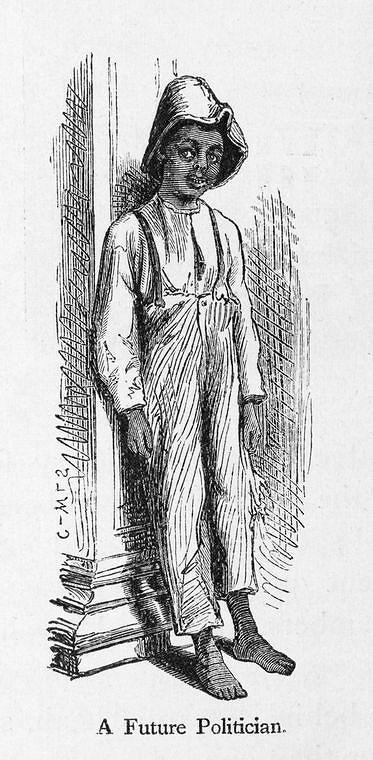
Edward King: A future politician (1874)
——
FauxDecency
“…I’d prefer to believe most would perceive such beliefs the utter opposite of Decency in action.”
This Decency Story considers Decency’s opposite, FauxDecency, and rails a bit against its inherent perverseness.
This Decency Story argues that true Decency has been twisted into a “FauxDecency,” which employs moral language to justify cruelty, bigotry, and control. I criticize political moves, such as labeling countries that support diversity, equity, inclusion, or abortion rights as human rights abusers, as examples of Decency turned inside out and upside down. I condemn right-wing conspiracy believers and public figures who proclaim their own righteousness while promoting inhumanity, racism, and claims of superiority, which I declare inherently self-discrediting.
In contrast, I define actual Decency as quiet, humble, non-competitive, and non-evangelical—something practiced by people capable of humor, selflessness, and forgiveness, and never used to humiliate or dominate others. Decency has no enemies, seeks no glory, and does not claim divine endorsement or inherent superiority; it simply acts for others rather than against them. I reject the concept that white supremacy or bigotry could ever lead to genuine Decency, insisting that any ideology that humiliates, seeks dominion, or parades its virtue could not possibly represent decency at all, but a perversion unworthy of the name.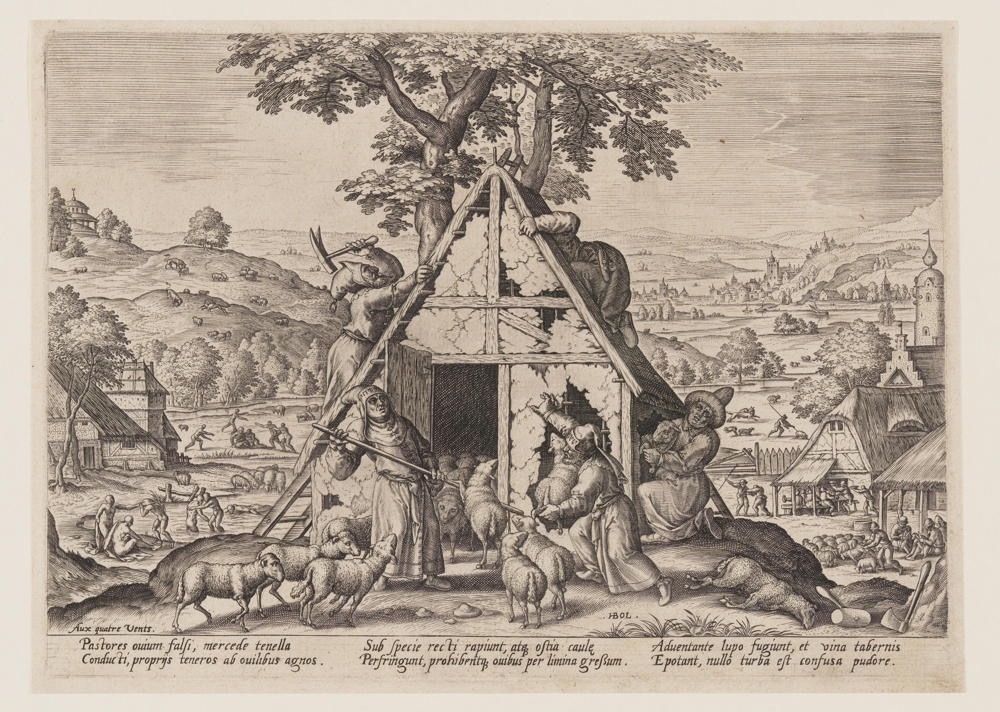
Jan Sadeler I: The False Shepherd (c. 1575)
——
Excluding
“…we can curl up in wonder…”
This Decency Story finds me in steerage, wondering how my interests got Excluded when hospitality became an industry.
This Decency Story criticizes the hospitality industry—especially airlines—for abandoning genuine Decency in favor of selling status and exclusivity. It argues that hospitality has become a system of queues, lounges, and elite tiers designed to separate customers into classes and flatter their egos, all while extracting more money for so‑called “free” perks and upgrades. Airlines now profit more from selling indulgences than from providing basic transportation.
People who just want to travel see this obsession with special treatment as sad and absurd, while those who buy into it are encouraged to think of themselves as kings. Common courtesy seems reserved for those who pay for priority, and everyone else gets treated as lesser. This manufactured inequality will prove to be unsustainable and may eventually provoke a significant backlash from Decent people.
Honoré Victorin Daumier: An Excusable Error. Chickens thinking they have found the cage where they spent their early childhood, plate 21 from La Crinolomanie (1857)
——
This Exchange Ennobled Us
Who was I to think that I might properly represent Decency in a series? I, while nobody particularly special, was perhaps a Decent representative of the sort of person charged with proliferating Decency in the world. There could never be any such person as The Decency Czar, and authority and power seem useless when used either to encourage or to discourage Decency. The seemingly simple tangles any odd anyone encounters when attempting Decency in this world hold all the instruction and reassurance anyone's experience could offer. We each struggle to be Decent in our own ways, and sometimes even succeed. Both our successes and failures seem perhaps equally instructive, for it seems as though Decency only ever really shows in practice, not in theory or in decomposing philosophy, however reassuring such exercises might prove. In practice, Decency seems ragged yet still deeply appreciated. It doesn't require success to achieve its mission. Near misses and apparent failures can also serve to reinforce its purpose, for Decency isn't merely what it does, what it achieves. After studying this critter for the best part of three months, Decency might first and foremost, and also last and utterly, be all about its underlying intention. That choice to act in concordance with a deeply felt sense—moral, ethical, or some other—counts more than whatever results. To live Decently seems to be a matter of choosing generously, of noticing and then acting, not of actually achieving any specific thing. Yesterday, I stood aside as I approached a doorway so that another who had been there before me could enter, but he insisted that I proceed first. I noticed in that moment that while my invitation wasn't accepted, both that anonymous man and I exchanged the most sublime Decencies between us. This exchange ennobled us.
Thank you for following along with me here!
©2025 by David A. Schmaltz - all rights reserved

Good For A Goose

Comeuppance (34)
Decency (90)
Decency Unscrolling (1)
EndDays (92)
Exiled (90)
Fambly (93)
FollowingChapters (93)
Grace (92)
Humor (2)
iAlogue (1)
Letters to the Editor (1)
NextWorld (91)
Personal (18)
Prosperity (94)
Steam Festival (4)
Unscrolling (89)
Vaporized (6)
Work (16)
September 2026
August 2026
July 2026
June 2026
May 2026
April 2026
March 2026
February 2026
January 2026
December 2025
November 2025
October 2025
September 2025
August 2025
July 2025
June 2025
May 2025
April 2025
March 2025
February 2025
January 2025
December 2024
November 2024
October 2024
September 2024
August 2024
July 2024
June 2024
May 2024
April 2024
March 2024
November 2006
October 2006
September 2006
August 2006
July 2006
June 2006
May 2006
April 2006
March 2006
February 2006
January 2006