ReClaiming
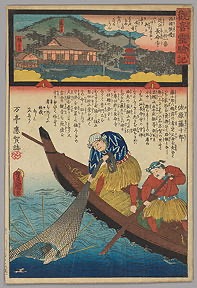
Hiroshige II (二代目 歌川広重, Ni-daime Utagawa Hiroshige
Chōmeiji Temple (Chōmeiji), from the series Miracles of Kannon
(1859)
"What begins as slander always eventually ends as ashes,
once the epic heroes show up to ReClaim their birthright."
We live in a time that might have been specifically designed to spawn one of those immemorial epic poems. Ours would be known as ProsperityLost and written by someone hopefully far more secular than Milton and less reckless than the probably apocryphal Homer. Ours would be no less epic, however, for we lost something far more precious than even a biblical Paradise or an ancient Greek empire, for our Prosperity had the decency to aspire without explicit expectation that it would result in any physical manifestation. We were free to believe without regard to the likelihood that any of us or our progeny would ever really realize the promise, yet that promise held. Hell, it was born self-evident! With it, we could succeed as a mere matter of birthright or adoption, for we were largely, by design, a nation of immigrants, citizens by some designation superior to race, creed, or even religion. We shared a dream of Prosperity rather than any individual lording over any other. We aspired to equality rather than any dominion over.
The enemies of this curious state were with us from before the fabled American Revolution, in which a minority asserted rights no nation had ever once guaranteed before or had any idea how to uphold.
ExistentialDread
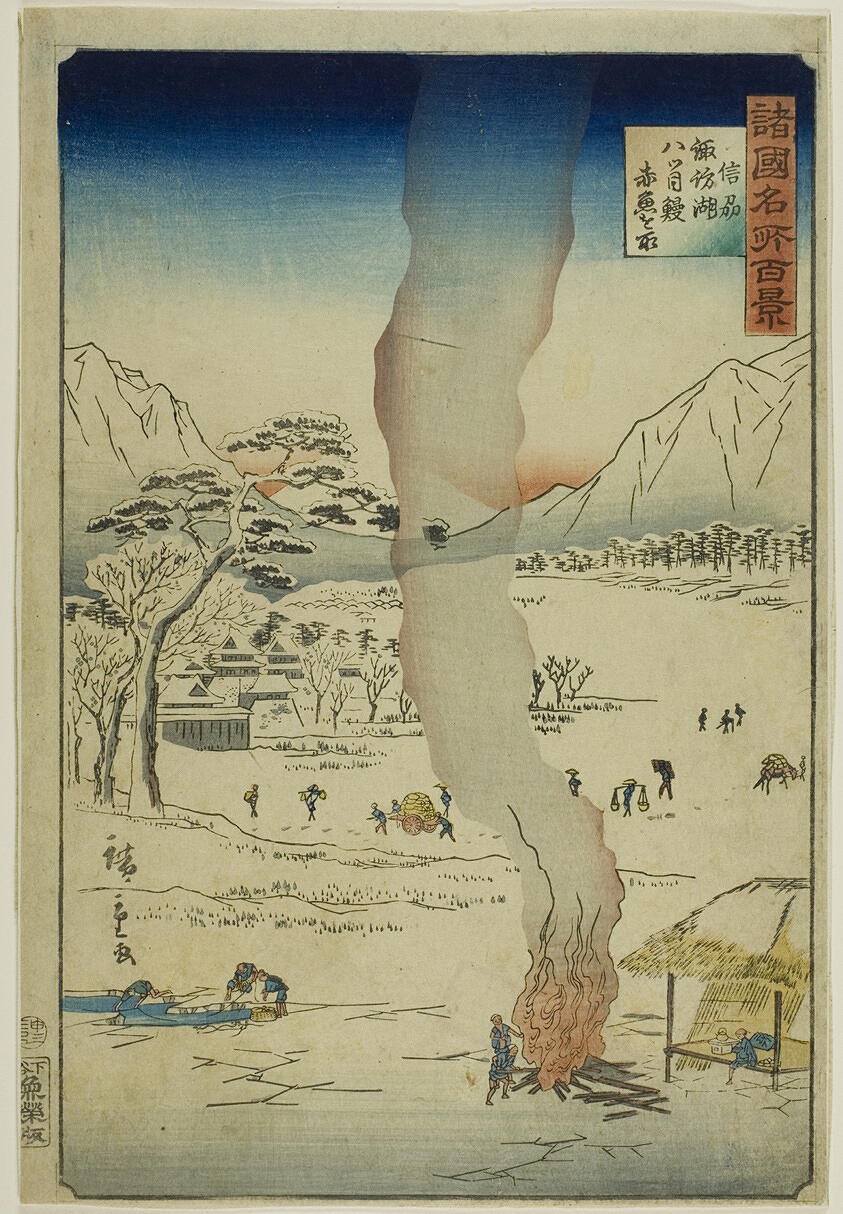
Hiroshige II (二代目 歌川広重, Ni-daime Utagawa Hiroshige
Catching Lampreys, Eels, and Red Rockfish on Lake Suwa,
Shinshu Province ,
from the series “One Hundred Famous Views in the Various Provinces
(Shokoku meisho hyakkei)”
(1860)
"…will this just become another excuse in the already overlong list of reasons why I can't have the Prosperity I once believed I deserved?"
One sure sign that Prosperity feels threatened comes when a persistent ExistentialDread descends. Periodic ExistentialDread offers no real information about the present or future, for these come and go as an inescapable part of any aware existence. To exist has always been to sense threats to continuing that existence, and, as long as these remain intermittent, they offer no real threat to anything, let alone existence. These come as more or less wake-up calls, increasing awareness of the inescapably temporary nature of all existence, of which human existence has never served as any exception. In some ways, intermittent dread serves as a gift. It can sharpen focus and reawaken a lost sense of urgency or significance. Love seems to flourish with a touch of dread in the mix since it can reassert the importance of assertion itself, reminding one that they’re more isthmus than island and should find reasons to appreciate sustaining relationships. But when the Dread turns Existential, and moves in claiming it holds a long-term lease, hinting at permanent residence, Dread’s few benefits quickly evaporate into much worse than nothingness.
The certainty that ExistentialDread brings remains just as illusory as any other certainty in this existence, but it carries a uniquely threatening gravity.
CTSD
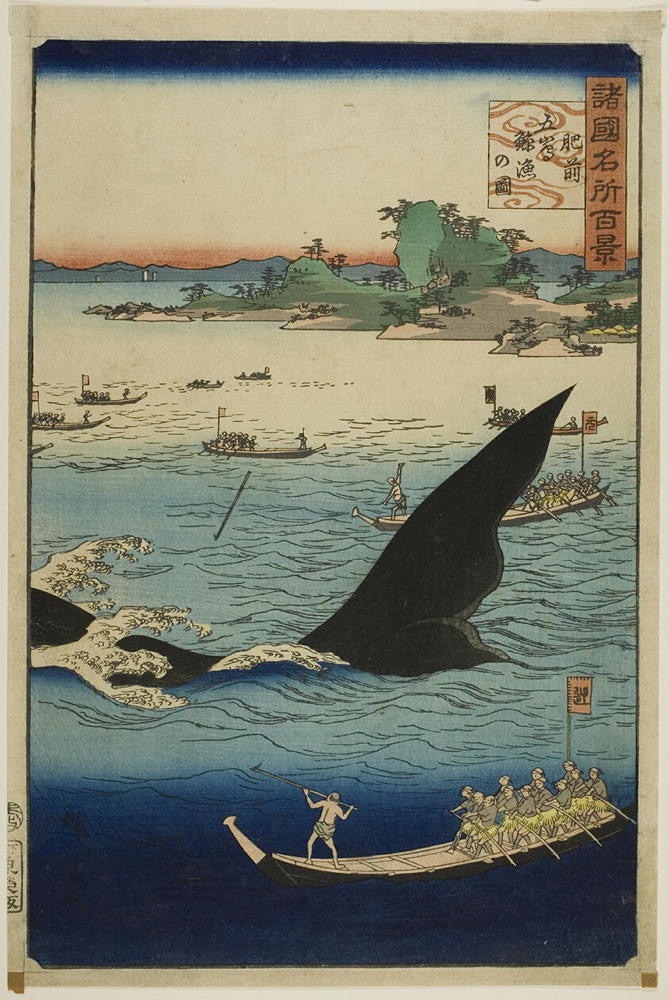
Utagawa Hiroshige II (Shigenobu)
Image of a Whale Hunt at Goto, Hizen Province
(Hizen Goto geiryo no zu),
from the series “One Hundred Famous Views in the Various Provinces
(Shokoku meisho hyakkei)”
(1859)
"I dare not wait until this insult ends to start taking better care of myself."
Traumatic Stress Disorders do not necessarily wait until a trauma passes. The overly popular Post-Traumatic Stress Disorder (PTSD) was very likely first experienced in its Concomitant form, while the trauma was still present. Trauma sows enough confusion that it’s often extremely difficult, if not absolutely impossible, to reflect upon the unfolding experience in the moments it occurs; hence, the much more common recognition of PTSD than its CTSD, Concomitant Traumatic Stress Disorder, predecessor. Trauma seems to be so busy winding up my spring that it might be relatively easy to overlook its presence. Sure, it’s upsetting, but what isn’t? In the moment, it often seems as though the stressors must just be passing through me, transitory upsets apparently leaving little lasting damage. Later, though, Post the Tramatic Stress, Disorders might emerge without having a clear or present cause. Then they can be confusing, as someone clearly not presently threatened by anything starts behaving as if under active siege. Then, if at all, the stories might begin to reemerge and some sense-making might start occurring.
If the trauma lasts longer than an episode or two, it seems probable, if not certain, that some more permanent wounding might be occurring.
Weekly Writing Summary For The Week Ending 08/27/2026
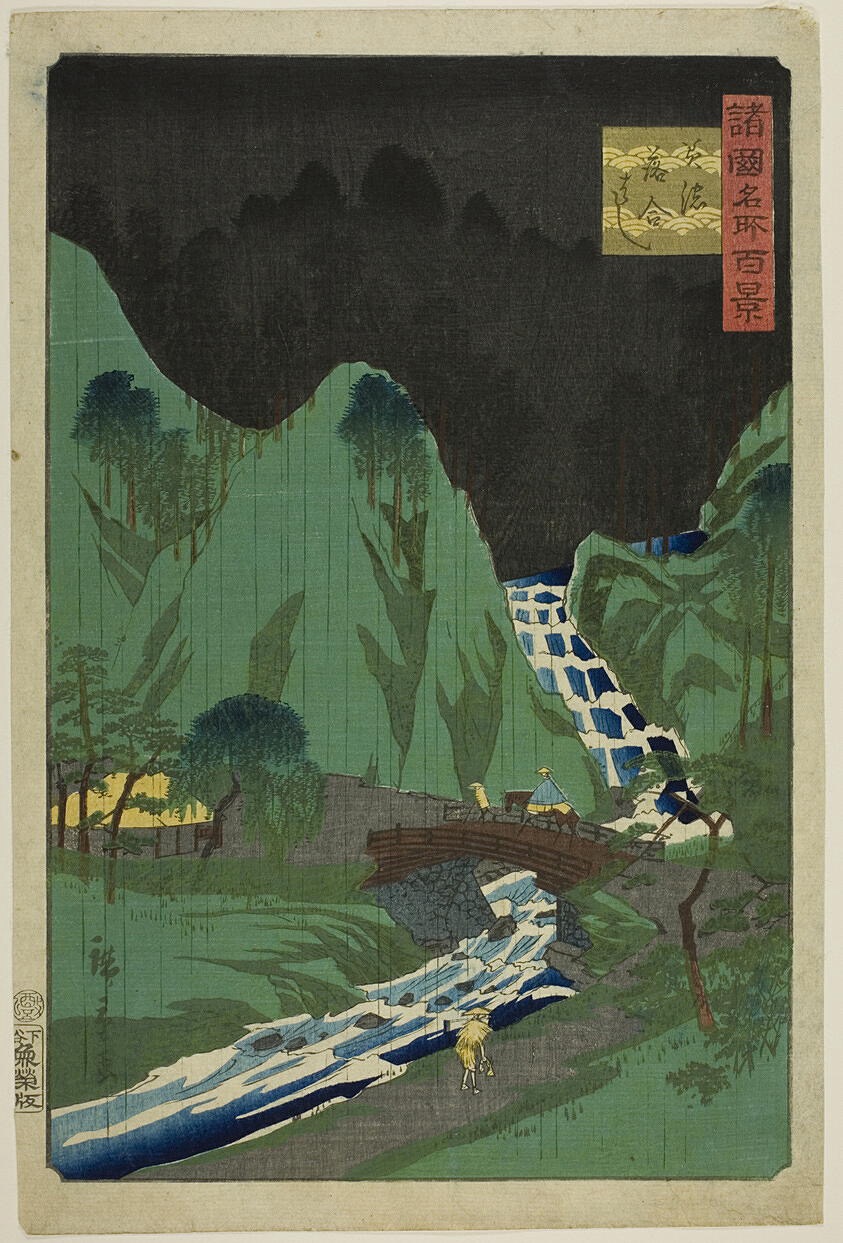
Utagawa Hiroshige II (Shigenobu)
Ochiai Bridge, Mino Province (Mino Ochiai bashi)
from the series “One Hundred Famous Views in the Various Provinces
(Shokoku meisho hyakkei)”
(1861)
This week’s Prosperity dispatches arrived as the series found its most sustained political argument and its most liberating philosophical resolution. The writing ranged from the economic indictment of PhonyProsperity to the legal and moral framework of Impunity; from the historical sweep of Anti-ProsperityPolity to the market pathology of Spookulation; from the kitchen-table fury of StickerShocked to the philosophical liberation of Accschleptances. This week, the series spoke of Spookulation, Spookulators, the self-helpless, and Accschleptance. The hamburger cost thirty dollars. The series, freely given, felt liberated by the end.
Thank you for following along!
Accschleptances
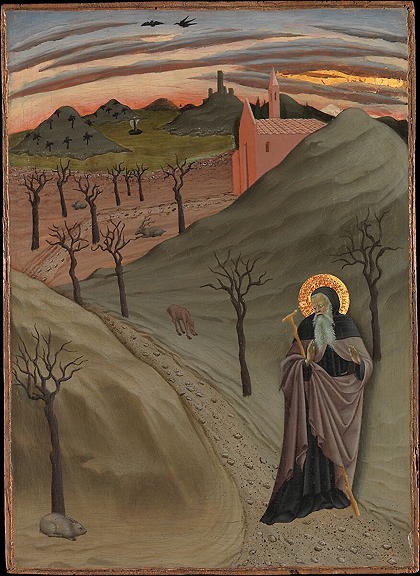
Sano di Pietro or Ansano di Pietro di Mencio
Saint Anthony the Abbot in the Wilderness
(ca. 1440)
"I'm better off without your perfection or mine."
I once believed that Prosperity could only emerge after something close to perfection occurred. Some previously unlikely convergence would produce some utterly surprising manifestation, some outcome seemingly approaching perfection, and Prosperity would thereafter reign. These weren’t completely chance encounters, but they often arrived unexpectedly, initially surprising the benefactors before becoming a seeming birthright. None are precisely born prosperous, and each must learn a few hard-earned lessons before they can properly incorporate the lived practice of Prosperity into a daily routine. Perhaps the key realization on the way to experiencing Prosperity comes when the naive notion that you must first achieve perfection crumbles. A precious form of acceptance replaces that naive notion, what I’ll call Accschleptance: the acceptance that good enough might, in fact, be good enough, that perfection is not only not required but also unlikely ever to appear. The forms within which Prosperity inevitably appears do not include perfection. Therefore, perfection couldn’t possibly be required as a necessary precondition for Prosperity to emerge.
This realization typically comes as a relief, often after a protracted effort to achieve some essentially unachievable perfection or other.
StickerShocked
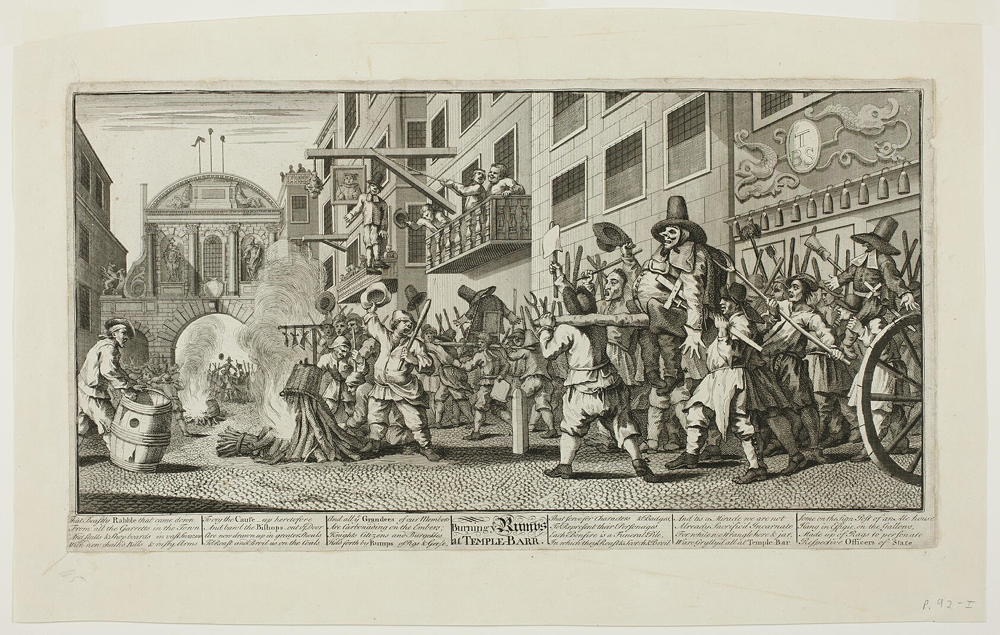
William Hogarth
Burning the Rumps at Temple Bar,
plate eleven from Hudibras
(February 1725/26)
"How much longer before nobody has a Benjamin?"
When I was seventeen, my older brother bought his first house. I remember that he paid about fourteen thousand dollars for it, qualifying for the mortgage under some government program designed to help working stiffs acquire a home. He was managing a Safeway produce department at the time and all of eighteen years old. I looked at that sticker price and quickly calculated how long the indenture would last before he could pay off that place, and I felt aghast. I couldn’t imagine ever willingly agreeing to such an indenture, no more than I could imagine myself ever being able to afford to buy anything priced at anything close to an astronomical fourteen thousand dollars.
I’ve spent my life since convinced that I couldn’t afford.
Spookulation
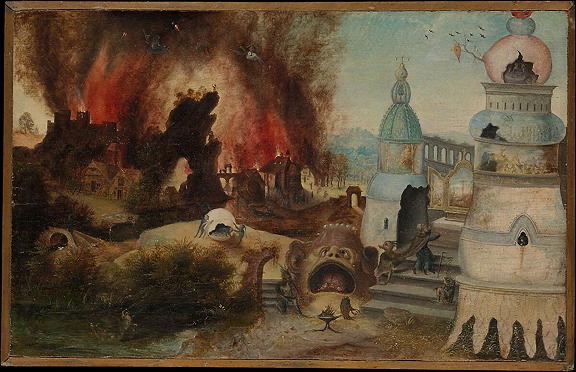
Herri met de Bles
The Temptation of Saint Anthony
(ca. 1550–60)
"The outcome seems certain from the outset."
Prosperity tends to keep speculation in check. The need for assuming great risk, hoping for even greater reward, might be capable of working as a precursor to periods of Prosperity, but it serves as no sure or certain cure for any ill, and should therefore be preserved for rare times of great peril or even greater possibility. When a society comes to perceive its future as necessarily speculative, it might be PreProsperous or merely lost. Only an eight-year-old would plan to succeed by continually upsetting otherwise reasonably stable apple carts. Invoked much more than once in a generation, speculation teeters on the indistinct edge of excessive, for betting the farm on anything too easily puts Prosperity off its feed. It seeks stability, and as such might be the most reliable indicator that the leader isn’t a wild-eyes speculator.
Our present leader turns out to be a wild-eyed speculator.
Anti-ProsperityPolity
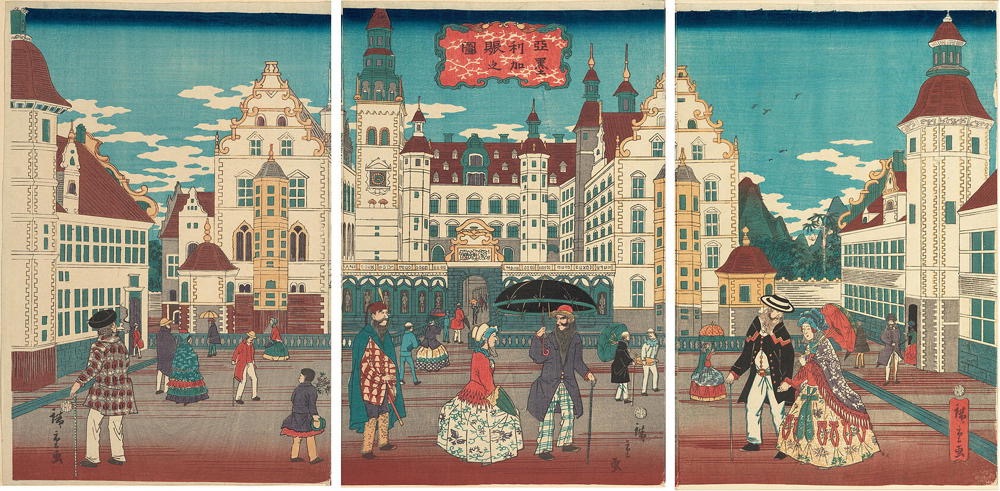
Hiroshige II (二代目 歌川広重, Ni-daime Utagawa Hiroshige
A Picture of Prosperity: America (Amerika shin no zu)
(1861)
"We had better believe we're capable of succeeding, or we've already lost."
Prosperity presented a problem for the captains of industry, for they relied on a tad more desperation in their workforce than Prosperity could provide. Give a worker union wages, and they might start to get ideas that they were more than merely created equal, but equal in more than a metaphorical sense. They’d insist upon something called Collective Bargaining, as if the rabble could comprehend the ins and outs of managing a competitive corporation. They’d surely vote for endless pay increases for themselves, while the shareholders, the real keepers of capitalism’s flame, would become second-class corporate citizens, forfeiting some of their fair share of what were rightfully all their rewards. They were, after all, the investors! Prosperity encouraged a mindset intolerable to the dedicated capitalist, for it equated labor with its natural superior. If capital weren’t king, would everything become a matter of voting? Shouldn’t owners have the final and deciding say?
The strategy was to somehow convince the newly and potentially Prosperous to vote against their own interests.
Impunity
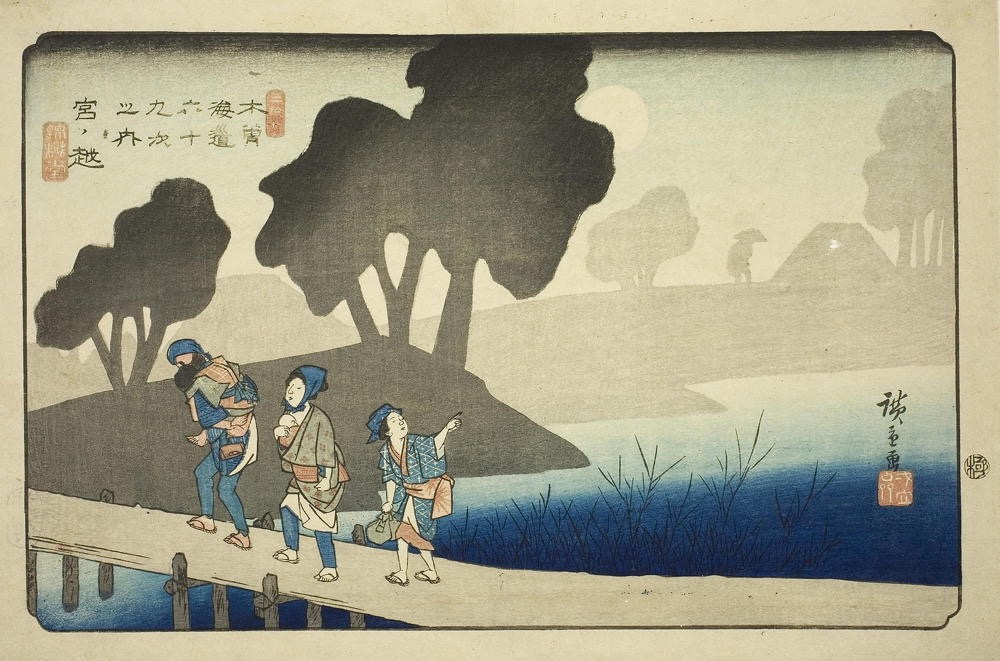
Utagawa Hiroshige 歌川 広重
No. 37: Miyanokoshi,
from the series “Sixty-nine Stations of the Kisokaido
(Kisokaido rokujukyu tsugi no uchi)”
(c. 1835/38)
"History might always ultimately get even withsomething resembling Impunity."
Impunity must be an enemy of Prosperity, for it implies getting away with something, and getting away with something suggests something requiring distancing from one’s actions. The nefarious depend upon Impunity to protect them from well-deserved retribution. They rely upon insider knowledge and special connections to protect them from discovery and punishment. They leave a devastation behind them from which they wish to escape association. They desire nothing better or worse than the freedom that can only come from irresponsible action, where costs get borne by others while they, Impunity, enjoy the ill-gained returns. Impunity can stand to live with itself when it wins by depriving others. It seems to enjoy breaking others’ toys. It believes itself above the law.
I overstate my case for a purpose: to project a brighter and sharper boundary between the Prosperities and their avowed enemy, Impunity.
PhonyProsperity
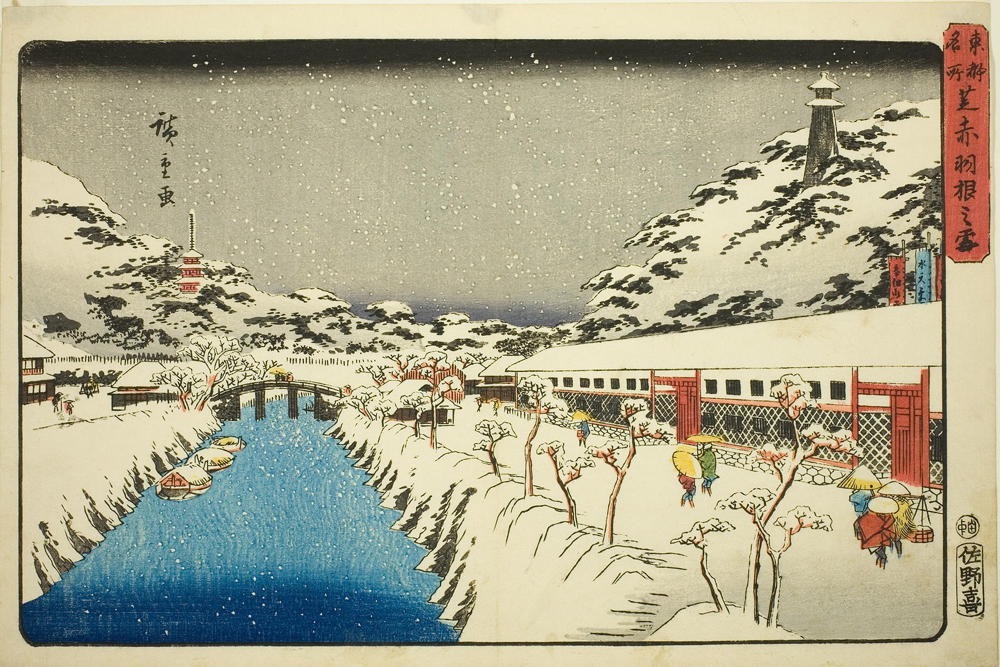
Utagawa Hiroshige 歌川 広重
Snow at Akabane Bridge in Shiba (Shiba Akabane no yuki),
from the series “Famous Places in the Eastern Capital (Toto meisho)”
(c. 1843/47)
"… this will most likely get really ugly before we recover our Prosperity again."
When a political party or ideology takes the US Presidency, it carries a few scant obligations to the American people and, indeed, to the people of the world. As the long-standing designated elephant in the room, the US economy exerts a uniquely influential gravity. This alone implies great responsibility, since so many other struggling economies rely on its stability. These factors and others have historically encouraged a certain moderation. It’s one thing to be powerful enough to do whatever you want, but quite another to be wise enough to restrain that discretionary power to better ensure overall welfare. Economies cannot afford to have many enemies. Few headlines scream what radical initiative a President chose not to choose. Properly managed, an economy should not be featured in many front-page, above-the-fold stories. The discussion of economics should remain dismal enough to nudge it well off the front page of everything, save an occasional Wall Street Journal.
Our incumbent was never anybody’s slave to wisdom or tradition.
Weekly Writing Summary For The Week Ending 08/20/2026
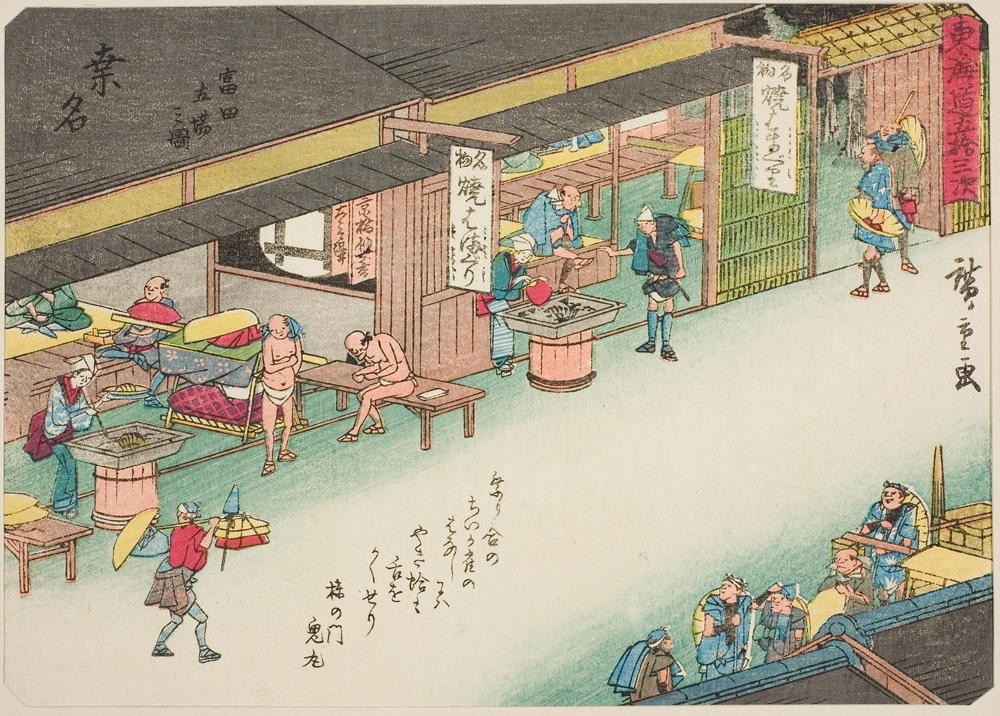
Utagawa Hiroshige 歌川 広重
Kuwana: The Post Station at Tomita (Kuwana, Tomita tachiba no zu),
from the series “Fifty-three Stations of the Tokaido (Tokaido gojusan tsugi),”
also known as the Tokaido with Poem (Kyoka iri Tokaido)
(c. 1837/42)
This week’s Prosperity dispatches arrived on the occasion of my seventy-fifth birthday. They kept arriving through a week that ranged from the tardy but welcome return of shearling slippers to the hardest installment yet written, from the philosophical breakthrough of Easements to the birthday meditation of ProsperityPasting, from the liturgical frame of OrdinaryTime to the coinage of another new term: Amsperity. The series turned sixty-one installments old this week. The slippers arrived three days early and felt like a shipment of gold bullion. The birthday arrived on schedule and felt like OrdinaryTime at its finest.
Thank you for following along!
Amsperity
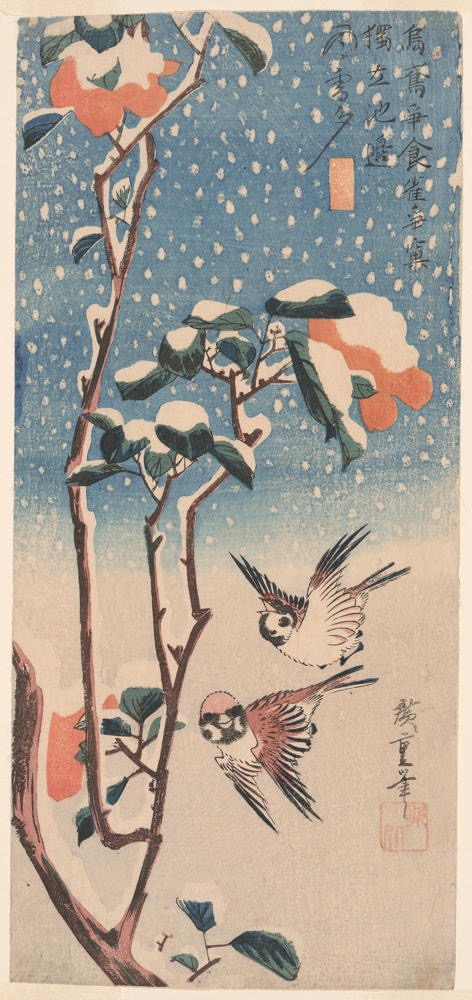
Utagawa Hiroshige 歌川 広重
Sparrows and Camellia in Snow
(c. 1831-33)
"Who, besides such conglomerates, benefits?"
We believe ourselves to be much more skilled at producing and retaining Prosperity than we have generally proven to be in practice. In practice, we have a long history of back-and-forth vacillations. We label these “business cycles” and consider them evidence of nothing more worrisome than The Normals, but these downturns do real damage. Were we more skilled or even professionals at producing and maintaining Prosperity, we might well have eliminated by now the disparities between haves and have-nots. It seems that some subgroup of haves always tries to nudge above their station to take a monopolist’s position in something that might thrive only through egalitarianism. Oh, the nudgers tend to equate egalitarianism with something dreadfully dangerous like communism or socialism, while committing what might be recognized as acts of antisocialism. These purposefully cruel and awfully unusual acts reliably undermine the general welfare and thereby Prosperity, for the myopic purpose of lining their own pockets. Our Prosperity frequently fails us, but usually only because we fail ourselves first.
We seem to be rank amateurs when it comes to producing and preserving our Prosperity.
OrdinaryTime
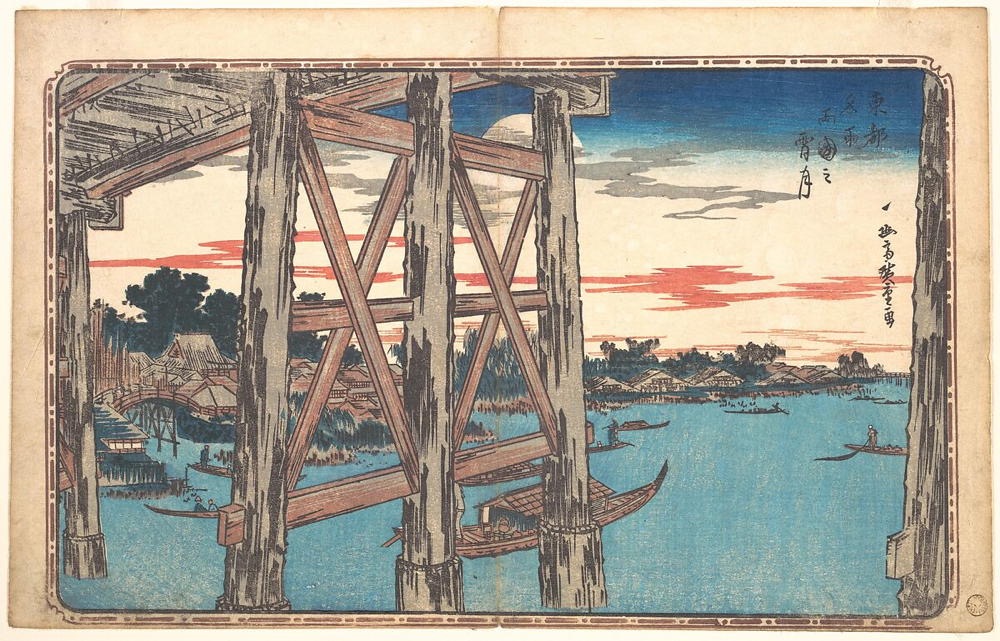
Utagawa Hiroshige 歌川 広重
Twilight Moon at Ryōgoku Bridge
(Not Dated)
"May we soon live in OrdinaryTimes again, Amen!"
Prosperity thrives during OrdinaryTimes. The Ecumenical Calendar divides each year into ferial and festal times, Ordinary days and designated extraordinary ones. It seems sometimes, especially to naive Americans traveling in Italy, that every blessed day has in some way been designated extraordinary on their calender, especially when you were expecting to find a bank or post office open for business only to find it’s the Feast Day of Saint Someoneorother, so whatever service you thought you needed would be unavailable until the following Monday, assuming, often wrongly, that that following Monday isn’t also designated a Day of Holy Obligation to Saint Somebodyelse. Regular life thrives on ordinary days, and, outside of Italy proper, celebrates infrequently. Imagine the difficulty of holding down a regular job while decked out every day in the appropriate garb for properly acknowledging the influence and holiness of good old Saint Martyrdom. Christmas occurs just once each year for good reasons.
When I began this Prosperity Series, I asked myself where Prosperity had suddenly gone, because it seemed to me to have gone missing.
ProsperityPasting
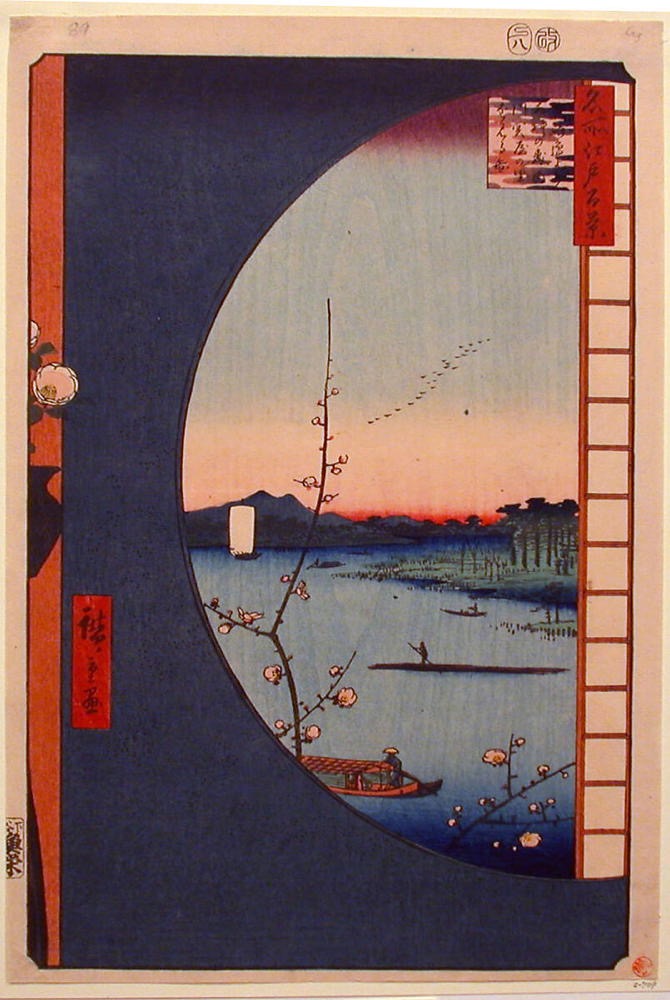
Utagawa Hiroshige 歌川 広重
Small View of Yedo
(1817–58)
"…the very definition of success, and therefore curiously eternal."
I am fondly recalling a Prosperity I never really knew on the occasion of the eve of my seventy-fifth birthday. I have no clue how I managed to survive to such an overripe age, other than to echo that ancient advice that insisted the only way to actually achieve anything must inevitably be one day at a time. My life, then, might only be properly characterized as a series of days, no two all that different, until, over time, great differences emerged. I experienced very few catastrophies, which might be the primary reason I can still sit here fondly recollecting. Even my most wanting periods seem downright prosperous in some senses. When I was foraging for sustenance, I still had my youth, an often underappreciated form of Prosperity that everybody’s certain to lose. As I’ve aged, I have retained many memories, another form that Prosperity assumes, as tangible as air, if not more so some days.
I was born into a world that no longer exists.
Easements
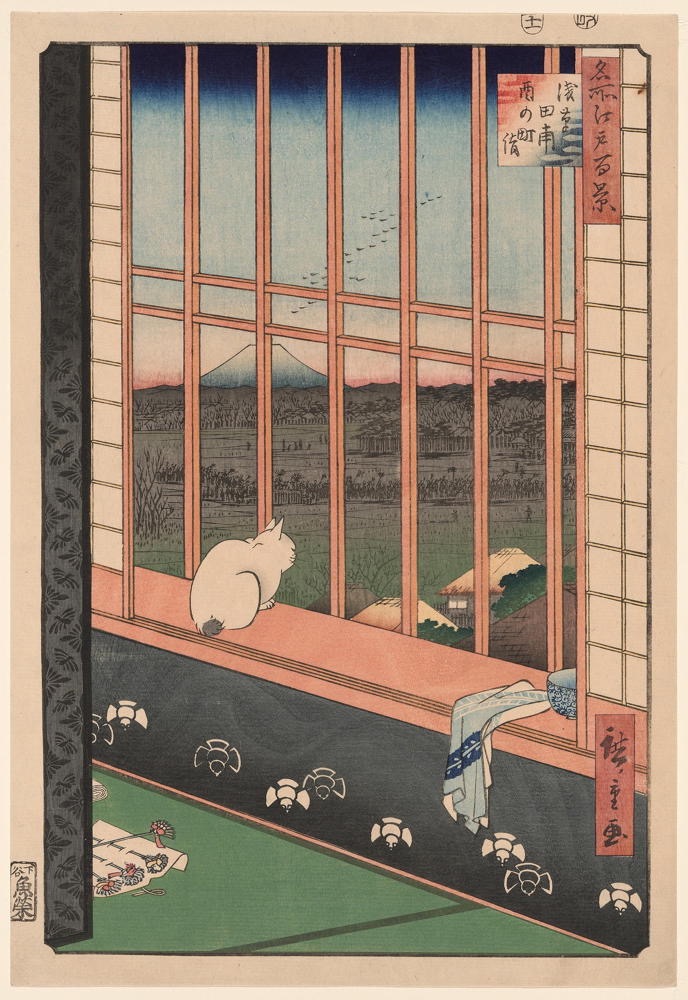
Utagawa Hiroshige 歌川 広重
Asakusa Rice Fields and Torinomachi Festival
(Asakusa tanbo Torinomachi mode),
from the series “One Hundred Famous Views of Edo (Meisho Edo hyakkei)”
(1857)
"…battling each other's spare realities with the jawbones of asses."
Prosperity resolves none of the primary existential human dilemmas, though it does seem to deliver a few Easements. No, not permissions to trespass across another’s property, but the largely psychological sense that one can afford to take one's ease. Freed from the constant pressure otherwise necessary for mere survival, a hierarchy of needs emerges. Higher order urges can take over once Prosperity seemingly resolves the barer necessities, even if only temporarily. I do not believe these higher-order interests are unavailable to the Pre-Prosperous or even the pauper; they just seem more conveniently accessible once simple survival no longer dominates existence. Many artists have flourished while living in icy garrets. Prosperity can reassure without necessarily resolving any of the inescapable human frailties associated with disease or even death. Prosperity cannot prevent that pirate from visiting, or even the odd thief in the night, but it can cast a convincing enough shadow to allow other interests to temporarily dominate one’s consciousness. It opens space without really resolving much.
We humans seem remarkable for how distractible we’ve always been.
Seeking
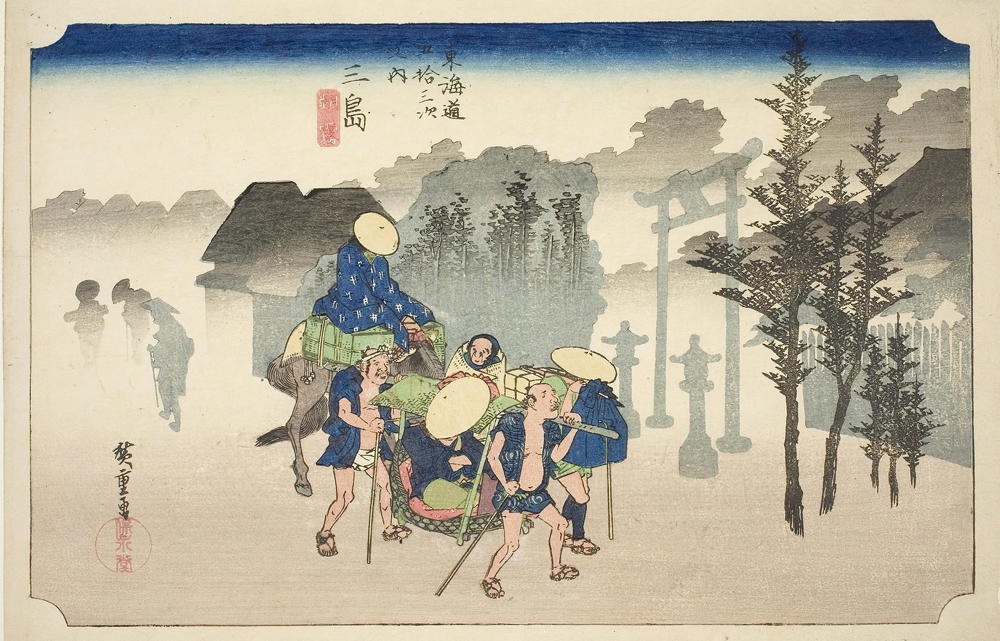
Utagawa Hiroshige 歌川 広重
Mishima: Morning Mist (Mishima, asagiri),
from the series “Fifty-three Stations of the Tokaido Road
(Tokaido gojusan tsugi no uchi),” also known as the Hoeido Tokaido
(c.1833/34)
"Finding it might forfeit its prize."
Prosperity doesn’t necessarily breed complacency. As a colleague confided to me, “I believe that most who are prosperous become quickly committed to the belief in being entitled and are driven to fear that someone will take away their prosperity. Of course, as with most beliefs, this is unprovable.” Nor does Prosperity necessarily breed defensiveness. The Prosperous might remain less than perfectly free to choose what to do, whatever their motive. I propose that Prosperity alone might hardly influence choice. The heart still wants whatever the heart wants, though it might be that Prosperity renders some of those wants to seem more achievable than poverty might, for instance. Prosperity might open possibilities without necessarily guaranteeing achieving anything. In my personal experience, Prosperity encouraged me into Seeking what had previously seemed out of my reach. This, too, qualifies as belief, and as such, proves nothing conclusively, other than accurately representing my personal experience.
The Muse might be a better example, for she’s definitely a seeker.
Slippers
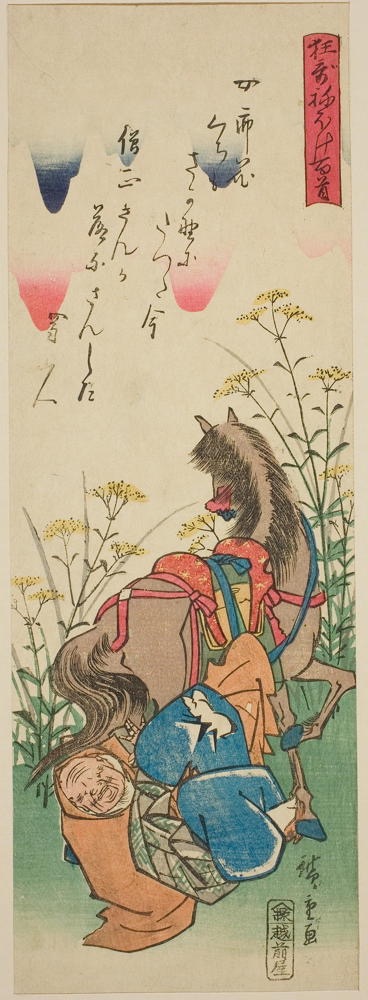
Utagawa Hiroshige 歌川 広重
Sojo Henjo,
from the series “One Hundred Satirical Poems (Kyoka neboke hyakushu)”
(19th century)
"Prosperity returns on the littest cats' feet, too, leaving familiar footprints."
Prosperities come and go with some regularity. The Prosperity I enjoy this morning seems unique, different than any previous one, and I could probably say this about any morning, any Prosperity, were I paying close enough attention to discern any differences. I’m mostly not paying all that close of attention because, like you, I have ten thousand distractions vying for my narrow awareness, and I am not always the most perceptive person on the planet. My Prosperities seem far too easy to take for granted. I rarely celebrate them, even though each and every one, if enumerated, should qualify for at least a participation trophy for showing up. They mostly find me unaware and unappreciative of just how deep down fortunate I surely must be. If this does not constitute a crime, I’m innocent. Otherwise, I’m certainly guilty as sin and fully worthy of some sort of punishment.
I started this series, fifty-some mornings ago, noticing that our Prosperity seemed to have gone missing.
Weekly Writing Summary For The Week Ending 08/13/2026
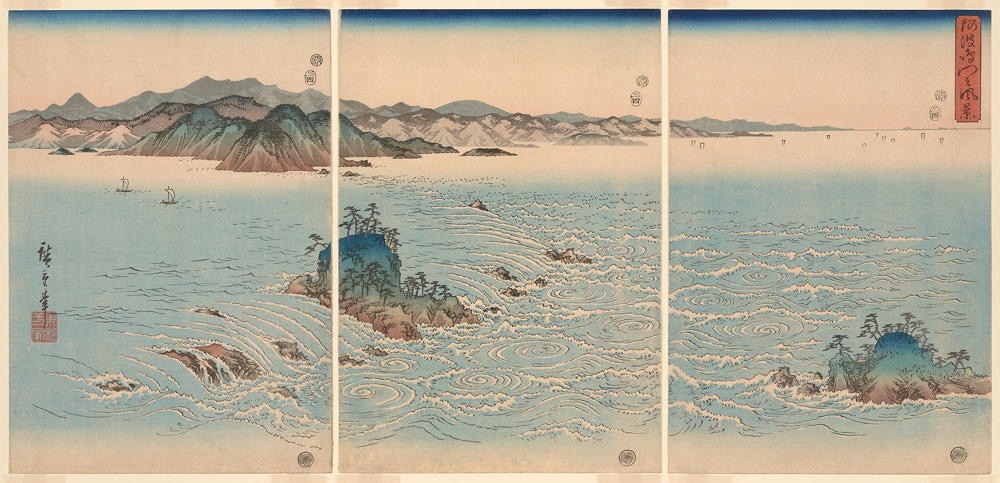
Utagawa Hiroshige 歌川 広重
The Whirlpools in Naruto Strait, Awa Province (Awa Naruto no fukei)
(1857)
This week’s Prosperity dispatches arrived as the series moved from civic urgency into personal witness and domestic intimacy. The writing ranged from the philosophical resignation of Quarter to the genuinely felt depth of Charity, from the Hubrisimiliation of a faucet set screw to the autobiography of Initiation, from the Believing that powered an Amazon open house to the Motleys that constitute the reliable indicators of Prosperity’s presence. The Muse fixed the faucet from her wheelchair. The open-house protestor who swore he wouldn’t go inside eventually shuffled in anyway, but asked nobody any hard questions when faced with the opportunity. The wardrobe mistress's responsibilities still seem bottomless. The series found this week that Prosperity’s most reliable indicators are rarely the ones anyone would choose to display.
Thank you for following along!
Motleys
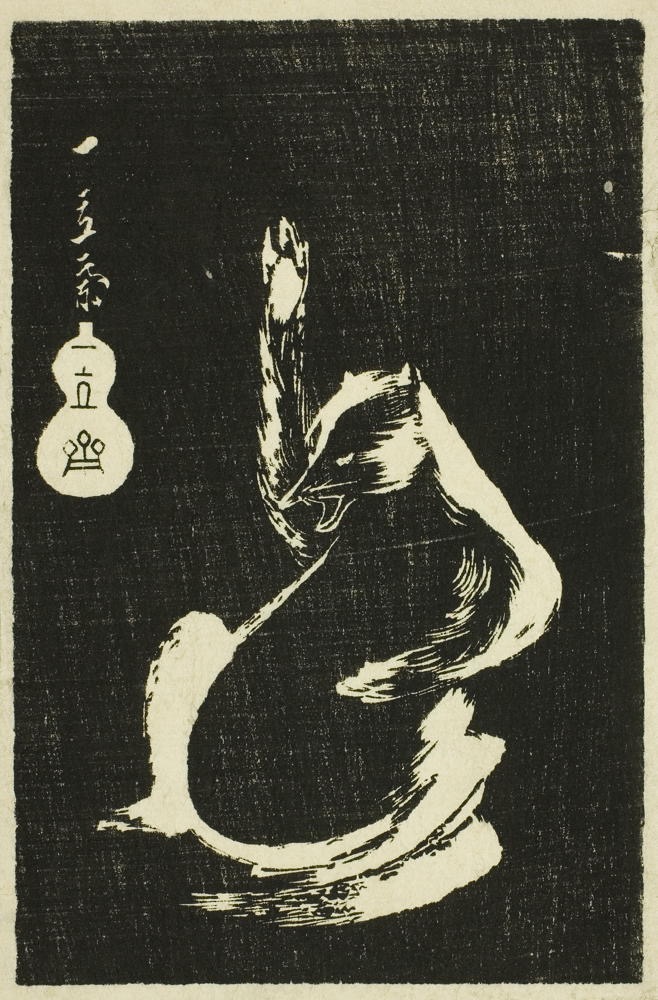
Utagawa Hiroshige 歌川 広重
Badger,
from the series “Mirror of Stone Rubbings of Views of the Provinces”
(Kohon meihitsu ishizuri kagami)
(Not Dated)
"Motleys might be the most reliable indicator of Prosperity's presence."
Prosperity seems to attract collections of things. The Muse collects Franciscan Appleware crockery, a pattern that began almost on a whim when I started fondly reminiscing about my mother’s Aunt Stella’s collection that I lost in my second divorce. I have a small collection of D-handled shovels that I maintain for no good reason other than that I favor them above the straight-handled kind. Our linen closet holds no linen, but exists more as an archive of our changing tastes in sheets and towels over the last thirty years. I have a friend who claims to own dozens of Tony Bahama tropical print shirts, bought to cheer himself up or on whims. I have a closetful of shirts distinguished by their very similarity; most are long-sleeved blue chambray. I tend to wear the same-looking clothes every day, with little actual variety. The Muse, on the other hand, has dozens of similar-looking “tops”, in a variety of colors, and a similar range of choices of pants and shorts. Her collection of clothes hardly qualifies as a collection, given the Motley range of styles and colors therein.
While The Muse recovers from her broken ankles, I have been trying to fulfill the role of wardrobe mistress since she can’t access her dresser or closet.
Believing
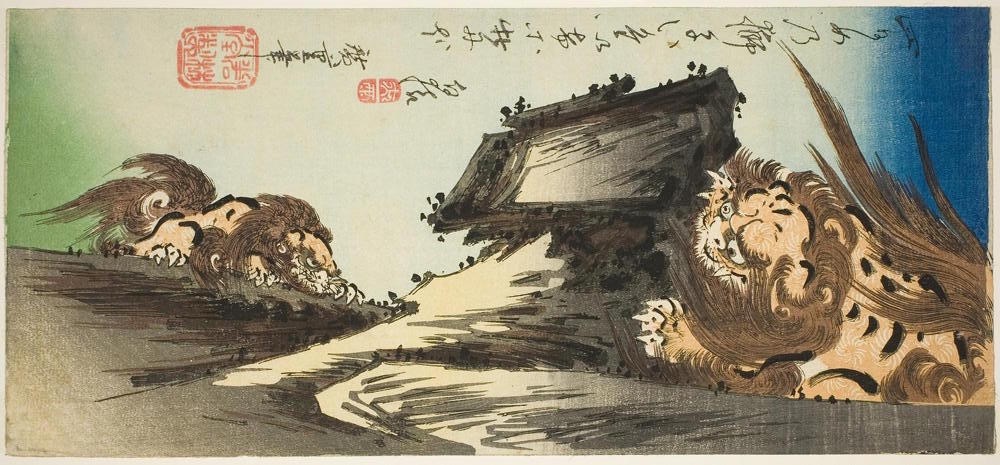
Utagawa Hiroshige 歌川 広重
A Lion Training a Cub
(c. 1832/34)
"…the first sweet or savory taste of a Prosperity finally emerging."
As The Muse and I prepared to attend the long-awaited Amazon Web Services Open House, a fresh anti-data center Reel appeared in my Facebook feed. I have been observing the opposition making public fools of themselves since they started protesting. They have performed every derivative activity with which generations of protestors before them had undermined their arguments. They misrepresented with the usual vengeance. They seemed to love to take information out of context, as if the state with the oldest and most mature environmental agency in the country could be equated to states with numbingly more primitive permitting standards and practices. Washington ain’t Virginia. They also characterized Amazon Web Services, arguably among the most environmentally engaged corporations on the planet, with data to prove it, as inveterate liars. Their message to not trust Amazon came across as “Don’t Trust Us,” instead. The latest message seemed to properly encapsulate their entire campaign. It said that they were going to attend the open house, but not go inside, and ask hard questions, but the spokesperson promised not to believe a word they received in response.
Their campaign came into full focus in that instant, or a few moments later, after I’d recovered from my stunned silence.
Initiation
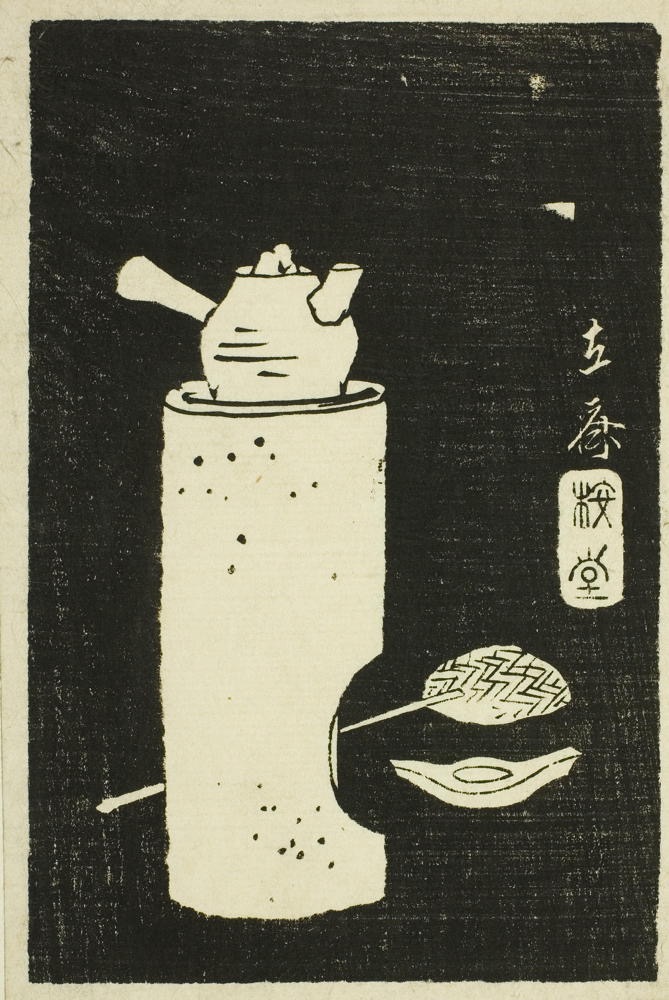
Utagawa Hiroshige 歌川 広重
Tea Kettle,
section of a sheet from the series “Mirror of Stone Rubbings of Views of the Provinces”
(Kohon meihitsu ishizuri kagami)
(Not Dated)
"I became Prosperous the day I realized that I could choose, and did."
The question eventually enters the conversation: How does one become Prosperous? The more common answers seem to omit something significant, focusing as they usually do on the obvious. But I’ve come to believe that Prosperity might be more like a guild than an individual achievement, and that there must probably be a multitude of ways to achieve this status, none by birthright. Being raised in a Prosperous family rarely prepares anybody to actually achieve Prosperity, for it seems to take more than mere familiarity to meaningfully succeed at it. Ten thousand subtleties influence this particular achievement. It apparently cannot be bestowed or inherited, for one might well inherit wealth or social position, but maintaining such a place with requisite grace qualifies as more of an art form, and not a necessarily easy one for some to come by. Prosperity seems an exacting designation, one requiring some maturity and dedication, hence the nagging question that eventually slips into the conversation: How does one become Prosperous?
My first marriage was not a promising one Prosperity-wise.
Hubrisimiliation
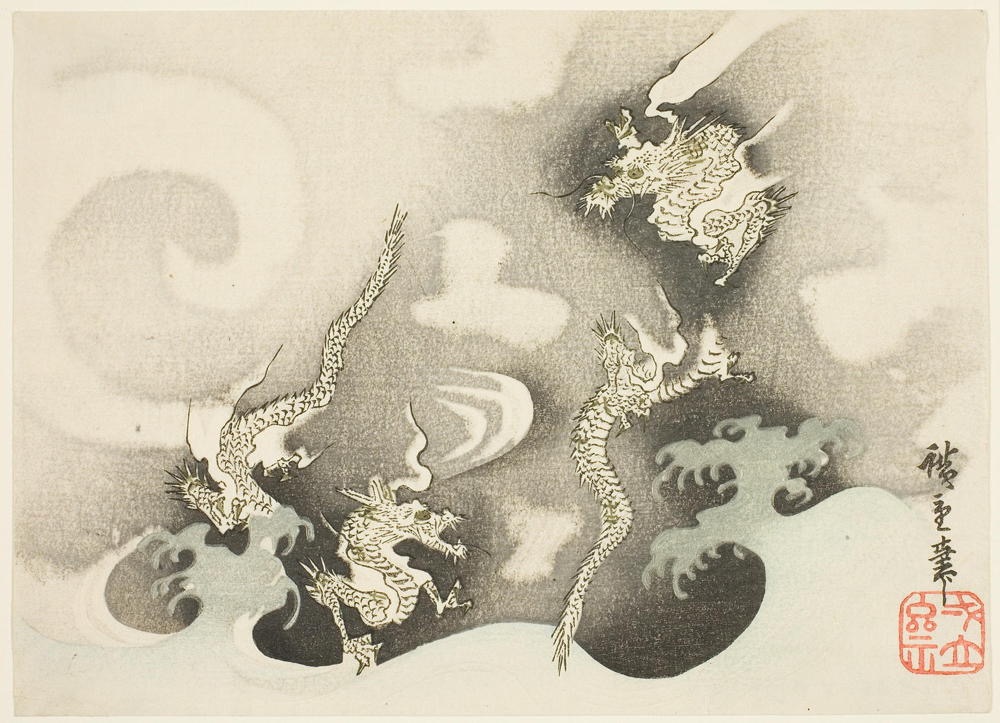
Utagawa Hiroshige 歌川 広重
Dragons Among Clouds
(1844)
"…humiliated into a begrudging silence again."
Prosperity has a way of attracting possessions. If one’s not extremely careful and cautious, these can accumulate to become suffocating. Short of outright hoarding, possessions can come to possess us, and they inevitably become harsh taskmasters. Among their most onerous expectations lie the necessary periodic maintenance. Nothing about achieving Prosperity prepares anybody for what becomes necessary to maintain their resulting possessions in something approaching original operating order. Even the kitchen faucet requires some infrequent maintenance, its very infrequency rendering this essentially impossible for the merely Prosperous to successfully accomplish. Still, a kind of hubris can overtake the Prosperous, the sort that temporarily convinces them that, if only due to their Prosperity, they might be capable of successfully engaging in DIY-ing, Doing It Yourselfing. They probably aren’t.
The primary reason we will never have household nukes generating our residential energy lies in this first principle of Prosperity, that the Prosperous tend to get these preposterous notions that possession somehow bestows the ability to maintain, when it might at best inflict that obligation.
Charity
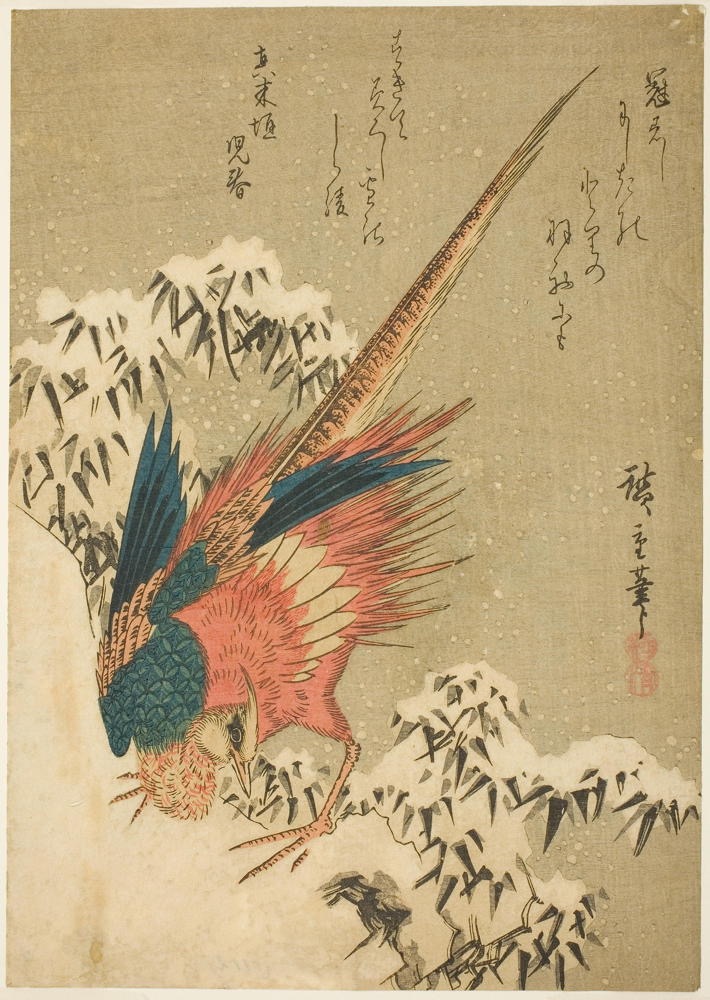
Utagawa Hiroshige 歌川 広重
A Golden Pheasant amid Snow-Covered Bamboo on a Steep Hillside
(c. 1840)
"Charity always begins at home, but it rarely ends anywhere near there."
Charity begins at home, but it never ends there. Charity seems to be the consistent means by which the Prosperous attempt to share their good fortune, however modest. This seems to be the ironclad principle universally practiced among the Prosperous. Some insist that they’re just giving back, but regardless of the underlying motive, the Prosperous give. They give “of” their time as well as their treasure. Each holds a few charities as well-deserved, and they act to preserve their missions. Some of these claim to be Christian, but increasingly, it seems, secular organizations have entered the charity business, and not for profit, though I suppose there are those charities who are in it for the money. These milk the government for subsidies, then spend less than they’re subsidized to provide their services, or they extract hefty handling charges that do more than reinvest in the advertised mission. But even the charlatans sing the same tunes in the same keys. Real or pretend, they extend assistance to the “less fortunate.”
A Prosperous person’s chosen charities are in many ways their identity.
Quarter
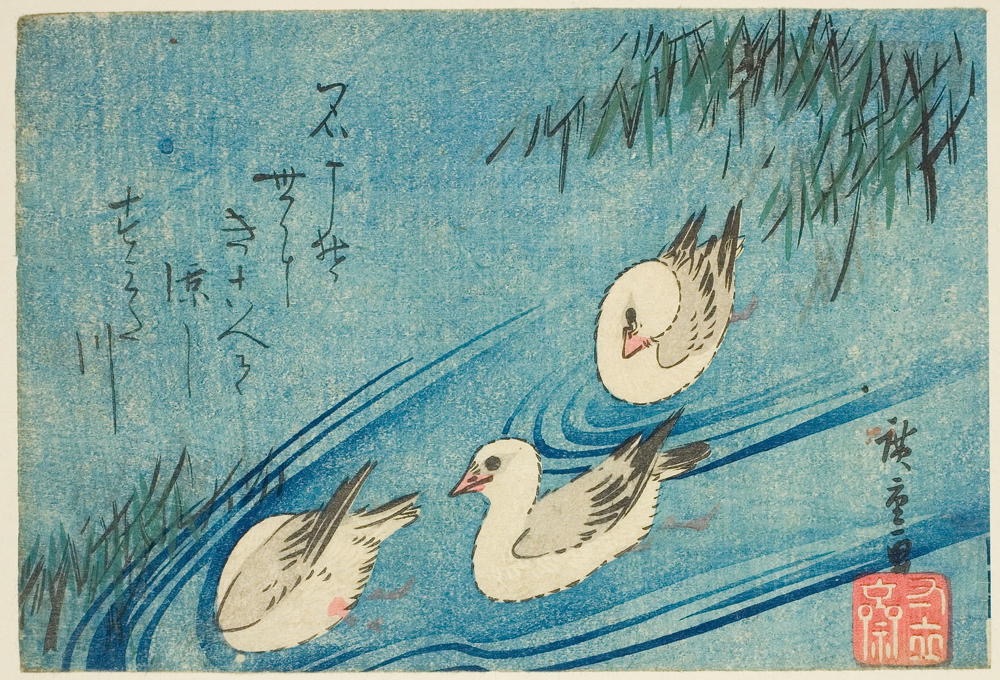
Utagawa Hiroshige 歌川 広重
Oystercatchers
(c. 1833/34)
"Hold your Prosperity lightly lest it break you when it slips out of your hands."
Prosperity definitely has its privileges, but practical limits seem to exist on how many and where. It can certainly provide the means to afford a relatively comfortable, if not necessarily carefree life, though not everything necessary to achieve and maintain that end can be inherited or purchased, or, indeed, possessed. The Prosperous remain vulnerable to most of the usual suspects. Hunger might only rarely cast a shadow across its porch, but misfortune shows no friends or natural enemies, and offers Quarter to pretty much nobody. Prosperity was never a guarantee of any happily-ever-after storylines. It might even amplify the sense of devastation at a loss, since the Prosperous do seem to possess more to lose than others. The Pre-Prosperous might not miss what they never acknowledged they possessed. The Prosperous miss their losses. They cost.
Practicing Prosperity tries to teach the Prosperous to hold their good fortune gently.
Weekly Writing Summary For The Week Ending 08/06/2026
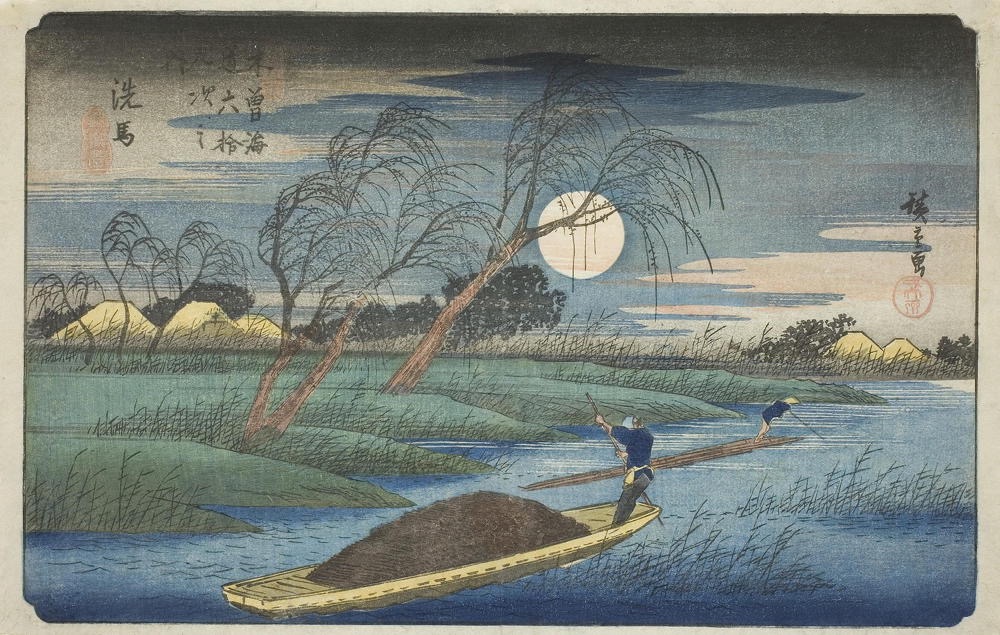
Utagawa Hiroshige 歌川 広重
No. 32: Seba,
from the series “Sixty-nine Stations of the Kisokaido
(Kisokaido rokujukyu tsugi no uchi)”
(c. 1835/38)
This week’s Prosperity dispatches arrived as the series found its philosophical center and then tested it against civic reality. The writing ranged from the tentative conclusions of Classifying to the identity function of EnoughIsEnough, from the legal and economic argument of Moritoria to the behavioral portrait of CheapShots, from the panoramic civic lament of Anti-Prosperity to the warmly domestic homecoming of City-State. The series stood before the County Commission this week, delivering the sole anti-moratorium argument against a curious flood of anti-data center support. It also returned home to find Prosperity waiting, as it always has, in the Villa Vatta Schmaltz.
Thank you for following along!
City-State
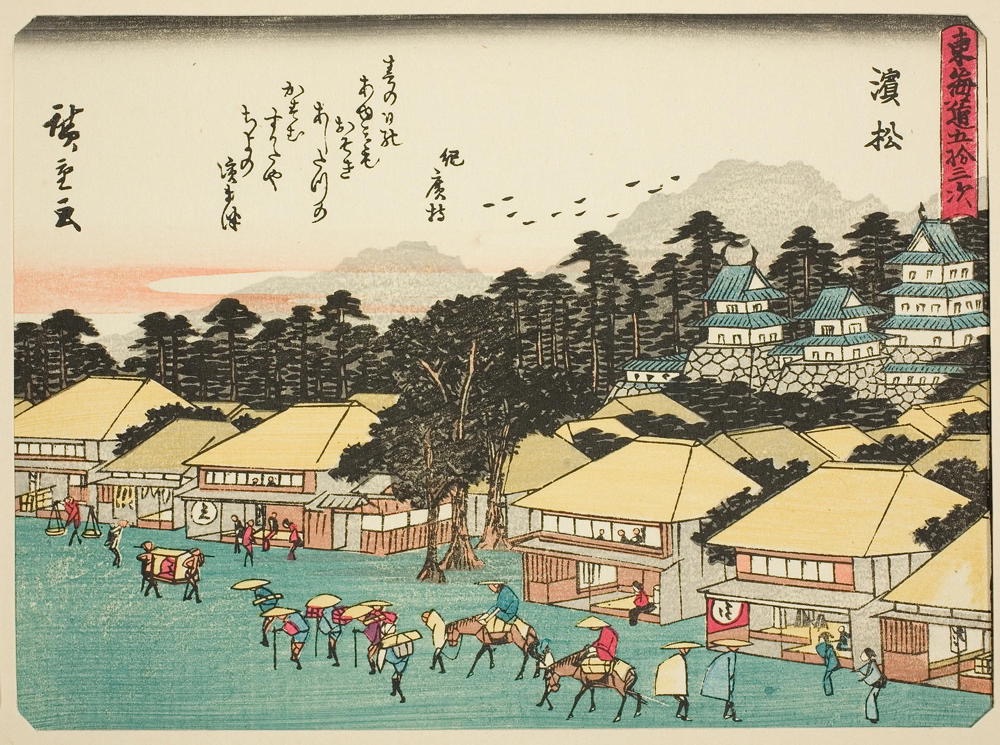
Utagawa Hiroshige 歌川 広重
Hamamatsu, from the series “Fifty-three Stations of the Tokaido (Tokaido gojusan tsugi),”
also known as the Tokaido with Poem (Kyoka iri Tokaido)
(c. 1837/42)
"I'm certain that anywhere I find Prosperity lurking fully qualifies as my home and castle while I'm there."
I think of Prosperity the way I think of an Italian City-State, a kind of autonomy, an anchor, an identity. In the same way that a person’s home, however humble, represents their castle, Prosperity serves as both the source and expression of cultural social standing. Each family in my neighborhood, a blessedly mixed configuration almost entirely unlike any gated community, inhabits their unique castle. Each, as they say, gets to be the asshole in their castle, holding an independence rare among the Pre-Prosperous. Even the very wealthy, who might live in actual castles, seem to be more owned by their relatively palatial palaces than inhabiting them. My neighborhood includes owner-occupied places next to rentals, older homes with more recent construction tucked in between on what was most certainly once the larger places’ original properties. The orderliness here does not seem overwhelming. It’s certainly not enforced by anything other than each inhabitant’s sense of civic decency. I, for instance, feel guilty if I miss mowing my lawn for a few days after it really should have been mowed, for this clutter seems an offense to the neighborhood’s tranquil sense of its own Prosperity.
For a few years, one neighbor, who lived just to the left of my castle, left his place derelict.
Anti-Prosperity
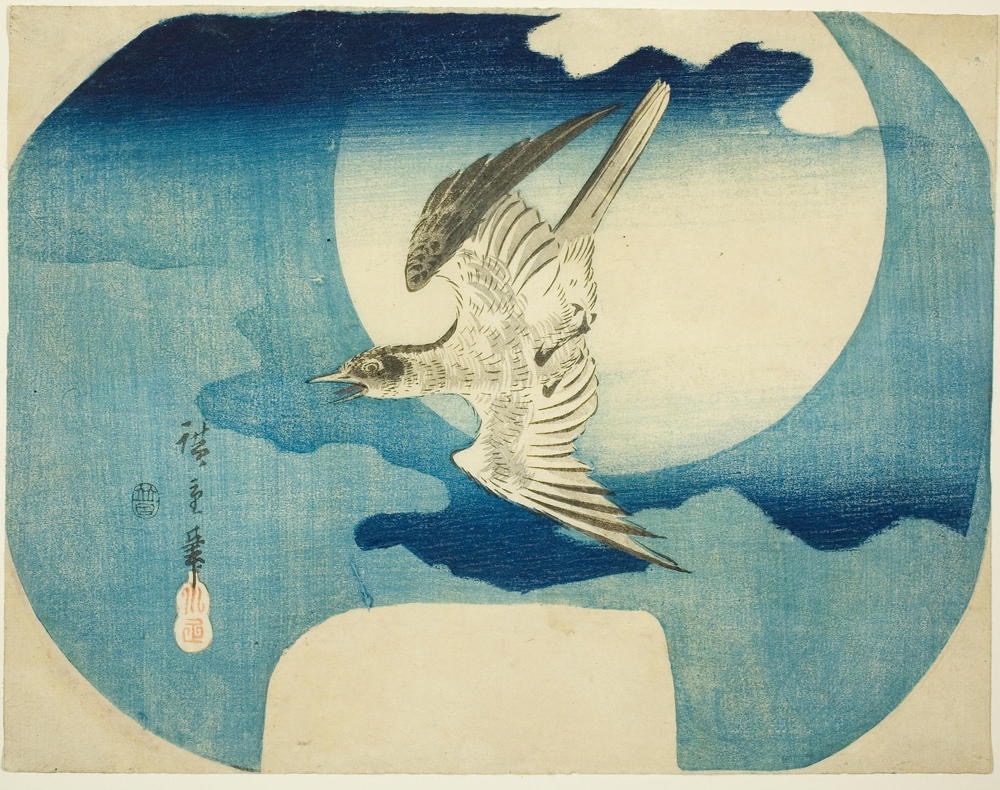
Utagawa Hiroshige 歌川 広重
A Cuckoo Against the Moon
(c. 1843/46)
"…what's to become of our once prominent Prosperity after we've managed to Anti- every alternative out of the realm of existential possibility?"
It seems to have become fashionable to oppose virtually any proposition. I blame the radical conservative MAGA movement for basing their politics entirely on opposition and thereby encouraging what might have always been a passion seething beneath the surface of the appearance of respectability. They opposed progress because it seemed to upset their overly delicate sensibilities. They encouraged long-discarded theories and practices in lieu of embracing modernity, which they at least pretended to believe represented evil incarnate. From there, it was a short portage to a place where any decency could be easily and convincingly opposed as either woke, whatever that was, or stupid, which never really qualified as an argument. They were opposed, whatever it was, and supportive of little other than the usual vacuous dribble: free enterprise, America (first, last, and always), and tariffs. They opposed more than the usual suspects, but some fresh villains, too: freedom of speech, which apparently emboldens enemies, free trade, which reportedly renders us all paupers, and justice, which always seemed to them to hold the wrong criminals responsible.
As absurd as their anti-everything platform might have seemed, their tactics rubbed off on even the most dedicated of their opposition.
CheapShot
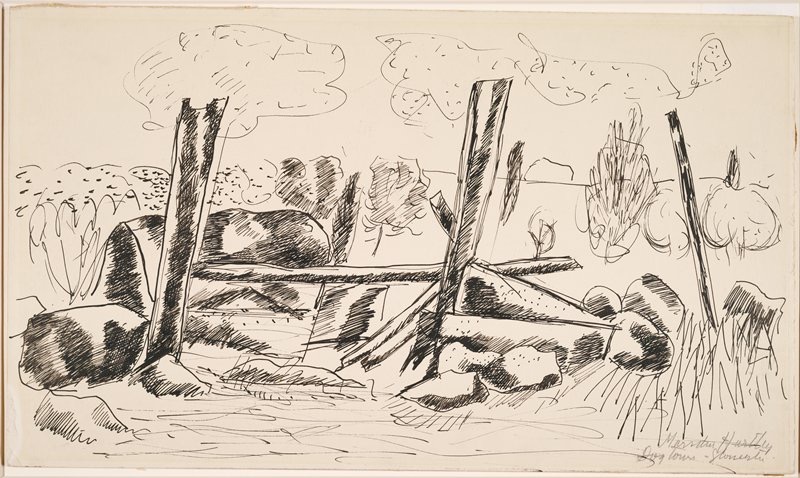
Marsden Hartley
Dogtown, Gloucester
(1934-36)
"Some days, this responsibility's easier to fulfill than on others."
I encountered a Pre-Prosperous person yesterday. She was explaining how she’d delivered what I instantly recognized to be a CheapShot to a potential benefactor. Why would anyone ever consider committing such a crime? That answer must be above my pay grade, though I can imagine a nearly infinite number of justifications my Pre-Prosperous friend might offer if asked. She would doubtless consider her gift a fair trade, repayment for a previously committed trespass or, more likely, a prepayment for a yet-to-be-committed but threatened-in-her-mind wrong. She always seems to be striving to keep an invisible scale balanced. She’s the auditor, the accountant, and eternal bookkeeper seeking only fairness, but exclusively from her perspective. She seemed to have been outclassed but was unaware of the imbalance, except, of course, to sense an imbalance favoring her. It didn’t. Everywhere she goes, she seems to encounter the same damned situation. People don’t seem to respect her. They often disappoint. Go figure! Isn’t this precisely the behavior we’ve come to expect from the Pre-Prosperous?
Many forms of Pre-Prosperity exist, though I dare say that they might be classifiable along the lines of the seven deadly sins, with many ancillary less deadly categories for the less seriously afflicted.
Moritoria
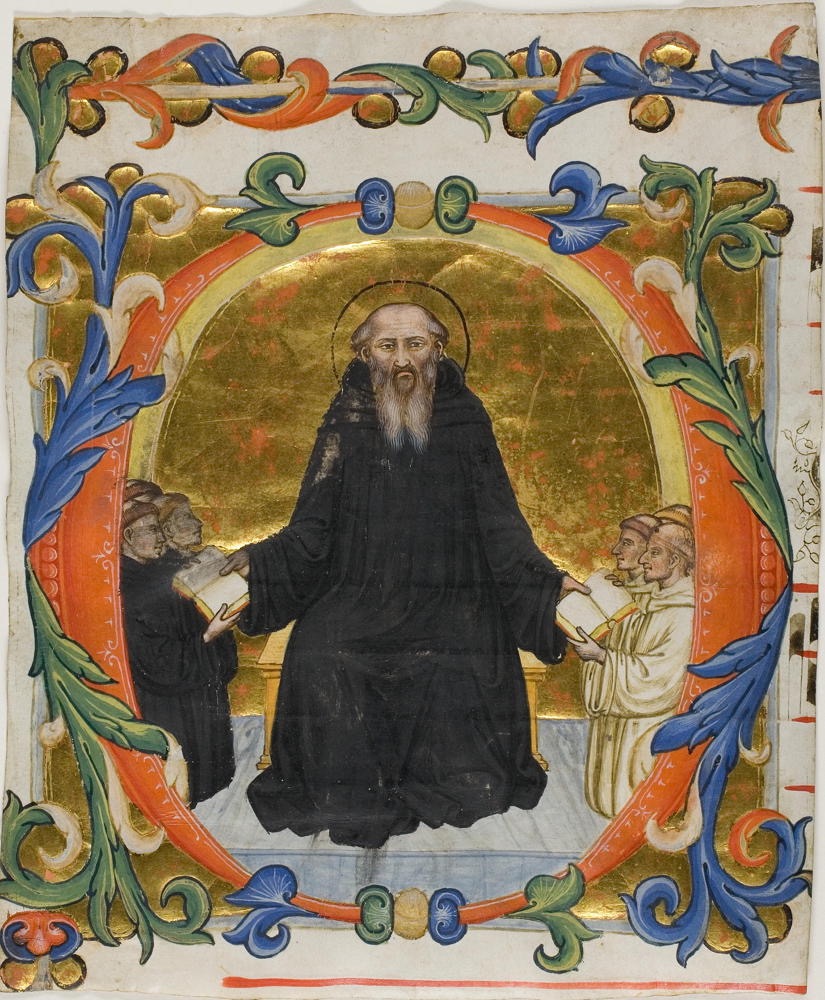
Martino di Bartolomeo
Saint Benedict Presenting his Rule to Benedictine and Cistercian Monks
in a Historiated Initial “O” from a Choirbook
(1394/95)
"…Moritoria are not regulatory achievements and do not deserve to be mistaken for them."
The Washington State Democratic Party approved a platform plank at their recent state convention that calls for a one-year moratorium on all data center construction in the state. I considered this plank extremely self-contradictory and a clear threat to Prosperity, especially since the party didn’t also immediately declare itself Internet Free and revert to operating as it did in the nineteen-sixties, before the intertubes connected everyone and everything. Apparently, some political consulting firm, trolling around for hot issues Democratic candidates could coalesce voters on, advised that an anti-data center perspective could attract otherwise indifferent voters to the cause, whatever that was. Data centers have become the favorite whipping boys of pretty nearly everybody, even though reliable sources suggest that most of the economic activity in the nation over the past few years has stemmed in some way from data center development. Those who insist that we must mature by despising our family of origin might easily explain this data center revulsion as a normal stage of emotional development, roughly akin to turning fifteen years old. It feels as contentious.
Prominent among the proposals for what to do about data centers stands the idea that they might be discouraged by municipalities simply declaring Moratoria on their development.
EnoughIsEnough
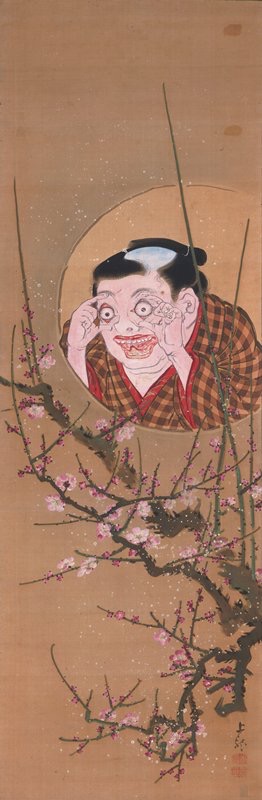
Mihata Jōryū
Peeking Boy
(1830s)
"Those who more than occasionally experience Enough have already won whatever race they once ran."
Contrary to the popular idiom, Enough is not always Enough, not for everyone. For some, Enough never was nor ever will be Enough, as I detailed in my NextWorld Story, Enough, from February 2025, which described the world emerging after we foolishly elected our current incumbent, a series that has proven to have been remarkably prescient. Prosperity seems to accompany that pleasing sense of enoughness. Whether that sense predates Prosperity or results from achieving it, I lack adequate data to say. I do sense, though, that the Prosperous well understand the theory as well as the practice of Enough to the point of exemplifying this odd little identity function. For them. Enough fully qualifies as Enough, always. The prosperous know satiation, and so actively seek to avoid it. The merely rich or simply wealthy seem to lose accessibility to their off switch. Like sharks, they live unloved, unsatisfiable and unrequited. To not know Enough means you can never stop swimming.
The Prosperous therefore experience love as well as attraction, though not usually to the point of obsession.
Classifying
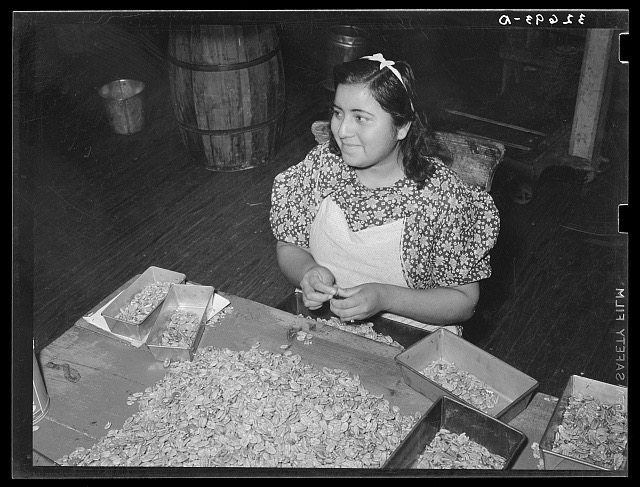
Russell Lee,
United States. Farm Security Administration
Classifying pecan meats. Pecan shelling plant. San Antonio, Texas
(1939)
"…I must be the source of all the Prosperities inevitably surrounding me."
This is not just a game. I have been considering Prosperity, mine as well as ours, for just over forty days and nights now, a suitably Biblical time span, and I am drawing two tentative conclusions, since I can’t seem to decide anything conclusively, nor should I. The first, which I have previously already heavily hinted at, must be that Prosperity only exists as a plural rather than a singular entity. Sanity insists that it always be understood as a multitude rather than as a singular state. It exists only in array. This translates into an understanding that no Prosperity ever stands alone. When I spot a Prosperity, this means that more must be lurking nearby. Prosperity seems to exclusively travels in flocks, herds, schools, or pairs, never “batch.”
The second tentative conclusion I simply must draw from my inquiry so far might seem as if I’m somehow cheating, and truth told, I might be cheating if Hoyle is judging.
Good For A Goose

Decency (90)
Decency Unscrolling (1)
EndDays (92)
Exiled (90)
Fambly (93)
FollowingChapters (93)
Grace (92)
Humor (2)
iAlogue (1)
Letters to the Editor (1)
NextWorld (91)
Personal (18)
Prosperity (73)
Steam Festival (4)
Unscrolling (89)
Vaporized (6)
Work (16)
August 2026
July 2026
June 2026
May 2026
April 2026
March 2026
February 2026
January 2026
December 2025
November 2025
October 2025
September 2025
August 2025
July 2025
June 2025
May 2025
April 2025
March 2025
February 2025
January 2025
December 2024
November 2024
October 2024
September 2024
August 2024
July 2024
June 2024
May 2024
April 2024
March 2024
November 2006
October 2006
September 2006
August 2006
July 2006
June 2006
May 2006
April 2006
March 2006
February 2006
January 2006